
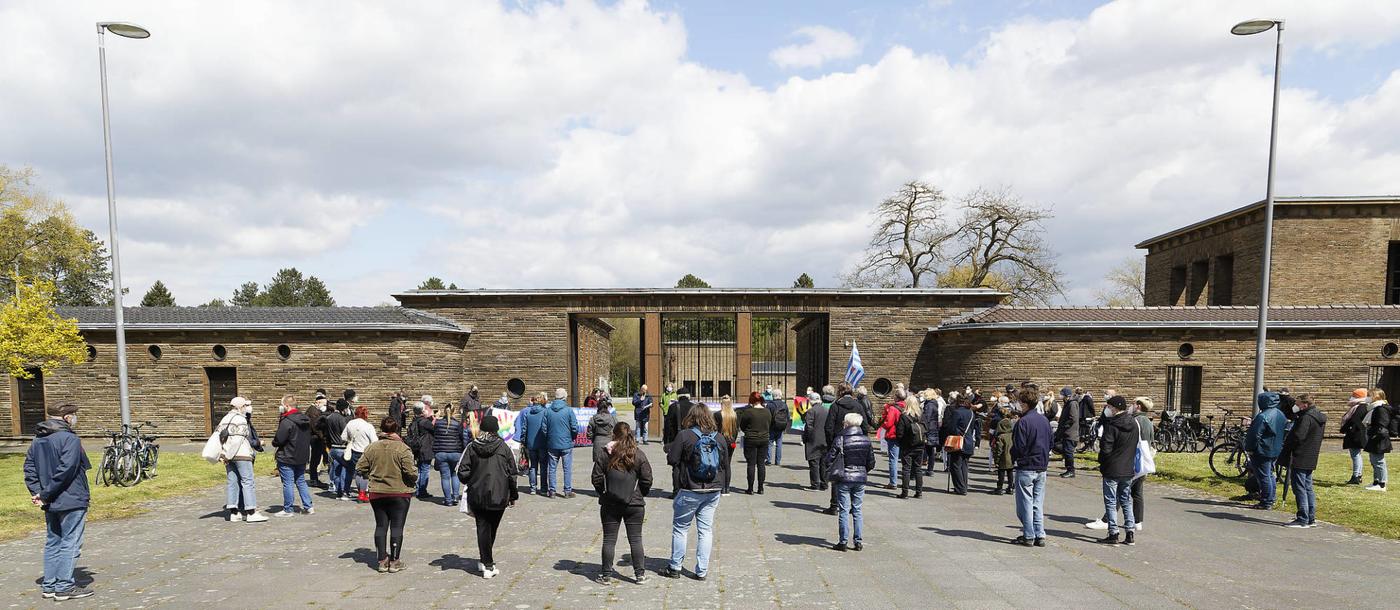
In consideration of the Shabbat customs of Jewish citizens, the traditional commemorative walk for today’s Liberation Day took place yesterday. More than 100 participants accepted the invitation from Bündnis gegen Rechts and Kinder- und Jugendring to visit the Fiedhof on Freigrafendamm. In his welcoming address, Uli Borchers, spokesperson for the Alliance Against the Right, emphasised that 8 May 1945 was indeed a day of liberation for the inmates of the concentration camps, prisoners of war and forced labourers. It was also a day of liberation for those who had to live in illegality: hidden and „in hiding“ Jews, women and men from the political resistance, or those who were subjected to persecution by the Nazi dictatorship for other reasons.
8 May was also a day of liberation for all those people in Europe who suffered under the crimes of the Wehrmacht and SS during the Second World War. Millions, however, did not live to see this day. They were gassed in the extermination camps, murdered by Einsatzgruppen, died under the conditions of forced labour or were killed by the SA, SS and Gestapo.
Uli Borchers: „Remembering these women and men is the recurring reason for our tour on this day. Today, we do anti-racist work in many different ways. A current example is the „Bundestag – Nazi-free“ campaign, which is being launched today.
The first stop on the tour was the Soviet POW burial ground. Felix Lipski, Holocaust survivor and spokesman for Klub STERN of the Bochum Jewish community, left it to his granddaughter Magarita Gosmann to give his speech. He recalled the millions of deaths of the prisoners and reported on the little-known resistance activities during forced labour in industrial plants. He described uprisings and escape attempts from the camps. The speech in full .
Angelina Lachenicht and Julia-Maria Kirstein from the „Kohlengräber-Geschichtswerkstatt“ from Gerthe reported on the results of their research at the forced labourers‘ graves. They have compiled a wealth of biographical information about forced labourers from death certificates. They criticised the fact that the condition of the graves at the cemetery has been appalling and unkempt for years and that the city is not fulfilling its legal obligations. The speech in full .
At the round of honour, Reinhard Junge, representing the VVN-BdA, reminded the audience that 21 June was the 80th anniversary of the invasion of the Soviet Union by Nazi Germany. He criticised the fact that the German government refuses to commemorate this day in any appropriate way and at what cost the Soviet Union played a decisive role in liberating Germany and Europe from fascism. The speech in full.
The historian Irmtrud Wojak, who initiated the Fritz Bauer Forum, which is currently being built in the former mourning hall on the east side of the cemetery, honoured Fritz Bauer’s role in the legal processing of Nazi crimes. She expressly emphasised that although the military defeat of the Nazi regime was sealed on 8 May, the consistent processing of Nazi crimes should have begun afterwards. Instead, it is largely considered a „success“ to have „smoothly“ integrated thousands of Nazi perpetrators into the judiciary, police, military and administration. The speech in full .
At the end of the event, Bochum DGB Chairwoman Bettina Gantenberg presented the aims of the campaign „Bundestag nazifrei – Keine Stimme für AFD und andere Rassisten“ („Bundestag nazifree – No vote for AFD and other racists“), which is a continuation of the successful campaign for the local elections. In last year’s election for the Bochum council, the AfD only received just over a third of the votes it received in the Bundestag election. The campaign is intended to send an unmistakable signal against right-wing extremism, racism, anti-Semitism, misogyny and discrimination of all kinds and motivate as many people as possible to become active themselves. The speech in full .
Jugendring and Bündnis gegen Rechts have organised the traditional commemoration of the Day of Liberation in a lively and interesting way. The simultaneous launch of the „Bundestag nazifrei“ campaign in cooperation with the trade unions made it possible to combine looking back and looking forward.
