
Autor/Autorin
Jurist and humanist Antonio Cassese was a leading intellectual and academic figure in the field of international criminal law and, among other achievements, served as the first president of the International Criminal Tribunal for the former Yugoslavia. In his work Pensando en Derechos Humanos. Reflexiones desde el Derecho Internacional ( Thoughts on Human Rights. Reflections from International Law – L’esperienza del male ), Cassese draws on his international experience to engage his readers in a deeply insightful way. He raises pressing questions on human rights, such as whether it is permissible under international law to drop a bomb on a residential building, hospital, or school during Israel’s military offensives in Gaza and the West Bank in 2014, knowing that a terrorist is inside and that civilians, patients, or children are being used as human shields. He also addresses how to verify and assess the existence of genocide from a legal standpoint, and recounts his experiences after being appointed by the Security Council in 2004 as rapporteur for the investigation in Darfur, as well as his earlier work in 1975 as a special envoy of the United Nations Commission on Human Rights investigating the dictatorship in Chile and the broader human rights situation there.
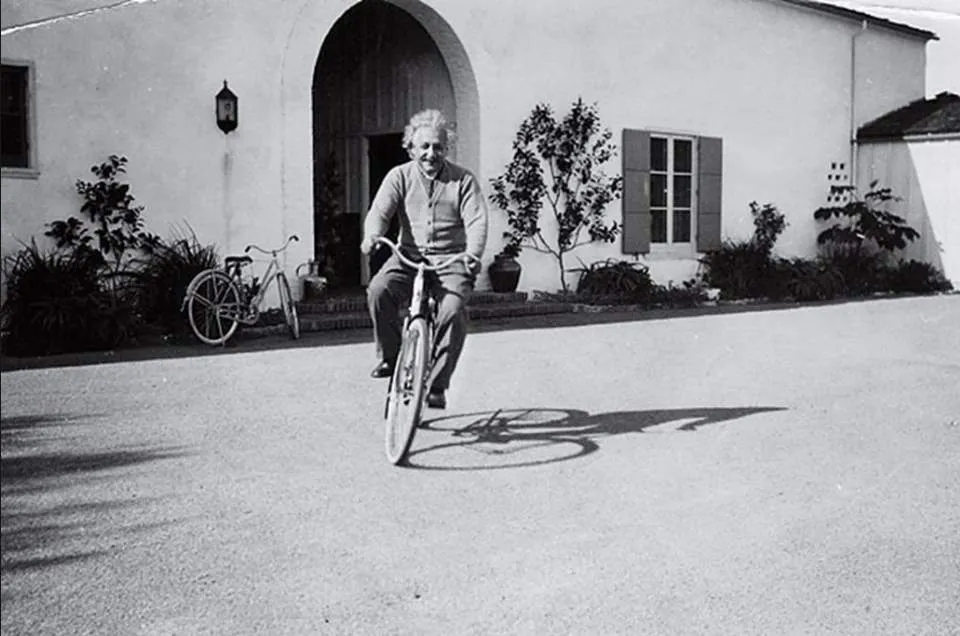
Silvia, Cassese’s widow, shared a personal photograph for the book—her husband smiling as he rides a bicycle. Opposite this image of Nino – as he was affectionately and respectfully known – appears a photograph of Albert Einstein, also smiling as he rides a bicycle. A life-size statue of Einstein in this same pose stands on a pedestal in several locations on the campus of the Hebrew University of Jerusalem, which he co-founded in 1925 and which has since produced eight Nobel laureates.
In 1930, Albert Einstein wrote a letter to his son Eduard, telling him: “Life is like riding a bicycle: to keep your balance, you must keep moving forward.”
Human rights are like that bicycle—dynamic and forward-moving by nature. We make progress when their recognition and effective exercise are extended to ever greater numbers of people; societies advance when they succeed in creating inclusive spaces for the development of human capabilities, fostering greater integration and cohesion without discrimination.
Human rights embody a vision of justice and a civic commitment to building a shared space of rights and responsibilities for all people, everywhere. They represent the most authentic and modern ideal of our time—a personal and collective treasure that protects the life project of every human being, whatever their chosen faith, ideas, affections, or cultural belonging. Above all, they enable each of us to fulfil our human potential by granting access to essential choices: the right to education, to family life, to work, to adequate housing, to social protection, and more. When human rights are brutally violated and the core of human life and dignity is attacked, we speak of international crimes—genocide, crimes against humanity, war crimes, and others.
Nelson Mandela—the moral colossus and giant of truth, as John Carlin described him—shared certain personal traits with Albert Einstein: both were rebels who believed deeply in human rights, both shaped their times through remarkable emotional and intellectual intelligence, and neither was the ideal father or husband. Mandela created enduring paradigms for the struggle for human rights. During the darkest years of oppression in South Africa, before the Rivonia Trial in 1963, he justified the armed struggle against the apartheid regime, which had carried out crimes against humanity targeting members of the African National Congress in Pretoria. He legitimised the armed response with the reasoning that “the oppressor chooses the means of struggle, not the oppressed.”
During his twenty-seven years in prison, Mandela redefined his strategy against violence, focusing instead on negotiation and on the legal struggle to secure recognition of the human rights of all minorities and communities excluded from public life. His approach paved a rapid path towards sovereignty for all South Africans, culminating in his election as the first president of the new, democratic South Africa in 1994. Yet Mandela’s greatest challenge was to establish the law as a system for resolving conflicts. Each day on Robben Island, as he read the Universal Declaration of Human Rights , he reflected on the third paragraph of its preamble—words that profoundly shaped his understanding of justice at its roots:
“Convinced that human rights must be protected by a system of law, so that man will not be compelled to have recourse, as a last resort, to rebellion against tyranny and oppression.”
There can be no justice, no progress, unless human rights are recognised and safeguarded within a legal framework. Otherwise, rebellion becomes a fundamental and logical human right in the face of terror and oppression.
Today, against the backdrop of possible genocide in Gaza and Russian aggression in Ukraine, it is both paradoxical and troubling, from a legal standpoint, that censorship and social condemnation arise when citizens or public representatives denounce violence and warn of a plausible risk of genocide. Months ago, the Pre-Trial Chamber of the International Criminal Court confirmed the indictment of Netanyahu and his former defence minister, Yoav Gallant, for crimes against humanity and war crimes (November 2024). A year earlier, South Africa had brought a case against Israel before the International Court of Justice for violating the Convention on the Prevention and Punishment of the Crime of Genocide .
In Gaza, humanity faces the opportunity—and the responsibility—to resist a new barbarism and to prevent impunity. Within the human rights protection system, prevention is the most effective form of protection: not the retrospective investigation or eventual judgment acknowledging the victims of genocide, but the ability to say no to violence and to protect those who stand on the brink of becoming victims.
In the words of Raphael Lemkin, wherever attempts are made to undermine humanity and its diversity with the intention of “tearing it from its life cycle,” there arises “a case for all of humanity.” The Shoah —the genocide of the Jews—was the most devastating act of destruction of our common humanity in modern times, and it remains the ultimate reference point for the gravest of crimes, sustained by the hope that horrors on the scale of the Holocaust will never occur again. Yet if we are unable to prevent such a crime, we bear the responsibility of documenting its possible commission. International law does not ask who is suspected of committing the crime but how we can most effectively protect the victims. It makes no distinction between alleged perpetrators: whether a terrorist organisation, an individual, or the state of Israel, Canada, Norway, Spain, the United States, Japan, or Myanmar—all must be held accountable, irrespective of political, historical, or legal context.
Historians and journalists gather evidence and testimonies in real time or from the past. Lawyers and figures such as Aryeh Neier and David Grossman, together with prominent civil society and academic organisations such as the International Association of Genocide Scholars and the respected Israeli NGOs B’Tselem and Physicians for Human Rights – Israel (PHRI), may legitimately invoke the Genocide Convention (Lemkin Convention) and present legal arguments as to whether or not the crime of genocide is being committed. It will then fall to the courts—in this case, the International Court of Justice of the United Nations—to determine, in South Africa v. Israel (2023), whether all the constituent elements of genocide are indeed present. Meanwhile, individual criminal responsibility is being examined before the International Criminal Court, whose Pre-Trial Chamber in 2024 indicted Netanyahu and his former defence minister, Yoav Gallant, for war crimes and crimes against humanity, though not, for the moment, for genocide.
We should also recall that a state may itself formally acknowledge the commission of acts of genocide and confirm their historical reality—as the Bundestag did in 1989 with the genocide of the Roma, in 2016 with that of the Armenians, in 2022 with the Holodomor, and in 2023 with the crimes committed against the Yazidis. In May 2021, the German government likewise recognised the genocide of the Herero people in present-day Namibia, apologised to their descendants, and offered reparations.
During the 2025 Tour of Spain, demonstrations in support of Palestine and against possible genocide—not in support of Hamas terrorism—were both legitimate and necessary acts of civic expression. The disruption of the race by some demonstrators, who entered the streets of Bilbao and Madrid and forced the event to pause, was a legitimate but technically unlawful act. In his instructive and insightful article “La Vuelta, Israel, and the Neutrality of the Olympic Charter” ( El País , 16 September 2025), Carlos Arribas explained why the events of the final stage in Madrid were entirely predictable, given what had occurred in Barcelona, Bilbao, and La Bola del Mundo. He showed how both the UCI and the organisers of La Vuelta 2025 acted against the principle of reality . Too often, invoking the supposed neutrality of sport serves only to conceal the elephant in the room.
Interestingly, on the same day that La Vuelta ended abruptly in Madrid, a UCI race was being held in Italy: the Trofeo Ciclista Giacomo Matteotti , celebrated annually since 1945 in honour of the socialist senator who was kidnapped and murdered by Mussolini’s fascist regime in 1924. The UCI did not denounce this legitimate tribute to a political and ethical symbol of resistance to barbarism. It chose instead to “stay out of politics” and allow the race—and its message of respect for Matteotti’s civic legacy—to proceed unimpeded.
When the legal system fails to respond to devastating and unacceptable crises such as the possible genocide in Gaza, our human needs and fears may ultimately find expression outside the boundaries of the law. In such moments, the exception becomes the norm—acts on the margins of legality acquire moral force. It would be misguided to dismiss the future impact of these gestures of empathy and protest, even when they take the form of illegal acts. For a small number of people made the wrong decision—to disrupt a sporting event unlawfully—for the right reasons: empathy for the victims and a demand for justice against impunity.
In practice, the protests had one simple objective: Let justice be done! As Oona Hathaway and Scott Shapiro write in The Internationalists : “ Real power—the power to achieve important and lasting political goals—does not exist without the law. The law creates real power. States can only achieve their goals if others recognize the results of their actions. The worldview based on state power is fatalistic and leaves little room for human action.” And although the law seeks to restrain power, it is ideas that give the law its form and substance.
In the pursuit of justice, the legal system remains unique, and the strategies to reach it are many. As human rights prosecutor Dolores Delgado has emphasised, “The investigation of the crimes in Gaza is already justice in itself.” Since the Nuremberg trials of 1945, Tokyo in 1948, the Eichmann trial in Jerusalem in 1961, the Frankfurt trials against SS guards from Auschwitz in 1963 led by prosecutor Fritz Bauer, the ad hoc international criminal tribunals for the former Yugoslavia, Rwanda, Timor, Sierra Leone, Lebanon, and Kosovo, the Pinochet case before the Spanish National Court in 1998, and the thirty-three investigations opened by the International Criminal Court since the Rome Statute entered into force in 2002—with sixty-nine defendants, eleven convictions, four acquittals, and sixteen thousand victims—the pattern has been constant: perpetrators are invariably driven by hubris, emboldened by impunity and by the belief that their victims have been forgotten. All of that illusion vanishes the moment power and immunity dissolve, when individuals—volunteers and professionals from NGOs, prosecutors, judges, scientists, public representatives, forensic anthropologists, and lawyers for survivors and relatives—join efforts and refuse to abandon the pursuit of justice.
This Sunday, the UCI Cycling World Championships will take place in a country scarred by yet another genocide. One can hope that the children and grandchildren of Rwanda’s survivors will call for justice, for an end to the massacres, and for the release of those abducted, during the competitions in Kigali. Without justice, there can be no lasting or sustainable peace. Dignity and progress depend on making the human right to justice a reality for the victims of the possible genocide in Gaza—without forgetting the origin of this abominable cycle of barbarism, unleashed by Hamas and continuing through all its victims: not only the Israelis murdered and kidnapped since 7 October 2023, but also the residents of Gaza held hostage by Hamas.
Paradoxically, today it takes great courage to be just—to join the quest for justice, without political calculation.
About the author
Joaquín González Ibáñez is Professor of International Law at the Complutense University of Madrid.