
Autor/Autorin
Call me what you like – I have two names. When I was built in 1973/74, I was called Trauerhalle Havkenscheid, also known as Trauerhalle Ost. Today, I am the Fritz Bauer Forum. Keeping both names suits me: I am a place of farewell – and a place of new beginnings.
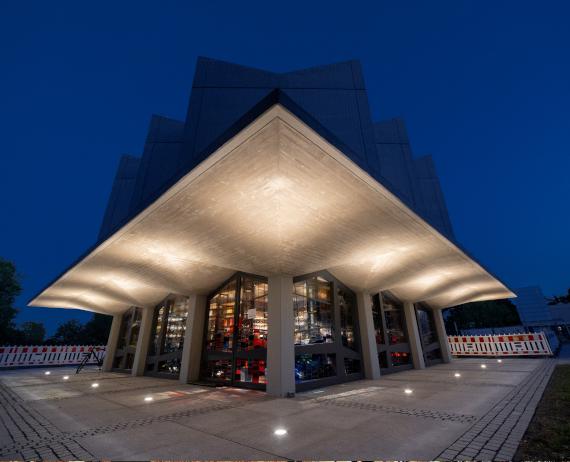
I stand in Bochum’s main cemetery. My body is exposed concrete, angular and clear. Experts call it brutalism. I like “honest.” Nothing hidden, nothing disguised. My roof towers over the entrance like a calm sail. Inside, light falls through colorful stained glass windows by Egon Becker, casting colors across the floor. No cross, no altar. I am deliberately designed to be open to all religions: a space for every life, every way of mourning.
My creator is Ferdinand Keilmann, long-time city architect in Bochum. His biography has shadows—that is also part of my story. But his design for me is a clear statement of the present: away from the monumental, toward human scale, toward open space. Those who say goodbye here find spaciousness instead of pomp. There is room for words, and for silence.
For decades, I have accompanied the last journeys of the great and the small. Families arrive quietly, colleagues and neighbors stand shoulder to shoulder. Speeches are whispered, sometimes laughter, often tears. My glass surfaces refract the daylight, and in this changing light, people endure each other and sometimes encounter each other anew. I am not a star, I am simply there—reliable, unagitated, attentive.
Then it becomes quieter. Funerals change, procedures move to other places. I am in danger of becoming empty: a concrete body without a heartbeat. But in 2015, I take a new breath – monument protection. Someone has seen what is inside me: the architecture, the light, the idea. And in 2019, my second story begins. I become the Fritz Bauer Forum, named after the lawyer and Holocaust survivor, the former Attorney General of Hesse, who demanded that the young Federal Republic of Germany face its conscience – enlightenment, human rights, democracy. My hall is carefully refurbished: library, archive, places to read and listen to music, think, discuss. The farewell room becomes a learning room. Grief gives rise to responsibility.
Today, two languages resonate within me. One: quiet moments of remembrance, exhibitions that make names and stories visible. The other: a vibrant present – lectures, workshops, conversations at café tables, students between bookshelves, neighbors volunteering. Children draw lines in the air as they trace the colors of my windows. Outside, the wind blows the leaves off the old trees; inside, hands leaf through biographies, judgments, letters. I am once again a house for everyone. Only now we deal not with eulogies, but with ideas of dignity and justice.
So what should I be called? Say: Former Havkenscheid Funeral Hall – today the Fritz Bauer Forum. Both names are fitting. They tell the story of my journey from farewell to open debate.
That is why I am relevant today: I show how places can change without losing their memory – from a space of mourning to a forum for human rights. In me, a city learns to endure the past and actively shape the future.

Click to listen (in German)
The “Talking Monument” is presented to you by the German Foundation for Monument Protection and WestLotto. The German Foundation for Monument Protection protects and preserves architectural monuments and brings history and culture in Germany to life. In North Rhine-Westphalia, it is supported by WestLotto with the GlücksSpirale lottery.