
Autor/Autorin
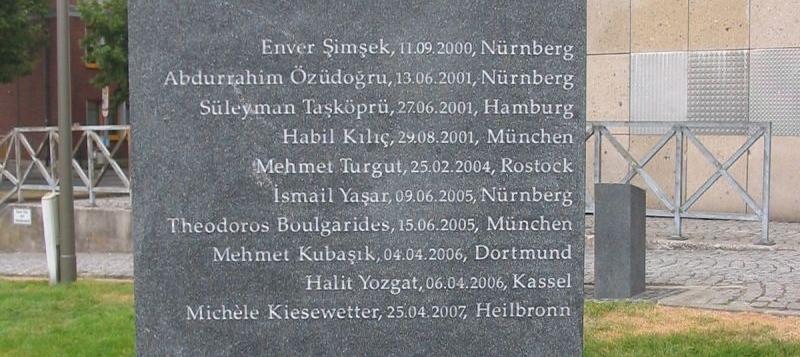
Mehmet Kubaşık (1966-2006), one of the victims of the neo-Nazi terrorist organisation NSU (National Socialist Underground), was 39 years old and a father of three. He found his first job in Germany as a labourer in a fruit and vegetable wholesale business and later worked as a construction worker. He suffered a stroke and, after recovering from it, set up his own kiosk. At midday on 4 April 2006, he was found lying dead behind the counter of his kiosk in a blood feud. He had been shot four times with a pistol and hit twice.
One day after Kubaşık’s death, the questioning of his relatives began. His widow and children were questioned about any drug dealings or mafia contacts of their father and were themselves suspected of the offence for a long time. As the suspicions against Mehmet Kubaşık soon became public knowledge, the family was stigmatised for years.
In the trial against Beate Zschäpe, Mehmet Kubaşık’s widow said in court about her husband: „He was very loving, he was very concerned about his family, he doted on his children.“
The trial against Beate Zschäpe and others involved in the NSU crimes has ended in the first instance, but the appeal proceedings are likely to drag on for years. Have we, society, the state and the judiciary, then done what is necessary or at least what is possible to come to terms with the horrific acts of the NSU? No!
There is a great temptation to pin the causes of bad deeds on a few people, whose punishment is then often enough believed to have done what was necessary. This became most obvious in the period after the Nazi regime. Hitler and his prominent helpers were blamed for everything. The millions of Germans who did not resist, or who even contributed in their respective roles to the fact that such a system could function at all, remained unchallenged. Their contribution was repressed into the collective unconscious in order to maintain Germany’s honourable self-image, which was itself only a victim of the Nazis. For the most part, lawyers and representatives of the judiciary in particular, who were then able to continue their careers in post-war Germany, were not prosecuted. Many profiteers, helpers and abettors of the atrocious crimes were thus spared justice.
It is well known that Fritz Bauer, who unswervingly advocated a relentless confrontation with Nazi injustice, was responsible for the realisation of the Auschwitz trial, which took place in Frankfurt am Main from December 1963 to August 1965. Especially in these days when people who want to save other people from drowning are being criminalised, it is important to remember what this says about the judiciary and state structures when someone like Fritz Bauer, who brought mass murderers to court, was considered to be a polluter, was massively threatened and, as he himself said, entered enemy territory as soon as he left his office.
As late as 1962, the later Federal Chancellor Helmut Kohl countered Fritz Bauer by saying that it was „still too early“ for a final judgement on the „Third Reich“.
And why does it remain important today? The crimes of the NSU are not comparable to those of the Nazi era. That’s not the point.
It’s about the principle. It’s about our attitude. It’s about how we deal with crimes and what we do to minimise them. It’s about a society-wide culture of error and the ability to reflect.
Shooting an unarmed, completely unsuspecting young family man who has done nothing to anyone is one thing above all: pathetically cowardly. Those who do this are neither thinkers nor fighters, they do not and did not stand for anything for which one could have respect. Even Beate Zschäpe’s statements in court, as far as they have been conveyed by the media, hardly command any respect. Some Nazis in the courtroom applauded because one of the helpers only received a light sentence. We should confront such figures with consistency, but also with courage. With the courage to recognise ourselves.
You can only learn from your mistakes if you recognise them and own up to them. As a state, justice system and society, we must react to the stupid, unreflective, empathy-less, cruelly harmful behaviour of individuals with wisdom, reflection and a feeling for people.
Beate Zschäpe can perhaps be locked up. However, the likelihood of something as horrific as the NSU murders happening again can only be effectively reduced if all the connections are relentlessly reappraised and analysed, and if consequences are drawn for the future. On the one hand, this reappraisal must take place legally, whereby the punishment of those involved is less of a priority. For Fritz Bauer, the criminal law of guilt came from the monkey era and he knew about the damaging effects of imprisonment in particular. Rather, the focus is on investigating injustice and establishing it publicly. However, a reappraisal must also and especially take place at other levels. Which structures in politics, the media, the judiciary, secret services and the police were decisive in allowing the NSU to murder unhindered for so long? And what can each and every one of us do to prevent this from happening again?
How many politicians are currently adopting AfD positions in order to stay in power? How many media professionals are reporting on the AfD and inviting its representatives onto their programmes in order to get ratings? How many of us pay too little attention to the terrible things happening in the Mediterranean and elsewhere? How many misuse refugees as projection screens for their fears and anger, how many fall far too easily for the abuse of refugees as scapegoats by numerous politicians? We must all be aware that we are committing such a great injustice and also creating a future breeding ground for people like the NSU perpetrators who want to lift themselves out of their insignificance in this way.
This responsibility varies in size. Living up to it begins with becoming aware of it.
Very few of us have the opportunity to influence fundamental things or prevent bad things on our own. None of us are heroes either. But the more people who answer the biblical question: „Shall I be my brother’s keeper?“ with „yes“ and see „brother“ not just as a business colleague, but as every human being, the fewer children will have to mourn the murder of their father in the same way as the children of Mehmet Kubaşık.