
Autor/Autorin

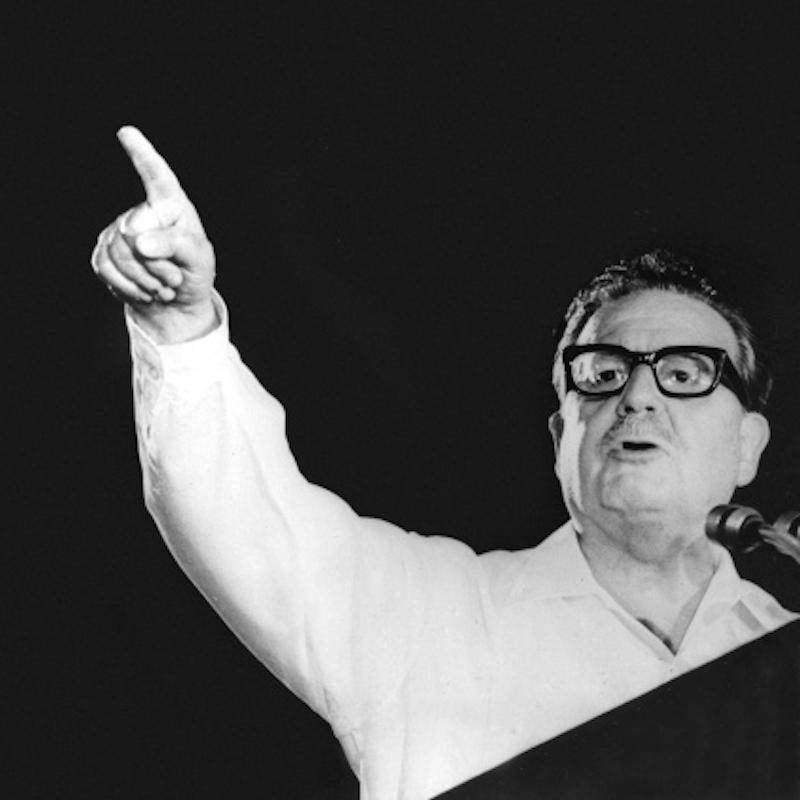
11 September 1973 is a memorable date: on this day, the democratically elected President Salvador Allende was overthrown in Chile, co-orchestrated by the USA, and democracy was replaced by one of the most brutal military dictatorships of the 20th century. Chilean filmmaker Patricio Guzmán lived through this period as a young filmmaker and addressed it in several films. Now, in a very personal and empathetic portrait, he approaches the figure of Salvador Allende, who was one of the rare personalities of integrity in the political arena. Guzmán uses impressive visual material to trace Allende’s political rise up to his suicide thirty years ago.
At the centre of Guzmán’s film is Salvador Allende, a politician who dedicated his entire life to the welfare of his people, who was not a dogmatist and who listened to the people in his country. His nurse had kept some of the photographs and documents about the president buried in the ground for over 17 years because Pinochet’s henchmen destroyed people and material in order to erase memories and other ideas. Like an archaeologist, the director sets out in search of the ruins of the past, of the walls on which the Chilean people expressed their revolutionary ideas back then and which now lie under a thick layer of oblivion.
Credits
| Original title | Salvador Allende | ||
|---|---|---|---|
| German title | Salvador Allende | ||
| French title | Salvador Allende | ||
| Other titles | Salvador Allende | ||
| Director | Patricio Guzmán | ||
| Country | Chile | ||
| Cinema formats | 35mm, DVD | ||
| Screenplay | Patricio Guzmán | ||
| Editing | Claudio Martinez | ||
| Music by | Jorge Arrigada | ||
| Cinematography | Julia Munoz | ||
| Sound | Alvaro Silvia Wuth, Yves Warnant | ||
| production | Jacques Bidou | ||
| Length | 104 min. | ||
| language | Spanish/d/f | ||
| Actors |
|
Awards
Sélection officielle Cannes 2004, hors compétition
„He was a „son of a bitch“: Richard Nixon was not talking about himself, but about the elected Chilean president Salvador Allende, who was overthrown with CIA help on 11 September (!) 1973. (…) Allende’s attempt to realise pluralist socialism in Chile had been brutally thwarted for fear of a Havana-Santiago axis; the president shot himself in his office. What followed was the horrific dictatorship of General Pinochet. Guzmán has long since dealt with all of this on film, but he is aware of the need for renewed remembrance: everything is still there under the plaster of the walls, the film suggests pictorially. Even the question of how revolution and democracy could be combined. Testimonies and documents come together to form a picture of a politician whose charisma and unimaginable energy are visible behind his almost bland appearance. Allende was controversial not only among the bourgeoisie, but also among the left itself with regard to the question of violence; this discourse is not absent from the film. It is a captivating document of a deep bond that does not want to erase the shock of that time.“
Martin Walder, NZZ am Sonntag
„Patricio Guzmán traces the life and death of the former Chilean president with great care and dedication. By no means neutral, but instructive. The director Patricio Guzmán, Chilean and contemporary witness to Allende, has now created a cinematic monument to this great political figure. In doing so, he not only portrays a man with a vision, there is more to it: the film takes a detailed look at the climate in Chile at a time before the brutal military dictatorship under General Pinochet fundamentally changed Chile’s political landscape.“
basel online
„The coup of the film is the appearance of the then US ambassador to Chile, Edward Korry. The retired politician tells how Nixon tried to prevent Allende’s election as president as early as 1970 by pouring millions of dollars into the election campaign of his opponents and convincing Christian Democratic parties in Germany and Italy to use money against Allende. In talks with the ambassador, in the presence of Secretary of State Henry Kissinger, Nixon described Allende as an „arsehole“ who absolutely had to be destroyed. On Nixon’s orders, the moderate army chief René Schneider was murdered after Allende took office, then the CIA initiated the lorry drivers‘ strike that paralysed the entire nation. (…) Guzman impressively demonstrates that in the last minutes of his life, Allende ordered the workers to stay at their workplaces in order to avoid bloodshed. How he shot himself – instead of fleeing – at his official residence when the troops stormed the „Moneda“, the presidential palace.“
View
„Film is a medium of memory and plays to its strengths when it contributes visually to the memoria of society. From the perspective of the Latin American continent, 11 September 1973 is a historic day of destiny because it was on this date that the democratically elected Chilean president Salvador Allende was overthrown by the US CIA. Patricio Guzmán, who experienced this period as a young filmmaker, uncovers the political murals of that time. He shows a differentiated portrait of the leading figure Allende, who was open to the concerns of his people and who worked persistently for the welfare of the population. Some of the documents and photographs had been buried in the ground for over 17 years. Allende’s nurse had hidden them there and saved them from destruction. Guzmán works on these traces of Chile’s democratic-revolutionary history like an archaeologist. In doing so, he avoids the pathos of revolutionary romanticism and instead dedicates himself to empathetic observation and precise research. In this story of the rise and fall of Allende, a personal involvement comes together with an informed political stance. The result is a gripping documentary film that illuminates Allende in a differentiated way and brings him back into the public consciousness.“
Charles Martig, Kath. media service
„The Latin American writer Eduardo Galeano once wrote a story in which a nameless village, lost in the vastness of the Andes, searches for a name. Someone is reading a book and when he has finished, he suggests the name of the main character as the name of the village. Everyone reads the book and then agrees to the name. They christen the village Salvador Allende and the book is his biography. It is precisely this fascination that Patricio Guzmán conveys in his documentary film Salvador Allende. A film about a man who changed the lives not only of Guzmán but of all Chileans by living his dream of a fairer society. Patricio Guzmán’s documentary film is recommended to everyone, whether they lived through this period or are hearing about Chile, Allende and the Unidad Popular for the first time. The film is informative and contains much that is new. It shows the man who believed: „Sooner rather than later, the great avenues will reopen through which the free man will walk to build a better society.“
Mario della Costanza, Forward
„Patricio Guzmán leaves the holy wrath of Michael Moore untouched: Instead of polemics, his film concentrates on Salvador Allende the political man. (…) It helps to tell the story of the country not just along the lines of a tragic caesura. Through conversations with young Chileans, this beautiful portrait film shows that time has moved on and that a new generation must clarify for itself what Salvador Allende bequeathed to it.“
Annabelle, Mathias Heybrock
Header photo and information about the film: Trigon-Film