
Autor/Autorin

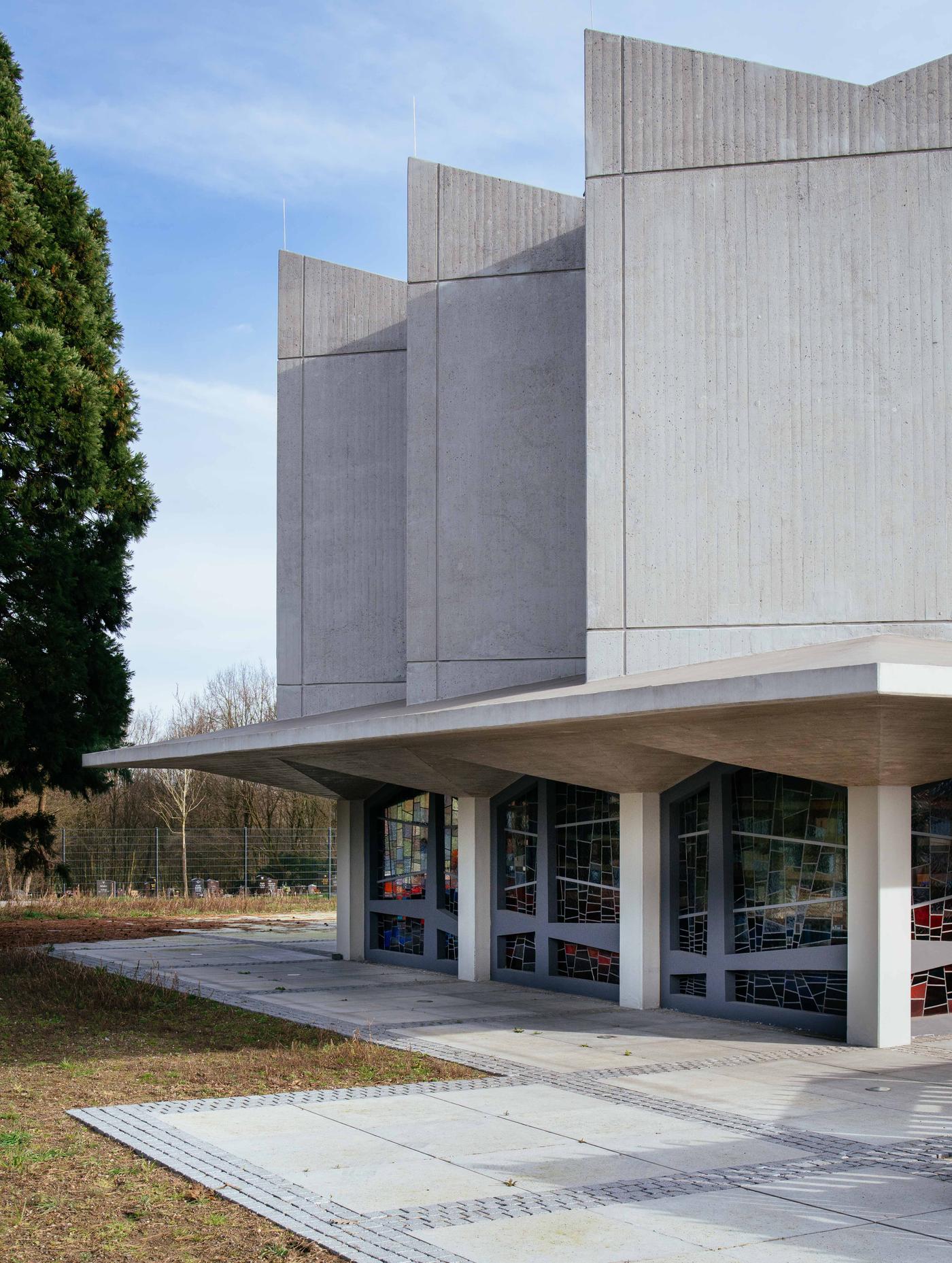
Today, 16 July 2023, is the 120th birthday of our namesake Fritz Bauer. Just in time for this day, the former „Trauerhalle (Ost) Havkenscheid“ has become a fascinating and well-equipped library and event venue . Now our books are gradually moving into this Fritz Bauer Library. The first programme of events will begin in autumn. At the same time, our seminar, exhibition, storage and office rooms plus a café are being built on the premises.
A new and interesting place of remembrance is developing, where the active NO to injustice and violence is just as important as the YES to the defence of democracy and human rights.
The lawyer and human rights advocate Fritz Bauer, who was born in Stuttgart, is being honoured today in the Stuttgarter Zeitung with an article by editor Jan Sellner. The article emphasises the commitment of pupils at Stuttgart’s Eberhard-Ludwigs-Gymnasium, where Bauer went to school. The grammar school awards an annual „Fritz Bauer Prize for Social Commitment“.
It is in Bauer’s spirit that this year the pupils are particularly focussing on the topic of resistance.
His life and thoughts were characterised by the deep political upheavals of the end of the 19th century and the first half of the 20th century. He was also influenced by the emancipatory spirit that prevailed in his grandparents‘ house in Tübingen, his mother’s home town. The Swabian idealist’s world of thought, his spirit of resistance, was shaped by the struggle for legal equality for Jews in Germany and the pacifist cry after the end of the First World War. As a student, he witnessed the rise of the Nazi movement in Munich. Bauer became a Social Democrat and fought alongside Kurt Schumacher to preserve the first German democracy. His fate as a persecutee of the Nazi regime, surviving imprisonment in a concentration camp and then ten years as a refugee in Denmark and Sweden, drove him on and on.
„I returned,“ he said later, „because I believed I could bring something of the optimism and faith of the young democrats in the Weimar Republic, something of the spirit of resistance and will to resist of the emigration in the fight against state injustice. (…) I wanted to be a lawyer who did more than just lip service to the law and justice, humanity and peace.“ (1)
Bauer returned to Germany with this programme in order to help bring about a fundamental new beginning and bring about the urgently needed „intellectual revolution of the Germans“. They should „hold judgement day on themselves, on the dangerous factors in their history“, as Bauer said, „on everything that was inhuman here“. (2)
It was not easy for Fritz Bauer and his not exactly numerous comrades-in-arms to remain optimistic due to the failure of denazification – especially in the judiciary. Bauer’s minority position in the trials for Nazi crimes (he saw the majority of the defendants as perpetrators and not merely as „accomplices“), his advocacy of international law and his assertion of a right and duty to resist when human dignity was violated appealed to the guilty conscience of mainstream society. He incurred the anger and hatred of those who wanted to be left in peace and not take responsibility after the Second World War and the Holocaust.
Bauer’s prognosis in 1968, a year of new beginnings, was sober:
„We emigrants had our holy errors. We thought that Germany lying in ruins was also a good thing. We’ll clear away the rubble and build the cities of the future. Bright, wide and people-friendly. (…) Then the others came along and said: ‚But the sewerage systems under the rubble are still intact! Well, and so the German cities were rebuilt, as the sewerage system demanded. (…) What do you think can become of this country? Do you think it can still be saved? (…) Take the first years of Bonn! No Wehrmacht! No policy of strength! Now look at the current policy and the emergency laws! If you like, use a ruler. Where does it point? To the right! What can come out of the extension?“ (2)
In view of this prognosis, the question arises as to where we are now. Possibly already at the end of the extension, politically at a tipping point, as with the climate?
After all, a far-right party in the Bundestag is currently receiving just as much inflationary media coverage due to its rising numbers as the fear of it seems to be growing. Because it is „democratic“ – after all, it was elected, they say. The „Last Generation“, on the other hand, whose civil disobedience and resistance is directed against the destruction of the planet and which demands faster action against it, is being criminalised. It is to be categorised as a „terrorist organisation“ and its members punished. Possibly because of them, loopholes in the law are to be sought and closed. Because their resistance is not compatible, they say.
Of all things, the protest and civil resistance of those who actively oppose the far-right occupation of environmental and climate protection as „homeland security“, who expose the nationalist core of far-right „climate policy“ and its ideological goals, are supposed to be „terrorist“.
Apart from the fact that civil disobedience or resistance is being practised because there is apparently no majority in favour of abolishing a particular emergency: Surely the time when disobedience and resistance are only „allowed“ if successful should be over for good? It is the fear of one’s own courage and the enemy in one’s own country that dictates such a mindset. It falsely calls for state authority and wants to call on it, whereas what matters is our own rethinking and actions, which should be orientated towards human rights.
Fritz Bauer repeatedly positioned himself against this authoritarian state thinking. Knowing that it is much more difficult to position oneself against the enemy in one’s own house than to seek it elsewhere. We can learn from him that resistance in the days of great injustice requires small-scale resistance in everyday life; it must be practised.
Apart from the fact that it is doubtful that right-wing extremism can be tackled with laws and bans – it would mean fighting it with its own means and its own ideology, which has always been doomed to failure – one thing is certain: with the „ Last Generation „, the wrong people are being criminalised. The judiciary and politicians would do well and better to strengthen civil society and disobedience against the right-wing extremism of the alleged „Heimatschutz“ with its racist world view.
That would not be a revolution – or perhaps it would be a revolution in thinking à la Fritz Bauer.
(1) Quote from an untitled article by F. Bauer for Deutsche Post , vol. 14 (1962), no. 24, p. 657f.
(2) Fritz Bauer, Die Wurzeln faschistischen und nationalsozialistischen Handelns. Frankfurt/M. 1965, p. 66f.
(3) Quote from Gerhard Zwerenz: Gespräche mit Fritz Bauer, in: Streit-Zeit-Schrift , VI, 2, Frankfurt am Main, September 1968, pp. 89-93, here pp. 92f.