
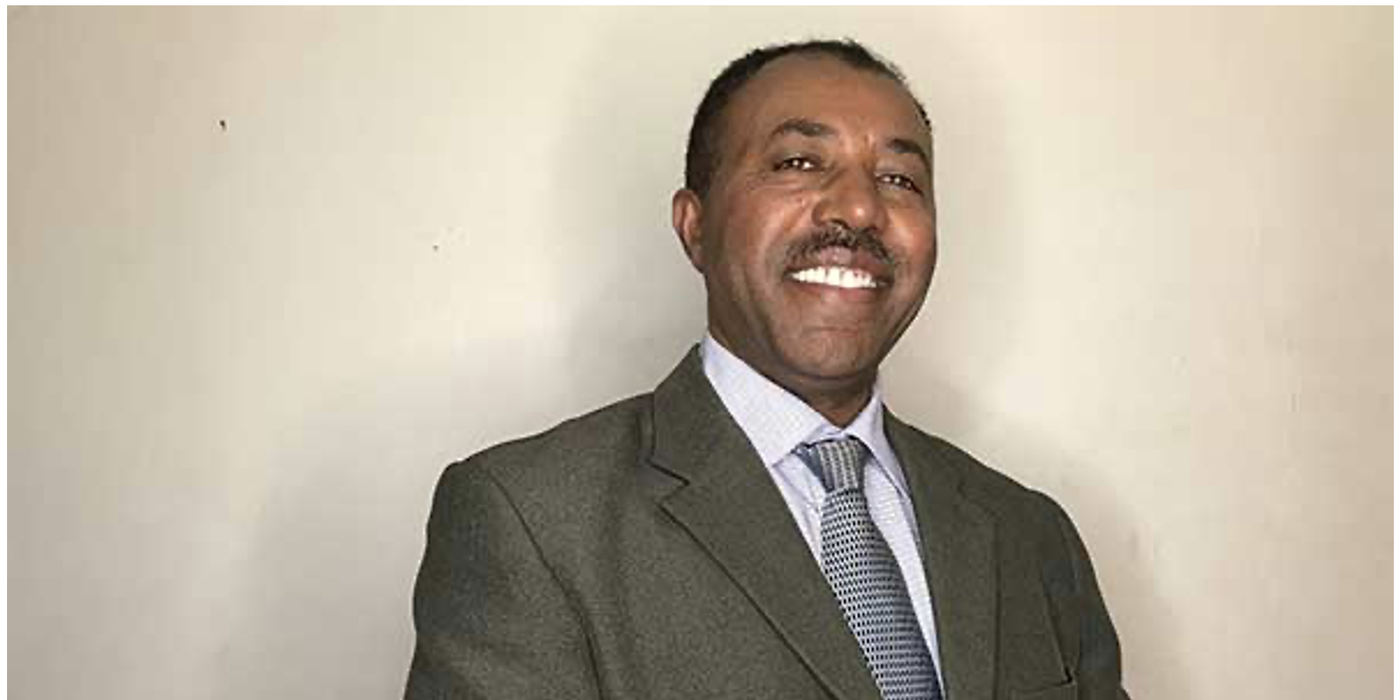
Autor/Autorin

„Yesterday was a sad day for me and many Eritrean journalists. We lost a hero, a fighter, a fighter for press freedom. A man who founded a newspaper to fight for justice, a man who was never afraid to express his opinion, a man who was a voice for those who had none.“
Aaron Berhane wrote these words just over a month ago in an obituary for his colleague and former competitor Milikas Yohannes, who had just passed away.
Tragically, the same words could now be spoken about Aaron himself.
On 1 May, Aaron Berhane, editor of Setit , Eritrea’s first independent newspaper, died in Canada from COVID-19. It is a great loss in so many ways. During his memorial service this weekend, many friends and colleagues described this warm-hearted and dedicated man. They spoke through tears.
Like so many Eritrean journalists, Aaron had to go into exile after the brutal crackdown on public protests against the Eritrean regime in 2001. In his gentle and humorous manner, Aaron told the story of how he and some friends came up with the idea of founding a newspaper in Eritrea. He had just turned 28 and his country had just won its independence after 30 years of fighting against the regional superpower Ethiopia. There had never been a free press. People were not used to reading newspapers, the printing presses belonged to the government and there was no distribution system. „Perfect conditions, right?“ said Aaron with an ironic smile.
After drawing up an overview and a plan, Aaron persuaded his father to give him a little support. They named the newspaper Setit after the famous river on the border with Eritrea, a river that never dries up. That was in 1997.
For the first issue, they printed 5,000 copies and thought they would last for a fortnight. To distribute Setit , Aaron and his friends put together a group of young people to sell the newspapers on the streets of Asmara. Everyone went out on the first day with a pack of newspapers. And they came back for more. And more. On the very first day, all the newspapers were gone.
„It was a most enjoyable day,“ Aaron wrote later.
Setit eventually became the largest newspaper in Eritrea with a circulation of 40,000 – four times larger than the official state newspaper. And soon others – like Milkias Yohannes – would follow suit and start newspapers in the young nation in the Horn of Africa.
This all came to an end on 18 September 2001. Since that day, all independent newspapers in Eritrea have been banned by the regime of President Isaias Afwerki. In the spring of 2001, a group of prominent Eritrean leaders wrote an open letter to the president demanding that he honour his promise to hold free elections. They were members of the ruling party, including Vice President Mahmoud Ahmed Sherifo and former Foreign Minister Petros Solomon. Aaron Berhane published the open letter in Setit on 5 June 2001, when he was editor-in-chief. He knew there would be trouble. That summer, he was repeatedly summoned for questioning. The police wanted to know his sources. He did not want to reveal them and at the same time he was determined to continue publishing new material in Setit .
On 18 September, Aaron’s thoughts turned to the coverage of events in the USA after the terrorist attack of ‚9/11‘ (9 September) when he heard the morning news on the radio. This suddenly changed life for him and so many thousands of Eritreans. The government announced that the politicians and civil servants who had signed the open letter had been arrested. And that all independent newspapers were banned with immediate effect. The newspapers are still not allowed and the arrested people have disappeared without a trace since that day.
Aaron and his colleagues immediately got together to discuss what to do. He feared the worst, but some of his colleagues were of the opinion that the whole thing would come to nothing. After that day, Aaron never lived at home again. But some of his colleagues did, despite the danger. On 23 September, the regime began arresting journalists. Aaron’s friend and colleague in the Setit editorial office, the Swedish-Eritrean journalist Dawit Isaak , was one of them. Dawit, Seyoum Tsehaye, Amanuel Asrat, Temesgen Ghebreyesus are now the longest imprisoned journalists in the world. They were imprisoned in the first wave and are reportedly still alive. Others have died in custody.
Aaron Berhane was an important and tireless voice who courageously stood up for his cause, and he showed that a free press cannot be silenced. After being granted asylum in Canada, he founded a newspaper there too – Meftih . He never stopped writing and taught journalism to a new generation.
Over ten years ago, I asked Aaron to write a portrait of his colleague Dawit Isaak for a book with translations of Dawit’s novel, a theatre play and his articles written for Setit . Aaron immediately set to work. But we didn’t meet until eight years later in Ghana, where an English-French translation of Dawit Isaak’s book „Hope-Espoir“ was presented at the UNESCO Press Freedom Conference. I was immediately touched by Aaron’s warmth. He later came to Sweden, where he spoke at public events, gave numerous interviews, met with parliamentarians and the Swedish Foreign Ministry and discussed how they handled the case of his friend Dawit. Politely, but very firmly and directly, he criticised the quiet diplomacy that Sweden has favoured for almost 20 years now.
He also met Dawit Isaak’s family, who live in Sweden. He knew better than most of us what exile means. His own family was unable to leave Eritrea and be reunited with him for seven years after he managed to escape. He told me how his youngest son didn’t recognise him. Aaron had to go into the next room and use the phone. Then his son immediately recognised his father’s voice.
It is really painful to know that this voice has now been silenced.