
Autor/Autorin
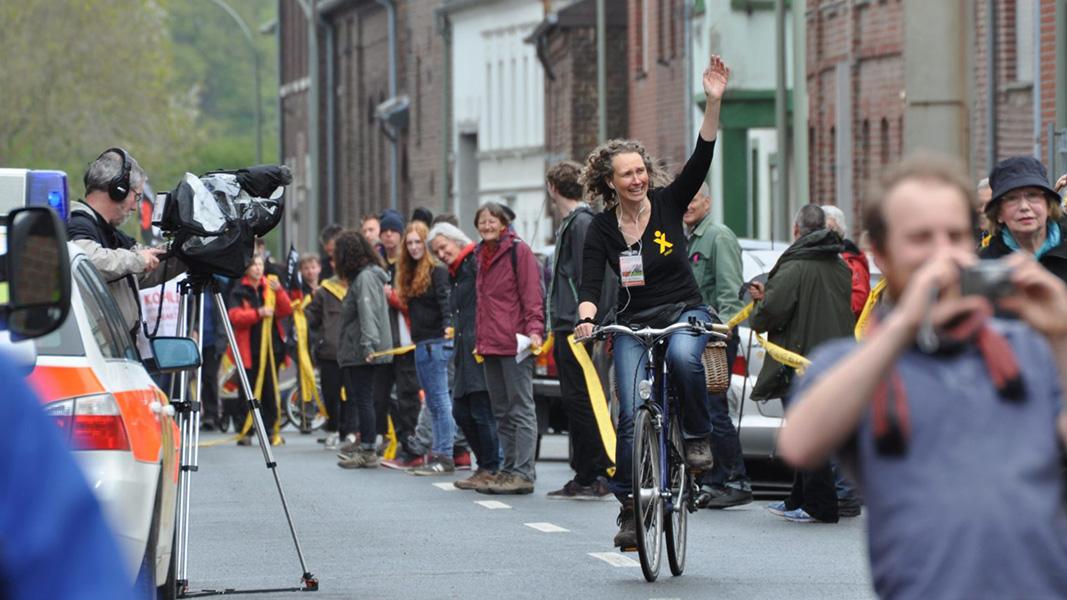
Antje Grothus is a well-known climate activist in Germany. She was a member of the Commission for Growth, Structural Change and Employment („Coal Commission“ for short) for the citizens‘ initiatives and is Coordinator for Coal Policy NRW at the Climate Alliance Germany.
The interview was conducted on the steps of the deconsecrated church in Kerpen-Manheim. Manheim is now almost deserted and is one of the villages that RWE wants to see disappear in the Hambach open-cast mine. During the interview, police and RWE plant security drove past us at walking pace almost every minute. What a threat two women sitting on the steps of a church can pose… During the interview, a resident of a neighbouring village came by and spontaneously took part, which again provided many interesting details and insights. We would like to take this opportunity to thank the unknown man.
According to public statements, the Hambach forest now seems to have been saved. If you look at RWE’s plans for the Hambach open-cast mine, it quickly becomes clear that even if RWE no longer cuts down any trees there, the water will continue to be dug out of the forest, which means the death of most of the trees and thus the forest. RWE and the state government of North Rhine-Westphalia also want to continue with the plans to excavate the villages in the Hambach and Garzweiler opencast mining areas as planned – despite climate change and the decision to phase out coal! The people’s fight for both the forest and the villages continues.
The interview with climate activist Antje Grothus describes the struggle of the people in the Rhenish lignite mining area.
DC: Hello Antje, thank you very much for the interview.
You were born and grew up in the Ruhr area and you come from a family of miners. Did that influence you in your fight against the coal industry?
AG: I was born in Bochum and grew up in Wanne-Eickel. That’s where I spent the first ten years of my life, so it’s still very much the Ruhr area. I wouldn’t say that I grew up in a family of miners. But my grandad did indeed work in coal research. And I also have a cousin who was a coal miner. So of course there is an affinity. Coal mining is simply part of the Ruhr region and I experienced it for many years. I don’t know if that influenced me. When I moved here and things developed with the Hambach opencast lignite mine and I became active there, I thought: somehow it’s a bit like going back to the roots . I grew up in a region with hard coal, but I was a child and didn’t see it from an environmental perspective. The Ruhr area was more of a cultural melting pot because we also brought in a lot of guest workers who also worked underground. But I also think, and I don’t want to sound disrespectful towards miners here in the lignite sector, you can’t compare the work underground with the work that miners do here in open-cast mines. You sit on large machines, press buttons and operate conveyor belts. The underground work of the people who worked in hard coal was a completely different kind of physical labour. I’ve also been inside once, once you’ve experienced it, the cramped conditions, the darkness, the depths, the temperatures, the weather, the winds that prevail, the coal was mined under incredibly physically demanding conditions. That’s something completely different to the open-cast miners here. For me, the real mining tradition is the underground coal mining tradition.
DC: And you’ve been living in Kerpen Buir since 1994, is that right?
AG: That’s right.
DC: How did that come about?
AG: I studied in Bonn, then I was in Regensburg, lived there for a few years and that’s where my older daughters were born. We moved to the Rhineland due to my husband’s career changes and then looked for a nice place to live with two small children, well connected by S-Bahn, intact rural environment, kindergarten, primary school in the village, lots of clubs, intact club structure. And that’s when we came across Buir. As we moved here from Regensburg, we didn’t realise what was actually coming our way and that the excavators were actually digging towards Buir. We didn’t realise it for a long time and I noticed it for the first time when I was out cycling in Hambach Forest, the children still in the bike trailer, and wanted to go to the swimming pool in Elsdorf. At some point I realised, oh, what’s actually happening here now? Villages are disappearing, there’s a huge hole. It was only then that I realised what was coming to Buir, but I still hadn’t taken any action.
DC: When did you get involved? What led to this?
AG: I only became active when the plans for the relocation of the A4 motorway, which was to be relocated to the immediate outskirts of our town as a result of open-cast mining, were revealed. I think that was in 2004, when we said, well, okay, the motorway will be relocated, then RWE will make sure that we get good noise protection. Even then, we said that the old motorway would have to stay because coal mining would probably no longer be able to be pushed so far because of climate protection.
Then we got active, wrote objections, everything you can do within a democratic framework. And we experienced how we were presented with these objections at a hearing. There was the phalanx of the district government, RWE, the state road authority and the mining authority on one side and us citizens on the other. We were reprimanded a lot, we were told that we were not allowed to say our names, but only the objection number when we stepped up to the microphone because of data protection. But RWE had the whole list with the names, objections and numbers, we found out by chance. Data protection my arse! Those were actually the things we were outraged about. Then we gradually realised that RWE has its tentacles everywhere like an octopus, both in church structures and in municipal structures, even up to the state government. And there were people, for example, when it came to the question of whether the town of Kerpen should now take legal action against the A4 motorway, who had given their e-mail address to the town council as Vorname.Nachname@RWE.com. They didn’t disguise it at all. They didn’t disguise it at all. You can see how interest-based politics is being played out and that we have a structural problem here in the region because everything is dominated by RWE, including the municipalities. And I also have the impression that even now the local authorities don’t really want to emancipate themselves from the RWE coal company.
DC: And probably the sports clubs too?
AG: Exactly, the clubs are sponsored, RWE is a major cultural sponsor, you can hardly go to an event because everything is or was sponsored by RWE. There’s a great book called Die Grube by Ingrid Bachér (Dittrich Verlag, Berlin 2011, editor’s note). She describes these structures that have been created in the clubs as dependency through donations. The clubs are happy when they receive money, the football club for floodlights, the shooting club for a new shooting range. And of course they won’t criticise them.
DC: In 2007, you founded the „Buirer für Buir“ initiative?
AG: Exactly.
DC: What do you do? What kind of campaigns do you organise?
AG: Back then, when it was a question of „We against the motorway“, we founded an association. An association can’t take legal action, but an association can, for example, commission expert reports. And then we organised a lot of public events, cultural events, big concerts where we raised money. Our statutes also state that we are committed to the quality of life in our village. It is very important to us to stand up for (!) something, for the preservation of the quality of life, which is massively threatened by the relocation of the motorway and the approaching open-cast mine, but also for the promotion of cultural life. We combined the two and were able to reach a lot of people. We really have spent a lot of money and commissioned expert reports, which we then made available to the people who have filed a lawsuit against the motorway relocation. Of course it is important, especially here in the region, where there is or has been very, very one-sided reporting, to bring critical reporting to the fore via the media (…) or to offer a bit of a counterweight with our voice.
DC: What does civil disobedience mean to you?
AG: We didn’t deal with civil disobedience for a long time. It started in 2012 with the first forest occupation, when there was an eviction and we were told that we were sitting in the trees and that this was something like civil disobedience, or we could chain ourselves to some tunnels. We thought about it for a long time. As a civic group, you have to deal with it, and we’ve actually found a very good position on it by saying that civil disobedience also crosses boundaries, sometimes even the boundaries of legality. But civil disobedience is important if you urgently need cultural change or social change. Civil disobedience has always been the driver of social change processes, which we urgently need here in particular. That was our stance on this and we are travelling together with everyone in the climate movement. There is a great diversity of solidarity, but of course there is also a critical solidarity that involves looking at the actions of others and discussing them. It was important to us, and we said this again in 2016, that in these disputes about coal it is very clear on the one hand that forests and villages must be preserved. But on the other hand, we don’t want people to be harmed in these conflicts. Unfortunately, this happens all too often and we have to prevent it.
DC: Which organisations do you work with?
AG: Our statutes state that we work together with organisations that have the same goals, i.e. environmental protection and safeguarding quality of life. We are actually part of a huge network that we have built up. In the beginning, it was only the local citizens‘ initiatives that we were networked with, for example, Leben ohne Braunkohle, which is more concerned with the power plant issue, or the Initiative Bergbaugeschädigter 50189, which deals a lot with the issue of particulate emissions, radioactivity from open-cast mining, i.e. health aspects. Then BUND NRW joined relatively quickly, as did the Netzwerk Bergbaugeschädigter. There are many more, that’s the regional framework. In 2011, BUND Youth organised the first climate camp, which took place here in Manheim, our neighbouring town. That’s when we actually started to focus more on the issue of climate problems for the first time and no longer just did pure parochial politics. We no longer just looked at what was actually happening here in our village, but what the climate crisis was doing to people around the world
Of course, we also work together with AusgeCO2ohlt, with Ende Gelände, a network that is also in close contact with forest conservationists. I have to be careful not to forget anyone, so many have joined us in recent years. Of course, we are delighted that since last year the really big NGOs and environmental organisations have also discovered the Hambach Forest issue for themselves, for years we always thought, my God, we are doing everything on our own here and why, yes, why don’t they actually have this as an issue?
DC: So Greenpeace and others?
AG: Exactly, Greenpeace, for example. Through Dirk Jansen and BUND NRW, BUND has always been very present on this issue, which is now attracting nationwide attention. I don’t want to say that we have been leading this on our own for years, we have organised ourselves well within our own framework. But for years we thought: „My goodness, why do so few people always turn up?“ And then we always said, „OK, but for the few that do come, it’s worth organising the event for them“, whether it’s activities in the forest or cultural things, it’s worth it for us, for us and for the people. None of us could have foreseen that it would take on such a dynamic as it did last year (editor’s note: 2018). We were very happy that we had the solidarity of the major associations. Because I remember, for example, Greenpeace set up a press container during the eviction. I think we would all have been hopelessly overwhelmed by this dynamic that suddenly developed. For example, Michael Zobel’s forest walks, I can still remember, spring or summer 2018, he said: „Antje, what do you think, should we offer forest walks every Sunday in September, when we’re approaching an eviction or the clearing season?“ I said: „Yes, definitely, it can’t do any harm.“ I still remember the first Sunday in September and there were 7,000 people at the S-Bahn station in Buir. I don’t know if you were there too?
DC: We were there! That was this rebellion!
AG: Exactly, I can still visualise it now. When I see the film THE RED LINE, I still get goosebumps today. I still can’t believe the momentum that developed around the issue. So many people, including the citizens‘ initiatives that were active before us, have made an incredible contribution. When the open-cast mine was opened in the 1970s, there were already citizens‘ initiatives. There was Stop Rheinbraun at the villages in Garzweiler, there was Verheizte Heimat , there were writings by students, Problemaufriss Braunkohle already in the 1970s (Arbeitskreis Chemischen Industrie Köln (ed.), Problemaufriß Braunkohle . Commissioned by the parliamentary group of the Green Party. Aachen, Cologne 1984; ed.), where everything that is happening now has already been described. They had no chance because the aim was to become independent of oil imports. They wanted domestic energy sources. And it was under the impression of the oil crisis in the 1970s, I believe, that these open-cast mines were authorised. We bear the cross, the climate crisis is now so bad and the fact that it is getting worse is an additional argument for us to take action against coal-fired power generation. In other words, the initiatives and those who are now active are also somewhat fortunate to be able to put forward this strong argument of the climate crisis.
DC: Lignite mining has been going on for a hundred years, but not on this scale. I also grew up here in the area, we had these smaller pits flooded with water everywhere, these were the excavator holes, we skated there. There was also lignite mining, I was taken through this large open-cast mine, Garzweiler, with my school class as a child.
AG: Me too. There were also pictures here in our local history museum in Kerpen, an exhibition. It was actually the case that people used to use buckets, like sand buckets from our children, to form huts in their gardens, because the coal was still on top, and they used it for their own home fires before it became this large-scale technology.
DC: But there was already commercialised lignite mining, just not this huge open-cast mine.
AG: Exactly, the giant open-cast mine only came in the 70s.
DC: Did village life change with the approaching excavators? Well, a resident of Keyenberg told me: „There’s a war going on in our village.“
AG: I find it very difficult to deal with this war rhetoric, because it’s always very, very divisive. But I think it gets to the heart of the matter a bit. The conflicts over coal are ultimately the cause of the conflicts that we have in the villages, some of which of course go through neighbourhoods, even through families. That’s a difficult thing. In the end, however, the conflicts only escalated when we became more vocal. It’s a bit like Gandhi. Gandhi once said, „First they ignore you, then they laugh at you and then they fight you…“ We have now reached the point of being fought, „…and then you win!“ („…you win!“, editor’s note) That’s how it ends, I think…
DC: I think so too, yes.
AG: Yes, that’s how it ends. We’re on the right track, that’s how you have to describe it, that’s how it is. The more attention we got with our issues, the bigger the forest walks became last year. When I was then appointed to the Coal Commission…, (there) you get a lot of attention. And that is (…) also difficult for the coal lobby, it is a threat or is perceived as a threat. I just said the Gandhi quote about the winner. I believe that we will all only be winners here, and by that I mean the people working in coal, if we manage to change the system together. I don’t want to divide into winners and losers. I believe that would divide the region even further and that must not be allowed to happen. I am very much in favour of a differentiated view. I mean, I’m not condemning an RWE employee just because his colleagues demonstrated on my doorstep, in front of my private home. I want to maintain this differentiated attitude, even though I sometimes find it difficult. I don’t blame everyone for the behaviour of a few. In Buir, there is a massive amount of agitation, against me of course, and also against the citizens‘ initiative Buirer für Buir. Posters were put up overnight (…), unbelievable, with my name on them… The nice thing was that my doorbell rang on the morning of 6 October and there was a family standing there who said: „Look, when we were getting bread rolls, there were banners everywhere, we took them all down and here you have them.“ I didn’t have to take them down myself. That’s nice too. I always say that there’s a part that’s in favour of coal, a part that’s against coal, and then there’s maybe a third in between that’s perhaps undecided, that’s not active, that simply says: „You’re way too late.“ That’s the line we hear more often: „You should have done this thirty years ago.“ We didn’t exist then, nor did Fridays for Future , they hadn’t even been born yet. Or: „RWE has always had the most power here, they’re the ones you don’t mess with, they’re always the winners anyway.“ Many people here have been socialised by and with RWE. It starts in kindergarten, where you get lunch boxes with the RWE logo. I’m still experiencing it at my daughter’s school: pencils from RWE, films from RWE, excursions to opencast mines. It’s simply difficult.
DC: You’ve anticipated a question a bit. That’s why I’d like to ask again in more detail what repression you experienced? I know, eighty workers from RWE…
AG: …I think there were about a hundred, but it doesn’t matter.
DC: On your doorstep…
AG: It started a bit earlier, I can’t remember exactly at what point. It was when Buirer für Buir became bigger and bigger or more and more noticeable, and we were often quoted in the newspaper or with quotes on TV, that’s when it actually started with verbal attacks and hate speech on social networks – pretty nasty insults. There was a group called RWE Employees for Fair Reporting, then I think it was called Wir im Revier. Yes, that was a real hate portal. You always ask yourself how long you watch it, how seriously do you take it? Do you perhaps give it too much importance (…)? I’m not on Facebook myself, for these very reasons we’ve always observed it or saved it as a kind of screenshot or at some point, when it got worse and worse, we handed it over to the police, but they didn’t see any need for action. Then it got worse, and I was named a climate hero by CARE (aid organisation, editor’s note) in 2017 as part of the COP in Bonn (editor’s note: world climate negotiations). Then there was an exhibition where I was often present, the forest walks by Michael (Zobel) and Eva (Töller) became bigger and bigger, with me as a supporter. Then came this appointment to the Coal Commission and this demonstration on my doorstep, which I have to say I found very transgressive. It’s also not allowed to demonstrate in front of private homes in Germany. I thought it was a scandal that the police allowed it. But I also thought it was a scandal on the part of the people because, at least that’s how it looked at this demonstration, it was led by someone who is the chairman of the works council at RWE and was also on the supervisory board of RWE at the time. A week earlier, before he led his people in front of my house to show them: „That’s where Grothus lives“, he was out on a walk in the woods and a village walk in Keyenberg, holding up posters of Michael and me. He stole our photo from somewhere, then wrote our real names underneath and „Employee enemy number one – Michael Zobel and Antje Grothus“ above it. That’s really violent. I’ve never actually said anything against RWE employees. My criticism is directed at the company, and I think it’s a shame how the company has managed to instrumentalise the employees and also how it is instrumentalising the trade union, especially the IG BCE, which should actually be addressing the employer. At least that’s my understanding of trade union work: it has to work to create sustainable, long-term, secure and climate-friendly jobs, but not to practically stylise the climate movement or people like me as the enemy. That really shocked me, but I realised it was an attempt at intimidation. They also brought in two extra people, two token women from the village, who held up a placard: „We’re from here. And you?“ and demonstrated outside my front door. I’ve lived in Buir for 25 years and I’m from here, just like the others. I always say that this area doesn’t just belong to the RWE miners and the IG BCE workers and the people who depend on coal or work there. This mining area, this region, belongs to all of us and we must all be heard. That is what I am ultimately in favour of, a fair balance of interests.
DC: What do you say to the RWE employees who are afraid for their jobs?
AG: I understand that when you have worked in such structures for years, decades, you want to keep your security. (…) On the other hand, no employee has this security these days. Everyone has to reinvent themselves, has to look for somewhere to work. Like in an industry that is threatened or affected by collapse, because they may have catapulted themselves into it. Or that he looks after his job himself, goes to the job centre and looks. I believe that they (editor’s note: RWE employees) are very well supported by our social systems. This is also enshrined in the coal compromise. Apart from that, I don’t see the jobs as being so much in danger, because we will need jobs for decades to come for recultivation and aftercare of the opencast mines, for the dismantling of the power plants. There will be no problem with regard to the age structure. There are some job losses in coal, (…) but that actually fits in very well with the demographic development in the labour force. The young people who are still in training at RWE are well qualified and will certainly find good jobs elsewhere, because we don’t live in a structurally weak region.
You could also give the (counter) example of a woman from Keyenberg. She has a farm, has a family and is a riding instructor, has horses stabled and has a riding centre. (…) She, for example, made me realise how unfair it all is here. RWE told her, „You can move, but you can’t take the horses with you, you won’t have any more land, you won’t be able to have a riding stable. None of that is possible in the new village“. Then she said, „How am I supposed to live?“ She went to the job centre and said, „Listen, I’m being relocated, I’m losing my livelihood, not just my home, I’m also losing my job, I need retraining, what can you offer me?“ Now she is completing a two-year retraining programme, is doing an internship somewhere, continues to run her farm at the same time because she still lives from it and earns money, still gives riding lessons, has to look after her family and small children, and still has to deal with RWE and the relocation. That’s an example for me, she has to go to the job centre, has to look for a new job, but RWE employees, they’re well looked after, they’re compensated, they’re sent into early retirement. Not that they shouldn’t be, that they shouldn’t be supported, retrained or something. But this inequality! This case shows this inequality so incredibly, how differently people are treated. And I think that’s unfair.
DC: Have you experienced a change in politics or in the way you are treated as a result of the change of government (in NRW, editor’s note) in 2017?
AG: Yes, absolutely. Initially, there were efforts to organise round tables in the state parliament under the red-green government. They looked at how to deal with the escalation at Hambach Forest, where environmentalists clashed with police and plant security. Not only with plant security, but also with the security companies commissioned by RWE, who are acting in a dubious manner. (…) There was also no escalation, with tree houses being cleared without it being necessary. I experienced our country as much more liberal, even if I look back on the last year now. A lot has been reversed, especially when it comes to climate protection. I think NRW was on the right track, it was a federal state that had the first climate protection law (…). Then, after the change of government, people kept saying in speeches: „Yes, but we’re doing so well.“ I thought that was a contradiction in terms. I am now experiencing that the expansion of renewable (energies) is being put on hold. Above all, I am experiencing an incredible polarisation by our Prime Minister, who has been trying to play coal and nuclear off against each other ever since he became Prime Minister. Now he has tried to play off the forest against the villages, along the lines of, yes, if the forest has to be preserved here, according to the coal compromise, then the villages have to go. I find that very unworthy of a prime minister. It contributes to creating more discord here in the region, which actually urgently needs peaceful solutions to the conflict. I am very, very glad that the people in coal and nuclear power, but also in the villages, will not allow themselves to be divided by such bad arguments.
DC: And this cramp, oh fight – cramp also fits (laughs, the ed.) – David against Goliath, that’s incredibly frustrating and takes a lot of strength. Where do you get this strength from?
AG: First of all, I take my strength from the fact that I find the system that prevails here absolutely and abysmally unjust. I have always been against unjust behaviour, especially against power structures such as those imposed here by RWE. That corporations are allowed to have so much power and that politicians are more industry and corporate lobbyists than citizen lobbyists, which I think they should be. I don’t find that honourable. (…) Where do I get the strength from? Of course I take the strength incredibly (strongly, the ed.) from the great team of Buirer für Buir. We have been politicised together by what RWE has done here. Then through the growing network, lots of great positive feedback. And last but not least: of course we’ve also had the odd success, that has to be said. I’ve had a lot of strength since last year, since such a great dynamic has unfolded around the topic, where so many people have come, just like that. Also, I think, politicised by the approach of the Minister of the Interior with the evictions. This has brought many people onto the streets and to us who perhaps didn’t have the issue of phasing out coal and climate protection on their radar (…). I have spoken to many people who have said, no, what is happening here, such an eviction in anticipatory obedience for RWE, a vicarious agent for RWE, the keyword was also used here today, our democracy is in demand, we have to do something about it. And that’s how I feel too. It’s about fair living conditions and a fair balance of interests, and not about increasing the profits of the company at the expense of those who have to make sacrifices in the villages, for example, by giving up their house or their home, or even their homeland, to use this unwieldy term.
DC: Do you get support from your family?
AG: That is very different. My family, I have three daughters, naturally suffers from the fact that I am away so much and work incredibly hard on the subject. But my daughters, who are 26, 24 and 16, have now, in the last few weeks and months, reflected back to me that they are incredibly happy that my work has been so worthwhile. They are happy that it has been so successful and they are also, well, proud is not the right expression. They are happy for me and with me. When they saw the film The Red Line, they were very touched by it. We all reviewed what had actually happened over the last few years. You can’t process that very well. I myself have not been able to keep up with the dynamic that has developed through and around me since last year. I don’t have the perception that many others have of me. I don’t feel that way, I’m just doing what I’ve always done. I’m approached by people who all know me, somewhere, you’re travelling on the train… that takes some getting used to.
DC: In 2018, you were an elected member of the „Commission for Growth, Structural Change and Employment“, or Coal Commission for short?
AG: Yes.
DC: How did you experience the negotiations?
AG: Well, first of all, of course, I was sceptical about going into a commission like this, which is already called „Growth“, yes? Actually, it should have been called the Climate Commission, that should have taken centre stage. What was my experience of the Commission? First of all, I would like to say what I experienced around it, that my appointment and that of Hannelore Wodtke created an incredible dynamic in the region, because people were happy that they were finally being heard through us and that the other side of the coin was becoming a little better known. Apart from that, it was an incredibly challenging time for me, a very, very exhausting time. I was not at all familiar with the political arena. Of course, it was difficult to meet political heavyweights in this commission, both party-political heavyweights, such as former prime ministers from the eastern federal states, but also people who work in a very well institutionalised way, for example in the BDI or BDW or in the trade unions.
(An unknown man joins us, editor’s note)
DC: Hello!
Man: Do you have a key to this? (Editor’s note: This refers to the desecrated church on whose steps the group is sitting during the conversation).
AG: No, no, we didn’t want to go in either. Do you want to go in?
Man: Well, I’ll have to have a look here. They’ve already torn the bell out here.
AG: Yes, I know, yes.
Man: That’s terrible.
AG: Yes, terrible.
Man: You’re Mrs Grothus, aren’t you? I only know you from the media. I’m from Elsdorf, we live in the dirt, you know your way around here, you’re from the region.
AG: Yes, yes.
Man: We get all the dirt from the Sophienhöhe (note: high dump of the Hambach open-cast mine). There’s always a westerly wind, it all blows towards us. (…). I think it’s terrible what’s being organised here. Every time I drive to Düren, I drive through this place (editor’s note: Kerpen-Manheim).
AG: It hurts, yes?
Mann: I had a lot of friends and acquaintances here.
AG: They’ve all moved now. (…) I just remembered something great. I got a postcard from someone, we might have to add a bit more in the addendum. When this action was organised by RWE employees who protested in front of my house, I received a lot of expressions of solidarity, which also gives us strength. I received postcards, I was sent bath salts and tea, people offered me their house if I had to retire, I was also offered beautiful holiday homes where I could go on holiday. (…) And someone from Elsdorf wrote me a black and white postcard (…) with a sailing ship on it. And he wrote on the back: „Mrs Grothus, no matter what happens, please stay on course!“ And that touched me so much, unbelievable. I know his name too, it was on the back. But I can’t manage to thank all those people. But that’s something that gives me a lot of strength, this really nice, positive feedback.
Man: What I think is bad is that the people from Buir and Alt-Manheim and so on, they’re all behind it, they’re behind RWE.
AG: Yes, they are behind Loni Lambertz (editor’s note: CDU councillor in Kerpen and wife of former RWE Executive Board member Johannes Lambertz).
Man: Well, I know someone in Buir, I think from your neighbourhood (mentions a name, ed.), who always writes a lot.
AG: Yes, yes, but he’s also rather favourable towards us.
Man: Right, he’s against RWE.
AG: Yes, yes, exactly. Yes, that…
Man: One day they trimmed him in the street. I always say, D., take it easy. You can’t go out on the street at night. That’s impossible.
AG: Yes, that was after the demonstration on my doorstep. My husband always took me to the train in the evening or in the morning, to the S-Bahn, for a while. You never know. There are also Facebook pages, for example „Rolf Martin Schmitz Ultras“ (editor’s note: Rolf Martin Schmitz is the chairman of RWE, the Ultras page in question no longer seems to exist), if you look at them, what a brainchild they are, how there are runes on the pages, you can get worried that at some point someone will freak out and think they have to do something to you. That’s the machinery of intimidation and that’s what they want to achieve, but they can’t, no, they can’t.
Man: Yes, do you think the forest will remain?
AG: Sure, nobody can put their saw to the forest anymore. What do you think is going on there?
DC: You’re taking my interview away from me now! (Editor’s note: everyone is talking and laughing at each other).
Man: Well, I have my doubts…
AG: What do you think will happen if the forest falls? I can tell you something, and that’s not my tone. But I don’t want to say who it’s from. Someone said to me, „Mrs Grothus, you know that if the forest falls, there will be war here.“ And it wasn’t someone from the activist movement, but someone from local politics who said that to me. Nobody can afford to do that.
Man: Kurt Claaßen also has his meadow there, he’s not so sure either. He also thinks that something is happening there now, that it should probably be cleared. (Editor’s note: Kurt Claaßen is the meadow owner who has made his meadow available to the forest squatters and is steadfastly refusing to sell the meadow to RWE).
AG: You know, that’s exactly the point. The diggers are so close, there’s a point to it. They want to unsettle us, that’s why the excavators are in front of the village of Keyenberg, we know what that does to people. It breaks people’s backs when they see this demonstration of power going on. When there’s a giant excavator fifty metres from the forest, it really gets to you. It gets to me too. I said today that if, like the forest (…), the money for structural change was at risk, then everyone here, all the politicians, would have been ringing alarm bells for a long time. If the compromise has to be implemented, then it has to be implemented one-to-one. And then the forest must remain.
Mann: I’m not so sure about that.
AG: I hear you grew up here. (…) You’ve lived here for a long time.
Man: I grew up where I live now. We used to have a well in front of the house, everything was completely dry for many years. I think it’s a mess. Fir trees have all been broken. It ruins everything (editor’s note: this refers to the lowering of the groundwater level by RWE). But whether it’s really caused by the bark beetle (…), I think the drought is also playing its part.
AG: I think that’s a bit of a difference, what I’ve just said. When you’ve grown up here, lived here for decades, been indoctrinated and infiltrated by RWE in kindergarten, then it’s even harder to take a critical stance, as you’re doing now anyway. I only moved here 25 years ago. I can perhaps deal with that more easily. But every day I experience anew how the structures are here and how RWE goes in and out of the municipalities, in the ministries and everywhere. I experience that, but you can’t give up because of it.
Mann: When you see what they’ve already destroyed. We used to live in Bergheim for a while, that’s when it started with the Bethlehem monastery, which you don’t even remember. It was demolished back in 1966. I was still there. What a building that was! They did everything there…
AG: Ah, and Bochheim House (name unintelligible, ed.) I could cry. There was no need to demolish it, it could have been left standing. It’s a really great building in the neighbourhood that could have been used as a conference centre. Because it was clear that open-cast mining would probably come to an end. Nevertheless, facts are being created, and even the church here (editor’s note: he points behind him)… Don’t you want to go in there?
Man: It’s closed, you can’t go in anymore…
AG: I thought you knew where the key was hidden.
Man: Unfortunately not. I was in there once, there was a funeral mass for a woman, so my wife and I said we’d come round again when the funeral mass was over, maybe we’d have a chance to go into the church. And that’s what happened. And then I asked the verger, „What do you think about all this being demolished? It’s also a cultural asset, isn’t it?“ Tears welled up in her eyes. I said, „Where do you live now?“ „Yes, in Neu-Manheim, we have everything new there, it’s nice and great.“
AG: Yes, yes.
Man: And when you drive through Neu-Manheim, have you ever driven through it? All magnificent buildings – we can’t compete with that.
DC: Although people told me during the Alle Dörfer bleiben campaign that none of it has a soul. You can imagine, it’s grown like this here, the old farms that have been built into the villages, some of them half-timbered houses, listed buildings, that’s different from new buildings.
AG: I’ve just spoken to a farmer from Etzweiler who moved twenty years ago. That was a village behind the forest. He told me he didn’t want to back then, he resisted for a long time. He told me that he’s only now realising in his old age what he’s lost. He was always against it, but he moved anyway and now he said that sometimes you only realise what you’ve lost ten or twenty years later. I believe that resettlement costs people several decades of their lives. B. from Wanlo once said that. She said that the resettlement process begins ten years beforehand, if you know it, then the ten years of the actual resettlement process — and then you need another ten years to get to know your new neighbours in the new village and to rebuild the structures there. I mean, that’s thirty years of life! (…)
Man: I have two cousins who lived in Etzweiler, they both had farms. And they were previously in Bedburg and moved from there to Etzweiler, then moved again.
AG: Oh God.
Mann: I’d like to say one more thing: all the ash that’s produced in the power plants is now in the open-cast mine, sulphur and all. At some point it’s going to turn into a new mess.
AG: For example, just as with the issue of power station ash and slag, dumping on the edges of open-cast mines, the Leben ohne Braunkohle group in Puhlheim is very closely involved. They have already managed to get the mining authority to put in higher provisions, but that is still not enough. I can also see that we will still have many of these eternal consequences. There are a lot of problems here, yes.
(To the unknown man who is now leaving) Thank you very much, it was a great pleasure! Bye!
DC: There were a few more interesting aspects, I’ll mention them.
Man : Yes! (waves, the ed.)
AG: Yes, one of the nice encounters.
DC: We were at the coal commission, yes?
AG: Yes, let’s start there again.
DC: Lots of political heavyweights…
AG: Exactly. There’s also a certain inequality in the way you’re set up, you have to realise that. Most of them, as I said, were institutionalised. I didn’t have a staff of any employees behind me. The only thing I have to mention very positively is that I was released from my actual work at the Climate Alliance Germany as coordinator for coal policy in NRW for the time I was working on the Coal Commission, because they said there would be no conflicts of interest. „You don’t have to report on what you’re doing or give an account. Take care of the issue, you know best on the ground what is important“. As a result, I didn’t have any financial restrictions during that time, because my family had already said, „Mum, if you volunteer for the coal commission again, then you can move out, something like that. If you’re as committed as I am, you usually also have financial disadvantages because of the amount of time you spend volunteering. You can’t earn any money during that time, that’s just the way it is. I had to take care of everything myself during that time, I wrote every speech myself, I booked my own accommodation, my own travel, I was my own PR person, my own research assistant and, and, and. And that was a huge challenge. I probably had a companion – „Sherpa“ (editor’s note: chief negotiator) was always the name – but I couldn’t afford to pay for it, so I had to rely on her being released from her duties by an organisation she worked for. And that was Daniela Setton from the Institute for Sustainable Transformation Research in Berlin. She supported me very well, especially on the topics of citizen participation and participatory processes, and contributed her expertise. I was very grateful for this guidance, support and relief.
Another aspect of (…) my commission work that is very positive and has given me a lot of energy is the support, the reinforcement, the trust that I have enjoyed during this time. I have to say that. When I was appointed, I said straight away that I couldn’t just go there and introduce things. There have to be people behind me who say what I should contribute. I want to represent the interests of the region. I then rented the community centre in Buir, every three weeks on Friday evenings, and invited people via the many lists to accompany me on this path, on this work. This gave me the opportunity to relieve myself and I was able to create transparency: what do I write for submissions, what do I do, what do I enter for texts, how do I act in the commission. I was also able to get support, reassurance and criticism. I was able to critically reflect with these people on what was happening. And that led to us developing our own structural change concept, because that’s how it turned out. I am incredibly grateful for this support for my commission work from the so-called „Civil Society Coordination Group for Structural Change“. (…) That motivated me a lot to continue. Working in a commission like this is difficult, especially when the commission is made up the way it was. We only had one third women. I always criticised the fact that there were no youth representatives at all, there were no church representatives and there were no representatives from the Global South, i.e. from people who are particularly affected by the climate crisis. It was clearly the case that two thirds were more in favour of the fossil fuel industry and endless economic growth. And then the decision is made the way it was made.
DC: How do you ultimately rate the coal compromise, the result?
AG: Whenever I’m asked, I always say that I can only give an interim assessment or an interim conclusion. Developments are constantly changing because it depends on what happens in Berlin. That’s why you can only ever draw an interim conclusion and say, yes, it was good that we did it this way and that I supported it. And then you say again, oh dear, what’s next… When you see what’s happening to the Hambach Forest now, fifty metres from the excavators, you think, yes, paper is patient. The preservation of Hambach Forest is there, but nothing is happening in that direction. However, it was important to me to support this recommendation so that we finally have a start on phasing out coal. We have agreed to shut down three gigawatts of power plant capacity here in the coalfield by 2022. I realised that this would also give us the opportunity to save the forest and the villages. That was the first step that was important to me. If this whole compromise had fallen through and we hadn’t managed to achieve anything, it would have been business as usual. That’s still the case right now, but Berlin is working on solutions, let’s put it that way. They are working on a coal phase-out law and a law to strengthen structures. These are the two important aspects of the Coal Commission’s recommendations: structural change on the one hand and climate protection and coal phase-out on the other.
It is clear to me that everything is taking too long. We have said that we want this to happen quickly and that the recommendations should be implemented in full. In my opinion, this is not happening right now. The Federal Government should have been much better prepared for this, as it knew that there would be recommendations and that they would have to be implemented quickly. At the moment, this is being very, very delayed. I am experiencing a political vacuum at various levels and the coal companies and RWE in particular are taking advantage of this to create facts. We are running out of time, and not just for us locally with the preservation of the forest and the villages, but also for climate protection. Every day that passes is one day too many and means that the measures we have to take are becoming ever more drastic. That this is not recognised! There is an absolute lack of foresight, of preventive, proactive and forward-looking action, which I totally miss in politics. And I also miss it in our dealings with the members of the Coal Commission.
DC: What does Hambach Forest mean to you?
AG: For me personally, as a Buir resident who lives a few hundred metres away from it, Hambach Forest is an absolute protective shield against open-cast mining: if you can’t see what’s happening behind it, this huge wound in the earth, fine dust and coarse dust emissions, noise and light emissions from open-cast mining, it’s a protective shield for us citizens in Buir. The symbolism of Hambach Forest has always changed for me. When I was there with the Climate Warriors as part of the COP (editor’s note: Conference of the Parties = World Climate Conference), I thought, „Man, it’s worth fighting for every forest, for every tree in this forest, because every tree that remains standing means that so many tonnes less coal will be mined.“ And that’s why the earth’s atmosphere is heated up less. Then some people say that Hambach Forest is a sign that we have realised that we need a change now. A sign for Paris, for the Paris climate targets. Since last year – and this is also what the forest stands for most for me at the moment – as a symbol of how much can be achieved with civil society and voluntary commitment. I don’t want to minimise the successes of BUND NRW, because without its legal efforts the forest would already be 160 hectares smaller. Thanks to BUND, two clearing seasons have been cancelled, a huge success that nobody would have expected. But the pressure exerted by civil society, which took to the streets on a massive scale last year and where almost 100,000 people were active in and around the forest from September to November, with demonstrations and their presence alone, shows me quite clearly how much power civil society has, people who join together in solidarity and diversity, how much can be achieved. For me, the Hambach Forest is the greatest symbol of this at the moment.
DC: So it’s worth continuing to fight for the rest of the forest, even if experts assume that the forest is already hydrologically dead?
AG: I wouldn’t say it is hydrologically dead, but it is massively damaged. It is being massively damaged by water deprivation. It lives off surface and precipitation water (editor’s note: the surface water flows off the edge of the open-cast mine, which is close to the forest). As we know, the climate crisis is also causing more and more extreme weather events and we are experiencing massive drought in all forests. This is why all forests in NRW are in a worrying state, especially the beech forests due to their structure. Beech trees are particularly susceptible to this heat stress. And I don’t think we will be able to avoid having to use artificial irrigation in the near future in order to preserve these forests. It’s definitely worth it because it has become a symbol for many people – including many municipalities, including the municipality of Merzenich and the municipality of Kerpen, which are focussing on structural change and the preservation of this forest because they say that many people want to come here. Perhaps we could organise a transformation academy there (…) Perhaps we could try out how alternative economies can work here, i.e. create experimental spaces for people in the region. I believe that if the Hambach Forest cannot be preserved, it will absolutely jeopardise the coal compromise. I also keep trying to make this clear at a political level. I just don’t think the politicians in Berlin are aware of this, which I find dangerous.
DC: You are also always in contact with the tree squatters in Hambach Forest. In the media, you are often portrayed as the link between people from the middle-class camp and the protest camp or the tree squatters. Do you see yourself in the same way?
AG: I see myself very much as a networker, if I may say so. You could perhaps also call me a link. For years, I think I’ve actually stood for the cohesion of various groups, not just citizens‘ initiatives that are as active as we are, but also the tree campaigners. I’ve known some of these people since 2012, and we’ve built up a trusting relationship. The work that people have done is incredible, what they expose themselves to by sitting on a tree and the publicity they get from it. It’s always important to me that people are perceived in a differentiated way and that we don’t pigeonhole people and say, yes, these are THE forest squatters. There is no such thing. There is also no such thing as THE police. There is also not THE citizens‘ initiative. Everyone is an individual and my appeal is that we try to meet as human beings in the disputes, even in the disputes, in the conflicts about coal or about the forest or about the villages. I think that would make it much easier for us to have this direct contact and not via social media, where all barriers often fall, where there are no more inhibitions and people are insulted and so on.
DC: Dialogue too…
AG: Dialogue is always important. We always stand for dialogue and we invite everyone to dialogue. I’ve always tried to mediate, I’m actually a very harmonious person. That’s why I always try to stay in contact and engage in dialogue. I also listen to criticism of what I do. I think it’s always important to stay in dialogue, in conversation (…).
DC: You have received various awards, the MUT medal…
AG: Yes, exactly.
DC: Various other awards too and you’ve been on television, on Maybrit Illner and Anne Will. Does that help you in your fight against RWE?
AG: Well, first of all, there’s a lot of work involved in such enquiries, let me say that first. When you suddenly get a request from Anne Will in your e-mail inbox asking if you want to come on the programme, I have to say that your heart is pounding if you’re not a media professional and haven’t had years of media coaching or anything like that. On the other hand, and here I have to bring the Coal Commission into play again, it was of course the case that we said right from the start that if we were represented on this commission, then we would have the chance to attract public attention to ourselves and our issues that are close to our hearts and to publicise them. And I think that has helped because we have made good use of it, not exploited it, but we have made good use of it. And the prizes, of course, are an appreciation of my work. That’s why I’m delighted, it was an incredibly great honour for me to be named a „climate hero“… I’ve also made it clear that I wouldn’t describe myself as a climate hero, but the fact that I’m standing up to all this hostility sometimes makes me feel a bit like a heroine, because you really do need a lot of courage. I always like to quote that I come from or live in the Kolping town of Kerpen, and Kolping once said that „those who show courage, give courage“. That is very important and unites many people who stand here with their face and their name for the cause. The MUT medal, however, is not called MUT because of ‚courage‘, although I think that would have been great, but for people, the environment and animal welfare. That brings us straight to the point: when you accept awards from political parties, you always have to be careful not to allow yourself to be instrumentalised and harnessed to some kind of cart. That’s why I always make it very clear that I am non-partisan. I have also received a Golden Swallow from the ÖDP. I’m doing this (…) as Antje Grothus, but on behalf of all those who are travelling with me here, i.e. who form these red line communities, a Michael Zobel, the people who live in the trees, who are active in citizens‘ initiatives. That helps to keep raising the issue and perhaps also to sensitise new sections of the population to what is happening to our planet as a result of coal-fired power generation.
DC: Last question: When you see all the young people taking to the streets now, Fridays for Future and Ende Gelände, what does that trigger in you and what advice can you give these young people?
AG: Let’s start with Fridays for Future . It’s unbelievably great that they became active at a time when the coal commission was actually coming to an end, and so they really put pressure on the streets and are still keeping the issue at the top of the agenda. I am incredibly grateful that there is a Greta who has somehow initiated the whole thing and that those who have taken Greta Thunberg as an example, who is characterised by perseverance and consistency in her actions. That’s what we need to keep working on this issue. However, I already said at an event in December that Fridays for Future has to be very careful not to allow itself to be instrumentalised. You often saw flags from other organisations and parties at the demonstrations. I always said that they had to be careful because this movement lives best through the colourfulness of the students, through the grace of the self-made signs, and it is only authentic in this way.
(…) I can only advise them to carry on as before, but they must all take care of themselves, especially those who are at the forefront. Like Luisa Neubauer, who is being treated with extreme hostility, even more extreme than me, including Greta, which I find simply unbelievable. In 2015, I still saw Ende Gelände as a relatively young group, but in 2016 and 2017, and also in 2018, I realised that Ende Gelände is now totally cross-generational. Of course, the focus is still on a lot of young people, but who I see there. A great example is that just this year someone from Bavaria, who is already around 80, called me and asked if I could get him accommodation here because he was starting to find it difficult to sleep in a tent for health reasons. But he really wants to take part in Ende Gelände again and told me about last year, when he was on the tracks. I think it’s unbelievable what layers of the population, generations and age groups Ende Gelände reaches. The fact that more and more people are prepared to practise civil disobedience and sometimes even put themselves in certain danger in the clashes, and then also sometimes with the police…
I also once said (…) that I have never really felt the need to cross a certain line, except a few months ago, when there was a road blockade organised by people in the Garzweiler villages because of a road that is now to be built. Although it is probably no longer needed, RWE wants to build the road now. That was the first time that I thought to myself, „Man, you really ought to sit down there too, if the people from the villages are already practising civil disobedience, then that’s a sign that no politician can look past and see that something is going wrong here. (…) In my opinion, the non-action or wrong action of our politicians or the government is currently leading to citizens becoming more and more radicalised. And politicians should simply realise what a miserable picture they are presenting and how they are radicalising citizens themselves. They always try to blame others for this. You can see this, for example, in the fact that the 50,000 people at last year’s Hambi-Bleibt demo are now mentioned in the constitutional report. It makes you scratch your head and think, what’s this all about! This divides and radicalises citizens, not the activities of citizens‘ initiatives or environmental associations or people who occupy a tree because they want to save it.
I: That’s a very nice conclusion. Thank you very much for the interview!
Website of Antje Grothus
Documentary film by Karin de Miguel Wessendorf DIE ROTE LINIE – WIDERSTAND IM HAMBACHER FORST (5/2019)
https://www.thurnfilm.de/die-rote-linie
www.facebook.com/FilmDieRoteLinie
Teaser: https://www.facebook.com/FilmDieRoteLinie/videos/1488455791288749/
WDR documentaries by Karin de Miguel-Wessendorf (2016/2017)
Part I : „Climate protectors against electricity giants – resistance in the Rhenish mining area“ (first broadcast on 10 November 2016)
https://www.planet-schule.de/sf/filme-online.php?film=10404&reihe=1512
http://www.thurnfilm.de/de_doku_braunkohle.php
Part II : „Leave the coal in the ground! – Red lines for the climate“ (first broadcast on 9 November 2017)
Trailer: https://www.facebook.com/karin.demiguelwessendorf/posts/10155913086156473
Award as climate hero by CARE Germany/Luxembourg, 12 November 2017
http://blog.care.de/deutschland-antje-gegen-goliath/
Video WHAT REMAINS (Summer 2018)
https://www.facebook.com/CAREDL/videos/443572686049633/?v=443572686049633
Petition by Antje Grothus
http://www.aachener-zeitung.de/zva/werbebeilagen/menschen-2017-171230/15/
Video from min 2.18
Publications
https://www.robinwood.de/sites/default/files/134-i-22-25-ene-rote-mitrl-neu.pdf
http://www.klimaretter.info/meinungen/standpunkte/23377-rote-linien-gegen-kohle
Listen now
Discover the podcast series of the Fritz Bauer Forum
Here, experts talk about justice, human rights and social change. They provide in-depth insights and develop diverse perspectives on current issues that affect our society.

