
Autor/Autorin
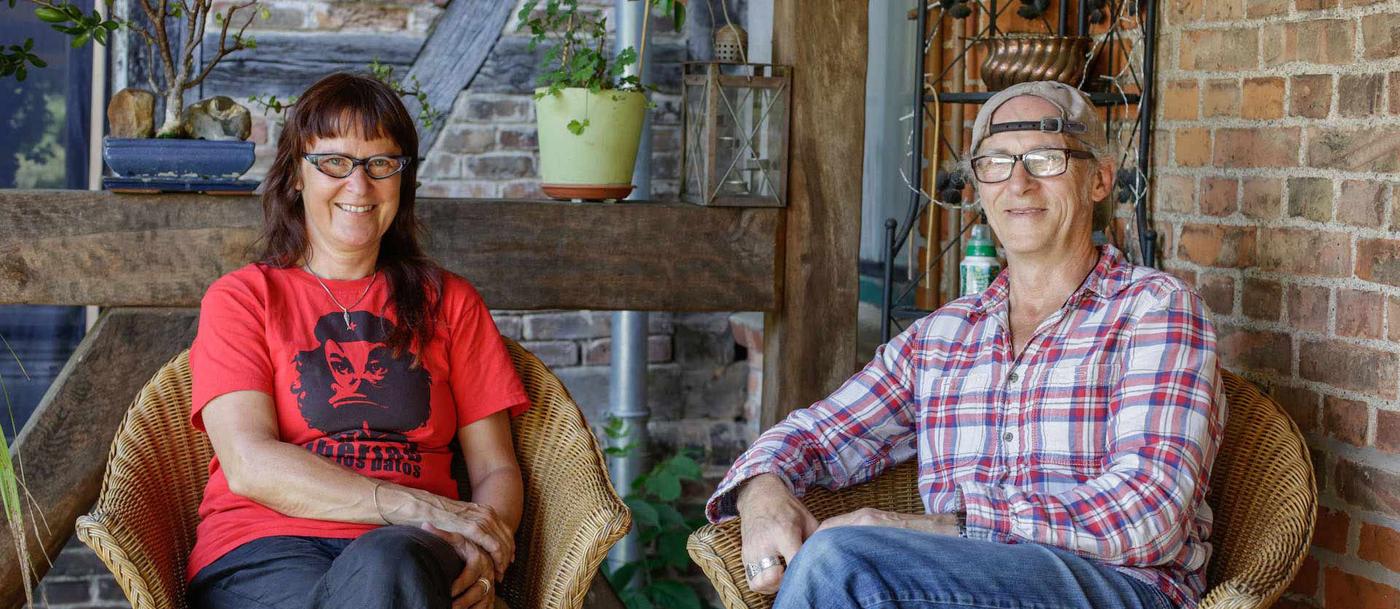
(Forsthof Jamel) In 2004, Birgit and Horst Lohmeyer moved from the big city of Hamburg to the small village of Jamel in Mecklenburg-Western Pomerania. They took over a listed forestry farm in an idyllic landscape by the Baltic Sea, fulfilling a lifelong dream. But within a very short time, the atmosphere in the village changed. Initially there was only one family with extreme right-wing views, but others soon followed suit. Around 90 to 95 per cent of the villagers now belong to the Nazi scene, including families with children. The atmosphere in the village became hostile towards the Lohmeyers, with threats, insults, theft and damage to property.
To counter this, Birgit and Horst Lohmeyer organised a rock festival in their garden in 2007 called „Jamel rockt den Förster“ (Jamel rocks the forester ), in the face of considerable resistance from their right-wing neighbours. In 2015, the Forsthof’s listed barn fell victim to an arson attack. But the Lohmeyers did not give up. With now prominent support, especially from the band Die Toten Hosen, the festival became bigger and more illustrious. It takes place every summer – still in the Lohmeyers‘ large garden.
The Lohmeyers have received many awards for their civil courage, including the Paul Spiegel Prize and the Georg Leber Prize for Civil Courage, as well as the „1Live Krone“ and the „Live Entertainment Award“, and they have been declared „Ambassadors of Tolerance“ and „Heroes of the North“ by the Alliance for Democracy and Tolerance.
When we arrive in the truly idyllic village after a drive of several hours, the village is decorated with colourful flags and appears friendly at first glance. Despite the beautiful weather, there are no people to be seen, but dogs are barking rather unfriendly in every yard. When asked about the colourful flags, Birgit Lohmeyer says laconically „yes, the Nazis celebrated the summer solstice last week“. The small village itself is easy to see: A few houses, some decorated with Reich war flags, a signpost to Braunau to the birthplace of Adolf Hitler, a mural with a typical Aryan family, an information box with pictures of the last NPD demo and a picture of Ursula Haverbeck as well as the newly designed village coat of arms.
The interview took place on the veranda of the beautiful old Forsthof. We thank Birgit and Horst for the interview and the clear words.
(Jamel, Forsthof) DC: First of all, thank you very much, Birgit and Horst Lohmeyer, for the interview today for the Fritz Bauer Library. Birgit, you were born in Central America in the Republic of Panama. That surprised me during my research. Did you grow up there too or how did you come to Germany?
BL: (laughs) No, not at all. I am relatively creative in my life. That is, also in the details of my biography. As an author, I know how little the written word is actually worth, so it’s all pure fantasy and invention. Which publishers didn’t always find funny. It was once called Reykjavik, then it was a place in Mali.
HL: (laughs) Bamako, exactly. We had a lot of fun with it.
DC: (laughs) And we fell straight for it.
BL: So don’t believe everything that’s printed in black and white or whatever. (laughs)
DC: (laughs) But you studied in Hamburg? That’s right?
BL: That’s right, yes.
DC: What did you do after your studies? How did you end up working as a freelance author and writer?
BL : There’s a long way to go here. I studied educational science with a focus on extracurricular youth and adult education, then specialised in criminology, which I studied part-time. I very quickly specialised in working with addicts and practised this profession for a good decade. Then I realised that it wasn’t a job I wanted to do until retirement age and thought about what else I could do. It’s just writing, fictional writing, which I’ve basically been practising more or less since I was a child. My husband reassured me: „You can do that. Why don’t you do more with it?“ So I took the unfinished novel out of the drawer, completed it and offered it to him. And I had the incredible good fortune – something that happens to very few authors – that one of the first three publishers I sent the manuscript to immediately accepted it and I was published.
DC: I’ve read that you’ve also had experience with prisons and worked in the red-light district – or is that also fiction?
BL: Well, you have to differentiate. I worked in prisons simply because my clients were always „guests“ (laughs) in prisons. I actually started doing what we called prison work on a voluntary basis while I was still at university. We ran leisure groups in the youth prison. We both ended up living in Hamburg Sankt Pauli for fifteen or twenty years. We had close daily contact with the red-light district.
HL : Well, more creative, I would say. I was very active artistically on the Mile. So we weren’t somehow, I don’t know, so deeply involved. (laughs)
DC: You’re a freelance artist, Horst. What do you do?
HL : I’ve done everything, painted, built furniture, made music. I’ve been able to be very creative in my life. I still do that today.
DC: And then in 2004 you both left Hamburg, the Reeperbahn, and started a little programme of contrasts. You moved to this beautiful, idyllic area in Jamel – why Jamel?
BL: We were looking for property from Hamburg and went on short trips to the surrounding area to look at properties we had found for sale on the internet. At some point, we found this historic forester’s lodge with this beautiful large plot of land. This was basically our lifelong dream of how we wanted to live when we moved away from the big city – hence Jamel.
DC: That was a break, wasn’t it? Between the big city and the village with forty inhabitants?
HL : We were always drawn to the countryside, whether it was on holiday or at the weekend, that was always our great desire. I come from the big city, but I’ve also lived in the countryside before and knew how to enjoy it. We agreed relatively quickly. At some point you get tired of the big city, everything goes round in circles, it gets boring. It’s a long process, of course, and you don’t just think it over at the weekend. As I said, we realised our wish to find exactly what we were looking for here in Jamel.
DC: Did you already know about the neighbours‘ attitude?
HL : There was only one here on site. We didn’t take the decision lightly. At some point we said: „Okay, we dare to do this. We were also confronted with a really difficult neighbourhood under other conditions, especially in Hamburg, in such close quarters. Then we can deal with that too.“ We simply dared to do it. We had no idea that it would develop like this over the years. It went relatively quickly, with building activities already becoming apparent here in 2005. At the time, we had a caravan resident on our property who was verbally attacked, which were the first signs: there are new people here in the village, with ten houses it’s very manageable, nobody gets lost here. It’s noticeable when there’s more going on here than usual, and so everything took its course – until 2007.
BL: Exactly, we didn’t move here, as is often wrongly assumed, and all the other Nazis were already here. It was actually just Mr Krüger plus his mother and sister who lived here. As Horst said, we simply didn’t think we could cope in any way with these people living at the other end of the village.
DC: And what is the situation now? How is the relationship?
BL: I’d say 95 per cent of the residents are now members of the Nazi scene, including their children. Entire families from Mr Krüger’s circle have moved here. Apart from our house, there are two other houses where people live who are not explicitly members of this Nazi group.
HL : At the beginning, when we moved here, we had extensive contact with our immediate neighbours. We had to get used to that first, as we came from the anonymity of the big city. But we realised from the outset that village life works differently to the big city. From one day to the next, it all came to a complete halt. There was no more „good morning“, no more „hello“. That was a very drastic experience, how things like that work, how things like that function. (…) It was also an experience that has been a recurring theme here in this region ever since. You can put it quite simply: „You either love us or you hate us.“ There are these two worlds, and people hate us more than they love us (laughs), I sometimes get the feeling.
BL: Definitely. We have fewer supporters than people who look at us shyly, who slander us, who circulate things that aren’t true. Even to the point of: The neighbour says we set fire to our barn ourselves. We are confronted with such things very, very often. The people who stand by us, who also exist here, are in the minority in terms of numbers.
DC: Are there people here in Jamel who stick by you? Or do you mean the people in the municipality of Gägelow?
BL: No, the region. I’m not talking about communities, we’re talking about the region.
DC: What’s it like to live in such a small village, forty souls, and you can’t just walk over to anyone, have a coffee, chat, have a chat at the fence?
BL: I’m super happy that it’s like that. Imagine, I’m a city dweller. I don’t want to have so many neighbourhood contacts. I’d rather choose my friends and acquaintances myself and not live in such a makeshift community. In that respect, I always say, it’s worked out, as ex-city dwellers we’re just the right people in this village, who aren’t at all keen on having such incredibly close neighbourhood contacts. That’s what allows us to put up with the situation here.
DC: But when you walk through the village, it’s like entering enemy territory, isn’t it?
HL : We no longer walk through the village. Of course we are approached, people notice us, the children wave. But the verbal encouragement is not always positive.
BL: (laughing) Oh, that’s a sweet way of putting it. Small scene: Shopping yesterday in the supermarket in the next small town. Mr Krüger and his son are also shopping there, see me and shout loudly through the shop: „It stinks in here.“ (laughs) That’s the kind of neighbourhood contact we’re happy to do without, of course. (laughs)
DC: How old is your son?
HL : Fifteen, sixteen.
BL: No, he’s probably seventeen already. He’s definitely already out of school. And I don’t know what he’s doing, whether he’s doing an apprenticeship or something, I don’t know (…) He’s learning to be a Nazi. (laughs)
DC: I’ve heard that he’s also been busy at demonstrations.
HL: Yes.
BL: Yes, of course.
DC: Five per cent of the people who live here are still „normal“ people in inverted commas, i.e. not Nazis. Do they keep quiet or do they have a friendly relationship with the Nazis?
BL : They try to avoid confrontation, let’s put it mildly.
DC: They duck away.
BL : They duck away, yes.
DC : That was out of the question for you?
BL : Absolutely not.
DC: Why not?
BL: Why should it? I mean, we’ve lived in this country since we were born and have learnt to appreciate the free, open society that we have. If people then come along who think that just because they have a different political opinion they can oppress us, commit criminal offences against us, I think it would be a strange way of saying: „Oh well, we were wrong, we’ll move somewhere else.“ (laughs) So that’s out of the question. Then we would not only have given up our country, our home, but also ourselves, our attitude.
DC: The Forsthof here is beautiful, very old and also a listed building. The barn that stood in front of the house was also a listed building, but I read that it burned down in 2015 and the public prosecutor’s office investigated arson. Did you have any help putting out the fire the night it burned?
HL : Yes, the fire brigade helped us so that our home wasn’t also affected. The barn burned to the ground in a very short time. We still had a holiday flat at the time, which was also occupied at the time, a family with three small children (lived there). That was a very dramatic experience. You realise they’re already coming to the farm and setting fire to it. What’s going to happen next? You had to make a decision and say. „OK, we’re going to get our suitcase with the important papers. Get it out, it could be that the house is also affected.“ And then to advise the holidaymakers to get their valuables out of the house. That’s an experience I wouldn’t begrudge anyone. You’re upset and in shock and simply can’t do anything when such a huge building burns down, you can only keep a distance of twenty, thirty, forty, fifty metres. That’s an enormous amount of heat that’s generated.
DC: And sympathy from the neighbourhood?
BL: Of course not.
HL : Yes, insurance fraud, setting fire to it myself and, and, and, all that sort of thing. (…)
BL : The local newspaper said that they had „allegedly“ seen someone running away. The local press always agitates against the Lohmeyers rather than writing in our favour or in the spirit of democracy. Let me put it this way: „To protect our boys from here.“ Mr Krüger was born here, which means he is a local. In this respect, he enjoys the protection and leniency of many, many locals who are not necessarily right-wing extremists themselves, but who know him and know that he is such a helpful boy …
HL : Why do the Lohmeyers always have to cause so much trouble? (BL: (laughs)) They can be quiet for once, what’s the point?
DC: You’re the newcomers from the city.
BL: And especially from the West. And that makes it even worse: Hostile takeover!
DC: And what other repression or attacks did you experience?
HL : Oh, we’ve had obstruction in traffic, theft, damage to property…
BL: …insults, death threats, blackmail, so basically I always say that we have the whole penal code more or less defined – as victims.
DC: Car tyres?
HL : Yes, yes, yes, of course. A dead rat in the letterbox is always nice, too. (laughs)Seen too many mafia films.
DC: How do you put up with that?
HL : With a healthy dose of sarcasm, let’s put it that way, to be able to laugh at everything and yourself. Of course, it’s also repression, let’s not kid ourselves. Sometimes there are days when you wish you could go back to your old life. That’s completely normal and madness, but there are also days when it’s really great to be here. It’s a beautiful property next to the forest, quiet, pure nature. That’s what we’ve always wanted, and we remind ourselves from time to time that there’s something nice about it.
BL: It also gives us strength, especially this old forester’s lodge, which is an energising place that gives us the strength to endure the adversities that come from outside.
DC: You always ask yourself: where do you get the strength to stay here and not just sell up and move somewhere else?
HL : Well, I mean, you don’t just buy a house and then say: „Oh, it was actually bullshit here, come on, let’s sell it again. We’ll buy a new one.“ Unfortunately, it doesn’t work like that.
BL: We could only sell this property to Nazis, if at all, and we don’t do business with Nazis in any way, be it property or otherwise. In this respect, the property is not for sale. We don’t have the small change in our petty cash to buy a new house somewhere else. In this respect, we are bound and feel bound to preserve this old building and not let the listed property fall into the wrong hands.
DC: When you read in the press about death lists being drawn up by various Nazi organisations, NSU has the 10,000 list, Nordkreuz has death lists…, does that scare you? Does that scare you?
BL: No more than we already were. Of course we realise that we are certainly on at least one list. We’ve known for a long time how violent the right-wing terrorists in our country are, what calibres we’re dealing with here in our region. We shouldn’t fool ourselves, act all shocked and say: „Ah, we didn’t know all that, how explosive it is and how violent the scene is.“ You won’t hear that from us. We’ve known for a very, very long time how much danger we’re all in, not just us activists, but the population as a whole.
DC: And the idea for the music festival, how did that come about?
BL : To put it bluntly: Horst is a musician, we are both cultural workers and we had the idea for this village. It shouldn’t remain or be or become a pure Nazi village, but we want to confront the public with what is happening here. This deliberate influx of Nazi families to create a model Nazi village, as we always say, should not go unnoticed. This means that we started to organise cultural events here on the farm, art exhibitions, garden exhibitions and then the first music festival in 2007 to give people the opportunity to see the village without any danger. To talk to us about why we stay here, why we become active. That worked, only the art exhibition and the garden exhibition became a bit too much for us after a few years because the festival became bigger and more elaborate. Ultimately, we now plan the festival all year round, which takes place on a weekend in August. In this respect, we’ve cut back on everything else and now only do political education work in school classes, in associations and so on, where we appear as speakers. That’s one of our mainstays. And the second is the big festival that takes place once a year.
DC: That takes place in your garden because you have such a nice big garden?
HL : It’s predestined for it, yes.
DC : Not everyone does that either, letting strangers into their garden!
BL: That’s probably true, but I don’t think we deserve to have such a large, beautiful area just for ourselves, so we’re happy to share it.
DC: The festival has been taking place since 2007. The list of artists performing is getting more and more illustrious: Tote Hosen, Ärzte, Fettes Brot, Kraftclub, all well-known names. Do you have to search for a long time or do the artists get in touch with you in the meantime?
BL: The story goes like this: in 2015, our big barn fell victim to arson and the news even made it onto ARD’s TAGESSCHAU programme. As a result, Campino, the singer of Die Toten Hosen, became aware of us and the village. The band spontaneously offered us a benefit performance at the festival – the arson happened a week and a half before our festival at the time. Of course, we were very, very happy to accept, and the band said: „But we’d like to do a little more long-term support for you Lohmeyers“, and offered to put a few professionals from their agency at our side. This gave us the benefit of having contacts to the big stars and bands. This co-operation, this support, is still happening, it doesn’t have an end date. (…). But now it also happens that people, such as Herbert Grönemeyer last year, get in touch with us independently and say: „We would love to perform with you.“ Our small stage – which isn’t so small after all – has become so popular that other musicians are also realising: The festival is very much in the public eye and what is said and done here from the stage ultimately takes place all over Germany.
HL : It’s a forum to position ourselves clearly and objectively. We have very professional help, it has to be said. This festival is run by professionals, with us as the driving force…
BL: …as semi-professionals too, of course.
HL : That’s really great.
DC: How did your neighbours react to the festival?
BL: It was extremely negative right from the start. Even when the festival was still very small, with a hundred visitors and six bands that probably nobody knew, it looked like the Nazis were putting up hand-painted posters in the village: „Jamel shits on the forester“. That was a quote.
HL: „Piss off“… The posters were then put up out of turn, the whole village was covered with NPD posters to welcome our visitors. We were accused in the relevant right-wing media of embezzling public funds and that none of this would help. Then photos were published, they had sneaked onto the site and taken photos of deserted corners.
BL: And it’s also nice that you always like to have T-shirts printed with slogans. There was the slogan „Here we rock“ in Gothic script, worn throughout the village during the festival so that our visitors could recognise it. These are the reactions.
DC: I heard from Mr Krüger, the leader of the neo-Nazis in the village, that he said in an interview that he actually quite likes the Toten Hosen. Was he trying to say to the press: „Oh, I have nothing against the festival, I actually think it’s quite cool.“ ?
HL : Yes, of course. You try to adapt a bit to a trend, not to put too much emphasis on this festival. That would be counterproductive, you’d have to go in advance, so to speak, if he didn’t think it was great or good or whatever, so strategy. Our silent hope is to make the children and young people think about why their stars are on stage here at Lohmeyer’s and why they are not allowed to go there. Whether there might be something wrong with what their parents are telling them.
HL : It sows doubt to say: „It’s great what they’re doing there.“ For those who are not yet so infiltrated. It’s a novelty, a festival like this in the name and sight of hard-core Nazis. These are fundamentalists who really believe in their cause. And then the reaction of the children, we’ve often seen children playing somewhere on the street when we’ve driven past them and they’ve turned away from us very quickly or they’ve been urged by the older ones not to make eye contact with us.
BL: Their eyes were even covered.
HL : Yes, their eyes were covered. I mean, that kind of thing is perverse. Imagine what they do to the children.
BL: It’s very bizarre.
DC: Were festival visitors threatened?
HL : In 2010 we had an attack by the right-wingers, two of them snuck onto the festival site and beat a visitor until he was hospitalised. That was a dramatic experience. At that time, there was no extensive police care like we experience today. After a conversation in Wismar, we were advised to talk to Krüger and everything would be OK again. We were very shocked at how laissez-faire the security authorities dealt with it. That has improved, we now have very good co-operation with the police, they are doing a good job and we are happy about that.
BL: That’s a realisation, a learning effect that we’ve had during the years we’ve lived here: that it always depends on who the police leader is. If it’s someone who is aware of the danger posed by right-wing terrorists and right-wing extremists, this is also reflected in the actions of the police. This has been the case for several years. The leadership has already changed once in the last four or five years, but the successor is also a very vigilant person and endeavours to achieve something in Jamel in terms of policing.
DC: The patron of the festival is now Manuela Schwesig, Minister President of Mecklenburg-Vorpommern. Does that help in any way, does that benefit you?
BL: That’s a question that can’t be answered that easily. Of course, it’s great that Manu is there for us as a patron, that she’s happy to support us. She is here at the festival for at least one day at a time and shows our visitors and artists how much the state politicians and basically also the federal politicians – she has already become a patron as a federal minister – appreciate this festival. The flipside is that this is in no way reflected in the actions of the regional and municipal administration. In other words, the lower you go in the hierarchy, i.e. the smaller the mayor, the head of the public order office or even the district employees: they don’t see why they should do anything special for this festival just because Manuela Schwesig is the patron.
DC: Do you also get obstacles from this side?
HL : Things are not exactly made easy for us. When I think about the festival’s reputation and how many awards we’ve already won, there are more questions than answers. Sometimes it’s not easy, because everything is reduced to formalities: a festival licence, a festival schedule and so on. The impact that this has on the region is not recognised. People keep a very low profile or remain neutral in expressing their opinions towards us. These are things that have developed over the years. As the size of the festival has grown, so has the rejection, or I won’t say rejection directly, but it is viewed over-critically. In my opinion, the proportionality is not right. The police are responsible for security, the authorities are responsible for authorisations, and there is certain content that can be discussed. But we don’t say: „Great thing, super. What you’re doing is great. What can we do for you?“ So they’re not beating down our doors. I imagined it would be a bit different and I’m disappointed. It’s also evident in politics, how the right-wingers are dealt with according to the motto: It’s all half as bad, let them have a bit of a whinge. Until here in the village: the municipality gave the central village meadow to a Nazi for an apple and an egg. The central village meadow is leased out for a handful of euros. What kind of sign is that? What kind of strategy is that? I don’t understand it. And it’s not just that, it’s official, but we have other things. We could go on for an hour about all the things that make us doubt that people really want to do something about the right-wingers.
DC: Okay. Would you like more support from the official side?
HL : Yes, definitely, definitely. I miss a lot of things. We’re not here to make peace, joy, pancakes and a little something against the Nazis with a small festival. We also criticise things that politicians do, for example the sale of a plot of land to a Nazi. That was criticised and communicated by us. Then there was an advert from the second mayor that posters were not allowed on the B105, which is the main road. As the second mayor, he was in contact with us a fortnight beforehand. I mean, if you drive past it, you can just drive to Jamel and tell us that you’re not allowed to do that. It’s all very disproportionate and we complained about it to his boss, who agreed with us. These are all basically small things where we say: „Guys, why don’t you talk to us? What’s going on? What’s the problem? Are we doing too much? Are we doing something wrong? Too much criticism? Can’t you take criticism? Can’t you live with it?“ Anyway, I don’t understand it sometimes.
DC: Can I ask you another question about your candidature? You ran for the district council in Northwest Mecklenburg for the SPD in May 2019, but lost the election to Mr Krüger. That’s not just Jamel.
BL: That’s not quite right.
DC: And why is that always in the press?
BL : I ran for two seats: one for the district council and one for the local council of our municipality as a whole, which includes Jamel. Mr Krüger stood for the municipality as a whole with his electoral list, not for the district council. These are two different levels.
DC: And you lost to Mr Krüger there?
BL: I wouldn’t call it that (laughs). In any case, I didn’t get enough votes to get a seat on the local council myself.
DC: Did Mr Krüger get the seat?
BL: Yes, Mr Krüger now has a seat there. This is the first time that an explicit right-wing extremist and convicted offender has become a member of our local council.
DC: And it wasn’t just the people from Jamel who voted for him.
BL: Since his list received over four hundred votes in total, you can explain it mathematically that it wasn’t just people from Jamel who voted for him (laughs). The region is already full of sympathisers.
DC: Do you still have the strength to carry on here after such an election?
HL : Now more than ever. (BL: Yes, of course.) It’s shocking, let’s put it that way, to realise that his list received over four hundred votes from just over 2,000 eligible voters and a voter turnout of 67 percent. There is still a lot to do.
BL: Yes, now these people have dropped their trousers by voting for Krüger and his list. That’s perhaps also quite nice, as it’s an important insight for us to know what the majority conditions are like here, what makes the community tick, how many sympathisers the right-wing extremists actually have here. If you can’t work in parliament, then you do it extra-parliamentarily, which has been our approach so far anyway. Which is sometimes also much easier (laughs), so the election result is bearable.
HL : We don’t care whether we have a public mandate or not, we open our mouths anyway.
DC: What are your plans for the future?
HL : After the festival is before the festival (laughing), it goes on and on. (BL: Exactly.) I haven’t got the feeling yet, and somehow I haven’t thought about the fact that it might be over at some point, and I haven’t set myself a fixed date.
DC: And in terms of local politics? Will it continue there too?
HL : That will continue, in any case.
BL: I won’t be leaving the party because I didn’t get a seat on the local council in the election – and not in the district council either, by the way. No, I will of course remain loyal to the SPD and try to keep raising the issue of right-wing radicalism, the danger from the right and right-wing populism. It’s not easy, because there is an insane resistance to the topic in the so-called bourgeois parties: „We don’t really want to have to deal with it. Everything is fine here.“ People would rather deal with other issues, which are not unimportant, but despite all that, I think I’m in favour of continuing to raise the issue of right-wing radicalism and right-wing terrorism in people’s minds wherever I appear, be it in the party or elsewhere.
DC: How can people continue to support you in this – for example?
HL : By repeatedly drawing attention to the major problem of right-wing radicalism. I mean, just recently a politician died, was shot dead. According to the Amadeu Antonio Foundation, over 180 people have been shot, beaten and burned to death in the last twenty years.
BL: By right-wing extremists! It’s good that the rooster is finally crowing about it. It was a very tragic event, but we are not surprised at all in this respect, we know the number of victims of right-wing violence. In this respect: keep at it, talk about it, don’t suppress it, that’s what it is. Everyone should do what they can in their own environment, it doesn’t always have to be a rock festival. Everyone can do something, take action against hatred, answer regulars‘ slogans in a smart, healthy, intelligent way.
DC: That’s a great final word. Are there anything else you would like to say? Is there anything that hasn’t been mentioned that is close to your heart?
BL: What is always very, very close to my heart is the appeal to all people working and travelling in the educational landscape: Please, please don’t forget political education. By that I mean recent German history. When we come to a grammar school and tenth-graders tell us: „No, so we haven’t had the Nazi era yet, the Holocaust, no, what is that?“, something is wrong.
HL : That’s an isolated case, but…
BL: But that actually happened to us, even if it’s just an isolated case. It was a grammar school in a rural area, but for me that in no way excuses anything. We are simply too oblivious to history in our country.
HL : Right-wing terrorism is the biggest challenge of the 21st century. If we don’t get to grips with it, everything will blow up in our faces at some point.
MF: I have one more question.
BL: Yes, of course.
MF: When your barn was burnt down, didn’t you think at some point: Okay, it’s really bad, the attacks from them are getting closer and closer and it’s real, so something could really happen. It could be that our house burns down at some point or something happens to us. Is it better to protect yourself and leave? Or was that really just encouragement?
HL : You develop an ambivalent attitude: on the one hand, the timing was just before the festival. You’re very busy with the one thing and the other, that someone is trying to prevent something. That means you concentrate on things. The thought of saying: „Now is the time to stop. The time to slowly pull down the tents here“ comes later. I’ve developed this kind of democratic defiance for myself and I think Birgit has too. We talked about it, discussed it and said: „What are we going to do here?“ We both realised, independently of each other, that we were no longer interested in material things. There are other things, I mean, if everything goes up in smoke, then you’re destitute, but you’re still alive. That’s the most important thing and not clinging to any material things. Being able to get rid of ballast is half the battle of being able to concentrate on the essentials. As I said, you don’t buy a house in order to sell it again within a very short space of time. We’re not in a financial position to do that, not to mention that. Democratic defiance means not letting a few idiots chase us out of here, that can’t be, then our world won’t be right. My God, 75 years after the „Third Reich“, after a lost world war, peace, freedom of expression, a pluralistic society, what more do we really want? What do the right-wingers want to tell us? That things could be better (laughs)? (BL: (laughs)) I mean, fascism, all dictatorships, have sooner or later perished or been confronted with strong opposition.
BL: Exactly, the idea of moving away was only there for a fraction of a second at most. On the contrary, even if we had become homeless in the night because our house had burned down, we would have put up a trailer and stayed. That’s just logical.
HL : Of course.
DC: Yes, great, thank you very much!
Listen now
Discover the podcast series of the Fritz Bauer Forum
Here, experts talk about justice, human rights and social change. They provide in-depth insights and develop diverse perspectives on current issues that affect our society.

