
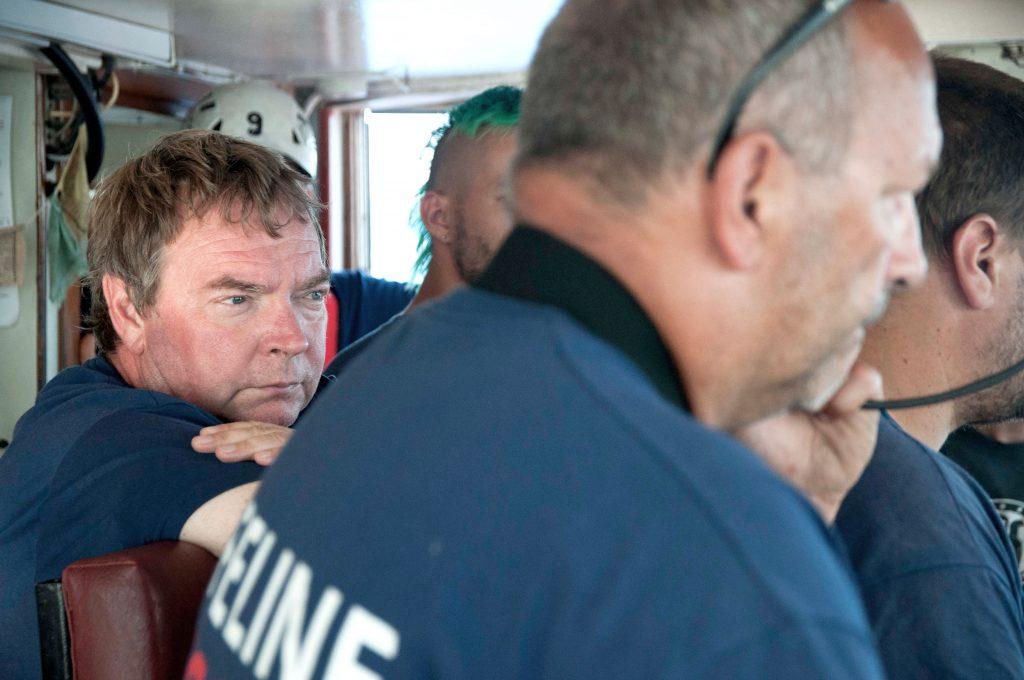
Autor/Autorin

CPR: Whether someone is fleeing because they are being politically persecuted or persecuted for religious reasons, or for other reasons, or ultimately also persecuted for economic reasons. It’s all about survival. And the reason for fleeing is ultimately irrelevant. It’s about survival. Everyone, including you and me, would of course pack their bags and get out of here. That’s quite clear.
It’s terrible when you see the unaccompanied minors, like the ones we had on the ship. Of the 235 people we had on the ship, 77 were unaccompanied minors. I found one case particularly blatant, a 12-year-old travelling with two 13-year-olds. I didn’t really believe it at first and then had it confirmed again. I was completely stunned.
CPR: We are a kind of emergency doctor. We are better equipped than an ambulance, we have six medical professionals on board. A doctor, four paramedics, an intensive care nurse and a tenth-year medical student. We are really well equipped. And we’re not actually designed to do this and would actually like to avoid taking people onto our ship and then taking them somewhere. Of course, we do this in an emergency if we are forced to, and we have now shown that we can do this, but we are actually a kind of first responder , we go there, we secure the people, we make sure that they don’t drown, and then we would actually like to get a ship from the European Navy or an Italian coastguard ship or a merchant ship to join us, which then ultimately picks up the people and takes them to a safe place. So that we can stay in the area of operation for as long as possible. If we have to leave with the people, then those who arrive the next day are on their own.
We are not primarily there to take people to a safe harbour. If we have to do that, then of course we do. But in principle, we are not a ferry. This is a 32-metre ship, 32 metres long, seven metres wide, but only seven metres wide at the widest point, the bow is pointed, as you know, and we were on this ship with 252 people.
Our crew manager, Hermione, manages our personnel pool, so to speak, if I may call it that, and from this pool we select the people for the individual positions for the mission based on their qualifications. You always have to find people who are available at the time the mission takes place. We try to have as many crew members as possible who already have a background from a mission. So they’ve travelled more than once. That is very, very important. We get a lot of applications, we can’t consider everyone who applies, we have to select according to qualifications. That’s just the way it is. What we are always looking for are people who are familiar with ship machinery, ship operation technicians, ship engineers, that’s a bit of a tricky point, there aren’t too many of them, it’s more of a shortage occupation, then the navigators and doctors are also a problem. There are also a lot of people who say: „I’ve driven an inflatable boat before, I could drive your inflatable boat.“ But driving an inflatable boat on the Ammersee or the Danube is completely different to driving a 120 hp rescue boat in two-metre swells. So we like to call on people who have done it before.
As we pay a lot of attention to safety, I’m almost a fetishist when it comes to it, I don’t have any expired fire extinguishers or anything like that, the rescue equipment always has to be kept up to date.
It must be clear to everyone from the outset that we are not travelling to a children’s birthday party, but on this mission, as on all the other missions I have been on so far, there have been no serious health issues. So as long as the Libyans don’t shoot and we don’t hit anything that’s floating in the water and we don’t see a container or anything like that, I don’t think it’s incredibly dangerous in principle. Contact with the Libyan authorities is a different matter, as they radioed us when we couldn’t even see them, i.e. only identified them on the radar: „Helper, helper, I kill you, I kill you!“. We were able to record this radio message from the Libyans, we record most of the conversations on the bridge, which really surprised us. The Libyans sometimes shoot at a German warship, they’ve already done that, at the „Mecklenburg Vorpommern“. Or on an Italian coastguard ship or even on the „Lifeline“. My ship has already been shot at off Libya. They always miss, thank God, but you just don’t know where it might actually end.
IW: So these are supposed to be warning shots, right?
CPR: Yes. In international waters, by the way. We don’t enter the twelve-mile zone, we don’t think that would be expedient unless we have European military cover. If we have to carry out a rescue operation within the twelve miles, on the instructions of the Maritime Rescue Centre in Rome, we would of course do so, but then only with military protection. I don’t want to mess with the Libyans.
As a matter of principle, the ship and therefore the captain are responsible for determining the fate of the ship at sea. We find the people in distress, the rubber dinghies and wooden boats partly through sightings triggered by search aircraft. There are three aeroplanes in total. One of them looks like a „Transall“, which we know, the German Armed Forces have them too. It flies out from Mallorca at night and then over the Tunisian border to the search area west of Tripoli and then back over the eastern side. They search specifically with thermal imaging cameras and binoculars. This is a maritime reconnaissance unit searching for boats in distress. That’s clear. That’s one thing.
Then there are privately financed search aircraft, such as the „Moonbird“, which is based in Malta and is currently not allowed to take off because it simply can’t get a take-off licence. As soon as they have personnel and money, they will also fly in these two SAR zones.
And then, of course, we are also out and about with our own sightings. During the day, there are always four to five people with binoculars in the lookout, searching the sea. We are much worse at this than the search aircraft. We can search ten square kilometres in an hour, an aircraft about a thousand. That’s a whole different ball game. We have our high-performance radar running at night and since we know in principle which towns the boats leave from, we can find out by asking the people we rescue: „Where did you set off from?“ Then they say: Sabratha, Zuwara, and so on. That way we know where the smugglers are currently operating. We then use the weather forecast, the wind direction and the current to work out where these boats are likely to be travelling. It’s all pure speculation and intuition. We then position ourselves at night at a point from which we set off for our search areas. We scan this area with the radar, and if we’re lucky and the sea is flat, then we have a chance of finding these boats with our radar equipment. Just like we found three boats that night when we took these 235 people on board. We lost one of them due to the Libyan operation, which ultimately stopped us in international waters. They were also on board with us and wanted the people back. During this story, the radar equipment on the bridge was monitored closely, but at some point this third inflatable boat disappeared from the radar, so to speak. We later heard that it had been found by Libyans – not by those who were on the boat with us, but by others – and unfortunately five lives were lost in this rescue. Five people did not survive this so-called rescue. That doesn’t happen here.
They had three targets on the radar during the night and then systematically approached the first target and realised that it was a rubber dinghy with around 120 people, you can roughly estimate how many people were in it from the size of the rubber dinghy. The inflatable boat made a very, very unstable impression, and once we had evacuated it, we realised why. This inflatable boat had a cheap floor construction that we had never seen before. You can imagine it like a half-inflated air mattress that moves very slightly in the waves on a bathing lake. And this air mattress has movements of its own. But now there are 120 people sitting in it, and we had the impression that this inflatable boat was on the verge of something happening and falling apart, so to speak. You can’t imagine these rubber dinghies like the dinghies we know from Central Europe. These inflatable boats are a better lorry tarpaulin. They are not built to ever get anywhere. This is a qualitative disaster and these inflatable boats also fail from one moment to the next. We experience a lot of instantaneous failure, a badly glued seam tears open and these inflatable boats have no safety whatsoever. My own inflatable boat, on my own sailing boat, is 2.70 metres long and has five compartments. These inflatable boats are twelve metres long and also have five compartments. You can imagine the rest. If one chamber fails, the inflatable boat and its people are lost.
Given the impression of how this inflatable boat was behaving, we then decided to take the people in immediately, destroy this inflatable boat, spray SAR „search and rescue“ on it, the case number that we receive from the Maritime Rescue Coordination Centre in Rome, and the name „Lifeline“, our ship’s name and the date. And then we slit open this inflatable boat, starting at the back and going forwards to the bow and back again on the other side, and then it takes about two days for this inflatable boat to sink. And then it’s gone for the time being.
IW: So why did you write that on it?
CPR: So that if another rescue ship finds this rubber dinghy within these two days, they don’t start searching. If we find a rubber dinghy, and we often do, that is not marked, we immediately start looking for people. Maybe someone is still swimming there. There are enough capsized rubber dinghies whose death toll never appears in any statistics. That is also the lie behind these statistics.
IW: To bring them back? To Libya?
CPR: Yes, I mean the Libyan captain wanted to go outside the territorial waters, when he was on board with us, that was 32 miles off the coast, he wanted to take the people with him, I then averted that. But in principle, we still have to do something, if there was an emergency control centre in Libya – we say there isn’t one, you can call three telephone numbers, but unfortunately no one ever picks up, if you send an email, you don’t get an answer either – so you can’t talk to these people. For me, that still means: Rome is in charge. That was the case at the time. It’s like a cat chasing its own tail. I write to Rome, Rome tells me to deal with the Libyans, I get no reply from Libya. Then, of course, I also have the German Foreign Ministry, the Crisis Response Centre, on my mailing list, as well as the RCC, the Rescue Coordination Centre in Malta. But then you don’t get a reply.
Yes, of course a ship like that has finite resources and you have to think about how long it will last. Due to the weather conditions, we simply set off in a northerly direction. Where else could we go? I mean, I can’t take them back to Libya, it’s just not possible for humanitarian reasons.
IW: You can’t imagine that there are other ships, container ships, nearby that you can radio and ask, „Help us, we have to continue our mission here!“ You can’t do that?
CPR: I could do that, of course, but nobody will take these people off my hands. Because, of course, their journey is interrupted. It’s my rescue case, not his. He has no instructions from MRCC Rome to take the people, otherwise he would have to do it, and nobody will do it purely as a favour, because the moment he has the people on the ship, he has the problem and I am rid of it.
That worked quite well in principle last year and in 2016. We were then sent a ship from Rome. The Maritime Rescue Centre instructed one of the nearest merchant ships or military vessels to take our people on board. And in return they were instructed to use a port of safety , a harbour, Lampedusa for example, you know Catania, and that’s where they took the guests. This has been stopped completely because Salvini no longer wants this, and the other European governments always take a very, very long time to make any decisions, in our case from 21 to 27 June inclusive. So that’s a very long time. We were very lucky with the weather. But a ship will not voluntarily take on people who are no longer in distress at sea – and if they are on board with us, then they are no longer in distress at sea. That’s not even the plan.
There are various maritime laws, for example Solas, Safety of Life at Sea , and it states quite precisely that every ship is legally obliged to rescue. They can’t just sail past and say: „Oh, I didn’t see that,“ or whatever.
I wouldn’t want to be in the captain’s shoes if, on the one hand, it was discovered that he had knowingly sailed past a distressed vessel, and on the other hand, there is always a judgement call. As in every profession, there are certainly unscrupulous people and there are people who, let me just say, think normally.
I mean, every sailor knows what it means to be alone at sea, to have an accident, to need help, and you can’t just pull over to the side of the road, take a breather and walk home. Unfortunately, walking across the water doesn’t work. Instead, people simply go under and drown. And that’s why, in such a case, assistance is simply unconditional, absolutely necessary and must be provided.
IW: And whose conscience wasn’t pricked during your mission? After you had the people on board in June, it seems that your conscience didn’t clear at various points.
CPR: On the one hand, Mr Salvini’s conscience wasn’t pricked in Rome. He claimed that we were transporting human flesh. A statement that I thought would have been a thing of the past about seventy years ago, statements like that. And then there was the German Minister of the Interior, who successfully prevented various federal states from wanting to take the people we had on the ship.
IW: There were promises?
CPR: There were promises. The only thing missing was the signature of the German Minister of the Interior, Mr Seehofer, and he refused to sign. So Mr Seehofer is primarily to blame for the fact that we had to spend an additional five days at sea. And the last day and the last night in particular were not much fun for the people on the ship. We had really bad weather conditions and we had over 150 seriously seasick people on the ship. Three of them were hospitalised and fell into comatose states. Ultimately, seasickness doesn’t cause food intake, people stop drinking and then they fall into a kind of hypoglycaemic coma, and if you don’t get it under control in time, they don’t wake up from this hypoglycaemic coma. As my doctor explained to me.
Necessity knows no bounds, they say. Of course there would have been a way, actually there are two ways, to finally sail into a harbour, even against the will of a government if necessary. One is to sue my way in, you can sue your way into a harbour under maritime law, I don’t know how long it takes, I’ve never been through this procedure. And the other thing is that I press the so-called red button, which means I make my own ship a maritime emergency. Of course, I have to justify that somewhere. I’m running out of water, I’ve run out of supplies, I have a technical problem, or because of the many cases of illness. Of course, I have the option of having individual people rescued, as we did with a young Somali man who had been badly abused, he had a hernia and his intestine was trapped in the hernia. We had to get him to hospital quickly, otherwise the man wouldn’t have survived. But of course I can’t have fifty or a hundred people brought in at once, that would of course exceed the capabilities of the rescuers, who would then end up rescuing me or rather rescuing the people. So I trigger a mayday call , a mayday case so to speak. And then something will happen very quickly.
The problem with the story is simply that we sailed up and down the Maltese coast in a targeted and tactically correct manner. They always wanted us to sail into the Italian sector, but I would never have done that, then I would have had to deal with Mr Salvini and I definitely didn’t want that. And so I put a lot of pressure on the Maltese government, on Mr Muscat, and he in turn put pressure on his European presidential colleagues. As a result, various countries, including Portugal, Ireland and France, agreed to accept a contingent of our guests.
If I trigger a Mayday case, then it is a Mayday case that only affects Malta. This means that Mr Muskat, the President, has the 235 refugees in the country and his European colleagues sit back and say: „Thank God the captain pressed the red button. I’m off the hook.“ But Mr Muskat falls on his feet. Now it’s not just Mr Muskat who is affected, but also the refugees. Under the Dublin Agreement, they have no chance of ever leaving Malta again. That’s it then. Malta is small, Malta is overpopulated. The island is not very big, it’s maybe twenty by fifty kilometres, if that, and almost half a million people live on it. It’s completely overpopulated. You can’t expect the country to do that, in fact you can’t expect it to do that, and it would have a big problem. And the refugees would be an even bigger problem. But because the pressure on the European countries has been maintained in this way, 30 people have come to Portugal, about 50 to France, 30 to Ireland, I don’t know the rest at the moment. This is much better for everyone involved and especially for the refugees.
Yes, in our case it was the case that we were guided with our ship „Lifeline“ to a cordoned-off part of the harbour. Everything was already prepared there, not just the large grandstand for the press, but also tents from the Red Cross, there were ambulances there, there were buses there to transport the people, there were lots of medical staff there, there was a wonderful, perfectly organised handover of the sick and injured.
IW: And then the police came to pick you up?
CPR: And then the police came and picked me up, yes, exactly. Yes, that was indeed the case. Everyone was always very friendly. Me too, of course. But you can read about how it ended in the press now.
Most of the people were then taken to what I’ll call a reception centre near the harbour. I visited there two days later, I wasn’t allowed in, I wasn’t really allowed to visit the people. But there’s a little stream in between, I was on one side of the stream and on the other side of the stream behind a wall and a fence were the refugees, and they recognised who was on the other side and shouted „Lifeline, Lifeline“ and „Captain, Captain“. That was a very moving scene that I won’t forget in a hurry.
It’s good to see that everyone was doing quite well, at least physically. We had a lot of miserable figures on the ship, men with a height of 1.70, 1.75 and a body weight of 45 kilograms. It was very reminiscent of the conditions during the liberation of concentration camps. If you paid attention in history lessons and saw one or two films about it, you saw people like that. It’s not really any different, at least in terms of the physical conditions. The people in Libya come from a kind of concentration camp. They are treated accordingly. It was thought that something like this would never happen again, but here, too, various people have unfortunately learnt nothing from history.
There are people who can speak French and English. If we have the time to talk to people, we do so. Of course, we would like to know where they come from and what they have experienced. We interviewed the Somali man we had to take off the ship because of his serious medical problem two days earlier. The man was tortured three times, each time with the phone to his ear, he was beaten up, you could see that in the man’s face, you could see the badly healed wounds, and then he told us, sometimes in tears, how he was there, how they beat him up, with the phone to his ear, that he simply called home and begged his relatives, his acquaintances to collect money and transfer it to some account with Western Union or some transfer method so that they wouldn’t kill him. The man was one of those who only weighed 45 kilograms. Our doctor, an experienced heart surgeon, was very shocked, so every second or third word he had in his mouth was: „complete malnutrition“. And what the people from these camps say… Some of them are tied to the floor, the phone to their ear, and then a burning liquid is poured over their backs. These are torture methods that are so barbaric, you can’t really imagine them. When you see the people and see the injuries, you believe them. There are men who can no longer hold a water bottle. They have two wrists that have grown together crookedly. At first you think, I’ve seen that on TV before, it looks like thalidomide. How did that happen? Their hands are tied together with cable ties and if they don’t get off the lorry quickly enough, they get kicked from behind. Then they fly off the lorry and everyone tries not to fall on their face, but moves their hands forwards. Then they fall on their tied hands and break both wrists. But as there is no medical care, it just grows together as it grows together. That’s something we see more often, for example. In addition to the various injuries caused by the beatings with cut electrical cables, which leave them severely injured on their backs and these wounds then heal somehow, more badly than well. I can’t give a first-hand account of the things the women say, as they tend to talk to our nurse. I also know a few stories that you can hardly reproduce. I don’t want to know what the women went through in these camps in particular.
Politicians are currently managing to successfully draw a curtain over this drama. We are not allowed to sail with our ships and the aeroplanes, the private planes that could document this, are simply not allowed to fly. So the curtain is being drawn on this drama and the world public no longer has any insight. And this is how they are trying to get the events out of the press.
It is claimed that our certification papers, our vehicle licence so to speak, if I may translate it that way, our vehicle licence is not valid. Our ship is registered in Holland, and of course everyone will be asking themselves why a Dresden aid organisation, which mainly sails with Germans on the ship, is registered in Holland? It’s quite simple: if you want to register a pleasure craft in Germany, and we are registered as a pleasure craft, then you can only do so up to a length of 25 metres and a weight of 100 tonnes. „Lifeline“ is 32 metres and has a net weight of 231 tonnes, so that’s not possible in Germany. We would have to sail as a commercial vessel, and running this ship as a commercial vessel costs three times as much as a so-called „pleasure craft“. As there are simply different regulations in Holland that we fit into with our ship and what we do, it is simply registered in Holland. That’s the whole reason for it.
Now they claim that this certificate, this international certificate from the Royal Dutch Watersports Federation, does not authorise us to fly the Dutch flag. But this certificate clearly states „Flag Dutch“, „Homeport Amsterdam“, home harbour Amsterdam.
I still maintain that this certificate is valid, this certificate must be valid, because it is not forged, as the authorities have now had to admit. This certificate is an original. Over 25,000 boats and ships worldwide are travelling with such a certificate. And this certificate from the Royal Dutch Watersports Association has also been used by all NGOs sailing from Malta or elsewhere since 2015.
I’ve sailed on three different ships, on six missions, and I had exactly the same papers each time. And it’s not as if we never have to present our papers. We have to present our papers at least three times on every mission. Once when we leave, once when we refuel, if we want to buy duty-free fuel, we have to present the papers, and also when we come back from a mission, we have to present the papers. And now, after three years, they suddenly come up with the idea that this certificate should not apply to our ship of all ships. „It’s not valid.“ It’s not valid.
How can a certificate that has not expired, that is valid until 19 September 2019, that is always valid for two years, that says „Homeport Amsterdam“ and „Flag Dutch“ and that is not forged, how can it be invalid?
It’s ultimately a delaying tactic, they want to prevent the search and rescue ships from leaving the harbour, and now they simply want to make an example of me as the captain, who is ultimately responsible for everything that happens on the ship.
Of course, this situation will make some people think twice about whether they want to take on the responsibility of captaining such a ship. It should, I suppose, also have a certain deterrent effect. That can be a good thing, yes.
So a maximum of twelve months in prison, and or a fine of 11,600 euros. I’ll see what comes of it.
IW: A trial has already taken place, hasn’t it?
CPR: Yes, several hearings have already taken place, the last one was particularly interesting because the Maltese prosecution authorities were supposed to present the evidence, but were unable to present this evidence because the Dutch side they questioned simply did not provide any answers. Allegedly because of a formal error in the enquiry. So not in the questions, but in the form in which they submitted these questions to the Dutch authorities.
In my view, this is a kind of delaying tactic. I mean, they can now postpone this trial against me until the day after tomorrow with some kind of trick, I’ll call it that now.
And we can’t leave the berth where we’re moored for that long. However, we always have to have a crew on the ship because you can’t just put this ship in the garage like a bicycle and say I’ll see you again in the spring. That doesn’t work with a ship like this. A ship like this is a huge machine, we have our own power generation, because we don’t have a shore power connection at this berth, which means that one of our three generators is always running, we have to keep the fridges running, we need light, the pumps have to run, and to guarantee that, we always need three people on fire watch on the ship at all times, and so that they can also go down from time to time, of course more staff so that three people aren’t tied to the ship. So we have six to eight people on the ship at all times.
Mission Lifeline spent a year and a half raising funds to be able to buy this ship in the first place. And then you also have to know that mission six, which we are all talking about now, my mission, was not mission six this year, but one to five could not take place because we simply didn’t have the money. We had the money to maintain this ship, to pay the insurance, to pay for the winter shipyard, the maintenance, but we had no money to go on a mission. We would have simply needed an extra 20,000 euros for each mission. We have to fill up with 17,000 litres of fuel, we have to buy 4,000 euros worth of food and activate the satellite system, which costs 2,000 euros per mission. So these costs add up, and we didn’t have the money for the mission itself.
We would have travelled the five missions beforehand, we had the crews, but we didn’t have the money.
So the time we are at sea is usually two weeks. The crews arrive three days before and leave three days after. There has to be a handover from one crew to the other crew, not everyone does two missions in a row, as I usually do. So there is an exchange within the personnel, so to speak, and it is of course good if you can hand over the individual stations directly from one to the other.
The ship is getting better day by day, so to speak. Yes, the people who are on the ship now naturally have a lot of time on their hands because we don’t have the ship in operation, not sailing. But there is always something to do on a ship like this, so rust removal and conservation measures are now being carried out, a generator is being overhauled, which would have been due at some point soon anyway, and so we continue to work on our technology and maintenance bit by bit and keep the ship operational. This means that if we were released from the chain today and the ship was returned from impoundment, so to speak, then we could go on a mission within a few days, a week at most. We would have to refuel, get the satellite system up and running, fly in provisions and the crew. The crew is the biggest problem, because most people also have a normal job and have to be on holiday first. But we know that we could get the ship at sea within a week.
As a captain, I actually pay for my own flight to the deployment and my own flight home. I also bring other things with me because I simply don’t pay every bill for everything I buy for the ship. I can afford to support the organisation to a certain extent, as I am also a donor to the organisation. And, of course, that’s a problem. People fly down, work on the ship, sand off rust and paint and then pay for the flight to this work assignment themselves. Board and lodging on the ship is free, so they don’t have to pay for it, unless someone wants a beer, in which case there’s a beer fund. Otherwise, non-alcoholic drinks are free. And that is of course a financial burden. I was very lucky that the artist Jan Böhmermann launched a fundraising campaign for my personal legal costs, which raised 200,000 euros within ten days, so my legal costs are in all likelihood covered, but otherwise I would ultimately be held accountable for them from my private funds. However, in addition to Mr Böhmermann, many people have offered to make a donation explicitly to cover my legal costs. I’m very, very grateful for that, not only because of the money, but also because of the solidarity I’ve experienced. That’s also very important, the moral support, that you can see, aha, there are an incredible number of people who say: „I think what you’re doing is right and we’re supporting you.“
Well, of course I also have stupid calls, it’s usually very brave people who call with a suppressed number, the display then says „unknown“, which you can’t trace, and then two or three foul-mouthed words are thrown at you, and before you can perhaps start a discussion, the phone is already dead again.
There are also people who write me a ridiculous letter, but the letters I receive and also emails or via Facebook, the response is predominantly positive. Even when I’m out and about in the town here in Landsberg, I mean in my home town – it’s not a very big town with 30,000 inhabitants – I’m sometimes simply approached on the street, someone shakes my hand and says: „You’ve done well“, „We’re behind you“, „Keep up the good work“, „You can’t let people drown, it’s not possible“. There was also someone who intervened in the conversation in the ice cream parlour, who then explained to me that his brother drives a container ship and sometimes drives over inflatable boats, then I said: „Yes, yes, I believe a lot, but not that.“ Then he said, yes, if he was travelling there, he would „plough them all under in the bow wave.“ Then I said: „Well, then you’re practically a potential murderer.“ Then he said: „Yes.“
IW: That’s unbelievable.
CPR: I was a bit shaken too, I have to say. I then asked him digitally: „Are you in favour of letting people drown, yes or no?“. Then he said flatly: „Yes!“
IW: It’s like being on stage in Dresden, isn’t it? There were shouts of „Let them drown!“
CPR: That’s a bit horrible. But I’d also be interested to know why these people are like that? What motivates them to say something like that? I mean, this man there in the not-so-cheap ice cream parlour, they actually sell handmade chocolate, it’s not the lowest price range, on the contrary, quality costs something, I like eating ice cream there because the ice cream is really really good. So, he bought a coffee there and he’s certainly not the poorest person running around Landsberg, he won’t drink any less coffee or eat any less schnitzel or go on holiday any less often or anything like that, but if you could have a discussion with people like that, then I’d actually be interested to know: „Where did you get the idea that you could just plough people under in the bow wave of a ship?“
However, I’ve also been on the phone with someone who called me, I picked up – there’s only one phone number that I know privately that is suppressed – and the calls with the suppressed number were more frequent for a while, so I picked up and then I answered normally with my full name, and he then asked me if I was the „tugboat king“. And then I said: „Yes, I am. What’s it all about? Would you like a tow?“ „No!“ and what I was doing would be a mess and everything. And then I actually had a conversation with him for over an hour, afterwards he offered me the „Du“, I found it very interesting, he was from the border region between Baden-Württemberg and Bavaria, I then asked him, he told me the place, but I can’t remember it now. I also asked him if he was doing badly economically. Whether he had any problems, what his fears actually were? And that was so vague that he couldn’t really explain it to me. And why we don’t bring them back? Then I told him about the Geneva Refugee Convention and about SOLAS, and then I also told him where he could read about it. So, if you can talk to some people one-to-one, your views change. I believe that the current populism, which unfortunately, unfortunately, unfortunately characterises politics, is simply putting a lot of people on the wrong track. And if you explain the facts to people, it will click with one or two of them, some of them certainly not. Like this person, who then says: „Aha, that’s how it is.“
Of course, you could get to a point where you say: „I can’t watch this horror anymore.“ But there are so many positive moments that you have to say: This is what I do it for.
I mean, the images of the corpses in the water, I just block them out. I can no longer do anything good for the dead bodies. I can’t bring them ashore to bury them, we don’t have the facilities on the ship. We have no refrigeration facilities, we can’t drive the bodies around in body bags for days on end, it’s not possible. I have to concentrate on making it possible for those who have survived to continue their journey. I have to make sure that as many as possible survive. And that’s the point at which I focus on myself, on those who have survived. When I look into our hospital, for example, we once brought in three very young mums with their babies during the night because the weather was bad, and they were sleeping on these treatment beds. And a little girl of about three years old with a soft toy that she had received from us, certainly the first toy the child had ever seen in her life. She had the soft toy in her arms and just lay on the bare floor of the hospital and slept there. It was such a totally peaceful situation in this, yes, I don’t want to say „horror event“ but, in this…
IW: In this horror…
CPR: Yes, in this horror. Then I left the hospital and went back up to the bridge, and my eyes were already wet and I thought to myself, that’s exactly what I’m doing this for.
Of course I think the dead are terrible, there’s no question about that, but ultimately there’s nothing I can do about it. I can no longer have an effect. But I can work together with my crew to bring the people who survived to a safe place where they hopefully have prospects and a future. So I have to look forwards and not backwards. Maybe that’s a weird philosophy, I don’t know, but that’s just how I deal with it. Not that I forget the dead or anything, but I try not to count them either, I don’t try to count the survivors either, I don’t get hung up on numbers, that’s not my thing. At least not numbers that relate to my own rescues. Some people count how many people they’ve saved, that’s not important to me now, so the number isn’t important to me.
At the moment, our ship has been impounded. We have signed a purchase option for a new ship, which means we have to finance the ship, we have to convert the ship, the ship costs around 400,000 euros and the conversion for our purposes, i.e. the installation of a hospital, then all the rescue equipment that we broke, the communication technology, etc., etc., will cost another 100,000 euros, so this new rescue ship will cost around half a million. We need money for this, and of course we are dependent on donors to enable us to get this ship up and running so that we can continue to rescue people in the Mediterranean. Actually, it has to be said, it is completely unnecessary, we have a ship, even the seafarers‘ union, the general secretary of the shipping union in Germany, Mr Geitmann, was with us on the ship, he accompanied me to the last day of the trial, as did a councillor here from Landsberg am Lech, who was also there. And Mr Geitmann, who himself has been at sea for over twenty years and has also written books on this subject, took a very close look at our ship and paid us great respect for the fact that we have this ship in such good order and was really completely convinced of the possibilities we have with this ship, of our rescue options. He said: „You simply have a wonderful ship, you can do what you want to do with it, you are superbly equipped.“
And now we can no longer use this ship at the moment because of a, let me put it casually, because of a blue notice that we are not allowed to leave, a fully equipped rescue ship has to stay in the harbour. We don’t really know whether we’ll ever get it back. That’s why we don’t want to give in now, but want to show our colours in the truest sense of the word, which is of course only possible with support from outside, i.e. from donors, by saying that we won’t give up at this point, but we won’t put up with it if our rescue ship is confiscated, then we’ll simply get a new one up and running.
That’s completely absurd, as you say yourself, because we have one. I would sail off with this ship immediately, it is perfectly suited, it has proven itself, this ship has – it belonged to another organisation before – this ship has saved the lives of over 20,000 people in its two and a half years of life as a – the ship is fifty years old in total – in its two and a half years of life as a search and rescue ship. This ship is ideally suited for this purpose. And we are now ultimately being forced to buy another ship. I can’t really understand why, but in fact we have no other choice.
No, the state can’t deal with you like this, nor can the states or Europe deal with you like this. And especially not with these people. It’s not that we’re now a fun club and we’d like to sail a big motorboat. I’m actually a sailor. Motorboats are not really my preference, to be honest. But it’s only possible with a motorboat, and that’s why I say okay, then it’s a motorboat, but we’re not a hobby club that operates this boat for its own sake because we want to have fun at sea. Rather, we are an association that is simply committed to humanity, that says: „We save human lives.“
And people simply have to help us so that we can help. We can only help these people with outside help. And that’s why I think it’s great that you’re interested in us, of course also with the background of the foundation, I think that’s great, yes.
IW: Thank you very much for talking to us.
CPR: Thank you very much for giving me this opportunity.
The interview took place in Landsberg am Lech in September 2018.
Interview with: Dr Irmtrud Wojak
Camera: Jakob Gatzka
Photos: Hermine Poschmann Hermine Poschmann
Transcription: Antonia Samm
Discover your next favorite book
Discover and support - browse the store now
Our store with the topics literature and human rights, survival stories as well as art and history.

