
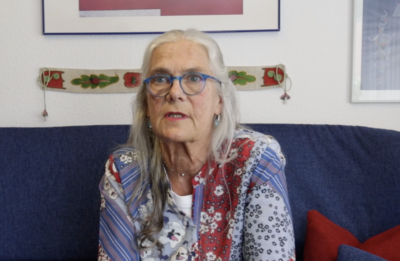
Autor/Autorin
DC: Mrs Hoffmann-Heinen, you grew up here in the Rhenish lignite mining region and lived in Wanlo for 45 years. What was your childhood and youth like here?
EH : I grew up on a farm and that’s exactly what my childhood was like. I loved the freedom on the farm. We had lots of animals, I had 35 cats, that was my terrain and I loved it. So it was beautiful, a very beautiful property. And outside the village, which meant I never had neighbours. But I always felt very comfortable and later, when I went to school, I had friends in the village. Then I went to school in Munich, to Reith, to grammar school, and I had friends there too. But I always came back. I felt very, very comfortable on the farm. I had another brother. And what you do with animals, that was my area. (…)
DC: So you were always a very nature-loving person.
EH : Close to nature… well, my parents did everything for us children. (…) I always had a particularly close relationship with my father and I also have him to thank for the fact that I didn’t play the role that other daughters played on farms, but he always pushed me and said, „You have to do A-levels“. And not specialised secondary school, but do Latin. Then you can go to university afterwards and have all the freedom you want. That was my luck. I went on to study economics, and I have him to thank for that. He was always very proud of me, because (…) as a woman, it wasn’t usual to follow this educational path back then.
DC: How has this region changed since your youth?
EH: Yes, it started with the fact that something changed when the rumour first came up, but we had known for a long time in the background that this whole rural area here was going to fall victim to lignite. So not really before. People who grew up in the village were always away temporarily, but they always came back. We had great clubs with events and all generations were represented. People simply didn’t move away from the village. People went away for education, they studied or did an apprenticeship, but they always came back. It was only when it became known in the 1970s that the Garzweiler II area was part of it, including Wanlo, where I was born, that (…) people were very, very excited and naturally scared. Imagine finding out that in twenty or thirty years‘ time, the house they’d had for generations would simply be taken away from them. In the village, it wasn’t usual for people to move away and build somewhere new, they didn’t want to. People lived in the old houses that they had had for generations. And then, of course, people started to think that it was no longer so homely. So there were big problems, even in the villages. But the cohesion and the result that Wanlo was then taken out of Garzweiler II meant that we managed to do that. It wouldn’t have been possible without this cohesion, but there were changes. There were people here and there who said: „Leave it alone. It’s good if it goes away. Then we’ll go somewhere else. New and…“ But that was actually rarer.
DC: In the 1980s, you started to fight against the destruction of the environment and village communities by what was then still Rheinbraun. What motivated you then? What was the impetus?
EH : It was precisely this fear. And it went through the village: „What do we do“? We have to do something. Then there were events and at one of these events, which I also went to with my father, the topic was: we need to set up a village interest group. And we need someone to lead it. Yes, and then we sat there with about a hundred people in a small room in the village. Then suggestions were made and, among other things, I was also suggested and elected chairperson of the village interest group. This village interest group was responsible for Wanlo and there was a similar group in every village. All of them then joined together to form the united initiatives against Garzweiler II, i.e. the entire Erkelenz area including Wanlo. Wanlo was the only village in Mönchengladbach that was affected. The other places belonged to Erkelenz and so we worked together. Then the work started, there was a lot of it. The problem when you’re in charge of something like this is all the correspondence: everything came to me, I was told everything, everything was sent to me. And I had contacts with the relevant people. I was actually travelling almost every weekend. That meant my family and everyone basically suffered, I’ll be honest. I was also still working full-time. During the week, in the evenings, we held meetings here. But the events I had to attend – you had to be present – were at weekends, so of course everything suffered as a result.
DC: How did RWE, or Rheinbraun at the time, approach the villages? How did the company convince or try to convince people to move away and sell?
EH : Well, in Wanlo, because there was a strong community and Wanlo was even further away, so we were the area that wasn’t yet in the pipeline. (…) There were problems in Immerath, for example. Immerath is already quite far away. They went there and of course asked: How can we win over the population? Training places were allocated. I think there were over ten apprenticeships for young people at the time, many jobs at RWE. In other words, they made it palatable to people, and with something like that they could divide society. The aim was to divide people. And they managed to do that with measures like that.
DC: I’ve heard that clubs in the village, sports clubs, were also infiltrated?
EH: They were infiltrated, which means they were paid. Rheinbraun also made sure that employees who lived in the village became, for example, marksmen’s kings. Then a lot of money was pumped in. Money is one of the things they can use to manipulate people. It’s very difficult in villages, because when they suddenly see money from somewhere else, their eyes go wide. That’s what happened in Immerath in particular, where the community was quite divided. Thank goodness that wasn’t as bad in Wanlo. There were people here and there who said: „Okay. We don’t mind if we leave,“ but most of them didn’t. When I see that today, they are so grateful that they don’t have to leave. There’s a firmness that you can’t even imagine. These are things that the RWE still… I don’t know if they would dare to do that. Or for example: at the very beginning we had a very young lawyer who had a doctorate in this field and knew his stuff. We were so happy because we said to ourselves: „Well, now we have someone to support us legally.“ It wasn’t long before we were told he could no longer work for us. Then we did some research and he started working for RWE – you can imagine how that went. I don’t think you need to do much more research. These are things that happened back then.
DC: The workers‘ demonstrations in front of the apartment blocks, was that also an issue for you back then?
EH: No. Thank God we prevented that, but it did happen.
DC: In Immerath, then?
EH: Yes, in Immerath, Spenrath, Holz, that’s this whole area that was the first to go. They proceeded slowly, from the Grevenbroich area. And, of course, there are a lot of companies involved in the whole open-cast mining operation. In other words, companies that profit from RWE and lignite. Small companies that supply and whatnot. These are things that RWE still uses to gain sympathy today. But today I’m noticing that the idea of the climate is increasingly taking centre stage, that people are already thinking about their children and saying: well, we may not live to see it, but the next generation will experience it worse.
DC: A resident of the village of Berverath, which is threatened by Garzweiler open-cast mining, told me during the star march that „there’s a war going on in our village“. I thought that was a very impressive quote.
EH: Yes, war, but it’s in Berverath. Berverath is right behind Keyenberg, but in Keyenberg, basically, too. We were even a bit scared at our event. Because we also knew that this situation was in the village. We also wrote in the flyer we put out that we didn’t want to force people to stay. Anyone who wants to leave should move. But we would like those who want to stay to be able to stay. Even if it’s just one person, they have the right to stay in their village. Until the day before the event, we had planned not to go through the village. Because there were two people who we expected to cause trouble – I don’t know what kind – we wanted to go around the village to the star march destination. But then he said it was OK, you can march through the village and the people who came from Holzweiler marched through the village. Some people shouted stupid slogans at those passing by. That does happen.
DC: You could also see signs in some houses.
EH: Yes, exactly. You have to imagine, some of them are already gone. There’s already Neu-Keyenberg, Neu-Berverath, Neu-Unterwestrich. The villages are all already there, near Erkelenz. Some have already moved there. But there are still people in Keyenberg who don’t want to leave, who would like to stay, for example the baker. My daughter recently sent me a report and since then I’ve always gone to Keyenberg to buy bread. He said he didn’t want to leave, and he stays until the last person says, I’ll buy from you.
DC: What campaigns did you organise in the eighties and nineties to take action against Rheinbraun/RWE?
EH: We organised chains of lights around the whole area. Then our big action in the Ärckerhalle, that was exactly thirty years ago. We had these unpleasant experiences there. You have to imagine that we were all amateurs. We organised everything we did after work, at the weekend, and put on a huge event. We didn’t have the media that you have today, so it was a lot of effort. We kitted out the entire Ärckerhalle with our banners and everything and invited the right people. Today there is still a brochure from the follow-up work, which contains everything we did, who was there and so on. And then, at very short notice, before it started, Rheinbraun came with buses, brought the people who had been given a free shift and came with banners and placed these banners in the hall in front of our banners. We hadn’t even thought that far ahead. So today at an event, we applied for police and whatnot. We didn’t think about that at the time. We had to put up with it all and then of course they took our seats and the tenor was the same. That’s the kind of thing you experience. Then you actually know what kind of opponent you’re up against.
DC: Was that the „Burnt homeland?“ event? Or was that…?
EH: Exactly, that was the „fuelled homeland“. And these are also the things where I say: of course, the employees were worried back then and they are still worried today, I can understand that, but even today I say: I have no sympathy for it, because the arguments, for the most part, that are on paper today, we all mentioned them back then. And nobody paid any attention to them. The event was over and everything went on as usual . Thirty years have passed and nothing has happened. Yes. And now suddenly we realise, okay, lignite is having a serious impact on the climate and now we have to do something. That’s why I now understand that the employees are affected. But they shouldn’t complain to us, who are now demanding that lignite production be stopped as quickly as possible, but to their employer. They’ve had time enough. As a small child – my parents, my grandparents, lived in Bruchholz when I was a little girl in the early to mid-fifties – my grandfather took me into the garden and showed me the diggers. „The diggers are over there and in ten or twelve years, they’ll be here.“ Nobody said anything. They were, I always say, devoted to God. They were probably still from the time when people believed in the Führer, they didn’t put up a fight. They said there was nothing we could do. That got the better of us (…) at some point people became rebellious and said we’re not going to put up with it any more. Then the problems arose: First the water, now the climate, and to that extent the resistance has become stronger and stronger. People have learnt. We also had to practise this resistance first. We had to learn that. (…) I can see what they’re doing today, I’m thrilled. For me, it was learning by doing , I had to get used to it first. I had to learn to be cheeky and go for it. They can do that today. They have seminars everywhere and they do it and they’re very calm about it. (…) I had to learn that back then. That’s also the story of resistance. You can see very clearly how it slowly developed.
DC: What did this slogan „Resettlement is beautiful“ trigger in you?
EH : Well, that was absolutely amazing, I couldn’t even imagine it. Thank God I didn’t even experience it, because Wanlo wouldn’t have got away. But I know how people suffer. And I know how people are rooted in the village. It’s different from living in the city and moving from time to time. When you live in the village, you don’t leave, you stay there, your roots stay there. And then to say something like „moving is nice“. If you look at these – I don’t call them villages either, these new settlements, they are settlements, … the problem is if you are one of the resettlers, if you have to leave, are forced to give up your property. Then you feel like a martyr. And then what do you do? Then you say „okay, but now I want my dream home“. So, and then comes the problem. The dream house is much more expensive than what you get from RWE. And then the people who used to live in the village get into debt. You don’t know debt in the village, it doesn’t exist. That means that the house you have when the old generation is gone is renovated a bit and then you live in it. There are a lot of people who have taken over. Before Jülich, Steinstraße was one of the villages that disappeared years ago. Today, none of the houses there belong to the original owners, because all that’s been built there are villas, the most amazing houses that people couldn’t afford. And that’s the problem, it’s no longer a grown unit, but everyone builds the way they want. And people are very generous with their planning permission. But then people are left alone with these worries, RWE no longer takes care of them. We make sure that they move and then that’s it. Nobody takes care of the emotional distress. And when people say (…), leave us alone, we don’t want to talk about it any more, what kind of sign is that? If I was happy to move or if I was happy about the new house, then I would have said, wonderful, do (…). No, they say we’re just sad. We don’t want to talk anymore, we’ve moved now and we have to get used to the new one. And that’s the problem.
Or the first evening I was back at the group. There were people from near Hambach. They said, we’ve sold our house and now I can see that you’re doing something, and now something is happening. Now Hambach has happened and we all have the feeling that something is happening. I would love to buy the old house back. Yes, we already have a building site and we’ve already started, but I don’t want that at all. I would like to try to ensure that the house isn’t demolished, the old one, but that we somehow find a way to get it back. That also exists. So people are not happy about it. And then to say something like „relocating is nice“. Well, I don’t know anyone who can honestly say that I’m glad I moved. There are some who have left and what are they supposed to do. But that’s a cheek. It’s a really big cheek.
DC: You didn’t just make friends back then either, I think. Did you receive any specific threats?
HH : No, they didn’t threaten me. It was just that our work was made more difficult by people who said: „No, we don’t see it that way.“ It’s easier to do something when you have the crowd behind you. There were always some who said, „Why are you doing this? We don’t care.“ (…) But these threats, I have to be honest, I always expected them. We were cheeky at the time because we said something that was justified, but that I experienced that? Yes, the only one at school. I once broke a windscreen on my car. And I was at the vocational college in Grevenbroich, it was never investigated, the school replaced the windscreen for me. We had classes from Rheinbraun there and I always had the sign: „Stop Rheinbraun“, the red one that you see in the villages, on my windscreen. I’m pretty sure that at least my car was the object of that, not me, I wasn’t threatened as a person.
DC: You were employed as a teacher in the public sector and taught politics and economics. Was there no public pressure on you?
HH: No, on the contrary. (…) We were given a house magazine at school. There was a shelf full of all kinds of company magazines, including Rheinbraun. When they read it, they said that what they were doing was better (…) than the creation of the world. What birds and animals they had released. I said to my boss at the time, I’ll do it, I’ll work on it. I know very well that you can’t say that. Of course they’re trying to do that, but they’ve previously expropriated people and taken people’s homes. Of course they’re trying to recultivate now, but it’s not the same as before. I no longer want the newspaper to be displayed here at school: „I don’t care how you do it, but I don’t want to see it here any more.“ And it’s no longer…, so either he cancelled it, I didn’t follow it up, or he got it straight away, when it arrived (…) it was destroyed. You simply can’t do that because it doesn’t correspond to reality. I can’t say that the place is nicer afterwards than it was before. Everything is missing, the whole social environment has been totally destroyed. Because many people also move away, they don’t move at all, they move somewhere else. Financially too, which means that nobody is allowed to talk to their neighbours about what they’ve got. There’s a code of silence. Then you can imagine that this also leads to different views and then there are disputes. These disputes were already very noticeable in the new villages. When we started, shortly afterwards, there was a social compatibility report on the villages of Königshofen and Harf, which were resettled years ago. And that came to light very clearly. Of course, new communities were formed, but it’s not like it used to be, the old village communities were gone.
DC: On the other hand, Rheinbraun also offered you a job. In the PR department.
HH: Yes, that was indirectly a compliment. In other words, we were probably good. But they really should have known what kind of attitude I had. But they tried everywhere, just tried. And I really had to pull myself together (…) otherwise I really would have got one over on him. So I didn’t just say that that evening, I was itching in my hand. I was really upset and said, that can’t be true now.
DC: Were you able to mobilise your students for your fight back then?
EH: To a limited extent. Of course, I had the opportunity to address the issues in both subjects. They also understood me, but of course I always had to be careful because many fathers were employees at RWE, it was right on the doorstep. (…) But I explained that this activity is not only there to generate electricity, but that many people have to suffer for it. That it also (…) upsets our water balance. (…) But as I said. I had to be careful with my students because their fathers and sometimes their mothers worked for RWE.
DC: Who supported you? Your family? I think your daughter was still of school age at the time.
EH : Yes, well, my father supported me for a very long time because: He also got me into it. He always said, you’re doing this, you’re doing it well. (…) My husband never saw it that way, he didn’t particularly support me. He didn’t grumble that I was always away, but he did his thing and said, well, if you want to do it, then do it. But I didn’t have much help there. So I gathered people from the village around me who thought like me and was more or less left to my own devices.
DC: What did you hope for from politics back then? When the SPD lost its absolute majority in 1995 and the GREENS joined as a small coalition partner, did you hope for more?
EH : I had hoped for more. We said we would use the parties for our own purposes, but we would stay out of party politics. But of course the GREENS were very close to us. The CDU was an absolute problem back then, including from the city of Mönchengladbach. They sent us a Rheinbraun representative to support us. Until we realised that he was ultimately working against us, he was working for Rheinbraun. Then we said straight away that we didn’t want him any more and we got a replacement, but he wasn’t much better. We couldn’t expect anything. But the GREENS were very intense, even back then. But of course they weren’t alone and we still criticise them today for not being more radical with their demands. They were always just the partner, they weren’t the leader, otherwise it might have been better. Some people I know from the past are still involved today. Dirk Jansen from BUND, for example, worked very closely with us back then and stayed on board. But we expected more. I always have to say that if the problem had been as clear back then as it is today, when these signs of climate change are becoming so obvious, then perhaps we could have achieved more.
DC: The Greens lodged a constitutional complaint in 1997 and failed.
EH: Yes, there have been many lawsuits. A farmer in Holz, that was before Immerath, still had his farm for a very long time and with the help of the initiatives and all those who fought there, he litigated all the way to the Federal Administrative Court, but lost. Simply because the Basic Law says that if the community needs the property to generate energy, then you have to give it up, I say. But that’s no longer the case today. The Coal Commission has said that the phase-out is possible earlier and expert opinions have been presented that the phase-out could take place even earlier, that this could save the villages as they are now. There is still enough land free of villages for the coming period, when there is still authorisation to mine. Of course, special fortifications will then be needed. Which is already the case in Hambach. These are additional costs for RWE and the shareholders are naturally angry. Of course, they will lose money if additional fortifications are made. But I say quite simply, if the coal under the village is no longer needed because alternatives are now being developed and have already been developed, and if lignite is so problematic, and if you want to get out anyway, then I can’t tell people you have to leave now just because RWE wants to carry on, just because of the jobs. I can well understand that people are afraid, but then you have to spend the money you spend to give people new job opportunities. And RWE wants to earn money, they will do other things. Then their people can just go into other areas. (…) I said that I sincerely hope that someone will get through this and simply say that I won’t give up my house. And litigate until the last instance, then I’m pretty sure that in the last instance it can no longer be said, yes, you have to give it away. Because it’s no longer necessary. It’s just different to thirty years ago.
DC: Then you finally gave up the David versus Goliath battle, which is also very gruelling. What were your reasons?
EH: Firstly, it was decided at the time to leave the place where I lived… – I have to say, I was born in Wanlo, on one side of the farm, and married on the other. In other words, I married a farmer from the village and then lived on the other side in Wanlo. And this village was taken out of the Garzweiler II area. It was said that Wanlo would no longer be mined. And that was the point where I said, okay, now we’ve achieved what we actually wanted. I couldn’t do it any more, I had been so intensively involved for almost ten years and it just wasn’t possible any more. Then there were other people in the village who agreed to take over and I moved away. I separated from my husband, bought this house and moved to the neighbouring village. Why did I do that? Because I didn’t want to leave. (…) So I moved, that’s 800 metres, not even, away from home, and practically started all over again in 1992. I went to a few events again, but I’m no longer a leader and no longer so intensively involved in the cause. But I was always happy, even when Mrs Fassbender came. I said I could write a book about the whole thing, I’ve experienced so much. (…) But at some point you get exhausted and then it was good that someone else did it. Then there were problems in Wanlo, the airport, glider airport, that’s there now. Then there was supposed to be a waste incineration plant there, so the village was already polluted, but thank God it didn’t happen and so now it’s pretty quiet. But now they have a wall and behind the village there will soon be a hole.
DC: And what gave you the strength, the courage or the reason to take up the fight against RWE again?
EH : Well, I have to be honest, when Mrs Fassbender came along… it was a few years ago, it took a long time with the film, I realised that I was still in it. I still enjoy this fight, if you can call it that. I’m still full of vigour and would like to do something else. When the film was ready, my daughter also supported me. She is now also a teacher in Grevenbroich and of course experiences it and thinks like me.
The two of us then went to Düsseldorf, watched the film and there were also people from Wanlo. (…) The daughter of our landlord at the time was there and had married a man from out of town. They were still fighting with the neighbouring villages. And then Birgit said: „Why don’t you come and we’ll organise an event soon, this star march. It would be great if you could just tell us about how you used to do it and everything.“ That was last year, at the beginning of the year. And I got in touch with her at the beginning of this year. Since then, I’ve been back in this „All villages stay!“ initiative. And we are practically working from outside, the Wanlo people and me. We are now joining the other villages in this community and doing everything that needs to be done. I didn’t leave it at the star march now, at the speech I gave. That was actually the point of the whole thing, that I should do that, but it meant so much to me what they are doing today, with the young people. I’m happy to be involved again. That means I’m now fully back in the fight.
DC: You told me that seeing the young people from Friday for Future gives you strength.
EH : It gives me total strength, yes.
DC : What advice would you give these young people? What would you want to tell them?
EH: Yes, just hang in there. Now is the moment when they can force a turnaround. I realise that very clearly. I realised that for the first time when I read the report from Hambach, from this event…., and I thought that it can’t be true that so many people who have nothing directly to do with it are getting involved. From everywhere. (…) We also got enquiries from Celle, they had already ordered a bus and I don’t know what. There’s a completely different response today thanks to the media. (…) So I can only say, if not now, then when! Now the moment has come. We probably all had to wait for it. Unfortunately, the villages still had to disappear, but RWE, for example, is now standing in front of this old motorway. That was so symptomatic for me because we also held our events there. If you looked further, you could see this embankment and behind it was this old motorway. It has now been decommissioned and replaced by a new motorway that runs through the open-cast mine. That’s a sign for me: This far and no further. I hope it actually stays that way. As I said, south of Keyenberg – Immerath is as good as gone – there’s nothing left. There is a huge area that is deserted. You could say that you couldn’t stop overnight, you could claim that. But then stop! Leave the villages as they are. It was agreed at the time that the villages would not be demolished as they used to be. In the past, the villages that were bought up were always demolished straight away. But at some point that stopped. If you drive through Keyenberg, you pass some beautiful houses that are all empty. If that were to really happen, if we were to say that we are no longer going to touch the villages, then a completely new concept would have to be developed. (…)
I always imagine it like this: Today I can still go to my village, I like going there very often. But I’ll never be able to drive any further, at some point there will be a wall and then a hole. I’ll never be able to go to Keyenberg again. I’ll never go to Immerath again… I travelled with my mother to my grandparents for twenty years, always through Immerath, past the cathedral, that’s what they called their church. And then at some point that was no longer possible. I was there too, on the Sunday when it was desecrated, it had been desecrated for a long time, but it was the last day. Oh, that was another picture. The Rheinbraun employees stood there with their white lorries. The diggers were parked around the church, the windows were out because there was an artist who had secured these windows. And then the people stood there and everyone cried. Then you stand in front of a place of worship like that and you know it’s going to be gone the next day, which is terrible. So I can’t imagine not being able to go to Wanlo anymore. I often cycle to Keyenberg and through this whole area, so I can’t do that any more. That’s the difference between whether I can still cycle there or not.
DC: The Hambach Forest also has a symbolic value and an ecological value. What does the Hambach Forest mean to you?
EH : The whole Hambach area was always a parallel to what happened here. The part that still exists now is a symbol for me. For the first time, Rheinbraun didn’t get what they wanted. And not directly through politics, but indirectly through the people. The people put up a fight. Basically, they simply occupied Hambach Forest, both in the trees and down at the event, and said: „Stop!“ And people seem to have noticed, because everywhere they go, everywhere, on TV, everywhere, I always hear „Hambi, Hambi, Hambi!“ It really has become a symbol of resistance and that’s how I see it. I said, Friday for Future , when I first heard that, and „Hambi!“, for me those are the two symbols, now we have a good chance of achieving something. To achieve our goal. I’m still hoping for that, even though it’s going to be really complicated with these half-empty villages. I still hope that at least the area will remain, the road that led to Immerath, which already belongs to Rheinbraun, will remain, the villages will remain in their structure, the church will of course remain. Even Kuckum, where the resistance is a little better because there are good people there. It’s a young man, David Dresen, who is very well connected and there is a lot of resistance there. A bit better than in Keyenberg. It always depends on the people and who they deal with and so on. There’s a lot going on there.
DC: What are your demands on politicians?
EH : Finally hearing what people are demanding, and for me that’s what young people are demanding. I even say we should have pushed it through a long time ago. We were too weak, but as I said, we really had to learn to be against it. I grew up very differently. (…) Today we simply say no, lignite is no longer necessary, and that’s why we have to stop this thing, otherwise we’ll all kill ourselves. The next generations will no longer have a basis worth living on.
I want politicians to finally be there for the people and not just for the economy. The economy will find its way. RWE will never close the gates and say, „You’ve got your rubbish here. If we can’t go any further, then it will be a bit of work and the shareholders won’t get such a good dividend for a while, but then we’ll have to invest the money in other areas.“ In this respect, I don’t have any problems, even with the jobs. Some may be lost, but RWE is strong enough to absorb that, and so are the politicians. I have no problems with that. There’s so much money in circulation at the moment, for all kinds of measures, village renewal and whatnot. We don’t need that, people will do it themselves, they will help themselves. There are even concrete plans in the back of their minds about what to do. They will be so grateful that they don’t have to leave that they will be prepared to continue to fight for it. Politicians should see that and not just do things like Laschet, for example, who doesn’t care at all. He says „Yes, yes, it’s nice that you did that“. When I drove home from the event in the evening, the RWE – I heard in the bathroom – said that Schmidt said that everything would continue as before because the politicians had given their nod. Politicians have been saying all these years: „Go ahead, go ahead, go ahead. We’ll make sure you can carry on.“ That’s simply not right. And now (…) in the political constellation, I honestly have to say that I don’t have much hope. And that’s why people must continue to take to the barricades. There’s no other way. We see that people are fighting back everywhere, just look at France. I said we don’t want French conditions, and the people who are fighting at the moment don’t want that either. They are rigorous, but peaceful. The fact that there are a few excesses in Hambach, okay, we won’t be able to defend ourselves against that. But these people – I’ve also met some of them – they’re really great people. You can only thank them for living their lives there to protect our property, otherwise none of this would have happened, Hambi was the crux of the matter for me. A lot has changed since that event. My daughter also told me that in her circle of friends, it’s the younger generation, she said, everyone says: „Wow! So now you have a good chance!“
DC: That’s a good conclusion. Do you have any other aspects you would like to mention? Is there anything important that hasn’t been mentioned?
EH: No, the only thing I’ve just said that I think is so great is that you realise from what you’re doing that you’re now successful. In other words, when we have given something of ourselves, it always takes a certain amount of time, and then I realise from some reports, politics or RWE, that it has been received. (…) I always say, what does a person who is in the dark and afraid do? They tell themselves something. And that’s what they’re doing at the moment. Of course they’re afraid of the situation because it costs money. But it is feasible, and because it is feasible, no one has to leave the village. What a village gives to people, no other unit, not even a new village, can give to people. That’s why you should leave people in their village and not bulldoze the villages. And there are a few people in the villages who are already relocating for the second time. We have friends who live behind Keyenberg, they used to live in Kasta, they had to leave Kasta, they built a new farm there and now they have to leave again. That is simply not acceptable. No one has to give up their home anymore, put an end to brown coal.
Interview : Daniela Collette
Camera : Mike Fischer
Proofreading : Dr Irmtrud Wojak