
Autor/Autorin

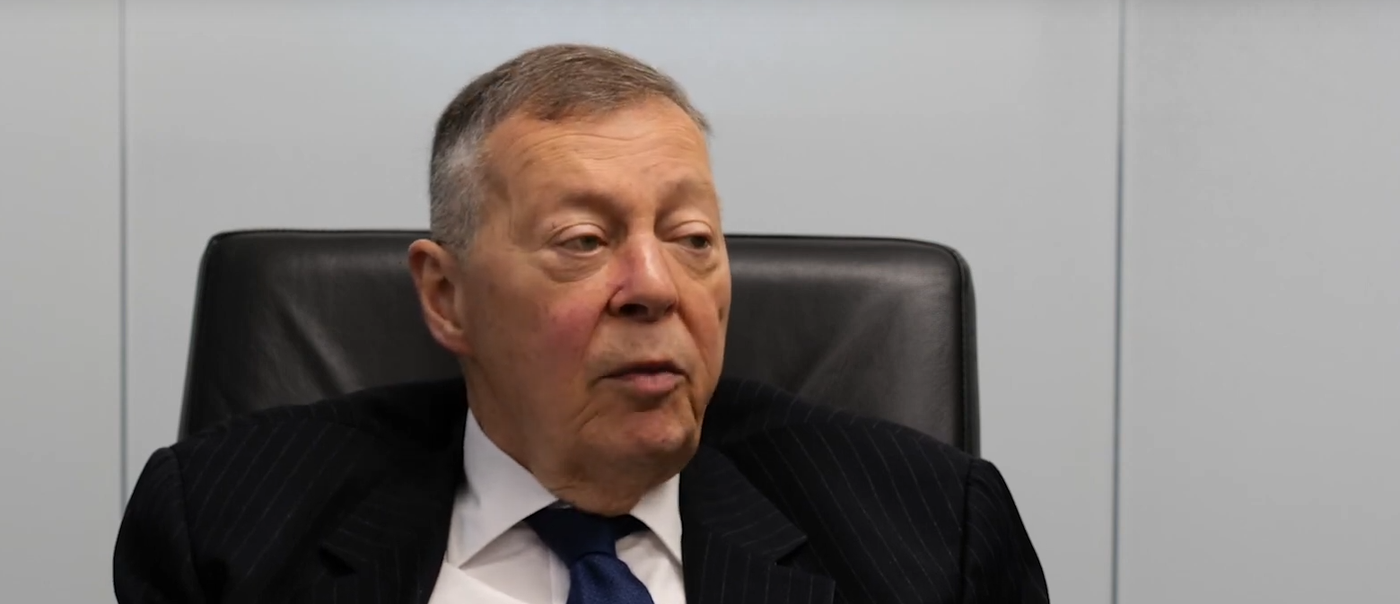
Aryeh Neier, born in 1937, survived National Socialism in Germany because his parents managed to flee first to England and then to the USA in 1939. He became a human rights activist, co-founded Human Rights Watch and was President of George Soros‘ philanthropic network Open Society Institute from 1993 to 2012. Aryeh Neier was National Director of the American Civil Liberties Union from 1970 to 1978, and he was also involved in the founding of Students for a Democratic Society (SDS). Read the full interview here. – The editorial team
IW: Mr Neier, I would like to start in Berlin. We were just talking about Berlin and that you were born in Berlin.
AN: I was born in Berlin, but I have no memory of Berlin. I was two years old when we left Berlin. My family is of Jewish origin. After Kristallnacht, my father realised that we had to leave and he tried to find a place to go. It was difficult at the time to find a country that would take us in, but the British agreed. The British actually took in more refugees from Germany and Austria at that time than any other country. I think the British took in about 70,000 Jews trying to leave Germany and Austria in the year or so before the war started and for a short time after the war started. My eldest sister went to England first. She was eight years older than me and came to England on a Kindertransport at the age of ten. She was there for a few months before we were able to leave. We actually arrived in England on 16 August 1939. That was about two weeks before the war started. At that time, the British were worried that there might be spies and saboteurs among the refugees. So they interned the men, some for a short time, others for longer periods on the Isle of Man, basically had them transfer each other and then they were allowed to leave. As my father was interned – not for very long, but he was taken – and my mother had to work to support herself – she couldn’t take anything with her from Germany – I was put in a home for refugee children.
JGI: Excuse the interruption, what profession did your father have?
AN: He was a teacher.
JGI: Ah, that’s the most important profession. And if you could start again later, when you realised where you came from? Would you tell us a little about the values in your family that influenced your outlook on life?
AN: Because my mother had to work and couldn’t look after me, I was placed in a hostel for refugee children. I spent eleven months in the hostel. After that, my father was no longer in danger of being interned and he was able to reunite the family. I hated the hostel, there are only a few moments there that I remember. But I remember behaving badly and I was put behind a bench in the corner of the room where the children were playing. I stood behind that bench while the other children went outside to play. I remember this incident, and I remember that when I left the hostel, I was wearing a new striped shirt and I drank a cup of cocoa that I spit all over my striped shirt before I left. Those are the two memories I have of that hostel. I was told that I didn’t speak when I was in the hostel. But I don’t remember that.
After that, the family was together again, my older sister, my father and my mother and me. We lived in a flat in London, under the roof of the building, it was a small flat. During the air raids during the Battle of Britain, we went with the other residents to the underground, where you were safe from the air raids, and people spent the whole night in the underground. At some point, my mum refused to go underground any more. She hated it. We went into the basement of the building we lived in. English basements are very well built and there were a number of other people in the basement, and our house was hit by a bomb. It destroyed most of the building, but nobody in the cellar was hurt. Everyone in the cellar was fine. But after that we had nowhere to live and people were evacuated from London. The way you were evacuated was like this: you went to one of the stations in London and got on a train, and at every stop on the train someone came on board and said, „we can take this many people“. At that point you got off and we did this in a town called Kettering, which is about seventy miles from London. Kettering is a town where boots and shoes are made. A pleasant town of about 30,000 or 35,000 people, it has a famous park called Wicksteed Park. Initially, the people who got off the train in Kettering were housed in a school. My older sister was playing in the school playground with a girl from the neighbourhood. The girl apparently asked her parents if they could take my sister in. The family said yes. It wasn’t a wealthy family, the father was a bicycle mechanic. The girl told my sister she could come and stay with them, and my sister said they would have to take in my mum and brother too. My father had stayed in London because they were evacuating the women and children alone at the time. The family agreed, so the three of us, my older sister, my mum and I, moved into the bicycle mechanic’s house. A little later, my father was able to join us and he also moved into the house.
In a typical English house, there is a front room and it is not used most of the time. It’s the place where some formal occasion takes place, some fancy event, but the main room of the house is usually the dining room. Because this front room was empty, we were put up there. We lived there for a short time, a councillor in Kettering had decided to become our guardian. His name was Mr Good, or Goode as they would pronounce him there. He looked after us and he wanted to get my father a job. And he found a job in a milk bottling factory. But the milk bottling factory was far away and my father didn’t ride a bike, so Mr Goode found another house for us to move into, it was a more suitable home. It was an insurance agent’s house. We moved into the insurance agent’s front room and then Mr Goode found us our own flat in Kettering and helped my father find work and teach languages. We survived the war in Kettering and later moved to a nearby town because my father worked at the school there. A town called Northampton, the county town of the region where Kettering is located. We lived in Northampton for two and a half years. My older sister, who was still quite young, married an American soldier who was stationed in England. She came to the United States as a war bride. My parents didn’t want to lose contact with their only daughter, so they applied to come to the United States. That’s how we came to the USA.
IW: When was that?
AN: We arrived in June 1947.
IW: I have another question about your family. Was it a religious family or not?
AN: It wasn’t a religious family, but it was a family that identified very strongly as Jewish. My parents went to synagogue very often. They celebrated all the Jewish holidays and didn’t keep a completely kosher household, but they didn’t eat pork or shellfish. But mixing meat and milk was fine. It was a very conscious Jewish family, but not really orthodox or not really religious. But being Jewish was very important to them. It was the way they defined themselves. And I was given a Hebrew name, Aryeh, which means lion.
IW: Did you later talk about your experiences in Germany before the war?
AN: Not very much. My father had been dismissed from his teaching position because he was of Jewish origin and was then employed by the Jewish community in Berlin, where he worked again as a teacher under their direction. They talked about Germany. You were not born in Germany. They were born in what is now Poland. They lived in a place they usually referred to as the Dreikaisereck, where the three empires, the Prussian, Austrian and Russian empires, met, and where my father earned some money as a child by smuggling cigarettes across the borders. My father was born in 1899 and after the war, after the First World War, he wanted to leave to get an education, he went to Berlin. After he left, my mother joined him in Berlin some time later. They married in Berlin and then lived in Berlin until they went to England.
IW: And your family, did you have family in Berlin or in Poland?
AN: No, originally my mother’s family had eleven children. Eight survived into adulthood, and of the eight, five died in various concentration camps during the war. One brother survived, he had lived in Berlin for a while, but he had emigrated to what is now Israel before the war. And a sister survived in Poland, she survived because her husband was able to survive in the woods. He had the skills and the strength to survive in this way. Although he died at the end of the war, he kept his wife alive during the war. She survived the war in Poland. A few years after the war, they were able to emigrate from Poland to Israel. The only family then was the family of my mother’s brother, who had emigrated to Israel. We had distant relatives in western countries. My father was an only child, he had no brothers or sisters. We found out what happened to my mother’s family because she had a cousin who had gone to Canada and who worked for an organisation called the Joint Distribution Committee. And he had immersed himself in what was happening in the family, and one day, completely unexpectedly, we had no contact with him, he turned up at our house in Northampton, England, and told us what had happened to various members of the family. Up until that point, we knew nothing about what had happened to the various family members.
IW: He found you in Northampton?
AN: In Northampton, England. Through his work on the Joint Distribution Committee , he was able to track down various people.
JGI: How did your awareness of the idea of justice and solidarity come about, because you mentioned that at sixteen you had to be very active to invite someone like Lemkin (Raphael Lemkin). I’m interested in how you probably realised over time what was the trigger for you to be active in the world of law; what was that process of your commitment to the cause of justice and human rights?
AN: I came to the United States and went to a high school called Stuyvesant High School. I attended the school from 1950 to 1954, which was exactly the time when Senator Joseph McCarthy was a major figure in the United States. He gave his famous speech denouncing the Communists in the State Department in 1950, and his downfall came in 1954 in what became known as the Army-McCarthy hearings. At that time, everyone in the United States was engaged in a discussion about McCarthyism. At my school, there were a couple of teachers who were called before the congressional hearings. We were very aware of McCarthyism during that time. The school was overcrowded, so it was split into two units. The first two years you attended classes from one o’clock in the afternoon until 5.30pm. And in the last two years, you attended lessons from eight in the morning until 12.30 noon. So in my last two years at school, I had the whole afternoon off. There was what was called the history club at school. We were called the history club because the teacher who was the counsellor was a history teacher and this was the framework for discussions about political developments, and I became president of the history club. In this role as president of the history club, I arranged activities, and since we had the afternoon free, we were able to invite speakers to events that took place in the afternoon. The students, who were present from eight to 12.30, had lunch and then there was a history club event. I invited the local member of Congress, I invited various other people who might be of interest. Because the school was particularly well known and was here in Manhattan, conveniently located for various public figures, it was quite easy to get the speakers that I wanted to bring to the school. And one of the issues of concern at the time was the ratification of the Genocide Convention. So I wrote a letter to Lemkin at the UN address, which reached him, and then he invited me to visit him in the delegates‘ lounge. I told him what I wanted, and he agreed to come to the school to talk about the American ratification of the Genocide Convention.
JGI: You wouldn’t invite anyone from McCarthy’s circle at that point, but you invited other personalities?
AN: Yes, and many of the speakers were people who were critical of what was happening during the McCarthy period in the US. I don’t remember that we invited anyone who was in favour of McCarthy.
JGI: And when you went to school, to university, what did you think at the time, that you wanted to preserve the idea of justice or…?
AN: We had no money, and so the question of going to university was quite an issue. We had come from Germany to England with nothing, and from England to the US with almost nothing. There was no money in the family. I found a way to go to university without any significant costs. One of the universities in the USA, one of the well-known universities, is Cornell University. Cornell University is primarily a private university, but there are also a number of departments that are or were and still are publicly supported by the State of New York. And one of the departments that has been supported by the State of New York is the School of Industrial and Labour Relations . Tuition at the School of Industrial and Labor Relations was free. Once you got into the school, the coursework was largely free. You could take a liberal arts course and there was no cost for tuition. In addition, New York State had scholarships for students attending universities in New York State, and these scholarships were awarded on a competitive basis. You took a test, and depending on how you did on the test, you got a scholarship, so I got one of the state scholarships as well. And then I also worked while I was at Cornell University. I worked jobs on the college campus while I was a student. And the School of Industrial and Labor Relations got me jobs for the summer holidays. So between free tuition, a state scholarship and what I earned, going to college didn’t cost my parents anything. I was able to pay for it myself. So that’s where I went to school. And while I was at Cornell, I also became active in political affairs and rights issues.
IW: And how do you explain that? Did you become involved with human rights or the law because of your experiences in the „Third Reich“ or where did this involvement come from?
AN: I would say that I had no memories of the „Third Reich“ myself. But I was aware of my family’s situation. I was aware of the number of people in my family who had been murdered, and that had a great effect on me. That sort of combined with the impression that I was going to high school, a secondary school, during the McCarthy era. Those two things came together and made me someone who was interested in rights. The two biggest rights issues that I was involved with at Cornell were that in January 1955 – I started at Cornell in September 1954 – the Montgomery bus boycott took place. It was about blacks in Montgomery, Alabama, refusing to ride the buses because the buses were segregated. The first article I wrote for the Cornell paper was about the Montgomery bus boycott. And the other issue that struck me the most was that in 1956 there was the Hungarian Revolution against the Soviet Union. There was a speaker on the Cornell campus, a man named Norman Thomas .
Norman Thomas had been the socialist candidate for president six times. I think the last time was…, I don’t remember exactly whether it was 1956 or 1960 (it was 1948, editor’s note). But he was a socialist presidential candidate. He was one of the founders of the American Civil Liberties Union (ACLU), and he was a socialist, very anti-communist.
He spoke, and he was a great public speaker, probably the best public speaker I’ve ever heard in my life. He spoke on the Cornell campus, there must have been three thousand students in the hall to hear him. After his speech, he went to one of the houses on campus. A certain number of people who wanted to continue the discussion went there and I was one of them. He said he had just had a visit from a woman named Anna Kethly . Anna Kethly was the foreign minister (deputy prime minister, editor’s note) appointed by the Hungarian government during the time of the popular uprising against the Soviet Union. She was appointed by Imre Nagy, the Hungarian Prime Minister. Anna Kethly was a socialist anti-communist like Norman Thomas. When she arrived in New York at Idlewild Airport, which was still called Idlewild Airport before it became Kennedy Airport, she went straight from the airport to Norman Thomas‘ office. She talked to him about the Hungarian Revolution. The next night he was scheduled to speak at Cornell, and when we gathered in the house and listened to him, he spoke about the Hungarian Revolution. That was also an important event for me. After hearing Norman Thomas, I went to some faculty members I knew at Cornell and asked them if they would be advisors if I started an organisation on the Cornell campus to bring different speakers to the Cornell campus. We called it the Cornell Forum. I was the president of the Cornell Forum. Norman Thomas was, before he became a presidential candidate, he had run an organisation called the League for Industrial Democracy , which was founded in 1905. A socialist anti-communist organisation, it had a student organisation that had chapters at a couple of other universities at Yale, at Harvard and at some other institutions. They organised events that dealt with the Hungarian Revolution. I connected them with the Student League for Industrial Democracy . Then I became part of that group, and a year later I became president of the national organisation. My predecessor died a few years ago, he was an American publisher called André Schiffrin , a well-known American publisher. He was a student at Yale and led the group from there, then I succeeded him and became president of the Student League for Industrial Democracy . I was involved in these activities in secondary school as well as in high school and college.
JGI: That’s wonderful. I want you to tell us – this is not psychoanalysis, but I want you to tell us – what people are there along with Norman Thomas, I see Hannah Arendt (JGI points to the wall where there’s a portrait of Hannah Arendt) – I like and identify with George Orwell being a socialist but anti-communist – or how difficult was it to take that attitude at the time?
AN: I have a copy of Animal Farm at home, I didn’t have much money, but I bought the book when it was first published, and when I look at it, it was the first edition printed, I think, in the United States in 1953 (1946, ed.). So, maybe earlier…
JGI: He died in 1950.
AN: It’s the first edition of the book, I bought it when it was published, and later in 1984 , they made a tremendous impression on me during that time. A lot of the literature I was reading at the time had a weighty political moment. There were the books by André Malraux, Albert Camus and George Bernanos. There was all this engagement literature from France that I read at that time, I liked the books very much and learnt a lot from them. Malraux wrote a book called Man ’s Fate (1933), which made a big impression on me.
JGI: Apart from writers, what other people have influenced you? You know that quote from Newton when he was asked how he was able to create his theory of physics, and he replied because I had a vision standing on the shoulders of all the giants who made me realise this view. What other people have influenced you because you were close to them, because you were inspired by them? I mean, we had Norman Thomas, he obviously gave you a lot of pleasure and you studied him and admired him, but what other people have been involved in this process over the years?
AN: Well, in my high school, the teacher who was the advisor of that history club, Mrs Brody, certainly had a significant influence on me. When I went to college, there were a couple of Cornell faculty members who had an influence on me. There were two or three faculty members in what was called the leadership department. One of them was a man named Clinton Rossiter , who became a well-known figure in the United States, and then among other things, at one point there was a series of books sponsored by the Fund for the Republic, Communism in American Life, which discussed communism in the unions and various other areas. He was the editor of this book series. Another lead professor at Cornell University was a man named Mario Einaudi . His father, Luigi Einaudi, was president in Italy. But Mario Einaudi had a great influence on me. And then there was a younger faculty member in leadership named Andrew Hacker , who is still alive. He’s a few years older than I am, and until two or three years ago you would always find his articles in the New York Review of Books . Andrew Hacker had an influence on me. There were two women in the Labour Relation’s School who had a big influence on me. One was a woman named Alice Cook , she was a labour historian, and for a while she taught with a woman who played an important role in American history. The woman’s name was Frances Perkins . She was the first woman ever to serve in the United States Cabinet. She was very close to Franklin Roosevelt, was Secretary of Labour under Franklin Roosevelt and was widely regarded as the person who pushed for the various laws that led to the New Deal . Franklin Roosevelt was very much influenced by Frances Perkins. But after she retired, she came to Cornell and became a friend of this professor of labour history Alice Cook and joined her in teaching at Cornell. And then there was another woman named Jean McKelvey , who was also a personality, I think, and at the Labour Relations School was a man named Milton Konvitz . He taught American constitutional law to the students at Cornell, and I really enjoyed his classes. I became personal friends with all of these faculty members.
At large universities, students have limited opportunities to befriend faculty members, but I became friends with all of them. They all had a significant influence on me. Besides Norman Thomas, there was another speaker I had heard at Cornell, a man named Arthur Garfield Hays . He was a lawyer associated with the American Civil Liberties Union , General Counselfor the American Civil Liberties Union . I became very interested in the American Civil Liberties Union , in part because I was listening to Arthur Garfield Hays.
IW: Can you explain in a little more detail what the idea of the American Civil Liberties Union was?
AN: The American Civil Liberties Union is about to celebrate its 100th anniversary. It was founded in January 1920. In fact, there was a predecessor organisation, the Civil Liberties Bureau , during the First World War. This organisation was founded to defend people who spoke out against America’s entry into the First World War or against conscription. Many of these people were sentenced to long prison terms, five years, ten years or even twenty years in prison. World War I was probably the most repressive period in American history, or the 1917-1918 period when the United States was involved in the First World War. During much of this time, Woodrow Wilson’s presidency was not going very well. His attorney general was a man named A. Mitchell Palmer, who was a repressive figure.
There was also violence by anarchists during the First World War. In 1919, after the First World War, anarchists blew up A. Mitchell Palmer’s house. The only person injured was the person carrying the bomb, who was killed. Nobody else was hurt, but it was a violent time. And after the war there were letter bomb attacks. In one letter bomb attack, a senator’s secretary lost her hand when she opened a parcel. There was anarchist violence during that time, but there were also people who were peaceful opponents of going to war and peaceful opponents of military service during that time who were treated very harshly. Originally the organisation was seen as a temporary organisation during the war, but as the attacks on civil liberties continued after the war ended, a permanent organisation, the American Civil Liberties Union , was formed. In the hundred years since the American Civil Liberties Union was founded, it has been the most important organisation in the United States for protecting the rights of individuals. Today it is a very, very large organisation. It has about one and a half million members and a budget of hundreds of millions of dollars a year. It has offices with lawyers in every location in the United States, in all fifty states and many offices in many states, and it handles thousands of court cases every year. It also actively lobbies Congress and in many other ways to protect civil liberties. When I first got involved, it was much smaller. When I got involved, it had sixty thousand members. It had affiliates in about half the states and had offices in about fifteen cities in the United States. I started working for the organisation in 1963, when I was 26 years old. I started as a field director and a year and a half later I became head of the New York Civil Liberties Union , which covered New York State, and then five years later, in 1970, I became Executive Director of the American Civil Liberties Union at the national level, which I remained until 1978. In all, I worked for the organisation from 1963 to 1978, fifteen years, and the last eight years as national executive director. I was much better known as a person then than ever again.
JGI: Where did the idea of founding Human Rights Watch come from? Was it a different concept?
IW: Please, Joaquín, let me ask you one more question before we get to Human Rights Watch , about the events that took place in Chicago, the Skokie case. Could you explain that a little bit and talk about that, because it’s important to us for our translation of your book Defending My Enemy .
JGI: I read it twice and wondered whether it was a virtue and what made you decide not to change your approach, because what you say in the book, your positioning, was seen so critically even within Jewish organisations. Did you really realise at the time that you were focusing on the defence of freedom of expression? Now that years have passed, was it really necessary to muster that strength and follow your personal compass?
AN: The American Civil Liberties Union has always defended freedom of speech for all. Even in the period before the Second World War, when there were Nazis or supporters of fascism or communism in the USA. It has defended freedom of speech for all and in the 1930s issued publications on why we defend freedom of speech for all. This was the firmly established position of the organisation. In the time before I joined the staff of the American Civil Liberties Union , there was a very well-publicised free speech case for Nazis here in New York City. The most famous American Nazi had been a man named George Lincoln Rockwell. Rockwell at one point applied for a permit to hold a demonstration in Union Square Park in New York City. The city refused, and the American Civil Liberties Union represented him and got him the right to demonstrate and the right to speak in Union Square Park. That case happened in 1960, and I joined the staff of the ACLU in 1963. I was very familiar with the fact that the ACLU defended free speech for all. And during the time I was director of the New York Civil Liberties Union, we were involved in a number of cases involving Rockwell and similarly diverse individuals. The Skokie case happened a little later, when I was the national executive director of the ACLU. The case involved a group that called themselves the American Nazis , and they had originally demonstrated in the city of Chicago and focused on an area in Chicago called Marquette Park. Marquette Park is a small park in Chicago. One side of the park has a population, or had a population at the time, that was predominantly African Americans . The other side of the park had a population that was predominantly Eastern European immigrants, Lithuanians, Poles, and so on. There was racial tension between these two groups. The Nazis originally held their demonstrations in Marquette Park to try to exploit these tensions. They had been banned from holding the demonstration in Marquette Park by a court order. The Nazis came to the Chicago office of the ACLU and asked for representation, the Chicago office agreed, and the whole thing was considered a routine matter. During the time the Nazis couldn’t demonstrate in Marquette Park, they wrote letters to various Chicago suburbs saying we want to demonstrate in their community. All but one of the suburbs ignored the letters. Skokie didn’t ignore the letters. It said, don’t you dare come here. The Skokie City Council quickly passed a series of laws, ordinances, to make it impossible for the Nazis to demonstrate. They had to post a $350,000 bond to cover any damages, no one could be allowed to demonstrate in uniform. There was another ordinance of this kind that they passed.
IW: And how many were there, the Nazis?
AN: About fifteen or twenty. The Nazis then decided that they would demonstrate in Skokie, but when these ordinances were passed, they came back to the ACLU, and the ACLU of Chicago agreed to represent them. It was considered so routine that the ACLU of Chicago didn’t even bother to notify us at the national office. It was just a standard matter. And then suddenly the press discovered this incident and the issue, which became a story: Skokie was a town of about 40,000 people and about 7,000 people in Skokie could more or less be described as Holocaust survivors. An unusually large number had come to this one place, and it became a press story.
I knew nothing about the case until it became a press story. I went to Chicago to talk to our people and I agreed that we would support them in this, it became a bigger and bigger story. Out of that came a series of lawsuits, there was a newspaper story about this Skokie case, a new page every day. I got invitations to speak about Skokie in very many places, and in particular accepted invitations to speak in various synagogues. I spoke in many synagogues and also in the one in Skokie. The discussion about the case was very interesting. Initially, most people were against the position of the American Civil Liberties Union . Over time, that changed. Over time, as people discussed the issue more and more, free speech became stronger and stronger and more and more people were convinced. Looking back, I would say that most Americans today would probably agree that the ACLU did the right thing. I’m not sure what the outcome would be. But it would probably be even most Americans, or it would be close, if a poll was taken today on this issue. As people debated the issue, the free speech side became stronger and stronger. One of the things I did when I spoke was ask people how many of them had participated in the table debates about Skokie, and then almost all the hands went up. Everyone had argued about it. The free speech side was emboldened in these arguments that took place over dinner. In the end, we won all the court cases and the demonstration could go ahead. And then, on the day the demonstration was supposed to be, the Nazis didn’t turn up. Not long after that, they held a demonstration in Marquette Park, where they were originally going to demonstrate. But they only had a handful of people show up, after which the Nazi group disbanded and no one ever heard from them again.
IW: The idea or the attempts to stop the demonstration gave them more publicity than anything else.
AN: It gave them more publicity, but once they won, it was all over. And there were some bad things that had happened by then. There was a radical American rabbi who then became a radical rabbi in Israel, Meir Kahane. Kahane organised demonstrations, including once at the offices of the ACLU in New York. He wanted us to call the police to throw him out, which would have meant good publicity for him. We managed to get rid of him that way. My home phone number is not public, people didn’t have my address, but apparently on one occasion a group from the Jewish Defence League (Kahane was one of the co-founders of the Jewish Defence League , ed.) followed me home. They found out where I lived and organised demonstrations in front of my house. However, there is an entrance to the building where I lived, which is on a different block, an entrance to a garage in the basement of the building. For a while, my wife and I used the garage entrance to the building to avoid the protesters who were in front of the building. At one point, the Jewish Defence League gave me a gift, a kind of plaque with a lampshade and something that looked like blood on it, and things like that. There were things like that, they took place.
JGI: I just have one question. I’m thinking about the European system and the American system. In the US, does freedom of speech include speech that incites crime or hatred of other people? Is that part of free speech here?
AN: The most important court decision in the United States is a 1969 case called Brandenburg v. Ohio. Brandenburg was involved in a Ku Klux Klan rally in Ohio. In this case, the clan members were convicted of sedition. The Supreme Court decision stated that you can only convict someone of sedition under circumstances where the sedition is likely to lead to the actual crime. One example I used is a Supreme Court Justice who famously said that freedom of speech does not include the right to falsely shout „fire“ in a crowded theatre. I tell people that the most important word in that sentence is the word „crowded.“ Because if you go into an empty theatre and falsely yell „Fire!“, nothing will happen. But if you go into a crowded theatre, then panic is likely to break out and people will get hurt. So you have to look at the context and not just the content. The content of the speech is what people say, the context is what deals with the circumstances in which the speech takes place. If the circumstances are such that violence is likely to take place, for example, if you take a lynch mob and there is an atmosphere where someone is going to be lynched and someone, a speaker, is shouting, „Go get him, hang him!“, in those circumstances the speaker himself has not committed violence, but he has incited people in circumstances where the violence is likely to take place, therefore the speaker can be punished because of that situation. But if it’s on a New York street and someone is standing in the street shouting, „Go get him, lynch him!“ everyone will somehow get away with it. There will be no violence. You have to look at the context as well as the content of the speech. I think that’s probably the main difference between American and European speech laws. Context is not a deciding factor in European law.
IW: Yes, that’s right.
JGI: There was a famous situation during the Obama administration that really surprised us from a European perspective. It was in Gainesville, Florida, when the pastor Terry Jones announced his plan to burn Korans. In the end, he didn’t do it, but if he had done it, it would have caused serious damage to individuals and American interests overseas, and I remember that President Obama, I mean, he was aware of the potential crisis, but he didn’t dare to intervene in that situation. Do you remember this case?
AN: Yes.
JGI: Everything was behind freedom of speech, but if he had dropped the book in the fire, it would have caused a lot of violence abroad.
AN: Yes, you see, this is an area that is similar to the freedom of speech issues that arise with the Internet, when you put something out on the Internet and it goes out to the whole world, but you don’t know the circumstances in every part of the world. That creates a difficulty that I’ve never encountered when dealing with these kinds of issues.
JGI: I understand.
AN: It’s a very difficult area, and I don’t have a well-defined view of the issues of incitement on the Internet.
JGI: Before we come back to human rights, let me briefly tell you about some real cases in Spain where people have been prosecuted for deliberately insulting the Crown in their artistic performances, and of people who have been victims of terrorism. For example, they have made fun in a song lyric when someone has lost a part of their body in a terrorist attack and have been prosecuted. The dilemma in Spanish society is not that it was of course an obvious lack of taste, a lack of respect. But they were charged with serious offences that carried a penalty of two years in prison, even five years in prison. When it comes to artistic performances, rap music, theatre, where do you think the line is? Because in a way, I think we need a kind of elasticity as a society and as citizens: the elasticity, the flexibility of a truly democratic approach to freedom of speech. I think that the rule of law embodies human rights principles and democratic values, but it also requires tolerance of opposing opinions and the presence of certain tensions. This type of artistic expression triggers a mechanism that leads to the question of what limits should be observed. In Spain, for example, any issue related to freedom of speech that concerns the Catholic Church is subject to particular public scrutiny.
AN: In the American context, the fact that it is art would not be a significant factor. One factor that would be significant is whether there is a direct relationship between a violation of law that the state has a right to prevent and the speech. If the speech is directly related to violence, then it would not be protected speech. If the speech takes place, say, in the hiring of an employee and results in discrimination at that time, that would not be allowed. But if there is no direct and immediate consequence that involves a violation of rights, then the speech would be allowed in the US. And in the US, speech of all kinds takes place at all times. We have a very strong commitment to freedom of speech in the US.
JGI: That leads me to the current problems with President Trump. What do you make of the fact that the head of state is targeting people who are actively strengthening the rule of law by doing their jobs as journalists? The denial of access to the White House to some journalists is unprecedented in this sense. But ultimately it is far more dangerous, as it goes to the heart of the American civil rights tradition and the rule of law.
AN: Yes, when a person is acting in an official capacity, there are more restrictions or there should be more restrictions on that person than when they are acting as a private citizen. People denounce Trump for these kinds of things, but until he actually breaks the law, there’s really nothing you can do about it. And if he does break the law, then the question is who will act in such a case. That’s something that freedom of speech law doesn’t really deal with.
JGI: Yes, but you expect, I don’t know if this is the right word, a certain dignity from people who perform a public function, who should represent and enforce the common interest of all citizens.
AN: One situation where I think he has incited violence in circumstances where violence could occur is when he has been at rallies and actually called on people to beat up someone who annoys him with the question being asked or the position being advocated, then he really crosses the line into incitement because violence really could take place in those circumstances.
JGI: Okay, thank you, and what do you think about solidarity? What about the principle of solidarity from your point of view? In the Treaty on European Union and in some European constitutions, the principle of solidarity is enshrined as a legal basis in the constitutions. It is not a political principle, but for us it is a legal principle. Since you are a human rights activist, a lawyer, and you are committed to this kind of cause, I would like to ask you to explain a little more about your idea of justice.
AN: I’m not sure how I define the principle of solidarity as a legal concept. It’s very difficult. What does it actually mean? What obligation does it impose on someone?
IW: What about the duty to resist when human rights are violated? I think that was Fritz Bauer’s idea, for example: that the fight for human rights has historically always been resistance and that there is a duty to resist when human rights are violated.
AN: I believe very strongly in resistance. I have the image of Hannah Arendt there, Hannah Arendt is the most controversial because of her book Eichmann in Jerusalem . In it, she is very critical of the Jewish leadership in Nazi-occupied Europe for not resisting the Nazis. I strongly support her position on this issue. But can you hold those people accountable who do not resist or do not take leadership? I don’t think you can. If they are afraid, or if they think it will make things worse if they resist, they may also be wrong when they say it will make things worse if they resist, but they may be right about that, so I don’t think they can be held accountable. I think you can make a case for resistance.
IW: Yes, you can advocate resistance, but what about German society in the 1920s or early 1930s? Were people not obliged to resist National Socialism and the rise of the NSDAP? I mean, weren’t we obliged to help the Jews or save the Jews?
AN: I am a great follower of the German philosopher who wrote about guilt at the end of the Second World War…
IW: Jaspers.
AN: Karl Jaspers. Jaspers divides guilt into four categories. He deals with political guilt, he deals with moral guilt, he deals with metaphysical guilt, I have forgotten the fourth category. In the end, he comes to the conclusion that only one of these categories, namely the guilt of participating in a crime, can be criminal guilt. And in his view, criminal guilt is always personal, whereas political guilt or metaphysical guilt or moral guilt are collective and cannot be prosecuted as a crime. You can criticise people for these collective forms of guilt, but you can only punish those who are criminally guilty, who have become personally guilty. I think you can generally accept Jaspers‘ point of view.
IW: Yes, I think so too. That’s also Fritz Bauer’s idea, I think, that you can’t judge people from the point of view of moral guilt. You can’t, because if someone has failed or something like that, what can you do? But from the point of view of the law, you have to punish them. You have to ask yourself what you did to the Jews, the Roma, the … and so on.
AN: Yes, but that can only be dealt with personally.
IW: But human rights are individual rights, not collective rights.
AN: Yes, that’s right.
IW: Can we talk about the time after Skokie, what did you do after these experiences?
AN: After the Skokie case, I initially thought of just taking it easy for a while, so I became a visiting professor of law at New York University, and my professorship became affiliated with a humanities department at New York University, which I directed. Around the time I left the American Civil Liberties Union, a friend of mine was organising Helsinki Watch , an organisation that dealt with abuses in the Soviet bloc countries and initially primarily in the Soviet Union. He was the head of a large publishing house, the largest publishing house in the US, Random House. And he asked me to work with him. He became the chairman and I became the vice-chairman of Helsinki Watch . I was active there while teaching at New York University’s law school and humanities department. And then, in November 1980, Ronald Reagan was elected President of the United States. The previous president, Jimmy Carter, had tried to promote human rights internationally. Reagan turned his back on efforts to promote human rights. And at that point, it seemed to me that the human rights issue was going to become a big factor in the US.
So I agreed to become the director of the organisation, provided that we would not just focus on the Soviet Union and the Soviet bloc countries, but would go global. I decided to develop the organisation step by step into a worldwide organisation. But I didn’t think we could tackle the whole world at once. That would be too big a task. But I thought that if we tackled one region and then another and then the next. That would be the right way to move things forward. Reagan was particularly opposed to Carter’s human rights policy in Latin America. So I started with Latin America and launched America’s Watch , two or three years later Asia Watch and then Africa Watch and then a Middle East Watch . All in all, it took about ten years before I felt that we could operate on a global basis. And when we became global, I used the name Human Rights Watch rather than the names of the different regions.
JGI: Or „ Planet Earth Watch „…
IW: And how did you manage to organise all this? People came together in every place or how did that work?
AN: It had to happen bit by bit. When I decided to get involved with Latin America and America’s Watch , I had to find people who were particularly knowledgeable about human rights in Latin America, and I needed a body that was knowledgeable about the issues in Latin America. I was able to do that in one region at a time, not all at once.
IW: You called them personally?
AN: Yes, I asked people I know, who do you value most in terms of human rights in Latin America? And I got different names, and one of the names I got was an Argentinian lawyer named Juan Mendez. I went to Juan Mendez and persuaded him to join the staff. Juan Mendez had been a lawyer in Argentina. He had defended political prisoners when the military dictatorship was in power and had been tortured himself. He was one of the disappeared.
JGI: Yes, I know Juan Mendez, he is currently a professor at the American University -Washington College of Law , and he was the United Nations Special Rapporteur on Torture , a very pleasant man.
AN: He survived because as a high school student in Argentina he had participated in an exchange programme where he lived with a family from Iowa in the United States. When he disappeared, his Argentinian family called his Iowa family, and his Iowa family went to the congressmen from Iowa and the neighbouring state of Illinois and got them to plead his case, which probably saved his life. After a year and a half in prison, he was released and came to the United States.
IW: As an immigrant?
AN: Yes, various members of Congress were active in his case and supported him. He made a significant name for himself over the years in the field of human rights. He became President of the Inter-American Commission on Human Rights when Kofi Anan was Secretary General of the UN, he was the Special Adviser to the Secretary General on the Prevention of Genocide . He was the UN Rapporteur on Torture. He has held various important positions and now teaches at the American University Law School. He is now about 76 years old, and he remains a close friend of mine and a close colleague of mine, we work together. I introduced him to Kofi Anan.
I remember Kofi Anan calling me after a few months of becoming Special Adviser on Genocide and telling me how grateful he was that I had introduced him to Juan because he was doing his job so effectively and so well. He is one of the people I feel is at the top of the list of special people. Of course I also found other people from other parts of the world, today Human Rights Watch is quite a big organisation. Not as big as the American Civil Liberties Union , but it’s pretty big, and the American Civil Liberties Union is limited to the United States, whereas Human Rights Watch deals with the whole world.
IW: Was Human Rights Watch founded before or after Amnesty International ?
AN: Amnesty International was founded in 1961. The first part of Human Rights Watch , Helsinki Watch , was founded in 1978, and then it took ten years for us to go global.
IW: Can you describe what the main differences or the main goals of both organisations, Amnesty and Human Rights Watch , are?
AN: When Human Rights Watch was founded, Amnesty had a very limited agenda. Amnesty was concerned with prisoners of conscience and torture. And then came the issue of the death penalty. Human Rights Watch took a much broader approach. The most important innovation at Human Rights Watch is that we deal with violations of the laws of war, i.e. international humanitarian law. At that time, Amnesty was not doing anything about laws of war, violations of the laws of war. Many years later they took this up. But they were reluctant to adopt international humanitarian law. Human Rights Watch also dealt with violations that did not involve political abuses, so women’s rights issues or gay rights issues or the right to a fair trial for ordinary people or the rights of prisoners who were not political prisoners but ordinary prisoners. So Human Rights Watch had a much broader agenda than Amnesty . Over time, Amnesty changed, and today there is no significant difference between the agenda of Amnesty International and Human Rights Watch . But back then it was very different. Another thing is that Human Rights Watch was originally an American organisation and was concerned with American foreign policy and the way it affected human rights. Amnesty would not have been concerned with that at the time. Amnesty ’s position was that they would only deal with American foreign policy if they could also deal with Soviet foreign policy. They could not deal with Soviet foreign policy or Chinese foreign policy. They didn’t deal with American foreign policy. Human Rights Watch immediately became very focused on how American foreign policy affects human rights. It also tries to look at everybody else and how their policies affect human rights. Human Rights Watch today has a very, very good relationship with Angela Merkel, by the way. Ken Roth, my successor, probably meets her once a year or every two years. And he is always very enthusiastic about his meetings with her.
JGI: What has been the role of NGOs and the development of their functions in recent decades?
AN: Over time, I think NGOs have become more important. There was a time when NGOs did not play a significant role in public policy. I think the earliest NGOs that played a significant role in public policy and the earliest human rights efforts were really the anti-slavery efforts in England starting in the second half of the 18th century and then in the US in the 19th century. I think the anti-slavery movement was essentially an NGO movement that then became government policy. You know, England first abolished slavery in the colonies, then the slave trade and slavery in England itself, and a little later the United States did the same. NGOs played a decisive role in this. But in the United States, NGOs only began to play a more comprehensive role at the beginning of the 20th century. The NAACP, the National Association for the Advancement of Colored People , was founded in the United States in 1909 and the American Civil Liberties Union in 1920, which became the most important NGOs working on human rights here in the United States. During the First World War, there was a civil rights organisation in England, led by figures such as Bertrand Russell, which was concerned with the right to conscientious objection to military service. And then the English organisation disappeared after the First World War, but was re-established in 1934, and today in the UK there is an organisation called Liberty , which is the same organisation as the National Council for Civil Liberties , which was founded in 1934, but there was this gap between about 1920 and 1934 in the UK. In France there was a human rights organisation that was founded in the 1890s as a result of the Dreyfus case, the Federation in France is a result of the Dreyfus case. In 1922, it became an international organisation. And it had a certain number of prominent figures from other European countries who were associated with the Federation . In Italy, for example, Matteotti (Giacomo Matteotti), who was assassinated by Mussolini, was associated with the Federation . In Germany, Carl von Ossietzky, who received the Nobel Prize and reported on German rearmament, was a member of the Federation . After Carl von Ossietzky received the Nobel Prize, Hitler decreed that no German could ever receive a Nobel Prize. So, you know, in Spain, Miguel de Unamuno, I think, was a member of the Federation .
JGI: Yes, in fact, a wonderful film about Unamuno as rector of the University of Salamanca during the first months of the Spanish Civil War has just been released in 2019.
AN: In the United States, during the Second World War, there were efforts to establish international human rights. What happened is that there were a certain number of French exiles in the United States who were associated with the Federation in France. The leader of the Federation in France was murdered by the Nazis. I don’t remember his name. But there were some members of the group in the United States. They got in touch with a man named Roger Baldwin, who had been the founder of the American Civil Liberties Union and was still its leader. They joined forces with him and founded an organisation called the International League for Human Rights . At first it was called the International League for the Rights of Man , and then they changed that name to include women and became the International League for Human Rights, which was active at the time of the adoption of the Universal Declaration of Human Rights and an organisation that supported the ratification of the UN Genocide Convention. It no longer exists, it was a small organisation.
IW: I think it still exists in Germany. It’s called the International League for Human Rights.
AN: Yes, I’m not sure if they were ever affiliated. I’m not sure if it was the same, I think the German organisation was separate from it.
IW: Yes. What you told us reminds me of a quote from Judge Thomas Buergenthal. When we questioned him, he said that human rights didn’t exist before the Second World War, „we invented them“.
AN: I think that the people who fought against slavery invented human rights, and I feel this way for the following reasons. Firstly, the anti-slavery movement was international, and it had to be international because slaves were imported from one country to another. And the second thing about the anti-slavery movement is that many of the people involved were altruistic in these efforts. That is, they were not concerned with their own rights, but with the rights of others. To me, the essence of the human rights movement is to be concerned with the rights of others. You can go back through history and find people who care about their own rights. The novelty of the anti-slavery movement is that there are people who disinterestedly care about the rights of others. People argue about what is the beginning of the human rights movement. I argue that it is the anti-slavery movement.
IW: I have one more question: why did you never go into politics?
AN: (Laughs) I never really thought I would be very good at politics. I had one experience that was in some ways a political one. When I was director of the New York Civil Liberties Union in 1966, we had a referendum in New York on whether there should be civilian review of complaints against the police. And I was the leader of the civilian review effort. We launched a major operation, and I won over a lot of important people to my side of the debate. I convinced myself that we would succeed. And we lost by a margin of 63 to 37 per cent. That was my only experience with a campaign that involved the general public. And if I ever thought about getting politically active, that one experience stopped me from going any further in that direction.
IW: And never becoming a member of a political party? A political party?
AN: I am a member of a political party. But only for the reason of being able to vote in primaries, I have never been active in a political party.
JGI: Let me ask you this question, which is important to me as a law professor. Thomas Bingham, the British judge, said that the rule of law is the soul of democracies. It is the inner content of democracies. What does the rule of law mean to you when it comes to the protection of human rights? I don’t think it can be separated from the protection of human rights.
AN: I think that human rights can only be protected with the help of the rule of law. The rule of law means everything to me.
JGI: Yes, I agree with you. My question is important because it means that if you believe in democracy, you are by definition a defender of human rights. That means that anyone who believes in democracy is an active defender of human rights. And that is one of our greatest challenges, that the rule of law is not the job of judges, it is not the job of legislators or lawyers, it is the job of active citizens to stand up for their common interest.
AN: I agree with that.
IW: But how is it possible to strengthen human rights in this political situation?
AN: It’s very difficult, I mean, I’ve never seen a greater polarisation of opinion than we have today in the United States, but also elsewhere in the world. The polarisation today is extreme.
IW: For example, Jakob (Jakob Gatzka) made a film about migration to Europe in recent years and that famous quote you mentioned from Angela Merkel when she opened the borders to immigration. That completely divided our country.
AN: You know what, look, I think she’s a hero.
IW: Yes, but some people say she only did it to keep political power. I really don’t know, it’s ambivalent because she’s very famous now because of this quote and on the other hand this has divided our country.
AN: I’ve never met her, but my successor at Human Rights Watch speaks admiringly of her. He says that when he meets with her, he finds a decent person. And when he says something, and it’s something she didn’t know about, she replies, „I didn’t know that.“ He said politicians would never do that… ((All laugh).
AN: You know, she’s a different kind of person than those in positions of power that he usually deals with.
IW: Interesting.
AN: And she has also acted in many individual cases. I know that she has stood up for certain victims of human rights violations. I mean, if I had to name one case that concerns me the most at the moment. I have a friend in Turkey, a businessman called Osman Kavala. Osman is a benefactor, a philanthropist in Turkey, a great supporter of minority rights in Turkey and also a supporter of cultural programmes. A typical deed of his is the founding of a cultural centre in Diyarbakir, the capital of the Kurdish population in Turkey. And it is now more than two years since he was imprisoned in Istanbul. Erdogan accuses him of financing the protests that took place in 2013 at a place in Istanbul called Gezi Park, which he sees as an attempted coup. This is absurd, but Osman Kavala has been in prison for more than two years on these charges. He has not had a trial. I know that Angela Merkel has spoken to Erdogan more than once about this case. And there are many cases like this around the world in which she has intervened.
When the wife of Liu Xiabo (Nobel Peace Prize winner in prison in China) arrived in Berlin, she was photographed with a grateful gesture towards Angela Merkel. And that was because Angela Merkel had negotiated with Xi Xingping. She was more actively involved in individual human rights cases than other leaders. Trudeau in Canada comes closest, but Angela Merkel was the most active leader in this area.
IW: Yes, that’s true. That’s what Teng Biao (lawyer and human rights activist) said yesterday in our conversation about China, that Angela Merkel was the one who asked about the prisoners. But he also said that this is not enough.
AN: Yes.
JGI: May I ask Mr Neier a question that Irmtrud picked up on in her interviews? Who was the most important human rights defender in your life?
AN: I can’t name one person who I could call the most important defender of human rights. I can think of people in different parts of the world and who I think are the most important defenders of human rights in that part of the world. For example, when I think of Russia and the Soviet Union, two people come to mind. I think of a woman called Ludmila Alexeeva, who died not so long ago at the age of 90 or 91. She was a friend of mine. She lived in the United States for a few years, and during that time we became friends, and when she returned to the Soviet Union in the second half of Gorbachev’s term, I visited her in Moscow, I visited her there many times, and when I resigned as President of the Foundation, she travelled to Budapest to attend a dinner for me, even though she was 85 at the time. You see, Ludmila Alexeeva was a great woman.
And then there is another person, Sergei Kovalev, who is still alive and is also about 90 years old today. He was a microbiologist and one of the first dissidents, and he was the main person in publishing a chronicle of current events , which was the best source of information about repression in the Soviet Union, and he served seventeen years in prison and then was in internal exile in Siberia. In the countries of the former Soviet bloc, he stands out as an opposition activist.
Adam Michnik in Poland is a friend of mine. I recently saw him here in New York. Vaclav Havel in Czechoslovakia. I never met Liu Xiaobo in China, but I knew about him for a very long time. I knew that he was teaching here in the United States when the Tiananmen Square events took place, and that he returned to China and was in Tiananmen Square at the time of the military crackdown. He probably saved many lives at that moment because the students who had occupied Tiananmen Square gathered at the monument in the square and debated whether they should leave or stay to oppose the military. He said let’s vote, and he presided and declared that those who had voted to leave had the majority. Almost all the students left the square and survived. Everything I learnt about Liu Xiaobo, I admired immensely.
When I think of Latin America, there are a number of people. There is a man still living in Chile called José Zalaquett (he died on 15 February 2020). He really played an incredibly valuable role in Chile. And in Argentina, a man called Emilio F. Mignone, he was the founder of an organisation called CELS (Centro de Estudios Legales y Sociales ) in Argentina. He had been the rector of the university. His daughter disappeared. And after his daughter disappeared, he resigned from his position as rector of the university and founded what is now the leading human rights organisation in Argentina. After the disappearance of his daughter, nobody could do anything to him. There was nothing that could intimidate him, because the worst had already happened to him. He played a hugely important role in Argentina.
In Brazil, the person I particularly admired was Cardinal Arns, the Cardinal of Sao Paulo, he was the main opponent of the military during the military dictatorship in Brazil. He documented their crimes, and there is a book called Torture in Brazil , which is the result of his documentation of the crimes, to the extent that the Church in Latin America became a strong opponent of human rights violations in certain countries. The influence of Cardinal Arns was particularly important. So these are the people of Latin America. When I mentally travel to different parts of Africa, Archbishop Tutu in South Africa is one of my heroes. I think he is a wonderful person and he also has a great sense of humour. I think Archbishop Tutu has played a crucial role in the resistance against apartheid in South Africa at all times, and I could name other people.
IW: Thank you.
JGI: Thank you very much. We appreciate this valuable time we have spent with you, which is both a new experience and a learning experience for those of us who value your commitment and legacy in the field of human rights.
The interview took place in New York in December 2019. Publication was authorised by the participants.
Interview: PD Dr Irmtrud Wojak (BUXUS STIFTUNG), Prof. Dr Joaquín González Ibánez (Berg Institute Oceana Enlightenment)
Camera: Jakob Gatzka
Translation: Dr Irmtrud Wojak
Listen now
Discover the podcast series of the Fritz Bauer Forum
Here, experts talk about justice, human rights and social change. They provide in-depth insights and develop diverse perspectives on current issues that affect our society.

