
Autor/Autorin
The racist arson attack carried out on the night of 23 November 1992 against two families who had immigrated from Turkey in the small town of Mölln in Schleswig-Holstein was a violent attack motivated by neo-Nazi sentiment. It claimed the lives of ten-year-old Yeliz Arslan, Ibrahim Arslan’s sister, her cousin Ayşe Yılmaz and her grandmother Bahide Arslan.
Ibrahim Arslan, who survived the attack as a seven-year-old, has been fighting for many years against the distortion of history, which seeks to declare the perpetrators and bystanders, and even an entire city, as victims, while the survivors are merely considered extras in an event of which they are in fact the main witnesses. A phenomenon that runs like a red thread through the history of German remembrance culture, but is rarely discussed openly because it addresses irreparable omissions and the constant need for change.
Ibrahim Arslan encourages reflection on a culture of remembrance that remembers crimes but rejects the view of survivors and their relatives as alien, i.e. continues to marginalise them and thus perpetuates the history of racist violence. The interview with him for the Fritz Bauer Blog was conducted by Daniela Collette from Bochum in Hamburg.
DC: Hello Ibrahim, thank you very much for agreeing to do this interview. Were you born and raised in Mölln?
IA: Yes.
DC: And you lived there with your parents, your sister and your grandmother Bahide Arslan. Can you tell us something about your family and your childhood in Mölln before the attack?
IA: Yes, I was born in Mölln in 1985, on 13 March. We lived in a large house with several family members, as many migrant families in Germany do. My grandmother brought my mum to Germany from Turkey and let her marry my father, so to speak. We are the third generation to be born in Germany, my father was the second generation and my grandmother was the first generation of guest workers. We led a completely normal life in Mölln. I didn’t go to daycare, it wasn’t compulsory back then. I then went to school and during my time at school, this racist arson attack on our family happened when I was seven years old. I had a sister, my parents had two children, and we mostly lived with several children in one house because my aunt also had a child, my cousin Emrah. And my cousin Ayşe came to Germany from Turkey and looked after my little brother. My little brother was only born in 1992, shortly before the racist arson attack on our family. (…)
DC: Your grandmother was the first to come to Germany and brought the family with her. What kind of woman was your grandmother Bahide Arslan?
IA: Yes, my grandmother Bahide Arslan was called to Germany, (she came) as a guest worker. So she didn’t flee or move away from Turkey to move to Germany, but she lived in very poor conditions. My father sometimes tells me that they lived in a wooden hut in Turkey, where they didn’t even have a proper roof, so when it rained, it rained in. To avoid this and to give her family a better perspective, my grandmother came to Germany as a woman – alone, by the way. She was already married to my grandad at the time and she had three children, my two uncles and my father. Without bringing them to Germany, she came and left her children and her husband in Turkey to see if they could manage here at all, with the work, the language and everything. My grandma sometimes worked eighteen to nineteen hours a day. She picked strawberries, in the asparagus season she picked asparagus. And she picked potatoes, all kinds of things that had to be done in the fields. And she also cleaned a pub. She was (…) hardly ever at home. She only came to eat, then she went back to work and hardly slept. (…) At the end of the 1960s, beginning of the 70s, she brought my parents, my father, with her two other sons and her husband. And she had another child in Germany, Yeliz Arslan, my aunt, was born. She is the only one of my grandmother’s family who was born in Germany. Then they built up a new perspective here. My father got married in Turkey, but was already living in Germany at the time, and he enjoyed a German education here. My father came to Germany when he was seven years old. His younger brother was two years younger and his older brother was two years older and they attended a normal school here and grew up here, worked here and paid taxes. They led a completely normal life, like many working-class families, migrant families…
DC: And when we come to the night of the arson attack: On 23 November 1992, neo-Nazis carried out an arson attack, initially on another house in Mölln, but that same night your parents‘ house was set on fire. Your grandmother Bahide Arslan, your ten-year-old sister Feliz Arslan and your 14-year-old cousin Ayşe died in the arson attack on your house. How did you experience the night of the fire?
IA: Our house was set on fire from 22 November to 23 November, in the middle of the night. You’re right, two houses were set on fire in Mölln and the first house was also a house inhabited by migrants. Fortunately, nobody died there. Three people died in our house. It was like this: (…) Mölln is a small town with a very small number of firefighters, which is why firefighters had to come from different towns, i.e. from different villages in the vicinity of Mölln. And the fire brigade from Mölln extinguished the first house first, which makes sense. And before our house was extinguished, before the fire brigade arrived, the neighbourhood actually helped. There were people in the neighbourhood who showed solidarity and then went out, they stretched out bed sheets to catch people who might jump down from the third or fourth floor of the house. My brother, who was born in 1992, was six months old when the house was set on fire, he was thrown out of the window by my mother, so the neighbours caught him on the sheets. My mum jumped after him and, logically, didn’t land on the sheet but, because she was heavier, hit the paving stones and broke her hip. The same scenario happened on the other side of the house. My aunt took my cousin Emrah on her lap and then jumped down with him. It was a miracle that my cousin didn’t actually feel any pain or suffer any fractures, but my aunt also had a broken hip. In her case, a metal rod went right through her hip because she fell from the third floor onto a metal door. We were on the first floor of the house and this scenario played out: I slept in a room with my sister and my cousin Ayşe. My grandmother Bahide was praying in the living room and then heard that the house was on fire because her husband had opened the door and seen the fires. The first thing she did – that’s how I explain it – she ran into our room and grabbed the first child she could and that was me (note: Ibrahim was sleeping right by the door). She wrapped me in wet towels and took me to the kitchen opposite. In the hope that the kitchen wouldn’t catch fire. When she then tried to go back, probably from the kitchen to the room, to save my sister or my cousin, she died herself. She was found in the stairwell and my grandma was actually the only one who was completely burnt from head to toe. The staircase is between my room and the kitchen. My sister and my cousin died of smoke inhalation in the same room. My cousin came to Germany as a tourist. She only had a week left and wanted to go back to Turkey. She was my brother’s babysitter and she returned to Turkey dead and not alive. (…)
DC: Do you have any memories of the night of the fire?
IA: Yes, I saw burning pots and sometimes I still wake up with this dream today (…), in the kitchen. I deduce this from the images in my head that I saw burning pots. I was the last one to be pulled out of the house, as the firemen say. My uncle started a head count at the hospital, he looked to see who had died and who had survived (…). He realised that one person was missing, and that was me. I was seven years old, wrapped in wet towels, next to a fridge in the kitchen. That’s why the firefighters didn’t see me at first and then found me after my uncle asked them to go back in. That was four hours after the firefighting work. That means I was still in the house for a long time after the fire had been put out. According to hospital reports, I was admitted with hypothermia, so I had to be resuscitated. I only had a slight burn on my nose. What I can remember are those burning pots and the next moment, waking up next to my mum in hospital. I couldn’t explain at all why we were in hospital at that moment. And I didn’t know what had happened to my mum and my aunt. (…) All I knew was that something very serious had happened to us and we’d ended up here.
DC: So the nurse wasn’t there either?
IA: I didn’t know that, at that moment my mum didn’t know that either, we only found out very late that my sister had died because nobody told us. Most of the people who visited us said (she) was alive and in hospital in Lübeck. So we were in Mölln and they told us that (she) was in Lübeck with Ayşe, (so that) my mother wouldn’t be traumatised again, they tried to (…) prevent her from getting any more pain. That’s why they invented this lie that my sister was still alive.
DC: In the documentaries you see on the internet, you are shown as a helpless little boy at and in the hospital bed of your mother, who was seriously injured. And the politicians – for example the then Minister President of Schleswig-Holstein, Björn Engholm – are standing next to her in the media, but don’t really know what to say. Do you still remember that? Did you understand what was happening, what these people wanted from you?
IA: Let me put it this way, a lot of politicians have come and gone. As a seven-year-old, you never understand who comes and who goes. But I know that it was an image thing. Mr Engholm came to Mölln after the arson attacks, he visited us in hospital. But before that, he was also in front of the house and first took a look at it. If you take a look at it, there is documentary material about that time and you can clearly see that Mr Engholm promises my father the house, or rather my father says that he would like it to become a museum or be handed over to the family, that it should remain a place of remembrance. And Mr Engholm nods and confirms my family’s request. And you can see that this nod or this existence only benefited the image of these politicians. Everything else was not realised. We didn’t get the house, nor was it converted into a museum. Today, refugees live in the house, which is totally bizarre. It’s a completely normal block of flats.
DC: There’s a plaque on the front.
IA: Exactly, there’s a plaque on the front. This plaque also has a history, by the way, and I’m not going to lie, but this plaque was put up on the house in 1998 or 1999. It said on this plaque:
Yeliz Arslan, Bahide Arslan and Ayşe Yılmaz died in this house as a result of an arson attack. However, as always in the media, but also in our politics, in our society, the word racism was excluded. That was a huge burden for us because our house wasn’t burnt down by an arson attack, but by a racist attack. It’s important for us to name racism (…). That’s why we designed our own sign in 2012, exactly the same sign but with the word racism on it. We presented it to the city at a press conference and asked them to put it up on the building. They didn’t show any sensitivity there either, they didn’t discuss it with those affected. They simply developed a sign on their own initiative, just don’t include the word racism, so that when people from the neighbourhood or from another city come to look at the house, children for example, schools, they shouldn’t see that it was a racist attack, but simply an arson attack. And anyone can carry out an arson attack, but a racist arson attack is only carried out by racists, cowardly fascists.
DC: After the fire, your family was promised support, including from the town of Mölln, as you’ve just mentioned, Mr Engholm promised the house. When you got out of hospital, what was done for you? How did the town of Mölln deal with you?
IA: Well, what I’m saying now is not just what we experienced, but what was actually recorded by the town of Mölln. Everything I say can also be reproduced in writing. This is a record kept by the town of Mölln itself. It is clear from the minutes that they tried very hard to find us premises. So they were looking for houses, flats, rooms for us where we could live. And the minutes show that many people, building authorities, but also private architects, were unable to provide us with premises because there were supposedly no premises available. No free premises. (…) When we were released from hospital, the very first thing we were taken to was a guesthouse. A normal guesthouse, you find them in small towns, where people who come to Mölln as guests are accommodated. We were supposed to stay there for a very, very short time. But what upset me a little, of course, and still makes me think today, is that my mother and my aunt broke their hips after the arson attack. My aunt and my mum had to use crutches to get from the hospital to the house on their own. In other words, no patient transport was provided and we were not shown how to get from the hospital to the house. They just said, here’s the address, go there. My mum reports that it took her five hours to get from the hospital to the house. That’s about two kilometres. (…) I know that my mum tried to cook for us at home with crutches without any help. Which a mum does, of course, and also to clean the flat. She couldn’t manage it. She says it once took her four hours to cook pasta, which you can’t even imagine today. Because she couldn’t manage to walk from the living room to the kitchen with her crutches, she had to crawl. There’s a story about my mum, (in which) she walked to the kitchen cooker, somehow, in two or three hours, and we were all calling for food the whole time. (…) When my mum was at the cooker, she tried to put the pasta in the pot and then she fell over. At that moment, one of our neighbours came and they cooked the noodles together, gave us the noodles to eat and then they cried together for another half an hour. Because my mum needed help, quite simply. But the town of Mölln or the authorities, as it is nowadays, didn’t have the sensitivity to help those in need. They really did leave us alone at that moment. Alone with our fate, alone with our suffering. And now people are probably asking where your father was. And that’s where I come to the point, my father went to get us papers, we had nothing left. We had nothing, we were homeless. We were like refugees, asylum seekers, because we lost everything in the house. Money, papers, our entire social life was in the house and everything was gone from one day to the next. There was no one to support us in that respect. We had to do everything ourselves and my father was always travelling and trying to sort things out for us. Even fighting for compensation. My mum was alone with her broken hip and my aunt wasn’t much help either because she had suffered even more by not only breaking her hip but also having these metal things in her body. That’s why we were up a creek and how am I supposed to feed my family as a seven-year-old, that doesn’t work either. And by the way, this all happened in Germany. Again, very important to mention.
DC: Were there any compensation payments from victims‘ funds back then?
IA: I can of course answer another explicit question about compensation payments if you like, and of course all victims of right-wing and racist violence know what I’m about to say: victims first have to fight for compensation payments. That is the problem. It’s not unbureaucratic, you first have to find out about these compensation funds, then you have to prove medically that you are entitled to this compensation at all. Then you have to provide medical reports in order to receive this compensation. And then you have to find doctors who will help you, unbureaucratically, and also see if your health insurance will cover it. But first you have to have health insurance, because we had nothing after the arson attack. Then you also have to have money to keep coming to these places, and then you have to get help to fill out all these forms, because not every migrant may speak German. We had to teach ourselves all these things and whether you believe me or not, I fought for eleven years, believe it or not, for my victim compensation pension, which is 140.00 euros a month. I had to convince the court that my symptoms were caused by the arson attack and weren’t just normal flu symptoms or something like that. I cough, yes, I always make strange noises, and I had traumas, I couldn’t sleep at night.(…) And I first had to (provide) medical reports, and there were a lot of them, I now have such a (thick) file, I had to fight for it all so that I could have this status in this society, the status of victim. A victim has to fight for that too. If you consider that victims don’t get these opportunities faster, more effectively and unbureaucratically, but perpetrators do, then it’s an incomprehensible and very unfair situation for us. If you look at it, and that’s not a lie, you can see that after an offender is released from prison, he is entitled to normal psychiatric treatment without bureaucracy. Try explaining that to a victim.
It may even be possible for a perpetrator in our society – as we discovered after the NSU – to work for the domestic intelligence service. The Office for the Protection of the Constitution hires ex-Nazis or still active Nazis and trains them to put them back into the (perpetrator) structure in order to gather information. That’s why it’s incomprehensible to us when we have to look for work, when we are obliged to rebuild our lives, our social environment, when we have to fight for it, but a Nazi, a racist, is simply put there, that’s an incomprehensible situation. And also an intolerable situation.
DC: If we come back to the time in Mölln after the arson attack: I heard from you in an interview that you were housed in a remote house afterwards, where you lived for years in fear that something would happen again because you were so remote and alone there?
IA: Exactly. So the town of Mölln had packed us into this accommodation, or this guesthouse, (…) I’m not going to lie, but we lived there for a week or two. And then the town of Mölln endeavoured to find a house for us, a flat. And during that time, they offered us an abandoned plot of land with a house on it. And this house was similar to our house, a very large three-storey house. It was going to be demolished, but we were allowed to live in it until it was torn down. It was a very frightening situation for us, we had come out of a three-storey house that had been set on fire and were afraid that it might happen again. And this time there are even fewer family members around to protect each other. My mum says that she never really slept in the house at night. And we lived in the house from 1993 to 1995, with a lot of fears. Every night we were afraid that it would happen to us again.
For example, my mum and my aunt said that one night it was so windy that the door downstairs in the cellar kept rattling. My father had left stun guns at home so that we could use them if anyone came. We had no protection, my mum and my aunt were home alone, you can’t imagine. My aunt had a stick in her hand and they went down to the cellar together to see if anyone was there. Whether there was a Nazi or something. They were absolutely terrified. My mum says that she was standing behind my aunt and had the stun gun on her back and was really scared, they didn’t know what to do, so they walked close together. My aunt then said to her very lightly: „It’s okay that we’re scared together, but if you hear any noise and press the button, then I’m gone. Then you’ll be here alone. So get that thing off my back.“ So a joke on the side…
The records of the town of Mölln show (…) that they had the house that was set on fire renovated by a private company. And then they actually presented us with a dilemma by saying that we couldn’t find any other option for you, either you move into a prefabricated house – prefabricated houses were set up for asylum seekers at the time – or you move back into the house that was set on fire. (…) Unimaginable but true, we had to move back into that house.
DC: These prefabricated houses were these barrack houses.
IA: Yes, today they call them containers. Back then, they were these prefabricated houses that were put on top of each other, next to each other, where asylum seekers were supposed to be housed. They actually wrote that down in their protocol, and we moved back into the house where all the suffering happened to us. I sometimes report in interviews that I actually had to look out of the same window and slept in the same room where I was rescued by my grandmother. It’s hard to imagine today, but we tried to overcome that. We even managed to do so to some extent, because we had to live in there for five years.
DC: How did the neighbourhood, civil society in Mölln react? Did you get a lot of support or were you the troublemakers who disturbed the social peace in Mölln?
IA: Well, the fact is that we – as many people affected by racist, right-wing and anti-Semitic violence can probably tell you – we were the eyesores of Mölln, just as Holocaust survivors sometimes say that they are the eyesores of Germany, that we have forever associated Mölln with the racist arson attacks. Whenever people saw us, they were reminded of the racist arson attacks. We were also made to feel that. I would say that we received very little to no help from civil society in Mölln. We received a lot of support from the migrant community, who visited us often. They never left us alone, they were often around us because some of them were afraid that it would happen to them too. Some of the migrant community actually stopped welcoming us and no longer wanted to have anything to do with us because they said something like that could happen to us if we knew them. We heard things like that. But there were very, very few of them, most of them were people who showed solidarity, who always stood next to us and visited us and were always with us.
We tried to organise ourselves after that, actually. I’m talking from my own perspective now, I was already a teenager when we moved into the house and we often went for walks outside with friends. What happened to us naturally made all of us in Mölln think. Now we have to organise ourselves out of necessity so that we are together on the streets. When we go for a walk somewhere, for example shopping, we no longer go alone, but five or six of us. Why is that? Because we don’t trust this city and civil society to protect us. We have to protect ourselves. It was actually the case that we were often out and about, for example there is a shooting festival in Mölln every year and there were a lot of Nazis at this festival. It was known for its Nazis. If we wanted to go on a merry-go-round, we had to go with several people, a few of us watched and the others rode the merry-go-round. That’s how our lives were organised. It sounds like a dictatorship city or state where you had to fear for your life, and it was like that at the time. Houses were burned every week, people were attacked every week, murdered by neo-Nazis, and there were no consequences. As migrants, we said we had to organise ourselves, maybe even arm ourselves, so that we could defend ourselves if the worst came to the worst.
DC: There was a classic perpetrator-victim reversal in the population. As we saw in the case of the NSU (National Socialist Underground), there were rumours of drugs and pimping, of drug-related crime. Although there was a confession call and the testimony of a little girl and the perpetrators were convicted.
IA: There was even a Spiegel TV report, just a week after the arson attack. While we were still in hospital, the people who live in Mölln were asked what they thought about the arson attack. And a demonstration is shown. In the documentary, all of our neighbours, who we also know, actually say that they think something else is behind it. And some even say pimping, where I think, „Hello, you grew up with us. You’re our neighbours. There was a confession call. How can you say that?“ Some say it probably wasn’t the two perpetrators. I think, who do you want to protect, do you want to protect racism or do you want to protect the two Germans who set fire to our house? What do they want? It was a typical perpetrator-victim reversal, even with us, although there were these confession calls. Although we were lucky that the perpetrators surrendered themselves. But (…) in this society, our justice system is such that they first have to be convinced of a racist motivation in order to bring charges. That’s madness. Otherwise people are called lone offenders or confused or crazy people or mentally disturbed people. Why can’t racism simply be labelled?
DC: The arson attack was heavily covered in the media, I can still remember it well. Looking back, how do you rate the role of the media?
IA: Looking back, I would say that for the most part they didn’t talk about a racist arson attack. And that they didn’t name the issue of racism (…). We can bring up the subject of Rostock-Lichtenhagen, there were also media reports. That was four days, four days in which a refugee centre was attacked, set on fire or pelted with stones. There were four days of reporting there and you can see that there is also documentation that no racism is mentioned there. It’s downgraded to „riots“ and they call it „riots“. The issue of racism has no significance whatsoever, so that civil society or the majority society could show solidarity and take action against it. For this reason, I would say that they reported insensitively and deliberately excluded racism from their reporting, as is still the case today. They swept racism under the carpet.
DC: When Helmut Kohl was asked why he wasn’t travelling to the memorial events in Mölln, he spoke disparagingly of „condolence tourism“. That almost became the „bad word of the year“, which also shows a bit of the mood among politicians at the time.
IA: I think Helmut Kohl made this statement deliberately because he most probably also recognised racist tendencies in himself. Helmut Kohl not only said that he didn’t want to go to Mölln so as not to join the condolence tourism, but Helmut Kohl is also the one who said, „The boat is full“, we can’t take in any more refugees. (…) Helmut Kohl did very little for migrants in Germany. On the contrary, he did a lot to motivate young Germans to commit racist acts. That’s a thesis I’m putting forward right now, which is a strong one, because I’m deliberately saying that politicians, even today, are deliberately inciting young people to commit such racist acts. Because they (note: the young people) assume, okay, if our government is behind us, we won’t have to face any consequences, then we’ll do it. And that’s exactly what happened, houses were burnt down every week. If you then expect solidarity from a Federal Chancellor, you get this line: I wouldn’t go there because „we don’t want to break out in condolence tourism“. Then you have confirmation of what you’ve done. Then you say, yes, my chancellor isn’t going there either, so he’s endorsing me, so what I did is okay. That’s fatal and there’s no outrage about it in this society.
DC: Ultimately, the basic right to asylum was also abolished as a result of the racist attacks – it was a continuous series back then, the 1990s, I still remember it very badly. That is also a perpetrator-victim reversal.
IA: Exactly, exactly. Mr Kohl also contributed a lot to that.
DC: Yes.
IA: (laughs) So here we have a person who this society celebrates as a hero because he helped bring down the Wall. And on the other hand, we have a person who acted quite racist and possibly even motivated many people to carry out these racist acts. And here we are talking about established politics, because it was the CDU, an established politician, and not a deliberate racist. If he was in the NPD or something like that, I would have said, okay, you can blame that on the party. And then they stand there today and talk about solidarity. That’s a bit incomprehensible.
DC: Despite the media fading out the issue of racism, there were also solidarity demonstrations – including anti-Nazi, anti-racism demonstrations. At that time, there was also an increase in West Germany after racist attacks were carried out in Mölln, Lübeck and Solingen. How do those affected experience these solidarity demonstrations, where there is sometimes a very heated atmosphere?
IA: Many people with a migration background, but also others, know who their friends and enemies are and go to demonstrations together with antifa Germans, but the people who come to these demonstrations naturally bring a certain anger with them from their involvement, and others bring their own national pride with them. And that’s why it always clashes at these demonstrations. I can also explain it this way – it has often happened in the past, but also today – not only Turks take part in demonstrations, but also Kurds and Afghans, Arabs, you name it. It should be the same. But when they bring their national pride with them, i.e. their flags, it can very quickly lead to them beating each other up. It has often happened in the past that Kurds and Turks have clashed and that is exactly the perfect situation for neo-Nazis. They then say that we don’t need to do anything more, they just bash each other’s heads in. Because these people in this demonstration lose sight of why they are there in the first place. They are actually there to fight against racists, German racists. Of course, the Antifa also get their share of the action, because they have to position themselves in some way – we’re somehow backing the nationalist Turks or we’re backing the nationalist Kurds. That’s why it often happens that a big brawl breaks out at such demonstrations.
This is then picked up by the media: Look, the left-wingers are radical left-wingers and they’re really bad and you can’t have anything to do with them. However, I have never heard in my life, perhaps you can confirm this, that a leftist has murdered innocent people. I’ve also never heard of left-wing radicals setting innocent people on fire at night. That’s why I wouldn’t even open this topic when I talk about right-wing radicalism. The demos should be about people leaving their own national pride at home because they are demonstrating against racists (…). I don’t believe that the migrants are afraid of the so-called black bloc, but that these fears of contact are not there. They think like this: the black bloc or the left are in favour of the Kurds and we are against the Kurds, so we don’t go to the demonstrations. We simply have to leave this typical Kurdish-Turkish conflict in Turkey, we should concentrate on our problems in Germany. We have a very big problem here and we as a majority society are affected by it. The Antifa Germans, but also the migrants, are threatened by the racist attacks in Germany. And this need must give rise to great solidarity.
DC: You have also reported on years of harassment by the police in Mölln against you, your brother and your family. Can you tell us anything more about that?
IA: Yes, the police arrested my father very often without a stated reason. I can remember one situation very well where the police came with four police dogs and my father was somehow rioting because he was drunk. Our neighbours threw pork and urine on our doorstep. It’s normal that my father got upset, he was provoked by our neighbours. The police came and attacked him with these dogs, they let the dogs loose on him. My father was bitten and taken to prison with these wounds without being treated. He had to stay for a day and was only released the next day with the wounds, without them being treated, so that he could go to hospital because of the risk of rabies and stuff like that. The way they treated us was racist, they wouldn’t have done that to a white German. So they might have let someone bite, but here it’s compulsory to call the fire brigade or the ambulance, even if you use pepper spray. They didn’t do that. There is evidence of that too, my father was in the Turkish newspaper and reported this harassment very often. It didn’t happen in one day, it happened several times, even I, as a child of eleven or twelve, was very often stopped by the police on my bike. Then the Mölln police very often said: „Well, you’re from the Arslan family, you’re going to commit a criminal offence at some point anyway, you can carry on riding for now. I was even intercepted by the police on the open day and then they said to me: Yes, what do you want to see here, you’re going to end up in prison anyway.
DC: You can have a look at the cell…
IA: …you can look at the cell, according to the motto. Of course, I ran home and cried at first. Those were conditions that were intolerable for us, so we decided to move to a big city where nobody knew us. Because we assumed that we wouldn’t get a proper education here, because of our surname, because of our history. We won’t have sensible neighbours here who accept us for who we are. And we won’t be able to take on the role of victim here, because in their eyes we still present the perspective of the perpetrator. That’s why we moved out.
DC: You’ve already mentioned it a bit, you experience structural racism for years after such a life-threatening attack. What does that do to someone?
IA: In a word, angry. If I were to expand on that, it traumatises you and I would say it makes you ill, definitely ill, because you always live with this feeling that it could be your fault that this happened. We were condemned to be guilty, and we still can’t forgive or come to terms with that. This condition makes people who are victims of racist violence or who are affected by racist violence ill. People deliberately talk about a second attack, because the first attack is the inevitable attack, and then there is this second attack, which is carried out by society, by the media, by the police, by the justice system. What I have tried to describe here in detail makes people ill. They try to go on living with their illness and may end up suffering from depression. Many people report, including survivors of the nail bomb attack in Cologne’s Keupstrasse, that they survived but were so afraid afterwards and felt so much anger and also so many racist circumstances around them and were sensitised to racism that they became depressed. One of them even killed himself in Keupstrasse. (…) The whole living environment was completely transformed by this racist attack. The state has definitely failed because it didn’t provide these people with quick help immediately after the attack. Because this society simply doesn’t value the migrant community, to put it bluntly.
I can give you an example. I’m sure you can remember the racist attack on Breitscheidplatz, for me that’s racist, not Islamist, when people are murdered because of an ideology and because of their hatred. There were also families of victims, because people died there too. I remember a year after the Breitscheidplatz attack, the victims spoke out and said that we needed solidarity support, immediate help, unbureaucratic support, we had not yet received any compensation. (…) You talk about the perpetrator all the time. You all realised that the next week Angela Merkel was there on Breitscheidplatz and met the victims, the victims‘ families, and she promised everyone quick and unbureaucratic help, medical care and the solidarity of society. And what happened? There were reports on television, in the news, on ARD for example, there were these slogans, solidarity with those affected, it has to be quick, it has to be there now, we have to show solidarity with those affected in society, we must not concentrate on the perpetrators‘ perspective here. And then they said that we must provide these people with unbureaucratic help, that is our duty. They also talked about solidarity and now I’m telling you that Holocaust survivors have been saying what they said for seventy years, we’ve been saying it today, we migrants have been saying it for fifty years. Where is that? Does a German Christmas market have to be attacked for this society to show solidarity? But who are they showing solidarity with? With the majority of white German society that was attacked? You have to take a look at that. After the attack on the mosque in New Zealand, for example, I went to Friday prayers at the mosque on the same day because it was a Friday. Our mosque wasn’t protected by the police, but Breitscheidplatz was guarded by bollards and police protection. Why was that? Because it was an attack on German culture. It doesn’t work like that, we are not second or third class people, we are also part of this society.
DC: The town of Mölln has initiated annual commemorative events, including church services, and the mayor has spoken. Was your family involved in the planning?
IA: No, definitely not! The town of Mölln not only held this day of remembrance, but also organised it. They have an organisation table every year in August where they talk about how they are going to organise the day. We were not invited to this organisation table for ten years. We didn’t know anything about the existence of this organisation team. At some point, I asked my father the question: ‚The town of Mölln, where do they organise all this, who decides which musician comes, for example. Who decides that the service is in the church and not in the mosque? They said, „We have an organising table, you are welcome to come.“ I then went there and sat at a table with representatives of the town of Mölln and also representatives of the Turkish community, the Turkish consulate was there and the Turkish mosque community. Together at this table they organised our day of remembrance, what belongs to us, our commemoration. I spoke up twice and said: „Pay attention, I’m also here today and we have demands and wishes for you. For example, we want to have an anti-fascist concert in Mölln. What do you think about that? Or we would like to have a demonstration in Mölln, which Antifa has always organised independently of the town, but now we want the town to organise it.“ You refused. With the words: „Mr Arslan, we are sitting here at a democratic table, we can decide together at this table, vote democratically, who has the decision about the commemoration.“ Who has the power over our commemoration.
I thought a horse was kicking me, I said, „This is our commemoration and you want to vote on who has the decision about it. So that’s not a vote and, above all, I’m alone here today, you can’t vote democratically. In the end, it’s just one-sided democracy, then we’ll make our own commemoration,“ I said, „I won’t sit at this table with you if you vote on it democratically.“
We have had our own memorial event in Mölln since 2012 and 2013 respectively. In other words, there are two commemorative events in Mölln, totally bizarre, but since 2012 we have been putting up extreme resistance to an institutionalised commemorative event that is decided over the heads of the people concerned. That is our political commitment in Mölln, to show that we are questioning the German culture of remembrance, we are not only questioning it, but we are distancing ourselves from institutionalised commemoration as long as it does not leave the reigns or the decision-making position to those affected. It’s just a divine image, the town of Mölln comes to the commemoration ceremony every year and lays its wreath in front of the house. We hold a vigil in front of the house and we are invited to the memorial service (note: the town), our family. And we invite him (the mayor, editor’s note) to our memorial service. You are welcome to come and see that too.
Then in 2007 (…) the town of Mölln launched the Mölln Speech. The Mölln speech was intended as an appeal against racist behaviour in society. We fought for it, we said we wanted to provide the speakers for the Mölln speech, and until 2012 that was OK for the town of Mölln. In 2012, we invited Mrs Beate Klarsfeld, known as a Nazi-hunter, to speak, and after Mrs Klarsfeld’s speech it became too political for the town of Mölln. They said that we no longer wanted to have the Mölln speech in Mölln, and they actually said so. They said it was too political for them, that we shouldn’t invite any more speakers for the Mölln speech. We said that this was a direct attack on our position because we had provided the speakers, and we also withdrew this from the city of Mölln and are currently organising the Mölln Speech in exile. Since 2013, the Mölln speech has been held in exile and in various other federal states.
DC: The mayor of Mölln, Jan Wiegels, (…) has said that the city of Mölln was branded as a city by the arson attack of 1992 and that this is a historical burden that the city bears. Does this not stylise the town of Mölln as the actual victim?
IA: That’s not just a theory of yours, it’s an actual form that the town uses. Two years ago, they told us straight to our faces that the town of Mölln is more affected than the family itself. That’s exactly what the mayor himself said on Remembrance Day.
DC: Unbelievable.
IA: Unbelievable, but true. We said we would like to talk to the town of Mölln about how they came to this decision, that they themselves were affected. I can understand it somewhere, because the town of Mölln really does see itself as a victim. They are labelled by it, by the racist arson attacks, and they want to remain Til Eulenspiegel Stadt, they want to remain a spa town and not a town where a racist act has happened. They want it to come across in the media that they are individual perpetrators and that it is an individual act that can never happen again. However, that is not the solution to combating racism. That’s another problem, by deforming those affected and taking away their concern. (…)
DC: So Mölln feels more affected than the family.
IA: Exactly, the town of Mölln is actually in this area, that they say the family or the arson attacks have deformed us in such a way that we are suffering from a loss of image, that we are endeavouring to work on this loss of image. I can also put it this way, the city of Mölln wrote a letter to the city of Rostock directly after these racist arson attacks, many people don’t know that either, in 1993 – I found this letter. This letter of solidarity is about how the city’s image could be rebuilt. Because the city of Rostock has suffered an immense loss of image as a result of the attacks and the racist pogroms in Rostock-Lichtenhagen and how do they deal with it? The funny thing is, the city of Rostock is also writing to them and this letter is precisely about this city image, our problem. But none of the letters refer to those affected and the victims. „How did you deal with those affected, how did you deal with your victims, how do you deal with your remembrance?“ This shows how insensitively they deal with those affected and how much they suffer as a city because of what happened.
I was also invited to speak at a school in Mölln on the 25th anniversary. I’ve been doing school education work as a contemporary witness for over three years, explaining things to pupils through a
I’ve been doing school education work as a contemporary witness for three years now, explaining to pupils through a workshop how these racist arson attacks happened and what it’s like today, through ongoing racism, from the perspective of those affected. And I don’t show pictures of perpetrators and such. I wrote to the town of Mölln very often, but also to the schools in Mölln, they were never interested. Except for the 25th anniversary, when they said: you can come once, organise an event in a school. So I said: okay, I’ll come, I’ll take advantage of the opportunities. I went, we had long discussions and at some point this topic actually came up: who feels more affected? And then the (…) teacher at the school said that the school would invite contemporary witnesses from back then. We’ve often done things here with contemporary witnesses. (…) Of course I looked and asked, „Who did you invite from my family or who did you invite from the Yaşar family?“ The Yaşar family is the other family from the house in Ratzeburger Straße. Then he says to me, „No, no, not affected families“, they’ve invited firefighters before and also police officers who were investigating at the time. I thought I wasn’t hearing right. So how can it be that they see the fire brigade as affected, when there are those actually affected who have not yet been invited, they can still be invited. What about the real ones, the main witnesses to the event, what about them? And at this moment, of course, my saying comes up again and again: victims and survivors are not extras, they are the main witnesses to the events. But the town of Mölln and other towns treat these people as extras. They only play a supporting role in the whole commemoration.
DC: There is now this circle of friends, Mölln Speech in Exile, which organises the Mölln Speech in Exile in a different town every year.
IA: Yes.
DC: How can you be invited?
IA: It’s not really an invitation, it’s a necessity of solidarity. Various cities write to us, mostly people who are already networked in anti-fascist structures, of course. They say that we would like to perform the Mölln speech in exile in our city. We look at it to see if it fits in with the theme for this year. There are simply cancellation criteria. There are several cities that make requests, and it always depends on how willing people are to do the work. We also want the people who invite us to actually take on the entire organisation. We only provide the speakers, everything else is organised by the people who invite us. In this way, we want to create something that contributes to the culture of remembrance, we want everyone to take part in our commemoration, all people in solidarity should believe that this commemoration belongs to them. Do you understand? So we want to present the solidarity community or society with a sympathetic commemoration that everyone can organise. But only with those affected, without those affected it is not an authentic commemoration. That’s also what’s happening now: the cities that invite us are taking over the entire organisation and trying to intervene with this Mölln speech themselves and present their struggles. I think that’s also very, very important, because that’s how we create a community of solidarity. That’s how we become a society of the many.
DC: Decades after the attack, when you hear about more racist attacks again, when the NSU murder sweeps through Germany and the police, politicians and civil society declare the victims to be perpetrators, do you experience a re-traumatisation?
IA: Definitely, re-traumatisation is actually a daily occurrence in our lives, because we are re-traumatised by our everyday lives. When everyday racism hits you, which unfortunately happens as soon as you walk out of your front door, you notice racist circumstances in your surroundings, when you get on the bus, when you go to work, when you’re at school, you realise how everyday racism is present. And all of this leads to re-traumatisation, that’s true.
DC: The offences were acts of embassy without letters of confession, but the messages got through to the addressees. As the „No tenth victim“ demonstration showed, the migrant population certainly understood the message, even if no one else did.
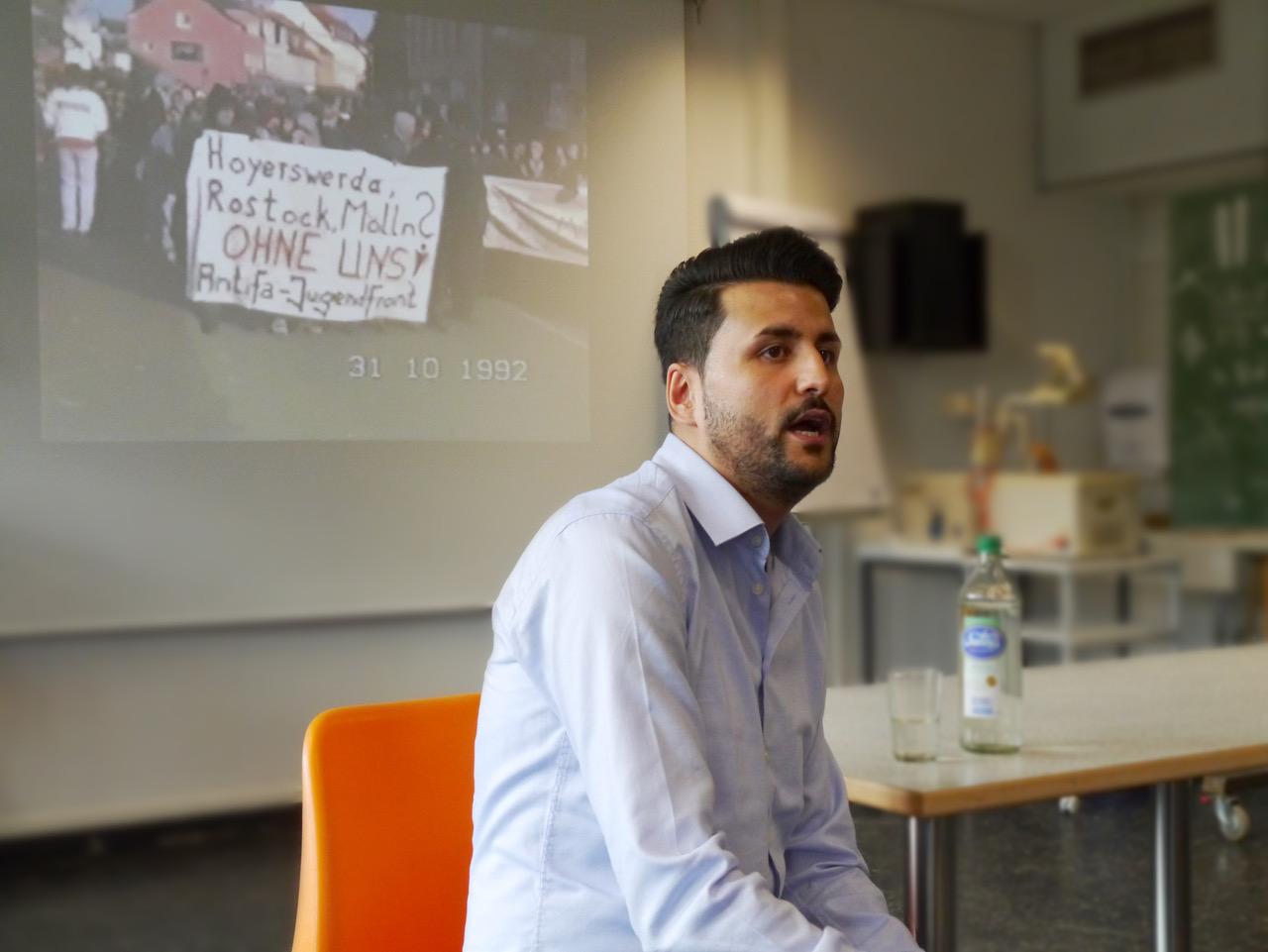
IA: Exactly, the „No tenth victim“ demonstration was in Kassel in 2006, and before that there had already been demonstrations pointing out racist acts. However, hardly anything was done by the judiciary. For example, there was also a demonstration in Mölln, three weeks before our house was set on fire, a granary was set on fire in Mölln. There was a rumour going around that the granary was supposed to house refugees, but it was set on fire anyway. I would say that Mölln and the surrounding area has a small racist structure, an effective racist structure that could have been investigated if it had been wanted. But no racist milieu was investigated at the time. It was labelled a fire and the cause of the fire at the granary was unclear. However, there had been this demonstration three weeks earlier. Antifa people and people from a migrant background were holding a banner in the air as they walked and it said: „Hoyerswerda, Rostock, Mölln?“ Three weeks before our house was set on fire. „Without us!“, they don’t want anything like that in Mölln. And also: because there were already nine victims, they didn’t want a tenth victim. They should now please investigate in the racist corner and investigate in all corners so that there is no tenth victim. In Mölln, if they had investigated every corner of this granary, they might at least have frightened the racists who set fire to our house. They could have been deterred. That’s my thesis. That didn’t happen and that’s why our house was set on fire. This knowledge of migrants and Antifa exists, this foreknowledge. However, it is swept under the carpet and that is also a very big problem in this society, that is also a racist approach, because this knowledge of migrants and Antifa is simply ignored. It is racism to ignore the knowledge of migrants. It’s similar in schools, when migrant children come from working-class families, they go to neighbourhood schools and not to grammar schools because the knowledge of these people is ignored.
DC: You are also experiencing an increase in racist threats and the Mölln speech at Exil 2019 in Frankfurt could only take place under massive police protection. The speaker had received death threats beforehand. What does that do to a person? What does that do to you?
IA: I’ll put it this way, nothing really, because we’ve been living with these threats all our lives. It also happens without us organising a speech in Mölln. Idil Baydar, who gave the Mölln speech, said the same thing. She was not dissuaded and gave the Mölln speech anyway. She said that she also receives death threats as a comedian . However, this is a direct attack on our own culture of remembrance and we see this as a problem because our remembrance is being called into question again and again and is now even being attacked. We gave the Mölln speech anyway and I’ll put it this way, although we live with these threats that we could die or be attacked at any time, we ultimately live in this society. That is our statement in schools, but also in public: if we do nothing, they will attack us. Then let’s do something together to stop them before they attack us. I try to motivate other people in the same way. In the NSU murders, for example (…), the victims were also people who hadn’t done anything actively against racists or were politically active beforehand. They were ordinary people who paid their taxes and went to work and hoped for a safe life in Germany. And died anyway.
DC: Idil Baydar also said, „What else do you want to take from us?“
IA: Exactly.
DC: „You’ve already done everything to us.“
IA: Perfectly formulated! The only thing they can still take from us is this life, the life in our bodies. Our knowledge, our desires, our statements, what we say, they can’t take that away from us, that will always remain in this society. The only thing they can take away from us is our life, and that’s numbered anyway. We’re going to die at some point anyway. And this body is made of flesh and bones, it will die at some point. But our knowledge, what we transmit, that will remain for eternity.
DC: Where do you get the strength to keep fighting? Don’t you sometimes just want to take your family and run away?
IA: Where to? Where to is a good question, unfortunately I don’t know of any country where there is no racism. I think that in Germany we at least have freedom of speech, so we can speak in public here without fear of being arrested. We have the opportunity to motivate many people to show solidarity with those affected. We are taking advantage of this and people showing solidarity have shown us that we can stay here. You also have to say that if all Germans were Nazis or racists, we would have a fundamental problem, that would definitely be a situation that would be intolerable and would force people to emigrate. That’s what happened under National Socialism. How many people fled, over 200,000 Germans fled Germany. Why? Because they simply couldn’t stand a racist situation. That’s why we should have emigrated from Germany, but that’s out of the question for us as long as there are people here who show solidarity. (…) It’s enough if the neighbourhood shows solidarity, if they accept you for who you are, just as I accept people for who they are.
DC: You travel through Germany as a contemporary witness and ambassador against racism and visit school classes. What is your experience of working with children and young people, with very young people?
IA: The cooperation is excellent, at first the pupils always expect a Holocaust survivor because they are told that a contemporary witness is coming today. Then the first surprise is always when they see me, oh, he’s not that old and he’s also dressed like us, so it can happen to all of us. That’s the students‘ first surprise. That’s a very effective, successful collaboration. And then I tell my story and the stories of the other victims. I don’t show any pictures of perpetrators, I don’t mention any perpetrators‘ names in my workshop. And yet the students are interested in my workshop and at the end, and I emphasise this again today, they say that we have never dealt with the victim’s perspective. We have always dealt with the perpetrators. I deliberately mention the names of victims of the NSU: Enver Şimşek, Abdurrahim Özüdoğru, Süleyman Taşköprü, Habil Kılıç, Mehmet Turgut… I then mention the name of the perpetrator or the name of a perpetrator at the end. Fingers go up at the perpetrator and no fingers go up at the victims. But that’s a problem of society, not of schools.
We live in a society of perpetrators, we deal with the perpetrators all day long, with the perpetrator’s perspective. But there is hardly any talk about the victims, the issue of victims is not even discussed in public. That’s why I want to fill a huge educational gap by bringing the victim’s perspective into schools. A trigger is set off in one or other pupil and an empowerment process begins. Suddenly a lot of children, adolescents, are talking about racist conditions in their everyday lives. It’s madness, it’s called an empowerment process , as Holocaust survivors or academics who develop these perspectives report, only those affected can empower each other. Why is that? Because I talk about what happened to me, about my experiences, about my everyday life, and as soon as someone else hears it, they automatically see a reflection in their everyday life. And then they say, look, I’ve experienced that too, I experience it every day. And today I have the opportunity to talk about it, otherwise I wouldn’t have the chance – and they start talking. Emotional moments happen, pupils start to cry. „Empowering“ moments happen, pupils come up with the idea of organising themselves and dealing with the victim’s perspective. In the end, it is said that we are creating a new society, a society that does not deal with the perpetrators or does not deal with them much, and therefore does not sympathise with the perpetrators, but rather deals with the victims and those affected and sympathises with them.
We use the word victim in a different way, by filling it with strength and sympathy and no longer expressing it as passive, weak and oppressed. We have to recast the words. That’s what I try to teach the students and it works really well, I get great feedback. However, I do this on a voluntary basis (laughs), I still don’t have the opportunity to work actively in schools on an educational module. Even there, I think there is still a lot missing. I’ve done my own research, we still haven’t filled this educational gap in our education system in the whole of Germany: Migration society and guest worker generation, that is missing in our education system, and for that reason these people are always foreign to us. For this reason, migrants do not feel represented at school because their history is missing. Their family history is missing. And we have to change that.
DC: That leads to the last question. What would you like to see from German society?
IA: Well, I actually answered the question in detail by mentioning the problem of the culture of remembrance. I said that we are questioning the culture of remembrance of the majority society by creating our own. Incidentally, Holocaust survivors have also been trying to do this for years and are still doing so. I said that we have to create new educational pathways, we have to develop new educational modules where we bring out the perspective of these people. We can only do this together with those affected, only together with migrants, if we also allow them to flow into these systems. That is indeed what I would like to see. I would like to see sensible interaction on an equal footing, communication on an equal footing with those affected.
DC: Is there anything else you would like to add that has not been mentioned that is important to you?
IA: A lot, but I think that would go beyond the scope of this article. For example, I could talk a lot about the NSU victims, but I’m not a victim of the NSU. I also often give examples from our family in schools, but also from other families. For me, it’s always important that when people see my interview or hear what I say here, they know that it can’t be reduced to Mölln. And that this behaviour cannot be reduced to Mölln society, but that we have a problem for society as a whole. I think that also came across well in the interview.
DC: Yes, thank you very much for the interview.
IA: Thank you.
The interview was recorded in Hamburg in February 2020.
Interview with Daniela Collette
Editor : Dr Irmtrud Wojak (BUXUS STIFTUNG)
Listen now
Discover the podcast series of the Fritz Bauer Forum
Here, experts talk about justice, human rights and social change. They provide in-depth insights and develop diverse perspectives on current issues that affect our society.

