
Autor/Autorin
In the face of the approaching climate crisis, what can young people do in the fight against the climate killer coal and large corporations such as RWE? What to do when talking and striking alone is no longer enough?
The Ende Gelände action alliance has been organising large-scale civil disobedience campaigns since 2015. Most recently, in June 2019, the North-South Coal Railway and the Hambach Railway, as well as the Garzweiler opencast mine itself, were occupied by over 6,000 climate activists and four of six production units were temporarily halted. The alliance was supported by the students of „Fridays for Future“, who organised a large demonstration along the open-cast mine. These mostly very young people used their bodies in a non-violent way against sometimes massive police violence to at least temporarily slow down RWE’s climate-damaging coal-fired power generation. Another mass action of civil disobedience is planned for November 2019 at the opencast lignite mine in Lusatia.
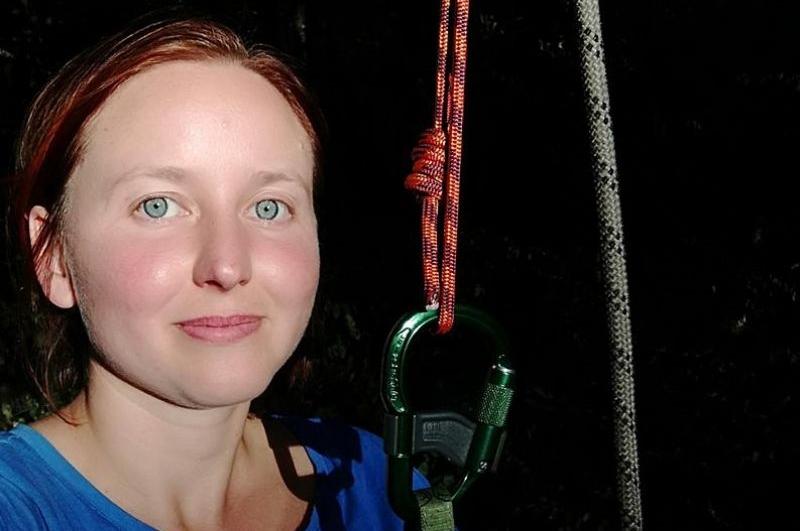
In the following interview, Kathrin Henneberger – spokesperson and activist for Ende Gelände – explains why climate change affects the people of the Global South first, but then all of us, and why it is becoming increasingly important to engage in civil disobedience today.
DC: Hello Kathrin, thank you very much for the interview. Perhaps you could start by telling us a bit about yourself. You live in the Rhineland and grew up in Cologne. So you have a close connection to this region and the Rhenish lignite mining area?
KH: Yes, I was born in Cologne and grew up in the Rhineland – and like many people from Cologne, I’m a bit of a local patriot. I really like living there. But what I got to know very early on, quite close to Cologne, less than twenty minutes away on the S-Bahn, is the largest source of CO2 in Europe, the opencast lignite mine of the RWE coal company. As a child, I learnt about the climate crisis and tried to understand the connections. It simply hurt a lot to realise that one of the main causes of the climate crisis was my home and was causing so much suffering for people in other regions of the world. That’s why I started campaigning against opencast lignite mining and against the coal company RWE.
DC: Those are far-sighted insights for a child. How old were you then? Was there a key experience?
KH: I was about thirteen years old (laughs) and started hopping around the Hohe Strasse in a penguin costume and handing out flyers about the climate crisis. There weren’t that many listeners back then, but that’s why I’m all the more pleased that the young people who are active today stick together so strongly, are so numerous and just get so damn loud.
DC: But how did you end up distributing flyers about the climate crisis at the age of thirteen in a penguin costume? Most 13-year-olds don’t even know what a climate crisis is yet.
KH: They do now. I stumbled across the topic back then and then simply got to grips with it more. Children are curious and one thing led to another. I was very quickly politicised by the issue, but it wasn’t just the climate crisis, it was of course also the anti-nuclear movement. It was all the other environmental crises that are connected. We’re not just living in the time of the climate crisis. In the beginning, of course, it was somehow about penguins and whales. Then I very quickly realised that this is about everything and that human rights are also very central to it.
DC: Did you then have support from your family, are they also active, or from friends?
KH: My parents aren’t active, but they always thought it was really cool what I do. I think it’s very important for young people to start forming gangs. For me, it was the student council at Rodenkirchen comprehensive school. We were just a very strong gang, a small gang that was very politically active. When I was fifteen, the Iraq war broke out and that was something that very much politicised my generation. On the day the war started, we called a general assembly as a student council and called for a strike. And then half my school really did set off for the city and joined the big student protests there. We only went on strike for one day, not like the young people today who strike every Friday, but that was simply a key moment that politicised us all. How can it be that you start a war even though all the evidence is against it, even though it’s against international law, and everyone goes along with it? And then to be part of this movement of millions of people and to stand up against this injustice – that was very, very important for all of us.
DC: You also experience a lot of solidarity that carries you. When everyone stands up together.
KH: Definitely. My first arrest was also when I was fifteen, at an anti-Nazi demonstration. I wanted to go to the anti-Nazi demonstration in Cologne with my gang. At school, we had learnt all about what the „Third Reich“ meant. I also learnt a lot about the history of what happened in Cologne from my family and then thought: „We can’t have Nazis demonstrating here again.“ So of course I joined the protest and wanted to block it, together with lots of other young people. We didn’t even make it to the blockade. We were all collected beforehand and taken to the detention centre. And that was the first time I realised how important it is not to be alone, to travel to such events together, to support each other. Back then, we didn’t have the kind of action training programmes we have today for young activists. You get into situations like that, where you suddenly don’t even know: „Oops, what am I doing in this police car?“ That was one of the key moments where I learnt that standing together in solidarity is very important in movements. Movements only work if the protagonists support each other, i.e. form gangs and stick together against repression.
DC: In 2008, you were a member of the federal board of the Green Youth and, I believe, its spokesperson? You represented the Green Youth in the Attac coordination group. What important experiences did you have during this time, which was also party political?
KH: Yes, I started to get involved in party politics in the Green Youth because Fridays for Future didn’t exist at the time and I wanted to get involved in climate policy. And the Green Youth was the only organisation that pushed this very strongly. I also wanted to make my own decisions about how I did politics. Many youth organisations, especially in the environmental field, tend to be told what they have to do. In the Green Youth, rebelliousness is part of the programme. It’s about showing your spines and deciding for yourself what you want to stand up for. You also learn to assert your positions against older people in the party or against the parent party. That was very important for me: learning to take a very self-confident approach and not letting the older generation tell me what content is realistic or not. Because every generation has its own task, which sometimes not everyone understands. For my generation, it was the climate issue. I started getting involved in party politics because I realised that it was about changing the framework conditions. You can achieve a lot with individual behaviour, but not everything. You can devote your whole life to trying to live in an ecologically correct way, but you won’t succeed one hundred per cent because you simply live in a system that imposes constraints on you. And for me, it’s about creating a framework that allows us to live in a CO2-neutral society, but at the same time live in a socially just one. Or the question: How can we transform the economy and society? How can we accompany this in a socially just way? I don’t want to leave that to others, I want to help shape and co-determine it myself.
DC: How important is it to bring together different movements and struggles? Is that even possible?
KH: Yes, they are interdependent. The climate movement belongs together with a movement for social justice and human rights. They can’t work without each other.
DC: Politicians are trying to play the movements off against each other. Now, for example, the anti-nuclear movement is being pitted against the anti-coal movement. And the people who are campaigning for the preservation of the villages against those who are campaigning for the preservation of Hambach Forest. It doesn’t always work, this playing off against each other, because it’s basically one and the same movement.
KH: Exactly. As a movement, we are diverse and stand together in solidarity. So the people who support the Hambi, of course, also those who support the villages and vice versa. Of course, there are always attempts by politicians on the other side or their economic allies to drive wedges between the movements, between individual actors. But that simply doesn’t work. We are very, very inextricably linked. It also somehow makes no sense to be in favour of the Hambi and not fight for the villages at the same time.
DC: At a press conference, Mr Laschet1 said something like, „Yes, now we have to preserve the forest, so we have to remove a village.“ Now we just can’t preserve the villages.
KH: Yes. Mr Laschet is someone who always tries to divide because he’s afraid of the strength of our movement. And of course Mr Laschet is still trying to push through RWE’s corporate interests. And because they have now come under such strong pressure in Hambi, they are naturally very scared. That’s why they caved in there. Our aim is to make them just as afraid when they start to touch the villages. And that is why we will now be focussing on standing by the villages.
DC: You’ve just said that climate justice is not just an ecological issue, but also a social issue. But why is climate justice also explicitly a fight for human rights or a fight against racism?
KH: The climate crisis is not a problem of the future. It is a cruel reality, especially in the countries of the global South. And it doesn’t affect everyone there equally. It determines how wealthy you are, your educational status, your access to infrastructure, your medical care. Whether you have gainful employment or whether you own land. And you can clearly see who is affected first: women from indigenous communities, for example, who are dependent on natural resources being available to them. These are women, for example, who live from subsistence farming in rural regions in the countries of the global South. Not because women are „weaker“ than men, but simply because they have less access to infrastructure, to education for example. It must therefore be clearly recognised that the effects of the climate crisis affect those who already live in poverty and are less able to protect themselves from the climate crisis. These are mostly people who are not white and not from the North. That is why the effects and causes of the climate crisis are also a very clear question of racism and human rights.
Not everyone can decide what happens next in the same way. What measures are we taking to stop the climate crisis? A very small part of the world’s population, which is also primarily white, primarily male and also very wealthy, is currently doing this. And the „rest“ of the population, unfortunately, has no say in the matter. If we are talking about stopping the climate crisis, then we also need to talk about how we can radically change our economy. How can we build a completely different economic system? One that doesn’t exploit people, that doesn’t exploit nature. And how can we manage to democratise our society? To create decision-making structures that really allow everyone to participate? Because of course it doesn’t help if you simply fill the old decision-making structures, which are not transparent and democratic and are characterised by patriarchal power, with more women. We need completely different decision-making structures. And that’s why stopping the climate crisis also means standing up for feminism, standing up for women’s rights. That women are actively involved in decision-making structures.
DC: And that’s why it’s so important for you to continue to network globally and to take part in the UN climate conferences? Can you tell us a bit about that?
KH: Exactly! I started taking part in the UN climate conferences about ten years ago. And I also take a very critical view of the climate conferences, in the sense that this is the 25th UN climate conference and we haven’t yet managed to really implement global climate protection at UN level. To put it bluntly, we have not yet managed to save the world in this way. But at the same time, they are also important because they give representatives from the global South the opportunity to raise their voices and for us to network. What I also took away from the UN climate conferences is an incredible amount of knowledge from women, especially indigenous women from countries in the global South, who I would not otherwise have met. We have formed global gangs or support each other very strongly globally with joint projects, with joint power struggles against patriarchal male structures, which unfortunately also take place globally due to colonisation. That’s why it’s simply very, very important that we don’t just look regionally at how we can become active, but how we can connect the individual, mostly grassroots movements globally and then build a different world of solidarity together? No matter what patriarchal power structures say.
DC: Now let’s move on to Ende Gelände2. Ende Gelände formed in 2014/2015 – you can’t say it was founded? What spectrum did the movement emerge from?
KH: Ende Gelände came together as a European climate alliance because we realised that nobody was really talking about coal. Especially here in Germany. Coal is one of the main sources of CO2 in Germany. If we want to pull the emergency brake with immediate measures and stop the climate crisis, then we have to tackle coal. Then we have to phase it out immediately. That is our local responsibility here in Germany. But nobody has really talked about it. It was a bit of a taboo subject. And even large associations and political parties have found it very difficult because, of course, the question immediately arises: what about the employees? How can solutions be found? To what extent do you suddenly find yourself in a dispute with the trade unions? That’s why there was very strong resistance to tackling the issue at all. But it was important for us and it was also important for us to be an actor who says very clearly what actually needs to happen from the perspective of the climate crisis. That we simply don’t have any more time and need to get out of coal now. If we had asked nicely, nobody would have listened to us. And nobody would have understood why this is so important to us. That’s why we decided to simply go into the coal mines and stand in front of the diggers with our bodies. To make it very clear that we climate activists are now taking responsibility. That we no longer want to stand by and watch how the way we live here causes so much suffering in other regions of the world and that it is simply our responsibility to take action now. Unfortunately, we had no other choice in this situation and unfortunately we still have no other choice but to stand in front of the excavators with our bodies. Because the politicians are simply not acting or not acting enough and the business organisations are not necessarily listening either.
DC: That’s why it’s so important that so many thousands of people at Ende Gelände stand with their bodies – as you say, at their own risk – partly in front of the police and in front of the excavators and in the pit and on the tracks.
KH: In the beginning, we weren’t 6,000 like last time, we were just over 1,000, and then every year there were more activists who came from all over Europe. It was a very international action every time. Last time we were well over 6,000 people who flooded into the open-cast mine. That also shows that more and more people are daring to take this step. Because it’s no fun going into a coal mine, of course it harbours dangers. But to take this risk and say: „It’s worth it to me now to flow through the police lines into the open-cast mine, to take all this upon myself in order to make a clear point: We have to get out of coal now and it simply can’t go on like this.“
What I have also observed over the years: In the beginning it was activists my age, young activists, the last time I met a lot of parents, parents of young children, who said: „My children are still too young for this, but I’m going into the pit for my children now.“ Fridays for Future simply had an incredible impact. (…) You could just see that the children realise what it’s all about and then the parents. Because it’s not normal for parents to go to the coal mine for their children. We live in a very absurd world where something like this seems to be necessary.
DC: There was also a „colourful finger“, where parents with small children, prams and people with disabilities and handicaps, wheelchair users also travelled along and stood protectively in front of the other fingers.
KH: Exactly, that was very important to us this time. One wheelchair user got in touch with us and said: „Hey, I want to take part.“ And then we said: „Okay, let’s make it happen.“ Then, of course, even more people got in touch when they heard that, and we founded the „Colourful Finger“. That was the first time, but it will take place again next time to give all those who, for whatever reason, can’t go into the pit, can’t slide down the slopes with us, an opportunity to take part. We are trying, so to speak, to make activism the way we live it, the way we actually want society to be: so that everyone can participate. (…)
DC: Can you tell us something about the next Ende Gelände actions, as far as possible?
KH: Our resistance as a climate movement has only just begun. And the next action will take place in Lusatia and next year, of course, it will continue. Ende Gelände was one of the first climate alliances to organise mass civil disobedience and there are now many. There are now organisations such as „Sand im Getriebe“, Free the Soil, AufBäumen and am Boden bleiben. Then of course there are new movements like Extinction Rebellion, so a lot has happened. There are now similar alliances across Europe and the exciting question is, of course, how can we come together as a climate movement in our diversity? How can we continue to exert pressure together and enforce climate protection? By shutting down coal-fired power plants, by perhaps also shutting down other fossil fuel industry targets. It’s not just coal. We also have to get to oil, we have to get to the car companies and simply push as a player.
DC: RWE tried to intimidate you this year – probably because you are the spokesperson for Ende Gelände – by banning you from the premises? They wanted to force you to sign a declaration to cease and desist.
KH: (laughs) Exactly. I was at the RWE Annual General Meeting. The critical shareholders gave me the right to speak, so I gave a speech and made it very clear to the white old men from the RWE Executive Board, who were sitting a few metres away from me, how urgent the climate crisis is and what we are planning to do and what they should actually do. They didn’t find it so funny that this young woman from Ende Gelände was suddenly standing there and criticising them. And then they called their lawyers on me and I was banned from the premises and given a cease-and-desist letter to sign. I didn’t sign it, I’m not so easily intimidated by a coal company. But the situation also shows that RWE is not too shy to engage in such repression and that they believe they can succeed with such attempts at intimidation. And we see this globally: large corporations always try to intimidate their critics, but we simply cannot allow this to happen. As an environmental movement, we will oppose this very strongly.
DC: Have you experienced any other repression or threats against you or people around you?
KH: Yes. The police have also tried to play their jokes. I’ve now been reported for a tweet. We always make a bit of fun of other countries where people are reported for tweets. They get reported in the Rhineland too. Me, because I posted a mobilisation tweet where I said: „Hey, everyone, come and take a walk in the forest on Sunday.“ The police reported it to the police and on this walk in the woods they came up to me and picked me out and gave me another report. That was a deliberate attempt to harass, annoy and intimidate the person from Ende Gelände who was talking to the press. My lawyers are looking into it. You can’t be intimidated by something like that. (…)
What always scares me a lot – well, it doesn’t surprise me, but it’s still frightening – is how especially male people on social media, on Facebook and Twitter, if you can even identify them by their account names, think they have the right to make threats. It starts with „You stupid girl“ and goes all the way to threats of rape or beatings. Especially in the Rhineland, if you look – especially on Facebook you can read about it very openly – there are a lot of people who feel somehow close to the RWE Group and think they can make threats via their social media accounts with very toxic male aggression. Against me if I speak out somewhere or if they have found an interview of mine somewhere, against other climate activists. It happens to me in the Rhineland in particular, but it happens to other climate activists in their regions or nationwide. Greta is the target of international hostility. And I think that’s also a reflection of our society. How much hatred there is in many people and how much aggression there simply is towards people…
DC: Towards people who think differently.
KH: Yes.
DC: What does civil disobedience mean to you?
KH: There are always moments in the history of mankind when, unfortunately, nothing can be achieved with kind pleas. There are always moments when actors have to consciously go a little beyond the current legal situation in order to draw attention to great injustice. My role model here is very clearly the women’s movement 100 years ago, which fought for women’s suffrage. That was something unimaginable at the time. But women came together, formed gangs and fought for their right to vote through civil disobedience. What we are doing, what my generation is doing, we are simply confronted with the climate crisis, with the great injustice of the climate crisis, and at the same time with a policy that is failing, a society that is failing. A society that relies on „That’s just the way we do things and that’s the law“. We are breaking the law by stepping over the open-cast mine and standing in front of the excavators, simply to make a very clear symbol: What is happening here is wrong and we are protesting against it.
DC: „We’re doing well in Germany“, that’s what you always hear. „Why put up resistance if we’re doing so well here?“ Should resistance be compulsory again?
KH: Not everyone in Germany is doing well. We have huge disparities in social justice. Wealth is very unequally distributed. We simply have to do a lot in Germany. We have a very repressive Hartz IV system. For me, climate justice also means making our society fit for the future. Because we will have fewer jobs in areas that are only designed to produce consumer goods in the short term. (…)
Climate justice in Germany also means reorganising our social systems and making them fit for the future. That we have an existential basic security for all people instead of these Hartz IV repression systems. That we manage to have well-paid jobs in care, childcare and education. And fewer jobs in areas that only produce short-term consumer goods. That we will have fewer jobs in the automotive industry, but at the same time more jobs in public transport infrastructure, i.e. local public transport. Climate justice doesn’t just mean that we have a CO2-neutral society and everything else remains as it is, but that we fight for a socially just and grassroots democratic society and a society with equal rights. (…)
DC: You would probably also say that to the people who fear for their jobs in the lignite mining region and are also being used by RWE?
KH: We need a social transformation now, especially in the Rhineland lignite mining region. There is an incredible amount of potential there if we invest in renewable energies. If we bring new technologies to this region. If we see this region more as a workshop for the future. What can a society look like? How can we live together in a new way? RWE is trying to incite the trade unions against climate activists. The sad thing is that RWE, as a coal company, doesn’t care about jobs at the end of the day, it’s all about making big profits for its shareholders. That’s why you can’t rely on big coal companies. Instead of this type of energy generation, we need more energy in the hands of citizens, for example, i.e. energy cooperatives and decentralised renewable energy supply. (…)
DC: Doesn’t it make you incredibly angry or frustrate you when, after the last Ende Gelände action, there is a debate about a carrot field that I heard had long since been harvested, but not about the violent police violence against people or the injustices that climate change brings with it? A carrot field that is suddenly much more important to politicians than anything else?
KH: Yes, the story with Farmer Willi is totally absurd and it’s unbelievable how the media, but also politicians, have responded to it. This story and the way it has been represented, especially in media like BILD, shows that we have hit a nerve. And that they then tried to distract us. Instead of writing about why these climate activists are standing in front of the coal excavators and why it’s so urgent, they prefer to write about a few carrots that don’t even belong to Farmer Willi and about an old white man who stands there and complains a lot, even though he’s not affected himself. He just wanted a lot of attention (…).
DC: How do you deal with the kind of anger or frustration that you often experience? Or don’t you experience it?
KH: I don’t actually experience anger at all. I’m just very annoyed with the politicians and I don’t want to let them get away with it. I want to hold them to account and I’m particularly angry about the current state government of North Rhine-Westphalia, which cleared the Hambi a year ago and is now trying to cover up who had what agreements. I am angry about a coal company that simply wants to carry on as before. And then also tries to get a lot of money as compensation for perhaps excavating a little less. I simply don’t want to let anyone here in the Rhineland get away with the fact that this is a region that causes so much suffering. That’s why for me it’s about putting a stop to them and breaking up these power structures and working together with everyone in a truly democratic way to ensure that we implement climate justice.
DC: What is your assessment of the results of the Coal Commission and the climate package?
KH: The results of the Coal Commission are rubbish. They are not even being implemented yet, a coal law will probably not come this year, nor next year, and it’s simply not enough. It’s not enough for the two-degree target. The target is one billion tonnes of CO2 short of the two-degree target. And this two-degree target is simply very dangerous, because even there the tipping points of the climate system are already beginning to be exceeded. What we really need as an immediate climate measure is for coal-fired power plants to be shut down now, in 2019. And that is easily possible. However, the industry is still trying to gold-plate the coal phase-out and does not see any point in giving up its short-term profits. This is where politicians should be called upon to reprimand them. But they are not doing so, and that is why it is the people who must now intervene, who must build up massive pressure through large demonstrations, through civil disobedience, through various other types of action. Only then will we really be able to make coal power a thing of the past. At the same time, the Coal Commission was a very non-transparent commission that met behind closed doors. The fact that it was set up in this way at all was clear from the outset: this coal commission is a very poisoned offer, nothing good will come of it. If we want to take climate protection measures, then we have to make sure that there is a good way forward.
DC: And the climate package?
KH: That’s exactly the same.
DC: Do you have specific demands or does Ende Gelände have specific demands for politicians? You just said one, an immediate shutdown of all coal-fired power plants. Are there any other specific demands?
KH: 1.5 degrees. Our demands are actually quite simple: we want politicians to stop trying to fob us off with palliatives like the climate package or the coal commission. And that they realise the seriousness of the situation. We want to do everything we can to ensure that we do not exceed the 1.5 degree limit. Because from 1.5 degrees, the tipping points are exceeded. This summer, we have seen what is happening in the Arctic regions. From fires that were actually predicted for 2090. That’s why it’s so important that we realise how serious the situation is and that we need to take immediate action now. It’s about this year and it’s about the next two, where we have to fundamentally change our whole way of doing business and consuming. We have to work very hard to become a climate-neutral society as quickly as possible. If we miss this window of opportunity, the mini window of opportunity that only exists now, then we will soon no longer have the climate system under control. Because once the permafrost thaws or once the continental ice sheets start to melt very quickly, as on Greenland, or once the Amazon starts to turn more and more into a steppe, then these are processes that we as humans will no longer be able to stop. That is why it is so important that we act now. We don’t have five years left, we don’t have ten years left, we only have 2019, 2020, and we need to be very aware of that.
DC: Then there’s always this two per cent figure in the media. That Germany is responsible for two per cent of CO2 emissions, which many people use to argue that Germany can’t play a role here. What do you say to these people?
KH: That’s nonsense. Firstly, Germany has a historical climate responsibility. Since industrialisation, we have been burning an incredible amount of coal, especially lignite, hard coal and other fossil fuels. It’s not just about what we’re emitting right now, it’s about what we’ve been emitting for the last 150 years, which has caused the current climate crisis. At the same time, industrialisation has brought us a great deal of prosperity, but at the expense of people in countries of the global South and at the expense of our children’s future.
Germany is still one of the world’s biggest emitters of CO2, so you have to look at emissions per capita. Of course, if you take China as a country and put it on a par with all other countries, then emissions have increased there. But if you look at the emissions per capita, then the emissions in China are still very low. At the same time, emissions in Germany are currently around eleven tonnes per capita. We should actually only be emitting around one tonne per capita per year. Germany is still very clearly one of the very strong emitters per capita and therefore also has a very strong responsibility.
DC: What does the Hambach Forest mean to you?
KH: The Hambach Forest, called Hambi, is not only a place of resistance, but also a place where we have begun to live a different society. By first standing together in solidarity, different actors. The Hambi is a symbol in two respects. On the one hand, it is a symbol for all the ecosystems around the world that are coming under very strong pressure and are beginning to collapse. Because the Hambi, like all other Central European forests, is beginning to suffer from the heat and drought of recent years and is simply not coping well with suddenly living in a different climate zone. Even when you walk through the Hambi, this summer, last summer, you realise that the forest is suffering massively from the climate crisis. That’s why, for me, it’s very symbolic of what’s happening to our ancient forests globally.
And at the same time, the Hambi is an incredible symbol of hope. A year ago, a year and a half ago, we didn’t believe that we could save the hambi. It was a very desperate battle that we were fighting. We assumed that the state government, that the coal company, would clear it with all its might, which they did, and then clear it. And then to experience that if we really all come together and 50,000 people demonstrate at the end, we can save it. Because it was only when the 50,000 demonstrated that the issue became topical in the Coal Commission. And only then was the word desirable written into the Coal Commission. That the forest is desirable to preserve. And you can see from that, okay, if we need 50,000 to save the Hambi, how many do we need to save the entire climate system, to save all ecosystems? We need millions, if not billions, of people to get involved, to demonstrate, to protest and to start making policy themselves.
DC: And you’ve been active for a long time now at the age of 32. When you see the 14- and 15-year-old students from Fridays for Future taking to the streets, what advice do you give them?
KH: They should listen to themselves. Because every generation has to learn and find itself. I always found it incredibly annoying when the older generation interfered with me. It is very important that we stand together in solidarity. So if there are young climate activists who need rhetoric training or press training, for example, then we run the courses. Our knowledge is their knowledge. There’s no question about that. But what I think is simply fantastic about the Fridays for Future movement is that there are an incredible number of very young women who are fighting very clearly to be heard. Because women are still not being heard on an equal footing when it comes to climate and energy policy. The fact that they are very loudly represented gives me incredible hope that we can still manage to build this other world together that we dream of.
DC: Is there anything else you would like to say in conclusion? Is there any important point that has not been taken into account?
KH: I don’t know. I’ve probably forgotten a lot again. But everything is actually fine.
DC: Okay. Then thank you for the interview.
KH: Thank you.
Interview : Daniela Collette (Bochum)
Photos : ©Ende Gelände
Editor : Dr Irmtrud Wojak
Listen now
Discover the podcast series of the Fritz Bauer Forum
Here, experts talk about justice, human rights and social change. They provide in-depth insights and develop diverse perspectives on current issues that affect our society.

