
Autor/Autorin

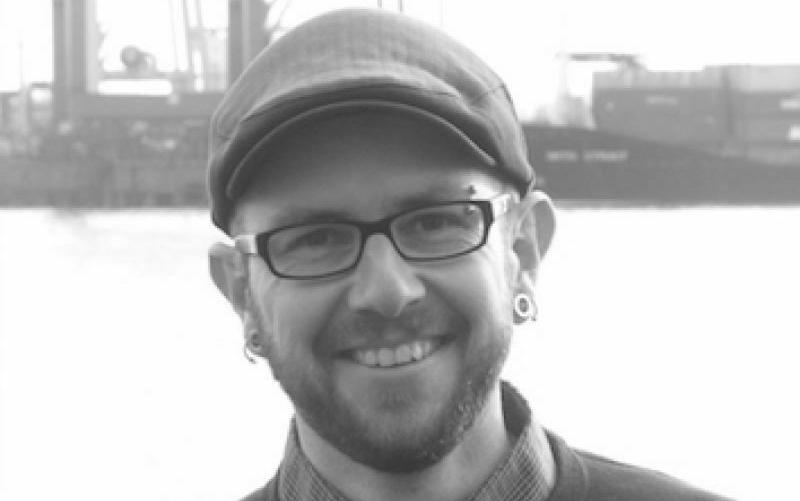
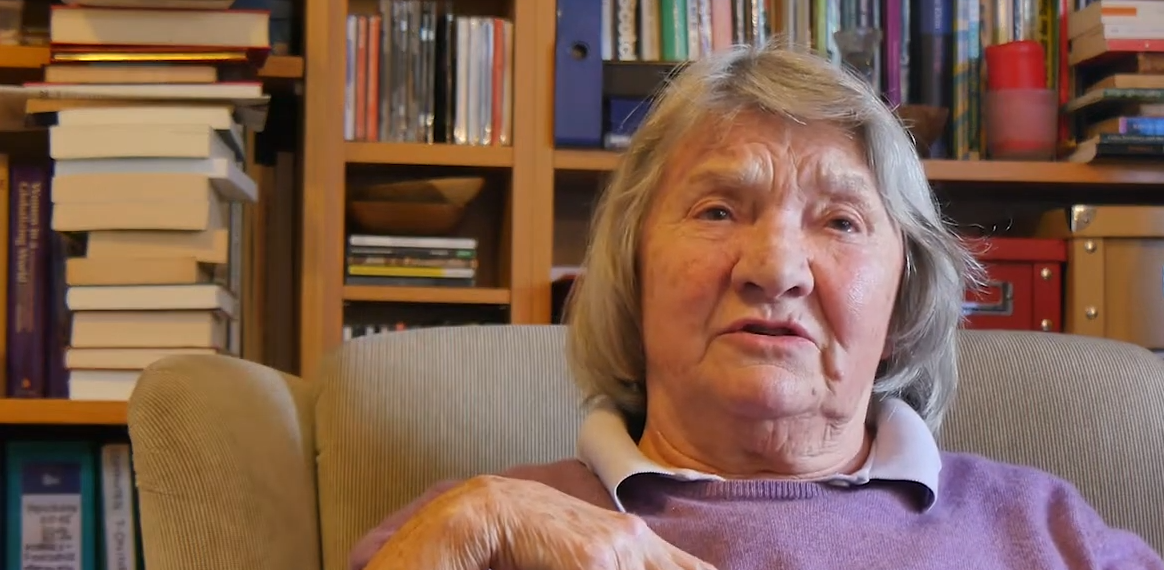
On 10 October 2018, historian Dr Irmtrud Wojak and educationalist Stefan Schuster visited feminist Maria Mies in Cologne and spoke to her about her career, patriarchy, religion, equality and human rights.
Maria Mies (1931*) is an emeritus sociologist. As a young woman, she moved from the village to the world. She gained valuable experience in India, fought with her students for the first autonomous women’s shelter in Germany and had a lasting influence on the course of the New Women’s Movement with her numerous writings.
The following are transcribed extracts from the interview. Omissions in the transcript are marked with (…).
S : Mrs Mies, can you describe the conditions in which you grew up, in Auel, in a little more detail? (Clip 1)
M: Yes, of course. (…) We were a lot of children and we had to work, like everywhere else in the country. That was quite clear. We had to work in summer and winter and we also had to go to school. That was also clear. But the more important thing was the work. (…) That’s a thing that no one understands today, that work was necessary and the children had to work. (…) And the school was, of course, designed so that we were farm children. (…)
I : And where are you in the line of siblings? In terms of age?
M : In terms of age?! Well, we are twelve children, so six little ones and six older ones. And I’m the oldest of the little ones. (…)
I : But in your family it was a matter of course that you went to grammar school as a girl?
M : No, it wasn’t a matter of course! I pushed it through, but it wasn’t a struggle either. My father took me to Trier, for example, when the French started to make a (…) school (…). He didn’t slow me down at all and neither did my mother. He also wanted me to do everything right, but he wasn’t ambitious either. He was sure that Maria could do it. Yes, that was the case. (…)
I : How long did you work as a teacher then?
M : Well, first I was a primary school teacher in the Hunsrück. No, that’s not true, I was first a primary school teacher in the Eifel and then I got transferred because there was nothing to do (…). Then I came to Morbach. That’s in the Hunsrück. And then I started training myself, but I had to pay for it myself, in Trier, to become a secondary school teacher. And then I took the secondary school teacher exam and chose English as my main subject. (…)
I : Somehow one senses that the corset of school was too tight for you.
M: It was too tight, it was simply too tight. Especially with the English. (…) I had time, there wasn’t much you could do in this small town. I just read and then I took this English exam. (…)
I : But with the idea of leaving school? (Clip 2 )
M : Yes! Even with the idea of leaving school. Because it was all too small and too narrow for me. And then came the story that really brought me into the world. (…) I was good at painting and then once there was a competition (…). Then I painted the history of transport on a big poster and then I got a prize and was able to travel all over Germany. That was my first big trip, free of charge – a lucky coincidence. Yes, and then came the story with the Pakistani (…). Someone had told me that if you come to Munich, you absolutely must (…) visit the Deutsches Museum (…) (…). Then this Pakistani stood in front of us, a tall, dark man, and asked if we spoke English. Then I said: „Yes, I do.“ Yes, that was the famous beginning of my love story. (…) It dragged on for a very long time. The man was Muslim and I was Catholic, that doesn’t go together. After that, I studied the religions in detail. That was my first confrontation with religion.
S : And what conclusions did you come to?
M : It’s not possible, it’s like a wall. He can’t give up his religion as a Muslim and neither can I as a Catholic. (…)
I : And when, Maria, did the topic of your life, I’ll call it that now, actually come up? (Clip 3 )
M: You mean the women’s movement? (…) I didn’t just want to be a primary school teacher any more. I really wanted // the world, to have something to do with the world. I didn’t know exactly where I wanted to go and then, quite naively, I applied to the Goethe-Institut (…). And then they offered me: „We’ve opened a new Goethe-Institut in India (…), you can go there.“ That was in Pune, in western India. (…) Anyway, I travelled there with great enthusiasm (…). Yes, and that was wonderful (…). There were no rules about what we should teach or how we should teach. So it was all open and I’ve had this situation very often in my life, that I go somewhere or drive somewhere and I can do anything. (…)
I : And the students you had there, I thought they were actually women, weren’t they?
M : No, there were men and women. There were also women there and I was very surprised, I only realised that later, that women from all over India came there (…) to learn German. (…) And then I asked some of these female students (…): „Why are you learning German, you can’t do anything with it here?“ And then it turned out that they wanted to postpone marriage. (…) This course lasted two years. They were able to delay the marriage talk for another two years. (…)
I : How long did you stay in India then?
M : That was five years. A long time. (…)
S : Did you already have a concept of capital and patriarchy at that time?
M : No, I didn’t have a concept, but I had experience. (…) I learnt all that too. A girl is a misfortune. When a girl was born, it was a misfortune. The son was celebrated when he was born, the girl was put to one side. (…) So it was a misfortune for the woman if she gave birth to a girl. You have to realise that. That’s when I became a feminist. I knew what it was. I would say I learnt the most from my own experience.
S : In your autobiography, you write that you discovered Marxism and that the eleventh Feuerbach thesis in particular played – and probably still plays – a decisive role.
M : Yes, but you’ll have to quote it now so that I don’t have to search around for a long time.
S : „ Philosophers have only interpreted the world differently, it’s a matter of changing it. “
M : That has remained my motto to this day: „The important thing is to change it.“
S : What fascinated you about this eleventh thesis?
M : Both that interpreting is not enough. That actually the whole academy, the university, is satisfied with interpreting the world, the philosophers. It’s up to others to change it (…). That’s the problem. (…) „It depends on changing it“ is really Marx’s main theorem. (…)
S : What I found interesting is that the reading of Marx, Engels, Hegel, coincides with the political night prayers. (Clip 4 )
M : Right, yes (…)
S : Your break with at least the monotheistic world religions also took place at this time. How did that come about?
M : Because I got to know other religions. And then the Catholic faith also became more and more ambiguous or dubious to me. (…) But the political night prayer was the break with religion. (…)
S : What significance did your feminist view of world religions have? (Clip 5)
M : Yes, exactly. If you look at world religions with feminist eyes, then you can no longer be religious. All the religions I know, the ones we still have today, have subjugated women. Women have no status there, just like men. They are patriarchal. Almost all of them, I don’t know of any existing religion that isn’t patriarchal. (…)
S : Finally, perhaps we could at least briefly discuss the relationship between capital, patriarchy and human rights?
M : Patriarchy and capital, let’s start there. Patriarchy is older, of course. That is what has actually characterised and still characterises gender relations worldwide, that women are subordinate to men. Even in modern societies, although all sorts of things have been done to achieve equality. But if you take a closer look, that’s not the case. Even though a lot has changed, practically changed. (…) There must be something else there. So it’s not equality. I don’t want to be on an equal footing with these men as they are now (…)
I : Yes, you’ve always said that, haven’t you? It’s not about EQUAL EQUALITY or what is always referred to as this EQUAL POSITION – ( Clip 6 )
M : EQUALITY is even worse!
I : It’s actually even worse, isn’t it?
M : Yes. (…) I always say to my husband, no male animal beats the female animal, beats the female animal. How is it that the crown of creation of all people sees this as normal? (…)
I : What do human rights mean to you? I mean, it’s been seventy years since they were invented, let’s say. What significance does that have for you? Did it play a special role in the development of the women’s movement? In your concept?
M : Human rights are important, of course. And that they are the same for men and women. They are human rights, everyone has the same rights. I can’t say now whether they will be handled in the same way afterwards. (…)
S : In your eyes, is the realisation of human rights even possible in capitalist and patriarchal societies? Or is this a fundamental contradiction that cannot actually be resolved?
M : That would have to be solved. It could be solved. But then capitalism would have to be abolished first. Because this system, capitalism, needs inequality. So there has to be competition. If you look at the salary of a manager, for example, (…) and say that everyone has to get that, then there would be no more capitalism. That doesn’t work (…).
S : When I look at the history of human rights, I think it’s fair to say that human rights have been appropriated, instrumentalised. And it is very clear, especially after the bourgeois revolutions, that human rights were de facto only valid for a certain group of people.
M : Yes, that’s right.
S : And women were not one of them.
M : No, that’s clear. It took a lot of fighting for women to get to the point where they had equal rights. And they’re still not quite with us (…)
S : Mrs Mies, I would like to finish by asking you a question that particularly concerns me personally. Namely, what role do men actually play in women’s liberation? Or could or should play.
M : Yes, I wouldn’t say should. They wanted to play or could play. (…) They can play an enormous role by spreading what we have discussed today among men. That would be very, very important. And not just saying that it’s one of those things that will pass, just like other things. For the most part, the women’s movement has already fallen asleep. When I look at what is still being written about the women’s movement. Whenever women are mentioned, Alice Schwarzer is quoted. That’s Germany. They’ve chosen a figurehead, you don’t know what she says or what she’s written, but Alice Schwarzer. That’s as good as it gets in Germany.
S : „ Women in the Bundeswehr.“
M : Yes, well, that’s also equality. So that means you can’t approach the question like that. It’s a question where everything has to be changed. (…) And then you can have a good life. (…) I would conclude by saying that a good life is possible. When I look at myself, I can only say: I had a good life. A full and good life. I’m now eighty-seven and I’m not ill, my memory doesn’t work as well as it used to, but that doesn’t matter. Yes, somehow we are also finite. And at some point it’s over. That’s not a bad thing either.
S: On that note, thank you very much for the interview.
I : Thank you, Maria.
Text and editing: Stefan Schuster
Transcription: Antonia Samm
Listen now
Discover the podcast series of the Fritz Bauer Forum
Here, experts talk about justice, human rights and social change. They provide in-depth insights and develop diverse perspectives on current issues that affect our society.

