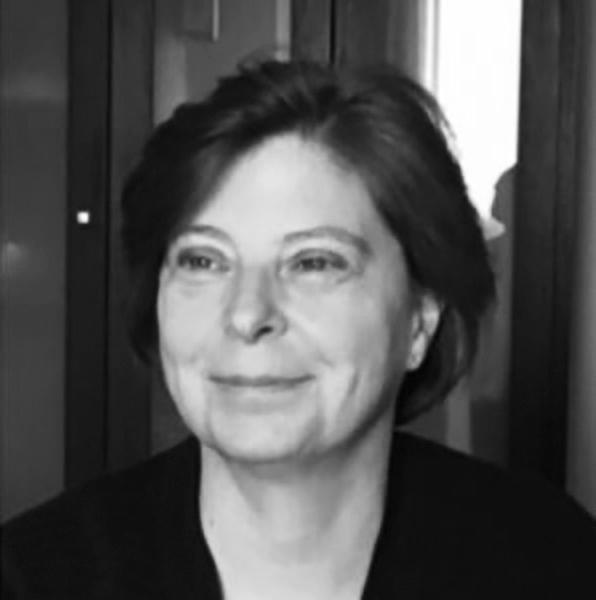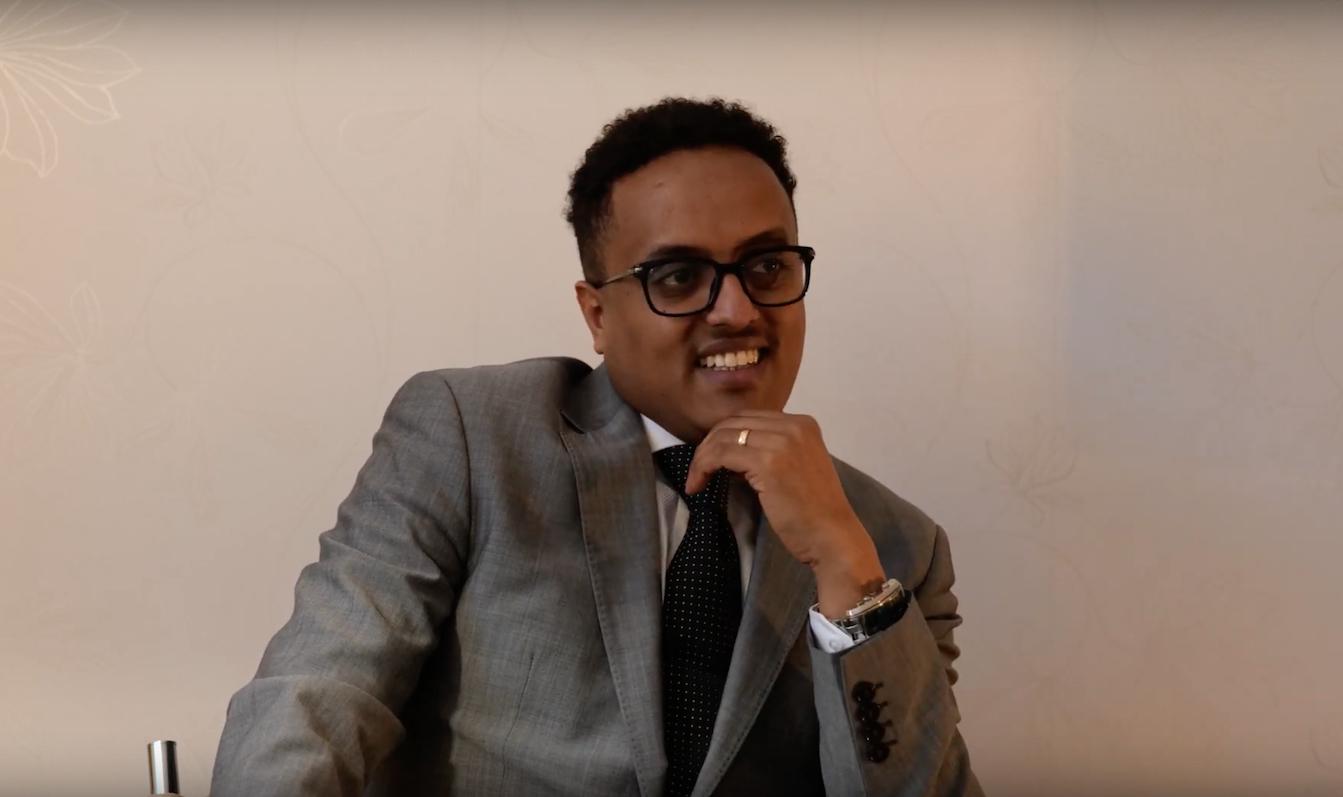
Samson Solomon is the son of the former Director of Telecommunications Solomon Habtom. Habtom was arrested in 2003. He spent fourteen years in Carcheli prison in Asmara without charge or trial, without any contact with his family or the outside world. He died in 2017.
Samson Solomon came to Germany in 2002. He studied linguistics, political science and sociology at the University of Marburg. He now lives in Frankfurt. After the death of his father, Samson decided to continue the fight for democracy and the rule of law in Eritrea on his behalf. He is a co-founder of the YAKIL! (Enough is enough!) protest movement. He runs seminars and workshops with the aim of politically engaging the Eritrean community in exile. In 2019, he published his first book, Risti Gujle 15 (The Legacy of G-15).
SB: You are one of the co-founders and main activists in the Eritrean protest movement „Yakil!“, which began on social media in 2018. How did this come about and what exactly is this movement about?
SS: It started when some activists on Twitter and Facebook used this call, this motto – Amanuel Dawa in the USA, for example, and also the Swedish journalist and activist Meron Estefanos in Sweden. They were the first to take up this new campaign on Facebook. „Yakil!“ means „Enough is enough!“ in German. It’s similar to the „Kifaya!“ movement in Egypt – „Kifaya“ also means „Enough“ in Arabic. We are simply fed up with being oppressed, with people keeping quiet about the terrible situation in Eritrea.
We then asked other activists to take up the call and spread it. That’s how it developed. We also tried to set up a „Yakil!“ group in every city. group in every city. That worked well at first, many cities got together and organised groups. This worked both online and offline. We also set up a special satellite channel (ERISAT) to broadcast this movement and all our work to Ertirea. That triggered a lot of positive reactions.
SB: What exactly are your goals now, how are you trying to realise them?
SS: It all came about quite suddenly, without a fixed programme. We have now tried to draw up an initial plan to give the whole thing a more concrete form. For example, we’ve put together a 14-point programme to take up and implement the Yakil! movement (see appendix – SB). Basically, our aim is to weaken and fight the Eritrean government abroad, where we live. Because the regime in Eritrea is also very active abroad. The embassy monitors and eavesdrops on activists, they threaten us and try to intimidate us. They are also very strongly represented in the churches and it is precisely at these points, i.e. where the regime is strongly active, that we want to fight it.
SB: So weakening the regime also means that you want to counteract the official propaganda?
SS: Yes, exactly. The problem is that, as I said at the beginning, Yakil! is basically a protest movement, but it should also lead to concrete action. Unfortunately, we have wasted far too much time organising ourselves instead of simply taking direct action against the regime. Secondly, the actions should be decentralised, so each city should organise itself under the motto „Yakil!“ and run its own campaign. However, this is not necessarily common in our society, in our tradition. Attempts have also been made to launch a nationwide campaign in Germany, Sweden, the USA and so on. But precisely when you start to act under one roof, you run the risk of working into the hands of the regime.
SB: So with this campaign, you are trying to trigger a wave of protest, mainly via the social media, which should overwhelm the regime from the outside, but also weaken it from within, so that resistance emerges in Erirtrea itself. You mentioned earlier the satellite television that you set up to reach the population in Erirtrea. I can imagine that this is not easy, because the people there have no way of protesting. So what exactly does that look like and what do you hope to achieve with these television programmes?
SS: We are providing information about Eritrea. Information inside and outside Eritrea about non-violent movements, about the emergence of protests, about civil disobedience, and so on. We also try to show this using very specific examples, which also gives us a lot of feedback. Many people have reacted to this and are now trying to organise themselves somehow, creating posters and flyers to spread information, including directly in Eritrea. This is a non-violent campaign and it is of course very difficult to gain a foothold there. But the beginning is always the hardest part. The problem is also that many of those who got involved put themselves in danger and were later arrested or had to flee. And all the actions that took a lot of time and effort were completely destroyed from one day to the next.
SB: It is always very difficult to allow protest to develop in a dictatorship, because it has no space to manifest and unfold. So my question is: How exactly do you design the content of the satellite programmes? How often do you have the opportunity to broadcast them in Eritrea? And who produces these programmes?
SS: Well, it’s a group of young people who are spread all over the world. We have pooled money for this satellite programme because it is very important to provide the people in Eritrea with information. At the moment, they receive nothing other than the programmes and propaganda of the Eritrean government. For example, we have many programmes that run on YouTube and that we send to Erirtrea that show the true face of Eritrea. Many people living in Eritrea don’t know very much about the regime and they were thrilled to receive information. Above all, we also showed alternatives, what possibilities there are for the future. So the people in Eritrea are now far more enlightened than people generally assume or realise. Now comes the second piece of the puzzle, so to speak. The first step has been taken, now it’s about how we can do something about this situation.
SB: How do you see these possibilities? What do you think, for example, of the relatively new Global Magnitsky Act, which makes it possible to penalise serious human rights violations worldwide with targeted sanctions? Have you ever tried to lodge an official complaint against members of the regime in Eritrea, in the USA or Canada?
SS: At the moment it is incredibly difficult to convince lawmakers to introduce new sanctions against Eritrea. Eritrea is on the U.N. Human Rights Council and the world is applauding the peace agreement with Ethiopia in the summer of 2018. The AfD (Alternative for Germany) has even advocated new measures to support the Eritrean president and approve new funding to allow Eritrean refugees to return to Eritrea.
Our main concern is to reach the public in Erirtrea, the people themselves. We have been waiting for years for someone to do something about this total oppression. That was exactly wrong. The first to do something is the people, and that is us. We ourselves must rebel against these circumstances.
SB: So, your main goal is civil resistance, the mobilisation of citizens in Eritrea and abroad.
SS: I mentioned our 14-point plan earlier. The basic idea with Yakil! was that each city focuses on one of these points so that the whole action is decentralised. So, for example, Frankfurt takes point 1, Berlin takes point 2, and within a short time the regime could be toppled (could be „flattened“). In this 14-point plan, there is also a point aimed at penalising human rights violations. The [Eritrean] president said in 2018 at the peace agreement with Ethiopia, „We have lost nothing“. So, he meant that the entire decades-long conflict between Eritrea and Ethiopia was ultimately just a misunderstanding and that we had actually lost nothing because we were now making peace. He literally said that and it made people very angry because they lost so many of their friends and relatives in this conflict, in this border war.
SB: And thousands of people have also had to flee Eritrea.
SS: Exactly, and that led to an uprising, but ultimately it was just a protest that was supposed to lead to concrete action, but that hasn’t happened yet.
SB: You emphasise that you are striving for a non-violent upheaval of the political situation in Eritrea. How did you personally come to this conclusion, because there are certainly also voices that are seeking a violent turnaround in Eritrea?
SS: We have clearly won our independence, our freedom as a country, through the use of violence. At the same time, it has been scientifically proven that the use of violence does not necessarily lead to democracy. We see non-violent action as the best way to solve our current problems. It is a modern form of resistance to weaken and overthrow the regime. I am firmly convinced that this can also succeed in Eritrea, with all its problems. If we use violence, it may lead to a civil war and then we will have a new problem.
SB: So your goal is to achieve a peaceful overthrow of the regime, because you believe that violence ultimately only generates new violence? Do you have any role models for this peaceful struggle, authors who have influenced you?
SS: Yes, definitely. Gene Sharp, for example, and Maria Stephan. Erika Chenoweth has done research on all changes of power since 1900, with and without violence. With a few exceptions, all changes of power that were brought about by violence failed within five years in an attempt to introduce a democratic system. In contrast, more than thirty per cent of the changes of power that took place peacefully were successful in their attempt to introduce democracy. I certainly see signs in Eritrea that it would be feasible there too. Ultimately, even many structures loyal to the government there want a change of power. It is only the fear of change that is holding them together. And that’s exactly where we have to start, show realistic alternatives, and then the regime will collapse on its own, that’s my conviction.
SB: That was also my question about your assessment of the situation in Eritrea. Are you optimistic or rather pessimistic about the timeframe for the desired changes?
SS: I am very optimistic. We had very good experiences in 2019. I have been leading this fight for over a year now and in 2020 we will do everything we can to bring about concrete changes. We also have a lot of feedback from members of the regime. They would like to do something, but they don’t see any alternatives and that is exactly what we are trying to change. We want to show feasible and realistic alternatives when we take power, what exact changes we are aiming for.
SB: You are trying to convey this aspect of positive alternatives to the current dictatorship in seminars and workshops that are mainly aimed at the Eritrean community.
SS: My aim is to activate the Eritrean community and get them politically involved. And I also see many signs that the younger generation, who have only just arrived in Germany or Europe, are very interested. At the same time, however, these young people in particular have no idea what they actually want to do. We give them a concrete idea of how they can get involved, in which programmes and so on. In some places this works very well, in other places not quite as well as it could be.
SB: How do you see the role of the internet? In Egypt a few years ago, it seemed that social media was an important tool in the struggle for freedom. And then the dictators undermined this medium, which was still very new at the time, relatively quickly and used it for their own purposes. Do you see similar problems today and are you worried that the current protest movement against Eritrea is not focussed enough, that it might get lost and not be well targeted?
SS: The main problem is that we currently have a generational conflict between the ‚old‘ generation and the young people of the Yakil! movement. The older generation thinks that we should simply follow their example. We, on the other hand, want to find a new path, take a new direction and reform the entire resistance movement. The internet is used much more by the younger generation. But the discussion is too often characterised by hate and disorientation. The Internet also has many disadvantages. The internet only exists abroad, not in Eritrea. And therefore it is not a means of reaching people in Eritrea. That’s why there’s a certain aimlessness on the internet – sometimes pointless things are debated and that takes us away from the really important issues.
Interview: Susanne Berger (Washington D.C., USA)
Film: Jakob Gatzka (Vierkirchen, Germany)
Editor: Dr Irmtrud Wojak (Eschenlohe, Germany)
Listen now
Discover the podcast series of the Fritz Bauer Forum
Here, experts talk about justice, human rights and social change. They provide in-depth insights and develop diverse perspectives on current issues that affect our society.