
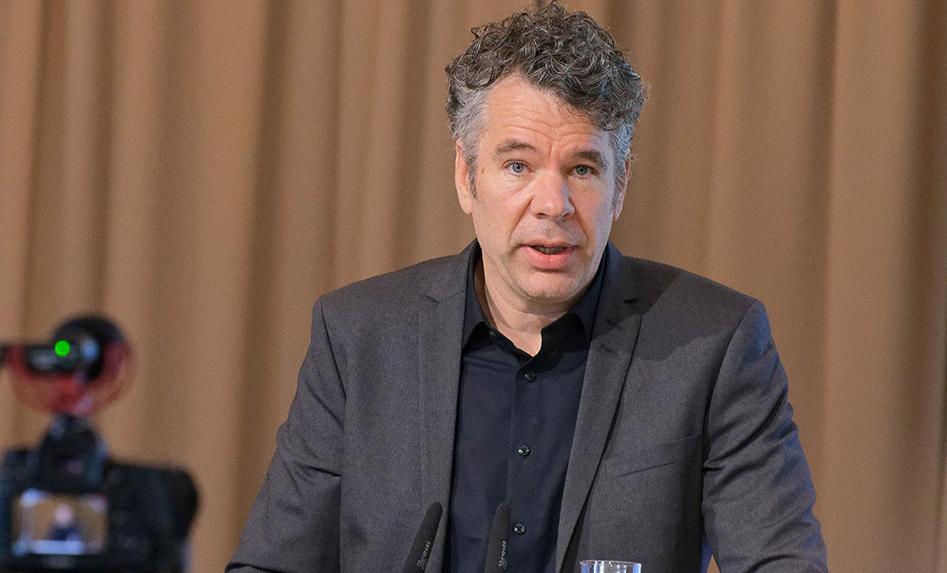
Autor/Autorin

As the head of prisons, Dr Thomas Galli published nine stories about serious and very serious criminals in his book Die Schwere der Schuld in 2016, nine out of around 62,000 stories of people who have to live behind bars in our country. It is rare to find a book about the treatment of the weakest members of our society that does so without pointing a finger. The stories provide answers to questions that do not begin with the offenders, but with society and ourselves. Thomas Galli has drawn no simple or easy conclusions from his experiences as head of various prisons; he now works as a lawyer. His book Die Gefährlichkeit des Täters was published in 2017 (Das Neue Berlin, 176 pages). – The editorial team
W : I was very impressed by the fact that you took such an in-depth look at the history of the individual. That the personal biographies came to light in this way and, on the other hand, that you fundamentally questioned the institution of prison, or am I seeing it wrong?
TG : Yes, I fundamentally questioned it, and I think the more deeply you deal with topics and people, the more you have to deal with people’s biographies. And if you then ask the question, how can I ensure that people do as little harm to each other as possible, i.e. that as few people as possible become offenders, then it becomes clear relatively quickly that it is of little help to punish people if they have done something or to put them in prison. Instead, we need to take a much more complex approach to the issue and think much more deeply and in the long term.
IW : Can you tell us a story that particularly moved you when you started thinking about your book?
TG : It’s difficult to tell a story because I worked in the prison system for over fifteen years, in different prisons, in different federal states, and I got to know many, many, many prisoners. I had a lot of conversations. You work intensively with some of them for years. You get to know them, you get to know their biographies very well. There are a lot of things that are always the same in the biographies of offenders. It’s very often the case that you think this is someone who should have been looked at much earlier – even as a child, when a lot of injustice happened to him and when he himself ultimately became a victim of violence and disregard. We should have intervened, we could have helped, we should have helped. Then, twenty years later, he would not have become an offender himself and would not have caused victims again.
IW : That’s what I thought when I read the stories. That many of these stories might not have happened if certain things hadn’t happened very early on in a person’s life. Perhaps if there had been more parental care, more love in the individual’s life. Is there any way at all to „make amends“ in prison, I say that in inverted commas? Is there a way for people who find themselves in a situation where they have become offenders to get out of it?
Well, I think that when that happens, in the structures of the penal system, the prison as we know it now, it tends to be the exception and is not designed, not made possible by the system. If you think about it, prisons really are a total institution in this sense. They are total institutions in which a large number of people are locked up so that they can be administered bureaucratically as cheaply as possible. Otherwise we wouldn’t even have the idea of locking up the people who are imprisoned as punishment all together in one huge institution. So ultimately it’s about – hundreds of larger institutions have over a thousand inmates – locking them up together and doing so as cost-effectively as possible. In this context, I cannot, in principle at least, speak for all individual cases, nothing positive can arise. So I go so far, or what do I mean I go so far, I am convinced that if we take a thousand law-abiding citizens and lock them up for one or two years, then we will also have seven hundred offenders afterwards.
IW : Which makes the whole concept of re-socialisation seem somewhat questionable, doesn’t it? How is re-socialisation even possible under such circumstances? Does the approach even make sense to continue pursuing it in this way?
TG : The approach of resocialisation makes sense in any case, but you can’t use it as a fig leaf or in Sunday speeches, you have to really live it and really want it. And then you don’t need a great deal of intellectual development to see that I can’t re-socialise anyone into society, integrate them in the sense that they behave according to the norm, at least to a certain extent, by excluding them from this society and locking them up in a world that is completely alien to their lives. Life in prison has nothing whatsoever to do with life in freedom. Despite all the fine-sounding programmes, intentions and penal laws. This means that if I really want to pursue the approach – and the approach is good and important and right, there are no alternatives – that I can only persuade someone who commits offences and does not comply with certain standards to do as little harm to others as possible in future and not to break certain important rules by integrating them positively into society. This approach is right and important in itself, but it basically cannot work in the prison system.
IW : Was that one of the reasons why you decided to leave the prison and work as a lawyer? You then made a very drastic decision and said: „I’m leaving this job as director of prisons and becoming a lawyer again.“
TG : That was ultimately the main reason, although it wasn’t a simple, clear-cut decision for me, it was associated with many conflicts, including internal conflicts. I would never go so far as to say that all people who work for the justice system or the penal system are behaving morally immorally or anything like that, not at all. Rather, there are many, many righteous, decent people who try to make the system as humane and sensible as possible.
But in the end I put myself under a bit of pressure with the book and by putting forward these theses, which for me were not really theses at all, but it was actually clear to me that this was the case. In this respect, I was a little surprised at how some people reacted, because I thought a lot of things were obvious and that I wasn’t really spouting any great wisdom. But then many people picked up on it. One prison governor said in all seriousness that prisons in the form we have them now should be abolished. And I also stand by that and have repeatedly advocated it in a wide variety of contexts.
After that, at some point it was a question of credibility for me to say to myself, okay, if I advocate this, then it no longer fits together if I still earn my good money in the civil service and on the other hand advocate these theses. That’s why the final consequence for me was to say, then I have to leave.
IW : A consequence of the reality you’ve experienced, isn’t it? And what are the issues that you have now taken up as a lawyer? Do you continue to work in the field of criminal law reform or what are your topics as a lawyer? Which people do you represent?
TG : Of course, I represent many offenders, many who are already in prison, where the aim is for them to be released early. I am also involved in some retrials where we are convinced that someone has been wrongly convicted. Another major focus is asylum and refugee law. I consider this to be one of the issues, if not the issue of our time. As a question of global justice, how do we in an affluent society look after people who are much, much, much worse off, how can we achieve global justice to some extent? That’s why it was very important for me to get involved in this area, which is why I also do a lot in the field of refugee and asylum law.
IW : What is your appeal in the current situation in terms of refugee policy, with regard to the deportations that we are now facing?
TG : It’s quite interesting, in my perception refugee law has a lot to do with criminal law, because both are highly symbolically overloaded subject areas. In some cases, collective emotions are aroused, fears, aggression against refugees, fears of foreign infiltration and fears of criminals are aroused, fuelled, but then also satisfied by demonstrative acts, be it locking someone up in prison or deporting someone. Then there’s another TV report that another plane has gone to Afghanistan.
TG : I recommend everyone to take a closer look and to engage with the people who are affected. The vast majority of people who are afraid of foreign infiltration or have a general aversion to everything foreign and to refugees and immigrants have never actually seen one or had a closer look at one. And they should do this and will then very quickly realise that the vast majority of them – if they can’t bring themselves to say yes, we must help them for reasons of empathy or humanity – will then realise that they are not a burden at all, they really are an enrichment.
And I don’t mean that in the ideological sense of „we are all colourful“, but there are people who have so much going for them, who have such great qualities, including character traits, that we here in this affluent society, in which we spend our time on completely irrelevant things, no longer know anything about.
It’s also about people who have experienced very existential things and from whom we can benefit a great deal.
Incidentally, our law firm also works with the Chamber of Industry and Commerce, and they say that the economy is up in arms. Because they can no longer find enough trainees in many areas, for example in bakeries or the care sector, because the Germans don’t want to do it. They have great people from Afghanistan or somewhere else who can do it, who can do it, and they are then deported for symbolic reasons.
So that’s my appeal to take a closer look and deal with the people!
IW : Thank you for the interview, Mr Galli.
Interview: Dr Irmtrud Wojak
Camera: Jakob Gatzka
Transcription: Antonia Samm
January 2018
Listen now
Discover the podcast series of the Fritz Bauer Forum
Here, experts talk about justice, human rights and social change. They provide in-depth insights and develop diverse perspectives on current issues that affect our society.

