
Autor/Autorin
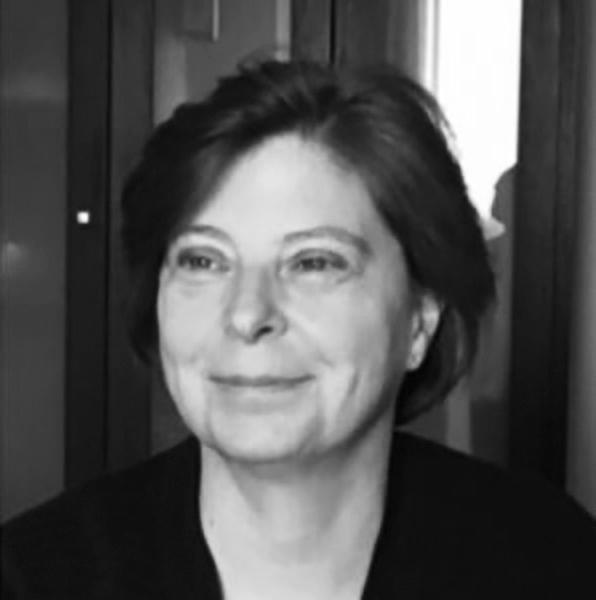
Yirgalem Fisseha Mebrahtu is one of Eritrea’s most prominent poets, journalists and writers. She was born in 1981 in Adi-Keih, one hundred and ten kilometres south of the capital Asmara. Since 1990 she has worked with both state and private media. She published poems, short stories and articles until 2001, when the Eritrean government banned all private newspapers. A year earlier, in 2000, she co-founded the well-known literary association „The Literary Club of Adi-Keih“.
In 2002, she attended the Asmara Teacher Training Institute (ATTI) and worked as a producer and presenter at Radio Bana for over five years.
In 2009, she was arrested and imprisoned in a military prison for six years without any contact with the outside world. Among other things, she was accused of plotting the assassination of the Eritrean president. She was subjected to severe abuse, which led to repeated hospitalisations.
She was only released from prison in 2015. Three years later, she fled Eritrea for Uganda. There she published her poems and texts, including a summary of her experiences in prison . Yirgalem Fisseha now lives and works in Germany. In 2019, she received the Freedom of Expression Award from PEN Eritrea. She was also one of five writers and activists honoured by PEN International in 2018 . In October 2019, she published her poetry collection I am alive (in Tigrinya).
SB: What is the biggest misunderstanding outsiders have about the political situation in Eritrea?
YF: The biggest misconception and the most important thing to know about Eritrea is that there is no government. I am always confused when countries or politicians refer to the „government“ in Eritrea. It’s a shame to even deal with such a regime that kills, tortures, arrests and disappears people for no reason. I have a question for everyone: „Why and for how long do we tolerate this regime?“
SB: What should the international community consider in its relations with Eritrea?
YF: I think all countries are unfortunately not paying special attention to Eritrea and its situation. They are pursuing so-called „quiet diplomacy“, which is very convenient for the regime. Instead, the only option we have is pressure, pressure and pressure, in all directions.
SB: What can be done specifically to help the prisoners in Eritrea, some of whom have been in detention for decades?
On International Women’s Day, Yirgalem Fisseha published the story of two courageous women she met in prison on the Heinrich Böll Foundation’s migration policy portal: „Ten Years of Darkness“ .
Are you writing, sketching and scribbling,
Silently roaring and arguing?
Engraving your deep emotions
With a dough of tears!
That give off steam and heat
There and then
When truth battles to speak, and justice is hijacked
Compassion is trampled, and love screams
When the centre cannot hold
And anarchy is loose
Do you shudder away by the pain and noise?
Or do you withhold, observe, and stay and write?
Their lie is called truth, your truth falsehood
Their bigotry is called honour, your courage is paid in death.
How could you then not not-write–
while standing there and it is fleeting before you–
Of course, you would write. How couldn’t you!
Go then and write, let it flow.
But where is the paper?
Just write it in the mind, or conceal it in the heart for now
The safe store,
where the wind cannot reach
And the flood cannot destroy.
(2014 – Translation 2019 by Ghirmai Negash)
The prison cell fits my body height
Its mud floor serves in lieu of my bed.
Suffocates, sickly atmospheric overwhelming,
like a bad effect of traditional medicine,
Hell in the inside, caged by a door in the shape of a serpent’s mouth.
Too much sorrow, I can’t bear.
If anyone would call, „Come with me!“
I wouldn’t want to ask „where?“
But would rather concur
To go along.
Never mind: with Demon or Man.
(2010 – Translation 2019 by Ghirmai Negash)
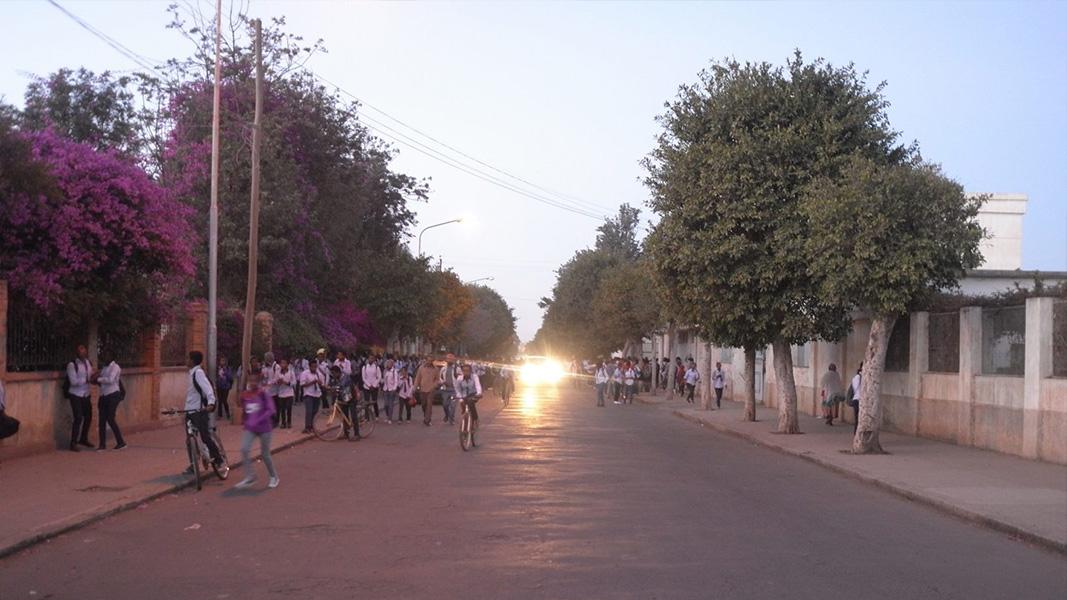
Photo: Header image Martin Schibbye , Future of Eritrea, Students going home from school in Asmara, Eritrea
Listen now
Discover the podcast series of the Fritz Bauer Forum
Here, experts talk about justice, human rights and social change. They provide in-depth insights and develop diverse perspectives on current issues that affect our society.

