
Autor/Autorin
Diane Foley is the mother of the American photo and video journalist James W. Foley (1973-2014), who was kidnapped by Islamic extremists in 2012 and brutally murdered two years later. She is the founder and president of the James W. Foley Legacy Foundation . The foundation awards the James W. Foley Humanitarian Prize annually in recognition of courageous human rights defenders and journalists. Information on this year’s award ceremony ( „Moral Courage in Challenging Times „) and the current award winners can be found here.
„Jim was about the truth – we can cover it up and we can forget it and try to get around it, but there are truths that are hard to escape. And one of them is … the horror that war is for civilians and children, for the whole population.“
SB: Maybe we can just start by you telling me a little bit about your son. Who was James Foley?
DF: Yes, I’d love to. Jim was the oldest of our five children and was born while my husband was doing his medical internship in Chicago. He was born at Evanston Hospital in Illinois, but his early childhood years were spent in New Hampshire. We came to Wolfeboro, New Hampshire – which is actually our home state – when he was six years old. Jim went to school here and grew up in a very rural, homogeneous part of the United States. We were simple middle-class people, living in a beautiful part of the country, there were very few minorities, very little poverty or hardship, a really unspoilt area of our country, shielded from the many problems that existed in the cities and the South. I really feel like Jim’s eyes were opened when he went to college. He did his undergraduate studies at Marquette University of Milwaukee, Wisconsin, a city with severe racial segregation, poverty and other social problems. And Marquette University was right on the border of a very economically disadvantaged neighbourhood. From the beginning, students were encouraged to volunteer, mentor and help students in the city’s poor neighbourhoods. Jim’s eyes were opened, I think rather abruptly, to a different reality of the United States. He spent a lot of time volunteering and later, during his university career, he made several trips to American Indian reservations. I believe these experiences opened his eyes to other cultures and the economic uncertainties in our own country. Jim was very interested in all kinds of people and cultures, and he was initially particularly touched by the adversities that many people face in our country.
SB: Did he always want to be a journalist?
DF: Not at all. But in hindsight, I think he had a good foundation for it because he loved reading as a child. He loved being read to until he could read himself, and as soon as he could, he read all the time. He loved history, he loved learning about other places and people and in turn other cultures. He also loved writing and travelling. My mum is from Ecuador and his uncle is from Spain, so he was very interested in Hispanic culture from a young age. At the age of eleven, for example, he accompanied my sister to Spain to look after her younger children. When he went to university, he majored in history and Spanish. Jim also had the talent that he could really listen. That’s why he always had a lot of friends, because he loved to hear other people’s stories.
SB: If you had to describe your son, if you had to sum it up in just three words, how would you describe James?
DF: That’s an excellent question and not very difficult to answer. Jim was very compassionate, he was courageous and he was very dedicated. He was also fun-loving, but I think as he matured, the first three were the most prominent aspects of his personality. Once he made the decision to do something, he was all in.
SB: It seems that when he decided to become a conflict journalist, he felt in a way that it was really the one thing that connected all his ideas and that he had found his life’s calling?
DF: I think you’re right, because initially, during his advanced studies, he did a lot of teaching with ‚Teach For America‘. He also worked again in underprivileged neighbourhoods in the city and saw a lot of the other side of America, some of the injustices and racial segregation that really bothered him. But he never felt like he was a good teacher, and I think that’s why he wanted to write and eventually felt drawn to real stories, true stories if you will, and journalism. It took him a while to find his way, but once he did, he really committed to it.
SB: When I read about James, one word came to mind: he was in some ways very authentic and, I think, unflinching. He was willing to document the suffering of the people he met and to try to bring the reality of war, these terrible conditions, to the public uncensored. But you can only do that if you don’t shy away from this reality. That really impressed me.
DF: Yes, and I think he was also a curious mind. He was really interested in why people do what they do. Even when he started as a conflict reporter, he first got accredited with the US Army, initially with the National Guard outside of Indiana. He was curious about why young men choose to be soldiers, and then when he went to Afghanistan and Iraq, he was very interested in the people there and their cultures, how our military presence has affected them.
SB: I saw the video he made where he interviewed members of the Libyan opposition forces fighting Libyan dictator Muammar al-Gaddafi, a postal worker and a mid-level administrative bureaucrat. They are all gathered here now, in this militia, in the middle of this conflict. I think he really wanted to document the very human side of the story, he wanted to show our shared humanity.
DF: I think he felt that very strongly, in the middle of the Arab Spring, which really started in 2011. And he was particularly interested in why these people were willing to literally risk everything, their lives, their families, their homes, to gain the freedom to live in a different way than they were experiencing. Jim was very interested in this and felt that the world needed to know. He was also very concerned because he realised that a lot of journalists were pulling out, especially journalists working for the big media companies, because the danger was increasing and Jim was very aware of that.
SB: Did you notice a change in James as a result of his experiences? The harshness of the war, the brutal conditions, how did that affect him?
DF: It affected him very deeply. Jim always had a fun-loving, optimistic nature, now he became much more serious, much more committed. He developed a real passion for hearing these stories and telling them. He was much more focussed and, as I said, more serious.
SB: Would you say that he was driven in some way, that he felt he had to do what he was doing?
DF: Absolutely. Friends and family, we all tried to dissuade him, especially after his 40-day detention in Libya. We tried everything to persuade him, but he felt really driven to do this. He felt that the truth was important. People needed to know how much these people longed for freedom, that they were prepared to sacrifice everything. It was something he felt absolutely driven and committed to do.
SB: When James went missing in Syria, how did you know something was wrong? How long had he been in Syria when he was abducted?
DF: Jim went to Syria for the first time in early 2012, and he was very careful and used all the [security] technologies that were available at the time, and they’ve improved tremendously since then. He went to Syria several times in 2012 before he was captured at the end of November that year. In fact, he was home for his birthday in October 2012. We were well aware that the situation was becoming increasingly dangerous. On his last visit, he promised to be home for Christmas, that he would come back.
SB: How much did you know about the group that had captured James and held him hostage, or about the conditions of his detention? If I understood you correctly, you knew very little.
DF: We didn’t know anything. In fact, until September of the following year, 2013, we didn’t even know if he was still alive. He literally disappeared, and because he was a freelancer, he didn’t have a security team or anything like that. Fortunately, one of his employers was able to get a security team to look for him, but they couldn’t find him. They really thought he had been detained by the Syrian dictator Bashar al-Assad’s people and was being held in Damascus, which was not the case. It was only much later that we realised that he had actually been kidnapped by a jihadist group and was being held in northern Syria. So we had no idea, and our government didn’t seem to know either. We were told that the U.S. had no assets or sources, if you will, in northern Syria, and the FBI was mostly asking us for information instead. We really had no idea for those first eight months whether he was alive or not.
SB: In the end, how did you find out which group was holding him, whose hands he was in?
DF: The security team working for James‘ employer at the time, The Global Post , thought Assad’s military had kidnapped him, while others had no idea. Jihadist groups were starting to infiltrate the country, but people didn’t really understand who was who here, there were many factions, many foreigners coming in, so it was all quite chaotic. We really didn’t know. Finally, there were two people who told us as eyewitnesses that Jim was alive, that was in September 2013, it was a Belgian citizen, Dimitri Bontinck, who spoke to me one day via Skype and said that his son, Jejoen Bontinck, a Belgian teenager, had seen Jim and said exactly where he was being held in northern Syria. And a month later, Omar al-Khani, who had been detained by the same jihadist group, also said that he had heard Jim’s name in prison and knew that he was indeed alive and being held along with many other international prisoners. And then, about a month later, in November 2013, we received an email from the kidnappers. However, they did not reveal themselves, except to say that they clearly hated the United States and that Jim, as a US citizen, was the target of much of their hatred. We did not know that Jim was being held with three other Americans until 2014, when some of the captives were released.
SB: It must have been a very difficult but also a very important moment to meet these other fellow prisoners. One of the most moving parts of the documentary film you made about Jim’s life are the conversations about how much Jim helped his fellow prisoners in their own struggle for survival. What do you think gave him this strength?
DF: Jim was always a big-hearted person, he really was, but he grew and matured as an adult, which I really didn’t know. I think during his captivity he turned to his faith in God and he spent a lot of time in prayer. I think he found the ritual of the five calls to prayer in Islam, praying five times a day, very helpful because it helped him to collect himself and ask for strength. I was really relieved to hear what the surviving hostages had to say about Jim’s prayer and his kind-heartedness, because I believe the prayer strengthened and empowered him to remain human and not allow the kidnappers to steal his soul, no matter what they would do to him. I am very grateful for that. I and many who loved him also prayed for him on this side of the ocean. And I truly feel that it was the power of prayer and God’s goodness and mercy that gave him the strength.
SB: James gave his fellow prisoners, as they testify, the strength to survive in many ways.
DF: Yes, he really tried. Jim was always a people person. I was very grateful that Jim was with other people, very good people. There was a lot of kindness around him. And knowing Jim, he would have been very interested in the international selection of prisoners he was held with. There were four French people and there were Spanish and Danish and German citizens, Italian journalists and humanitarian workers, all incredibly interesting and good people. I am so grateful for the people who were with him. I’m sure he enjoyed their company, despite the horror they went through. They became very close.
SB: I asked you this in my letter yesterday: do you see your son differently now? Is there anything you have learnt about him that you didn’t realise before?
DF: Definitely. He was the eldest of our five children. He was always a very loving son, very attentive, kept in touch even when he was far away because he knew we were worried. That’s the side of him I saw. But I never knew of his deep kindness to others, and that was partly because of those who witnessed the last days of Jim’s life, but also because of the hundreds of people who have told us what an impact Jim had on their lives – from Teach For America students who started their own non-profit organisation to carry on Jim’s legacy, to people he met by chance, people from the Middle East and so on. I didn’t know these things about Jim. Jim only ever told us that he was a lousy teacher and that’s why he wanted to write, and we never knew that he continued to mentor many of his students after he became. We simply had no idea how many lives he had touched or that he aspired to be a person of moral courage. As parents, it’s hard to know what kind of adults our children will become, especially when they are as humble as Jim. He really wanted to know how we were doing when he came home, he didn’t talk much about himself.
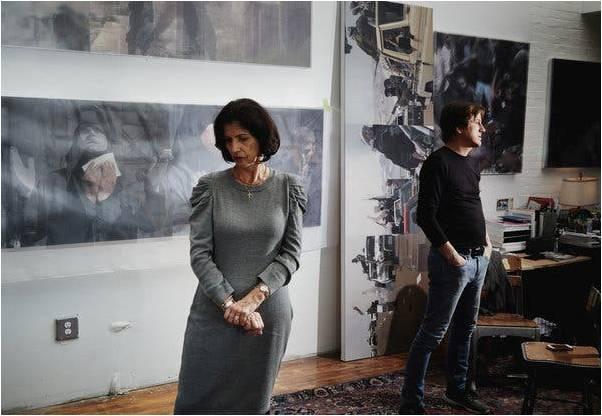
SB: You have commissioned a series of artworks to honour Jim’s memory and also to keep his work alive. The title you have chosen for this series of paintings is „Inescapable Truths“. How did you and the artist Bradley McCallum come up with this term?
DF: Well, first of all, we didn’t commission these works at all. Bradley reached out to us out of the blue. He’s a human rights artist who has done a lot of work on apartheid in South Africa. He had heard about Jim, and he was very interested in Jim’s legacy and how to find a way to artistically translate what Jim was trying to convey in his work. So he approached us, and fortunately we happened to have an old backpack of Jim’s with some B-roll of photos and videos that he had taken, mainly in Libya, which this artist picked up and used for many of his paintings. It was difficult to come up with the title, we spent a long time looking for the right title, but I’m happy with it because it’s about the truth – we can cover it up and we can forget it and try to get around it, but there are some truths that are hard to escape. And one of them is certainly the horror that war is for civilians and children, for the whole population. I think a lot of that is captured very poignantly in some of these images.
SB: Yes, I think James was really prepared to take that on, which is not an easy thing to do. Also in terms of his fellow prisoners. I think that’s why people reacted so strongly to him. They felt his authenticity, they felt this honesty with which he addressed them. But it is very difficult to remain so strong when you are confronted with your own mortality, with these elementary fears. It shows what an impressive person he was.
DF: Well, Jim really thought about life. I think that came partly from reading. He really read widely, was very interested in spirituality and the role of religion and faith and the strength it gives people to endure horror, hardship and deprivation. Jim had explored a lot of this personally, and I think that’s why he was interested in the Islamic faith and why people risk so much. He was very fascinated by it all. Jim aspired to be a person of courage, especially moral courage. He always had physical courage. But moral courage, he realised, was the greater courage, and he felt obliged to do his small part through journalism. That would be a way of expressing the truth about the horror of what was actually happening in Syria, for example. That was something he aspired to [in a very big way.
SB: I remember him saying in the documentary film about his life: „What good is it if I have the physical courage to report a story but then don’t have the moral courage to make sure it actually gets published?“ This shows how much he felt there was an obligation to fight for and insist on the truth. Realising that is not easy.
DF: It’s not, and that’s part of the reason why we, the James W. Foley Legacy Foundation, are committed to protecting journalists who are trying to investigate, report with integrity, and really seek the truth. It’s not an easy time for journalists because there’s a strong backlash. A lot of people don’t want to see the truth, don’t want to hear the truth, a mixture of claims of „fake news“ and other things. It has become very difficult to even determine what is actually true.
SB: I would like to talk a little about the work of your foundation. What was its initial aim, what is it doing now and has the aim changed over time?
DF: It has changed somewhat. It was very difficult to decide what to focus on because Jim had so many broad interests. But because of our ordeal and his own, we decided to focus on three areas initially. We have since narrowed it down to two. We advocate for the freedom of all innocent Americans who are kidnapped abroad. And secondly, we endeavour to protect journalists worldwide. We are also very interested in different aspects of human rights, especially people who are disadvantaged because of poverty or war or conflict. However, we felt that we had to drop this part because there are so few organisations working for hostage families and the return of hostages, and not many helping to teach safety practices for young journalists. So we focused on these two gaps that we had experienced ourselves. That’s why we focus on helping American hostages. Americans because there are so many hostages around the world that we realised we couldn’t do that. We felt we had to limit ourselves to US citizens who were unjustly imprisoned or taken hostage abroad. To protect journalists, we have a preventative curriculum for journalist safety at the undergraduate and graduate levels that we co-sponsor with non-profit organisations that advocate for press freedom. We are very interested in the preventative side so that students who want to become journalists and freelance journalists know how to protect themselves and the people they cover. That’s not easy these days.
SB: You have said very openly that you felt completely overwhelmed when you were first confronted with the crisis of your son being taken hostage in 2012. Looking back, what was the most serious problem for you?
DF: Well, I think one of the most difficult things was the not knowing, the uncertainty. We didn’t know whether Jim was alive or not. And also, we were told by the FBI not to tell anyone. And even though we found out at the end of November 2012 that James was missing, we had Christmas and didn’t tell anyone except our closest friends that Jim had actually been abducted again. So I think it was very hard not to scream for help because the FBI told us to keep quiet, that they were on top of it, that Jim was their number one priority. But it was very difficult when the first FBI agent who came to our house didn’t speak Arabic, didn’t know anything about Syria, had never been to the Middle East, didn’t ask anything about Jim’s mobile phone and so on. It was just very problematic. He even told us that we should ask President Assad for help to find Jim. It was very disturbing to see that this person who had no idea what was going on was leading Jim’s investigation. That was very hard, and then to hear nothing – that was incredibly difficult. In early 2013, we decided as a family to go public. I was desperate to get help from anyone. So we first turned to the media to see if anyone anywhere in the international media had any information. We made some wind noise to find out if anyone, anyone had seen or heard of Jim, and then I started my trips to Washington to get attention for Jim’s case. But the hardest part was that there was no one in Washington whose job it was to bring American hostages home. There was simply no one. There were a lot of people who were friendly and condescending who met with me and told me that Jim was their top priority. But that wasn’t really true, because nobody had any information for me, and it was nobody’s priority, nobody’s job to find Jim and bring him home.
SB: So you were completely on your own.
DF: You’re right. At the time, I didn’t realise that there were four Americans being held hostage, not just Jim. A lot improved after Jim’s death. Especially after the death of Steven Sotloff, an Israeli-American journalist from Florida, and then after the deaths of two human rights activists, Peter Kassig and Mueller. I think it’s important that people know this. Earlier the same year, American journalists Marie Colvin, Luke Somers and businessman Warren Weinstein were also killed. After all of these murders, there was a public outcry and President Obama subsequently called on the National Counterintelligence Center to conduct a full review of how our government handles hostage cases, which included interviewing families of hostages. The result was that in June 2015, Obama announced a new policy, Presidential Directive 30, which created the Interagency Hostage Fusion Cell, now housed within the FBI. It includes representatives from all intelligence agencies, the State Department, all branches of the military and the FBI itself, all under one roof. Their priority is to bring the American hostages home. They also appointed a Special Presidential Envoy for Hostage Affairs at the State Department, at the ambassadorial level, to handle all hostage-related issues that require diplomatic action, that is the expertise of the State Department. And the last part of this directive established representation at the National Security Council level so that the White House is fully aware of all hostage situations and can respond to any of the plans or strategic recommendations of the Hostage Fusion Cell and the President’s Special Envoy.
After Jim’s death, I worked extensively with the National Counterterrorism Group to share our horrific experiences. The Foley Foundation continues to work closely with the U.S. Hostage Fusion Cell, the President’s Special Envoy for Hostage Affairs, and the Hostage Recovery Group. To evaluate the results of this new structure in hostage situations, the JWFLF began an annual qualitative research report on the experiences of American hostages and their families in 2019 titled „Bringing Americans Home.“ To President Trump’s credit, the return of innocent Americans who have been taken hostage or unjustly detained has been a higher priority for this administration. So there has been some progress.
SB: You have asked journalists and politicians to question their personal attitudes towards the official US hostage policy of „no concessions, no negotiations“. Can you explain a little more about what this policy was about? Is this policy still in force today or does it exist in a different form?
DF: That’s an important question because it has become official policy, but in many ways it’s more of a slogan, if you like. „No concessions, no negotiations“ was the prevailing thought in 2012. I didn’t really realise it at the time, but President Obama absolutely felt that it was critical to maintain this very strong stance of no negotiations with terrorists. Because Jim was kidnapped by a terrorist group, the FBI did not want to negotiate with them in any way, which of course led to the families, meaning us, having to negotiate with these kidnappers, which was really ridiculous. Our country could have gathered so much information through our experts who were trying to talk to the kidnappers, as opposed to us families who had no idea what we were doing. But the other, even more disturbing thing is, having done our own research, and as the studies done by the Rand Corporation, the US Military Academy West Point and others show, it’s clear that American citizens, as well as British citizens, whose governments adhere to this „no concessions“ policy, actually end up faring much worse than countries that are willing to find ways to negotiate over the lives of their citizens. In fact, there is a little book written by Joel Simon, the executive director of the Committee to Protect Journalists in New York, called We Want to Negotiate : The secret world of kidnapping, hostages and ransom: The secret world of kidnapping, hostages and ransom, Random House, 2019). This seriously helped us realise that there are ways to negotiate without necessarily making concessions that make terrorists richer or more powerful. That there are smart ways to negotiate with hijackers that can actually make a lot more sense. This has become a real problem. Many governments now see that kidnapping people is a good way to put pressure on our country and others. It’s a centuries-old tactic, but it continues on a large scale, and that’s why we continue to advocate for the return of our citizens and for information for and active support of their families, because it’s a terrible experience for any family.
SB: You yourself commissioned an official study that shows that the „no concessions“ policy is not doing what it was intended to do, which is to make American lives safer. In many ways, it has had the opposite effect.
DF: Exactly. Our citizens don’t come home as often as those of other countries. And the other countries are pretty smart about what they do. That really touches on the question of how important are our citizens to us? Is the American passport a protection? Is it something that, if you’re in that situation, is it really going to protect you or not? And we realised that if Jim had been French or Italian, he would have been home, whereas the British and all the Americans who were captured by the same group were all killed.
SB: Is this policy still in place or has it been changed? What is the current status?
DF: Well, it still has a lot to do with the respective government authorities. We still say that we don’t negotiate, or rather, we don’t make concessions to terrorists. We are allowed to negotiate, and that is what I expect from our government. I think it is essential that our government is prepared to negotiate with anyone who is holding one of our citizens. It is a human rights issue that our government must take care of that person. But in terms of concessions – our government is more flexible, if you will, not so strict as President Obama that they won’t even talk to kidnappers. Now our government is willing to negotiate and at least consider how to bring people home, how to free them.
SB: What are you trying to do to bring those who committed these terrible crimes to justice, to fight impunity against these crimes? And can there ever be such a thing as justice? What does that word mean to you?
DF: I think if we have total impunity, no accountability, there is no justice at all. I think it’s essential that we demand accountability. We have to have the patience, the tenacity and the commitment to do that. I don’t think the drone killings of various leaders, the extreme jihadist leaders, is very helpful because I think it leads to fuelling more hatred. I think it is extremely important that people who have committed these crimes against our citizens are brought to justice in a fair and transparent way. In the case of the two former British jihadists – Alexanda Kotey and El Shafee Elsheikh – who were identified as members of the kidnap cell according to the testimonies of the surviving hostages and who were captured in 2018 and are currently imprisoned in Iraq, it is very difficult to get things moving. In August 2020, our Attorney General decided to waive the death penalty so that the US could gain access to British evidence. This means that the extradition of Kotey and ElSheik to the US for trial could be possible in autumn 2020.
To be honest, I don’t know if it’s possible to achieve true justice in this lifetime, but I think we should demand accountability and I hope that they are eventually brought to justice so that people learn of the atrocities they have committed. And that if they are convicted and found guilty, they should spend the rest of their lives in prison. But I also think of the hundreds of thousands of people who have been killed in Syria, these atrocities that also need attention. There are the massacres of the Yazidis, and so it goes on and on. But I think the fight for accountability is essential, and we also need to protect the human rights of the captives (the kidnappers), I think that’s important. But, again, the truth has to come out. Because I don’t believe that killing each other through drone strikes or other attacks is a way to peace, but that in turn only causes more hatred. It’s complicated, isn’t it?
SB: It’s terribly complicated because by using drone strikes you are in a way turning these people into martyrs, which in turn is attractive to young people. This brings me to my last question. You said several times that you underestimated the level of hatred that these groups and radical Islam in general harbour against Westerners – and basically we all did. What do you think is the answer to breaking this cycle of violence and hatred? What can we do, what is the solution?
DF: Well, I don’t think isolation is the solution. I think the opposite. I think we need to take an interest in other cultures and care about them, understand them, definitely. I think that economic insecurity and poverty are often the cause of this, and racism. An example is these British jihadists who had the privilege of growing up in Britain. Some of them were able to go to university, but they just didn’t feel like they belonged, and they felt stigmatised and marginalised by their ethnicity. So I think it’s very important that young people learn to appreciate and respect different cultures and different ethnicities, different religions, because that’s part of our world. And I think that as long as we don’t have real respect for each other, there will always be war. I also don’t think secularism is helpful. I think we need to believe in something bigger and more loving and more merciful than ourselves. I think we humans can become very self-centred. I mean, it starts one person at a time, understanding each other, forgiving each other and seeking peaceful solutions to conflicts. Trying to reduce poverty is important because obviously that can be a big issue. I think there are a lot of things that our country is facing right now. On a larger scale, it’s certainly happening all over the world. It’s not easy, not easy at all. It also requires a special kind of leadership and moral courage.
SB: Which brings us back to your son. That’s exactly what he did. He has tried to reach out to others, to create a better world through deeper understanding. Thank you very much for taking the time to talk to me today.
Interview: Susanne Berger, BA (Washington D.C., USA)
Photos: Diane Foley, the mother of the murdered photojournalist James W. Foley, and the artist Bradley McCallum with paintings Mr McCallum made based on Mr Foley’s photographs and his chronicle of war’s human cost. Credit: Andrew White for The New York Times ; Stacey Stowe. „Life After Horrific Death for the Journalist James Foley“. The New York Times , December 21, 2018 https://www.nytimes.com/2018/12/21/arts/design/james-foley-bradley-mccallum.html
Contact: info@fritz-bauer-blog.de