
Autor/Autorin

Liao Yiwu, born in the Chinese province of Sichuan, whose father was accused of opposing the Cultural Revolution, grew up in great poverty with his mother. In 1989, when he wrote his now famous poem „Massacre“ during the brutal suppression of the student-led protests on Tiananmen Square, Liao Yiwo had long been a well-known writer and poet, but his poetry was blacklisted in China. Two years after its worldwide distribution, the poem „Massacre“ led to a four-year prison sentence, which the writer only just survived. When he was awarded the Freedom to Write Award by the Independent Chinese P.E.N. Centre in 2007, the Chinese government prevented this recognition. For years, the poet was unable to leave the country and his book Fräulein Hallo und der Bauernkaiser – Chinas Gesellschaft von unten was banned in his country. It was only after his book For a Song and a Hundred Songs , Liao Yiwu’s unsparing testimony from Chinese prisons, was published in 2011 that he managed to escape to Germany.
His new book, Mr Wang, the man who stood in front of the tanks: Texts from Chinese reality , has now been published here by S. Fischer Verlag with previously unpublished texts. The title story is about the unknown man who stood in front of the approaching tanks in 1989 and thus stopped the massacre for a brief historical moment. To this day, it has not been established how many people were shot in the massacre around Tiananmen Square. In his 2012 book The Bullet and the Opium , Liao Yiwu published a list of the „Mothers of Tiananmen Square“ with the names and short biographies of 202 victims, including many children and young people.
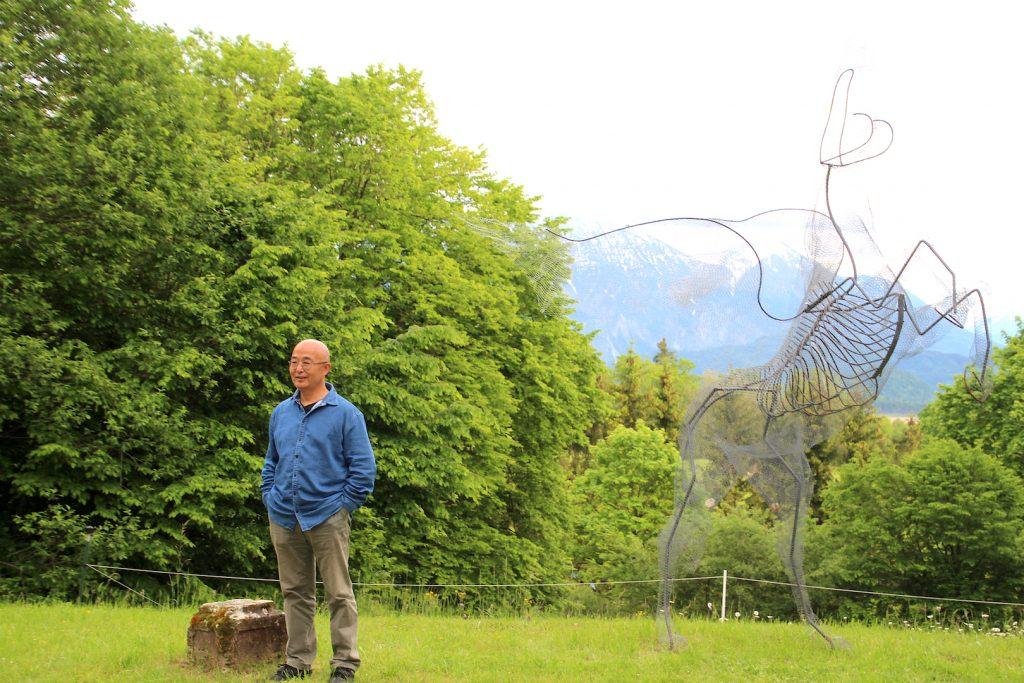
We would like to thank the fighter for human rights and 2012 Peace Prize winner of the German Book Trade, Liao Yiwu, as well as Stefanie Speermann (Speermann Arts) for her hospitality and Stephan Knies (Hamburg) for his special support of our conversation and our film recordings of the only performance of the poem „Massacre“ 2019 in Germany in the garden of Speermann Arts in Murnau am Staffelsee. We were allowed to film the performance in the wonderful surroundings of the mountains, whose beauty Liao Yiwu chose for the performance and which left nothing to be desired on this day. The film recording of the performance will soon be available on the Fritz Bauer Blog. (Ed.)
IW : Dear Mr Liao, first of all, I would like to thank you for allowing us to meet here today in this beautiful setting and have this conversation. This is a great pleasure and honour for us. I don’t think we need the occasion of the 30th anniversary of the massacre of 4 June 1989 to talk to each other, but your poem does. What prompted you to write the poem „Massacre“?
LY : If it hadn’t been for 4 June thirty years ago, I would certainly have taken a different path in life. And I wouldn’t be sitting here, opposite you, talking about this historic event. I was actually an anarchist poet back then and when the student movement started, I was also in Beijing. But I didn’t want to be too deeply involved in politics and the protest movement. I was a supporter of the Beat Generation, like Allen Ginsberg or Jack Kerouac, and was enthusiastic about their literature and lifestyle. And I wanted to stay away from politics. But the massacre changed me.
A few hours before the massacre, I was visited by a Canadian friend, a sinologist (Michael Day, ed.). He visited me in my home and brought a radio with him. This enabled us to listen to foreign stations, such as the BBC. We could hear the shots and screams on the radio and then the tanks rolling. We could feel the horror of the people very well. I had never in my life experienced such a terrible feeling from listening to the radio as I did from witnessing the events in Beijing. Then I wrote the poem and recorded it on a tape. We each had two cassettes and we copied them over and over again. There were many, many copies, and they spread to over twenty cities throughout China.
When I was arrested and sentenced two years later, a policeman at the court carried a whole basket full of cassettes in front of the judge, which were confiscated. The judge said to me: „This is your crime. It’s so obvious, it’s like a mountain in front of you now. And the punishment you’re getting now is too light for you.“ There were several dozen people arrested in the same case. I was arrested at the railway station in Chongqing. When I entered the station, I was thrown to the ground by plainclothes policemen, taken away in a car and taken to prison. When I got to the prison, they undressed me even though it was March and still very cold. Then they searched my whole body, pushed me to the ground and poked my anus with a stick to see if I had taken anything into the prison. Then someone shaved me, shaved off my hair. I immediately had the feeling that I had lost my dignity, that I was no longer a poet at all. This poet has long since died. I tried to take my own life twice and experienced all kinds of torture in prison.
Although I managed to get out alive and even learnt to play the Chinese flute from an old monk in prison, I came out of prison disappointed and desperate. All my friends were afraid of me. They avoided me like the plague. One brief meeting, a quick lunch, that was it, then they didn’t want to have any more contact with me at all. I was like a disgrace or a dangerous disease to them. I even had the feeling that I wasn’t in prison for a noble reason, but really like a „normal“ criminal. I was also afraid that I would be forgotten by the world and that drove me to write. I had to record my story and the story of many other people, because if I didn’t, I would forget them and the memory of them would be lost. Even if I couldn’t publish it, I could at least manage to keep a record for history and memory. So I wrote the book, which is available in German translation: Für ein Lied und hundert Lieder . I wrote it three times because the manuscripts were repeatedly taken away from me by the police.
IW: Where did you live in the two years leading up to your arrest? How were you able to survive these two years in China? And why did the poem hit such a nerve so quickly? Or what nerve did it strike that the state reacted so cruelly to it?
LY: The poem „Massacre“ was simply a cry of despair from me. And if you can be here in the tent for the performance on 2 June, you will experience it again. And the audience will experience it too. We will bring it to the stage again. I have performed the poem all over the world. And every time the memory comes up, the memory of the radio programme I heard, the sounds of the marching army and the desperate Chinese, their crying and screaming. I didn’t think much about myself during that time, about my own fate and what might happen to me. In hindsight, I think I was also a bit lucky. Someone said to me: if you had been arrested within three months of the massacre, you probably wouldn’t have got out of prison. Because that was a wave of arrests, a wave of harsh punishments, and I was arrested about two years after writing „Massacre“. But I didn’t think very much about it either. I paid my price for what I did. And now, thirty years later, when I look back, I don’t regret it. Prison was my teacher, it was my university. We say in China, and I think there is such a saying in Europe or Germany too: it was fate. And now, thirty years later, I’m sitting here in Germany being interviewed by you. Yes, that’s a long time, thirty years. But I realise it was my destiny.
IW: That means you didn’t expect the regime, the government, to react so brutally back then. Many of your companions or you yourself say that when you came out of prison, you didn’t recognise your country, you couldn’t find your way around as a human being. Does this also have to do with political developments? With international developments since 1989, the opening up of China and, yes, actually with the beginning of aggressive capitalism in China?
LY: During the Tiananmen Square protest movement, the Chinese believed that they could realise this with their own efforts, with their hard struggle: To have values such as democracy, freedom and human rights in their own country. Everyone has a dream. And everyone has a good dream. My dream back then was a little different, it was the dream of being a poet like Allen Ginsberg or like the other writers of the Beat Generation. Most people, the „normal“ citizens, believed in justice, in the realisation of justice in our country. That’s why the student leaders entered into negotiations with the government. They were very naive and believed that justice could be realised in China. But the regime responded with bullets, with weapons. They used bullets and tanks to destroy and crush people’s dreams. Millions of Beijing citizens took to the streets to take action against the army and protect the students. They fought with their lives and many lost their lives because they believed in our country, especially in freedom for our country. That was a unique event.
Later, after the massacre, especially with the rise of turbo-capitalism, the regime prescribed opium to the people. The West is also partly to blame because they believed that capitalism could lead to democracy in China. They failed to see that capitalism and dictatorship have a common belief and that is money. Capitalism and dictatorship have worked together. The Chinese economy has experienced several rises, „Great leaps forward“ (1) to its current size. This is thanks to the West, the West has given it this opportunity. With Western technologies and capital, they have managed to change the country from the ground up. Of course, Western companies have also made a lot of money in China. However, the naive idea from the beginning that democracy could come about through capitalism is now a thing of the past for the West.
As far as China is concerned, many people have emigrated from the country, left China. First it was the high-ranking officials, the party functionaries and their families, the businessmen who are super-rich. Then the big stars from the entertainment industry. The „normal2 population saw this and could no longer hope for justice, neither for justice nor for an improvement in their own lives. They only saw that those who could make it had long since jumped ship. That was a sobering truth for them and after that they themselves no longer wanted to stay in China. If they could make it, they would run away from China. Nobody from the „normal“ population wants to continue fighting for democracy in China. Terror and despair were the powerful weapons used by the regime to control the people. That’s why I think reciting my poem again today, reciting it again anywhere in the world, has a meaning. I want to bring back the beautiful time before 1989 and present it again to people in the West. Also to show: I haven’t changed much. I have remained true to my dream or the Chinese dream from back then. I am one of the few people who have not changed much.
IW: How did you manage to go into exile?
LY: I wrote a book. The book was published in Germany with the title Fräulein Hallo und der Bauernkaiser . It was at the Frankfurt Book Fair in 2009, when the guest country at the fair was China. A large delegation of Chinese writers, more than 130 writers, were there. Even Xi Jingping himself was there. Only I couldn’t leave China, and that became a huge scandal because my book enjoys a very good reputation in Germany and has also sold very well. I couldn’t leave the country and I didn’t realise that this large delegation of Chinese writers and my absence had caused such a scandal in Germany. Suddenly I had many requests for interviews from Western journalists. This made my book even better known. In 2010, I was invited to come to Germany for a literature festival, but I was still not allowed to leave the country. Chancellor Merkel interceded on my behalf, and a special envoy from Germany was even sent to China, to the German consulate in Chengdu, to talk to the Chinese side and try to get me to come to Germany for the literature festival.
But it was not successful. When this special envoy visited me, I thanked the Chancellor and gave her a DVD through him. It was a pirated Chinese copy of the German film THE LIVES OF OTHERS. That was my present for Mrs Merkel. I hoped that she would continue to stand up for me, for my departure. Later, I tried to leave the country again and was even taken away directly from the plane by many armed police officers. This scandal was even bigger and the German Foreign Minister even issued a statement on the case.
Then, in September 2010, I was finally able to come to Germany for a literature festival. Many friends tried to persuade me to stay in Germany, but I didn’t want to stay here. I still have many friends in China, I can’t speak German, so I went back. But then came the Arab Spring, which also affected China, and the political mood was very sensitive. I became afraid again that I would never be allowed to leave China again, even though my book Für ein Lied und hundert Lieder was soon to be published in Germany, and then the Chinese version in Taiwan. My publisher told me that they were worried about my safety and even wanted to postpone or cancel the publication. That was a turning point for me, I really wanted to take another chance with the publication of my work. I bribed the criminal gang on the border with Vietnam and they in turn bribed the Chinese customs officials – there is a lot of corruption on the border with Vietnam and you can achieve many, many things with money. I actually spent a lot of money, then travelled across the border to Vietnam and finally came to Germany.
IW: Mr Liao, I get the impression that you are not very optimistic about the current situation in China and the human rights movement. You said that many people are leaving the country or will leave the country. The next exile movement will come from China. Are you not at all hopeful about the human rights lawyers currently in China, their efforts towards democratisation and greater respect for human rights?
LY: When I received the Peace Prize of the German Book Trade in 2012, I gave a speech in St Paul’s Church. The speech was called „This empire must break apart“. In my opinion, the Chinese regime has lost all legitimacy after the Tiananmen Square massacre and they have turned China into a giant market and a giant pile of rubbish at the same time.
As for the human rights lawyers, there is no reason to be optimistic either. Over two hundred lawyers were arrested overnight. Even Putin didn’t go that far. That was this so-called „seven zero nine“ wave of persecution against human rights lawyers. For example, the lawyer Wang Yu (see also the interview with Prof Dr Eva Pils about the fate of the Wang family), he disappeared for more than a thousand days and no one knew where he had gone, not even his wife could find him. Everything was done in secret, his arrest and detention and then his conviction. There wasn’t much you could do for such lawyers, apart from speaking out and talking about them in the West. In the West, I have also seen in recent years that the power that the West has used for such human rights fighters against the Chinese regime has diminished. There were only protests against such bad cases from the Foreign Ministry’s human rights commissioner, no other higher authority or heads of state who made a very clear protest. That was a deterioration for me. When I couldn’t leave China, even Mrs Merkel stood up for me. But nowadays, the efforts of the West to do something for human rights lawyers are not energetic enough.
And now is a new time for the West: not to help China become more democratic, but to defend its own values against the aggression of the Chinese dictatorship. It is like a trade war between democracy and dictatorship. Either China exports its terror, surveillance and dictatorship to the West, or the West can prevail and export democracy and human rights to China. None of us want a world like 1984 , but the Chinese regime or the Chinese Communist Party believe very, very strongly in technological progress. They believe that if they have better technologies, they can defeat all forces. They are also on their way. If we look at human history, there was the conflict between Sparta and Athens. In the end, the democracy of Athens didn’t achieve much and was defeated by a militaristic Sparta. In the West, you have to recognise this tendency and this state of affairs correctly and clearly. As a writer, I may be a little pessimistic, but I have never stopped trying to show this state of affairs to the whole world through storytelling, through events like the second of June here in Murnau.
IW: Thank you very much for this clear assessment, which emphasises the threat to human rights posed by economic interests and, of course, the task we have here and what we need to do. Finally, I would like to ask you one more question after we have quizzed you so much: Is there anything you have not yet been asked but would like to tell us?
LY: I always have to repeat the things I’ve said. My interpreter, Peigen Wang, always reproached me (laughs): It sounds like over and over and over again. That does indeed sound rather boring, but I have to say I have no other choice. My job is writing and bearing witness to the world, to history. The reason why I always have to repeat myself is that people in a democratic society think that freedom, democracy and human rights are for nothing, that they sometimes show a bit of indifference towards such values. And I don’t think that’s an attitude. That’s why I simply have to emphasise and mention these things again and again in conversations or in my writing.
I have a certain level of recognition in Germany and I also find it relatively easy to be heard. That’s why I simply have to use these forces to uphold and defend the values that are so important and valuable in our society. For example, I have repeatedly talked about Li Bifeng (2) and written about him, and many Germans are actually impressed by my story. Some Germans have even travelled to China to Chengdu, where Li Bifeng is locked up, to visit him in prison. I think that’s very good. Once, Chancellor Merkel was visiting Chengdu when she suddenly said to the official accompanying her in Chengdu that she wanted to visit Li Bifeng in prison. That simply terrified the official. I thought that was very good and is the reason why I keep repeating the same questions or the same material.
There are different religions and beliefs in this world. Christianity, Buddhism, Islam. As a former political prisoner, my belief is simple: fight for the freedom of others! That is my belief, that is my religion.
IW: Thank you very much, Mr Liao, for the interview.
Find out more about the fight for human rights in China in the interview with lawyer Eva Pils , Kings College London, whose research includes the Chinese human rights lawyers‘ movement.
Translation: Peigen Wang (Hanover)
Camera: Jakob Gatzka (Vierkirchen)
Listen now
Discover the podcast series of the Fritz Bauer Forum
Here, experts talk about justice, human rights and social change. They provide in-depth insights and develop diverse perspectives on current issues that affect our society.

