
Autor/Autorin

Honoured guests,
I am delighted to be here today to briefly explain why a school in Herne is committed to the Interactive Fritz Bauer Library and very much welcomes the establishment of this forum here in Bochum.
To begin with, I would like to outline how the Eickel grammar school in Herne became a pilot school for the library. I will then look at the educational mission of the school and conclude with an outlook on our work.
A few years ago, during a project week on the topic of „democracy“, I worked with a group of pupils from years 6 to 9 for the library and found that the young people were serious, committed and creative in their approach to telling stories of people who had resisted in some way.
I still remember the impressive products on Steven Biko, Rosa Parks and William L. Moore very well.
Eickel Grammar School’s ongoing participation in Amnesty International’s letter marathon also repeatedly focuses on people who stand up for human rights and are imprisoned, persecuted or have to fear for their lives for this reason.
In my view, the defence of human rights, tolerance and the preservation of our democracy go hand in hand.
And to all those who live in our society with their eyes wide open, I don’t need to tell you that protecting the values and achievements associated with this is more necessary than ever.
Furthermore, as headmistress, I see it as my duty as part of our educational mission and responsibility to society to make our pupils aware of these high values and to sensitise them to their vulnerability, whereby it is necessary to look at history, the present and the future.
The fulfilment of this educational mission is primarily achieved through extracurricular projects, for example through our annual participation in the Dr Otto Ruer Prize, through our work as a „School against Racism – School with Courage“ and unfortunately only very sparingly, I must say at this point, through the curriculum of individual subjects.
But in my view, this educational mission is fulfilled in a particularly sustainable way through our work for the Fritz Bauer Library.
Because in one of the many conversations with Dr Wojak, one statement particularly motivated me to get pupils interested in this library:
She said that it was not about focussing on the victim, as history lessons are only too happy to do, but about focusing on those who did not want to or do not want to be victims, but used their strength to draw attention to grievances and defend their rights.
As I have already said, pure school lessons do very little here, which is also repeatedly criticised in discussions with pupils.
In the classroom, the focus is on acquiring a wide range of skills; only the subjects of German, social sciences, history, religion and philosophy are explicitly dedicated to values education.
So if schools also have the task of releasing critical, self-confident, tolerant, committed and, last but not least, courageous people who stand up for their opinions into society at the end of their time at school, and the lessons alone do not offer enough for this, how can this be achieved?
So how do we teachers ensure that these young people, who are entrusted to us over several years, preserve and defend the democratic society in which human rights are actually anchored?
How do we get these young people to recognise threats, denounce grievances and discuss them in a well-founded and convincing manner?
The answer is simple: by talking to them about situations in which our democracy is in danger, in which our rights are restricted, in which people encounter resistance because they stand up for their rights, in which people are discriminated against.
We do this by seeking out role models with our pupils who have shown and demonstrate that it is worth standing up for others – for human rights – by talking about these people and their courage, by recognising their actions as valuable.
We tell their stories and pass them on so that they are not forgotten.
In this way, we give these people a voice – against oppression and discrimination.
Looking at the victims creates compassion and regret.
Looking at the people who have resisted and continue to do so creates the ability to act.
It is a wake-up call, it is a motivation, it serves as a role model and creates examples to defend our human rights and the democracy in which we live.
In this way, school creates learning through storytelling and listening and, last but not least, engaging with people whose stories of resistance are passed on offers an opportunity to educate for civil courage.
It is the wish of Eickel Grammar School to grow the Fritz Bauer Library, which now also has a real location, into a huge database and to motivate other schools to join in.
In this way, we would like to encourage many people to take part in the fight for human rights, just as Fritz Bauer would have wanted.
Thank you for your attention and I would now like to pass this on to our pupils and to my colleague Mrs Knop, who heads the Human Rights Working Group.
Honoured guests,
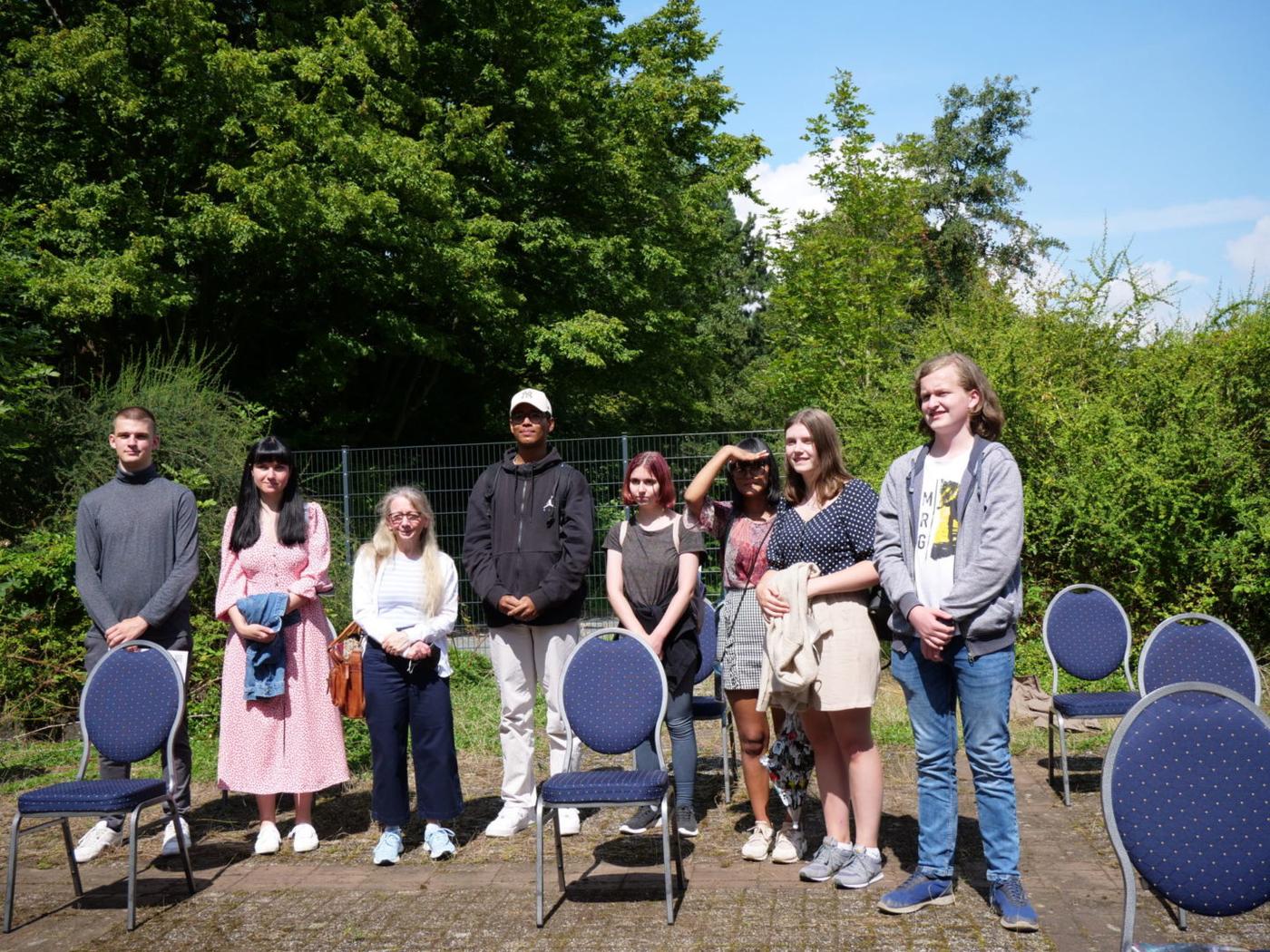
I am also pleased to be here today and to be able to speak on behalf of all the pupils who took part in the Human Rights Working Group.
I would like to take this opportunity to express my special thanks to Dr Wojak, without whom our working group would never have been able to take place, and also to Ms Theiß, who brought the project to the school together with Ms Fehrholz and actively supported us on the way to this evening. I would also like to thank my colleague Lisa Stremmer, who ran the working group with me last school year.
Since autumn 2020, seven Year 8 and EF students have been evaluating various sources, diligently researching articles and selecting suitable images as part of the human rights working group. The aim was to take an in-depth look at the biographies of seven special people, all of whom were united by their fight for human rights, and to create profiles of these people for the interactive Fritz Bauer Library. The result was seven articles for the interactive Fritz Bauer Library, a unique database of human rights fighters, which were published on the Fritz Bauer Library website in June.
Manju Weis investigated the story of Oskar Schindler, who, together with his wife Emilie, saved around 1200 Jewish forced labourers employed by him from being murdered in the Nazi extermination camps during the Second World War.
Chiara Pohl chose the story of Adolfo Kaminsky, who – also during the Second World War – saved numerous Jews from persecution and deportation by producing forged identity cards for them.
Raphael Braune dealt with the biography of Joshua Wong. He gained international attention as one of the spokespeople of the protests in Hong Kong.
The biography of US whistleblower Edward Snowden was examined by Aaron Maurer , while Jan Kotlowski focussed in particular on the life of Harriet Tubman, the founder of the Underground Railroad, who led thousands of slaves to freedom in the USA.
Jasmin Merten focussed on another US-American woman. She chose the biography of Marsha P. Johnson, an important activist of the LGBT movement, whose death is still unsolved today – just like that of Fritz Bauer.
Jordan Döring investigated the life story of Martin Luther King, the world-famous civil rights activist and campaigner for the rights of African-Americans. As different as these biographies may be, they are all united by the tireless fight for human rights and the hope for a united, peaceful world.
The pupils were particularly interested in the question of what actually enabled the people whose stories they had researched so long and so deeply to act so courageously. Where did their courage to stand up for certain rights come from? Are these people heroes? And what can we do for human rights?
The possibilities are as varied as the biographies that the pupils have analysed. What remains to be said, however, is that with the entries in the Fritz Bauer Library database, the working group on human rights has taken an important step towards safeguarding human rights and thus towards a democratic future.
Furthermore, it should be emphasised what Mrs Fehrholz has already said: the working group and the Fritz Bauer Library offered and still offer a unique opportunity for schools to deal with the topic of human rights in depth and thus to provide pupils with an education in values and democracy that goes far beyond the prescribed curriculum. In view of current global political developments, this is more important than ever and it is our task to educate pupils and enable them to think independently and critically. So the foundation stone is being laid today not only literally, but also in a broader sense, and I hope that many more schools will be enriched by the Fritz Bauer Library.
Many thanks and good luck for the future of the Fritz Bauer Library.