
Autor/Autorin
Militarisation and „war readiness“ have been massively promoted in Germany since the announcement of the „turning point“ in security policy following the Russian attack on Ukraine. The aim is also to win over the minds of the majority of sceptical citizens – especially young people. „We must become fit for war“, Federal Defence Minister Boris Pistorius (SPD) has repeatedly demanded, referring not only to the Bundeswehr, but also to „our society“, in other words all of us. And so the path to a „defencible“ society and a „war-ready“ Germany is being accompanied, supported and justified at great expense politically and ideologically, in the media and mentally. Only recently, the Bavarian state government achieved a further stage victory in this process: with a legally mandated militarisation of the state education sector.
In future, Bavarian schools, colleges, universities and research institutions will be required by law to cooperate more closely with the Bundeswehr. This is regulated by the new, first nationwide Bundeswehr Promotion Act, which the Bavarian state parliament passed in July 2024 with the votes of the CSU, Free Voters and SPD (LT-Drs. 19/1556; GVBl. No. 14 of 20 July 2024, p. 257). In addition to a general requirement to co-operate , it also expressly stipulates that universities must co-operate if this is „necessary in the interests of national security“.
The law is intended to ensure „smooth cooperation“ with the Bundeswehr, as well as its „unhindered access“ to research and development at universities, scientific expertise and scientifically qualified specialists, according to the explanatory memorandum. The text of the law literally states: „Research results obtained may also be used for military purposes of the Federal Republic of Germany or NATO allies“ – including NATO states that systematically violate human rights and international law. The legal text also states: „A restriction of research to civilian uses (civilian clause) is inadmissible“. This is because, according to the justification: Civilian clauses are „unacceptable in view of the existing security policy challenges“. Ultimately, the research and scientific potential of Bavarian universities must be secured „also in favour of military research and development“; and this also includes entering into and carrying out „cooperation or third-party funded projects with armaments companies or armies“.
As is well known, „civilian clauses“ are voluntary commitments by scientific research institutions to conduct research exclusively for purely civilian and peaceful purposes. The freedom of teaching and research enshrined in the German constitution allows for such voluntary restrictions. Ultimately, the underlying idea stems from the peace movement of the 1980s; the aim is to promote a policy of disarmament and détente, fully in line with the „peace commandment“ of the Basic Law. The first civil clause came into force at the University of Bremen in 1986. Today, around 70 German universities and colleges have introduced it – but so far none in Bavaria, which is now categorically prohibited from doing so in the future.
All schools in Bavaria are also affected by the law: from now on, they are to work closely with „youth officers“ and also with „career advisors“ from the Bundeswehr as part of political education on „questions of security and defence policy“ – the latter as part of school events for „professional orientation on career and deployment opportunities“ in the Bundeswehr. In the past, schools and teachers were able to decide for themselves whether and how to include the Bundeswehr in social studies lessons. However, since 1958, youth officers from the Bundeswehr have increasingly been giving talks on security policy and the armed forces in the education sector throughout Germany, often in conjunction with visits to troops. Since 2008, cooperation agreements have been concluded between the Bundeswehr and a number of education ministries in the federal states, which regulate such Bundeswehr visits to schools on a binding basis. This has been met with protest from the German Education and Science Union (GEW), which criticises the increasing influence of the Bundeswehr on the content of lessons and teacher training. Political education „belongs in the hands of trained civilian educational experts“ and not in the hands of youth officers. After all, the principle of neutrality applies to schools. The German Peace Society (DFG-VK) and the German section of the International Physicians for the Prevention of Nuclear War / Physicians in Social Responsibility e.V. (IPPNW) also consider the opening of school lessons to Bundeswehr programmes to be incompatible with education for peace, non-violent conflict resolution and international understanding.
In fact, the Bundeswehr is not legitimised for political education work in schools, neither constitutionally nor according to the education laws. However, according to a report by the Bundestag’s scientific services („Bundeswehr im Schulunterricht“, WD 3-09/10, 2010), information by and about the Bundeswehr in the compulsory part of school lessons should be constitutionally permissible in principle because „the armed forces are part of the state and anchored in the constitution“. However, youth officers may only take part in lessons at the invitation of schools and the school must remain in charge of the information event. The more controversial the content is in the public eye, the more the school must pay attention to balance and integrate opposing positions, such as through representatives or organisations of the peace movement (which, however, often does not happen). Because of the obligation to neutrality and tolerance, there should be no targeted influencing of pupils in a particular direction (ban on indoctrination). This also applies in particular to current war missions or military interventions. Controversially debated social issues must be presented and discussed controversially. And an advertising effect in favour of military service, i.e. service in arms, must be prevented from the outset – although such an effect may be at least latently associated with the deployment of youth officers in schools.
With the new Federal Armed Forces Promotion Act, such limiting requirements will become practically obsolete, and the co-operation of Bavarian schools with the Bundeswehr will practically become compulsory. This can affect pupils‘ freedom of conscience if they are influenced unilaterally. And, in addition to the mental militarisation associated with this, it reinforces a worrying trend: in the last five years, the Bundeswehr has already recruited around 8,000 minors nationwide and trained them in weapons (with the consent of their parents or guardians); and this has recently been on the rise: in 2023 alone, there were almost 2,000, a record figure (taz 26.07.2024), and in Bavaria almost 14 percent of those recruited are such child soldiers. This is despite the fact that the UN Committee on the Rights of the Child demands a recruitment age of over 18, i.e. the age of majority. The coalition agreement of the coalition government also states that „training and service at arms … remain reserved for soldiers of legal age“. However, a reversal is not yet in sight. As a result, minors who can be inspired by technology and weapons, clear order, camaraderie and adventure are still being made „fit for war“ – especially in Bavaria.
The justification for the Bundeswehr Promotion Act states that it is the „task of the state“ to „prepare our society for the fundamentally changed security situation“, which has an impact on almost all areas of life. The Free State must also „contribute within the scope of its (regulatory) competences to strengthening the Bundeswehr, shaping the framework conditions for the fulfilment of the Bundeswehr’s tasks … in the best possible way and consolidating the support of the population for our soldiers“. However, this is not a Bavarian speciality, but fits in with the nationwide government efforts to make the Bundeswehr comprehensively socially acceptable and to make us all „fit for war“, which means much more than defence capability in accordance with the Basic Law. And indeed, the Federal Ministry of Education has long had plans to have the military inform and advertise even more intensively in schools nationwide in order to develop „a relaxed relationship with the Bundeswehr“ and „prepare pupils for war“; and universities, not only in Bavaria but nationwide, are to be opened up more to military and armaments research in future and made available for service. Bavaria is thus the vanguard with its Bundeswehr Promotion Act, possibly as a blueprint for the whole of Germany.
In view of such developments and dangers, it is more than appropriate, especially against the backdrop of German history, that organised opposition is stirring against this: and so the DFG-VK, trade unions, members of schools and universities and numerous public figures warned in advance against the adoption of the law and announced a constitutional review. More than 1,500 people – including labour lawyer Wolfgang Däubler, theologian Margot Käßmann, former IG Metall boss Jürgen Peters and singer-songwriter Konstantin Wecker – signed a petition against the law because they feared a far-reaching „militarisation of the education and research sector“ – with nationwide repercussions. The law „disproportionately interferes with the autonomy of universities and thus with the freedom of research and science“ and also violates the principle of neutrality and freedom of conscience in schools.
For all these reasons, the Bavarian Constitutional Court must be asked to review the constitutionality of this military promotion law and its presumably fatal consequences as soon as possible. And the peace movement, which will hopefully soon be strengthened again, together with trade unions, members of the education and research sector, students, schoolchildren and parents, will have to continue to vigorously address and resolutely oppose this disastrous issue and the increasing militarisation of society.
– Schools and science must Bavaria adopts Bundeswehr Act: https: //www.lto.de/recht/nachrichten/n/bayern-bundeswehr-zivilklausel-kooperation-hochschulen-wissenschaftsfreiheit
– Critics of Bavaria’s Armed Forces Act threaten to sue: https: //sueddeutsche.de/bayern/bayern-bundeswehr- gesetz-kritik-klage-lux.Tw2GeZXiz48UQgZFsMHgSo
– Over 500 people support petition against Bavarian Armed Forces Act / Opposition to draft law on militarisation of education in Bavaria: https: //www.gew-bayern.de/themen/nein-zum- bundeswehrgesetz https://www.gew-bayern.de/aktuelles/detailseite/zum-gesetzentwurf-zur-foerderung-der- bundeswehr-in-bayern https://www.gew-bayern.de/presse/detailseite/widerspruch-gegen-gesetzesentwurf-zur-militarisierung-des-bildungsbereichs
– Bavaria turns militarisation into law: ban on civilian clauses in the event of increased recruitment at schools :https://labournet.de/branchen/dienstleistungen/bildung/bayern-macht-die-mili-tarisierung-zum-gesetz-verbot-von- zivilklauseln-bei-verstaerkter-rekrutierung-an-schulen/
– Draft law with justification: https: //bayern.de/wp-content/uplo-ads/2024/02/Entwurf-Gesetz-zur-Foerderung- der-Bundeswehr.pdf /Bundeswehrförderungsgesetz im Bayerischen GVBl. Nr. 14 v. 20.07.2024, p. 257.
Source: „OSSIETZKY“. Fortnightly magazine for politics / culture / economics no. 17-2024 from 24 August 2024, edited by Rainer Butenschön, Daniela Dahn, Rolf Gössner, Ulla Jelpke, Otto Köhler. Founded in 1997 by Eckart Spoo / Editor: Rüdiger Dammann. https://www.ossietzky.net/zeitschrift/ Single copies and subscriptions via: Ossietzky Verlag GmbH, Siedendolsleben 3, 29413 Dähre. Mail address publisher: ossietzky@interdruck.net / Internet: https: //www.ossietzky.net/
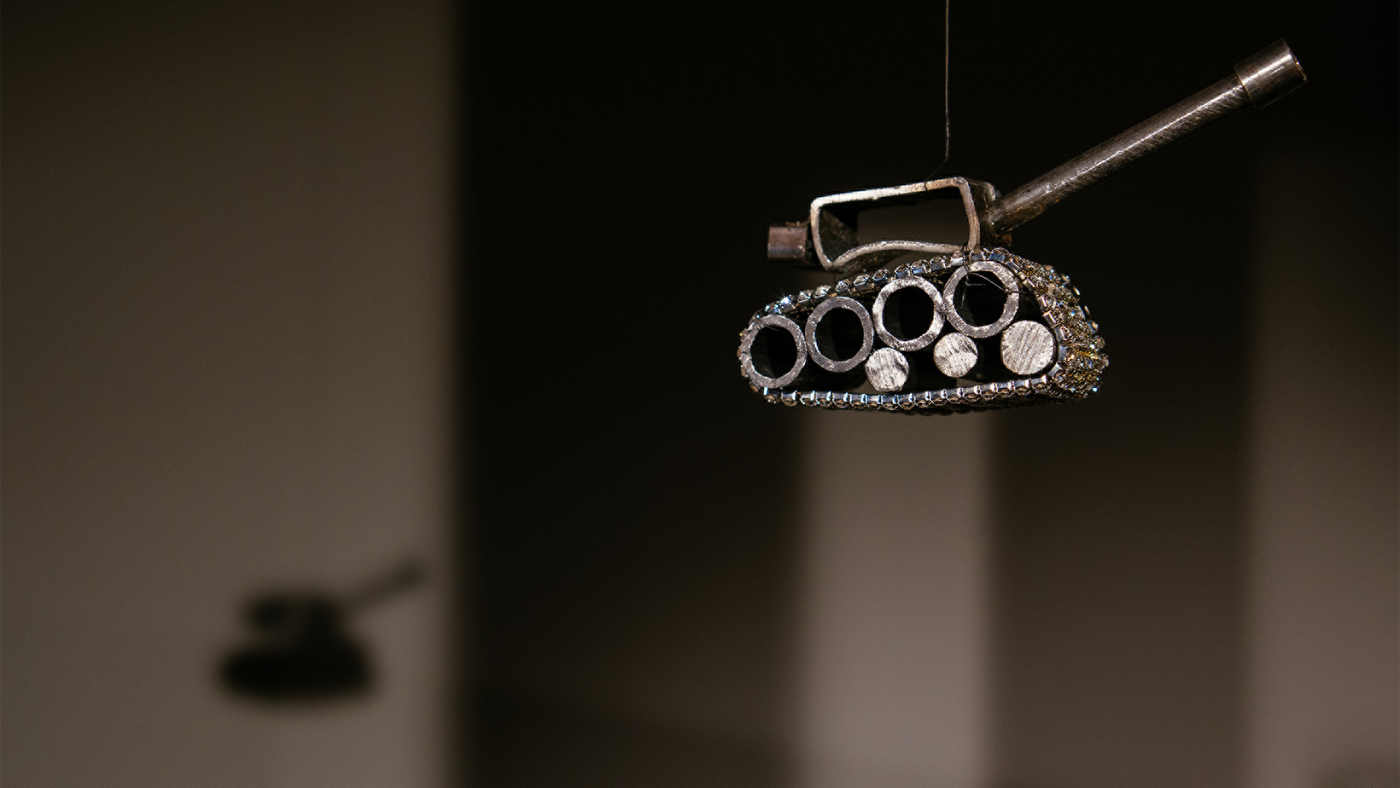
Photo in header: Fritz Bauer Forum | BUXUS STIFTUNG, photographer: Richard Lensit; photo of „The Visitor“ by artist Angela Schilling in the exhibition for the opening of the Fritz Bauer Library, August 2023; Feature image: photo of „Chainged“, also shown by artist Angela Schilling at the opening of the Fritz Bauer Forum.