
Autor/Autorin

In the very first week of the new year 2024, we were faced with a major change: a new logo. We also took part in the protests against right-wing extremism and organised two exciting events.
Since the beginning of the year, the appearance of the Fritz Bauer Forum has changed significantly. The old logo has given way to a new, dynamic approach that graphically distinguishes the Fritz Bauer Forum from the BUXUS FOUNDATION. This new logo, designed by Bochum-based artist Uwe Siemens, not only brought with it a new colour palette, but also new design options for our websites, flyers and, of course, for the Fritz Bauer Forum, which is currently still under construction.
You can read here why we decided to do this and what it means for us.
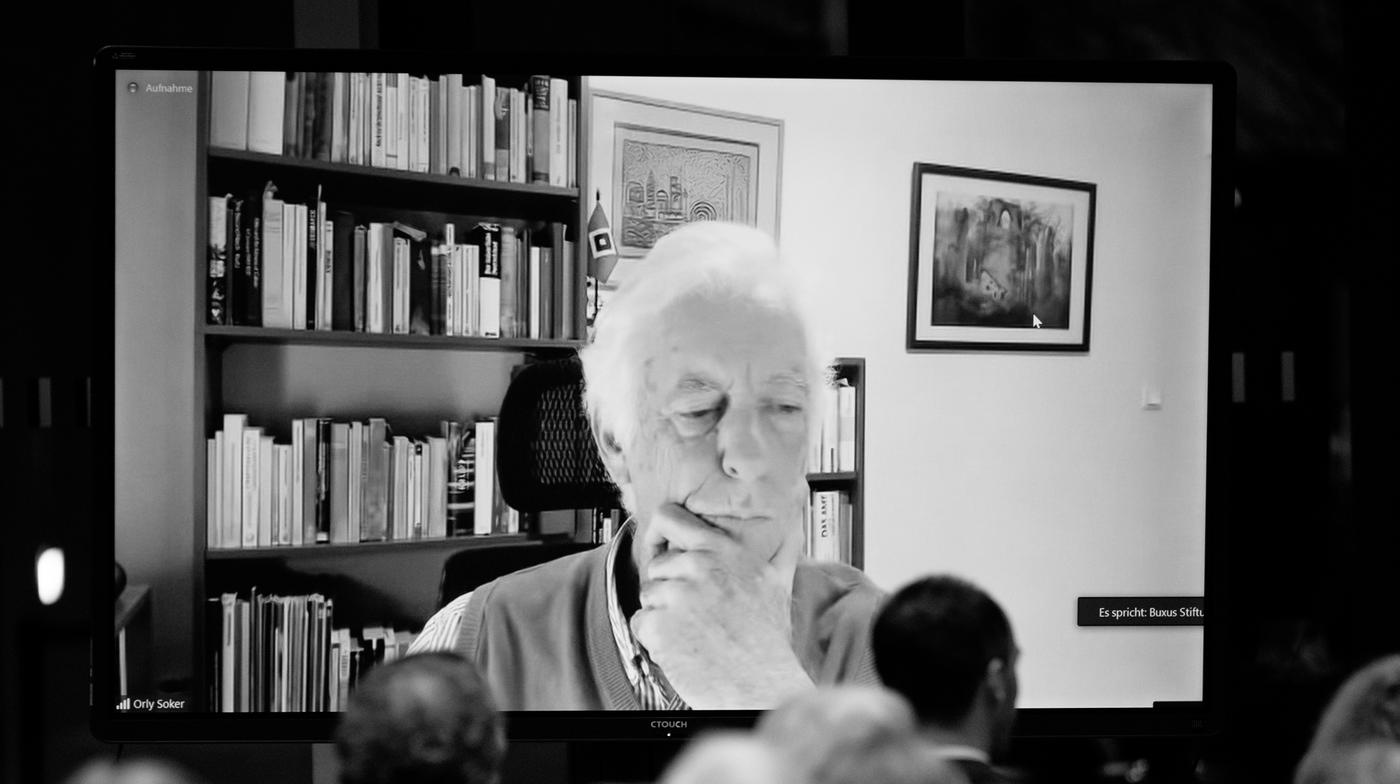
The serious events in Israel and Palestine continue to haunt us and we are grappling with them. While the Israeli government continues to reject a two-state solution in the face of international pressure from the USA and the European Union, we have invited one of its biggest advocates to Bochum: Prof Dr Moshe Zimmermann. Unfortunately, due to the current situation, the historian was unable to come to Bochum in person as originally planned. However, he gave a lecture at the Bochum Justice Centre via video link, in which he not only addressed the latest developments in Israel, but also placed them in the context of historical developments and outlined the acute problems of the Israeli state.
The entire lecture is available here on our YouTube channel.
In the discussion that followed, people from the audience were able to ask Moshe Zimmermann questions about Israel, the conflict and its possible solutions. The questions focussed in particular on current attitudes and perceptions among the Israeli population. Zimmermann once again spoke out against the war and called for a solution to the conflict through communication. The historical developments in Europe and the relative peacefulness of the continent since the Second World War could serve as a model for this, even if it is clear to him that „the Middle East is not Central Europe“. Even if, according to Zimmermann, Israelis are still living on 7 October, with all the pain, suffering and anger, it is necessary to break out of the cycle of violence. One actor at this point could have been the broad civil society that was present on the streets of Israeli cities just a few months ago. A movement that has been shrinking since 7 October, however, as a significant proportion of this group are reservists who are now waiting in barracks for a possible deployment and are therefore unable to take part in demonstrations. Zimmermann summarises the current situation in Israel as a Greek tragedy. A situation with no way out? No, but it requires pressure and help from outside. According to Zimmermann, the Israeli government is currently not in a position to resolve the conflict and Benjamin Netanyahu does not seem to be interested in finding a solution either. Israel needs the international community now more than ever to find a way out that ends the mutual killing, enables communication and allows the wounds to heal – a solution that involves two states.
The event took place in cooperation with the Bochum Justice Centre and the Evangelische Stadtakademie Bochum.
The plans for the deportation of millions of people from Germany, which were forged at a meeting of AfD politicians and well-known neo-Nazis, were a dam break for many people in Germany. The subsequent demonstrations brought thousands of people onto the streets, including in Bochum. The fact that between 13,000 and 15,000 people from very different social backgrounds made a clear statement against the AfD here alone is encouraging.
The statements made at the meeting in November 2023, the planning of deportations and the denial of citizenship clearly reveal the ideology behind them. The right-wing extremists who are vocalising these plans want far-reaching changes to German society. While it may initially seem that this is only about migration and refugees, it is becoming increasingly clear that the far-right is not only concerned with „certain“ groups. The more powerful the AfD becomes, the more clearly it will also take action against its opponents (of any skin colour, any gender, any sexuality, etc.) – and the AfD’s enemies are all those who stand up for human rights and democracy. So it’s about ALL of us who stand up for peaceful, respectful coexistence and a progressive world. Now is the time to take a clear stance against racism and right-wing extremism and to stand behind those who are already directly exposed to racist hostility (not only from the AfD).
We are grateful that so many different people in Bochum from political groups and parties, sports clubs, trade unions and social organisations are taking a clear stance against right-wing extremism! However, and this could be a new quality of the demonstrations, not only those who are already organised in groups, have been doing political work for years or have been campaigning for social issues for a long time have taken to the streets. But people who have perhaps never taken part in a demonstration before, young parents with their children, couples with their dog, the cashier from the supermarket, the elderly woman from the end of the street – the centre of society.
It is clear to us at this point that we need to do more, together. Not only because the term deportation alone is a reminder of what is probably the worst and darkest chapter in German history. But also because we can now show what we have learnt from it as a society, as historians and as activists. „Never again is now!“ is what is being said in many places, in the press and on social media at the moment – and rightly so – but what does this „Never again!“ have to include? What options do politics and society have to defend themselves against the AfD? This has already been discussed in the past. And the debate about banning the AfD is certainly good and important, just as it is good and important that the hurdles for such a procedure are so high.
But shouldn’t the motto be, albeit somewhat provocatively, „Never again was yesterday!“? This would not call into question the significance of the Buchenwald Oath, but would emphasise it: An extreme right-wing party is gaining strength in Germany and this despite our culture of remembrance. After all, „Never again!“ does not mean attending annual commemorative events and paying lip service, while otherwise not giving this topic a second thought throughout the year. Just as it did not mean remembering the perpetrators and their deeds while ignoring the strength and courage of the survivors by always categorising them merely as victims. After all, surviving means resisting!
„Never again!“ was and is a daily reminder from survivors, whether in everyday life, during leisure time or on election day. A reminder not just to be affected, but to act. There are many ways to do this, be it in the democratic parties and trade unions, with the „grannies against the right“, in the football club that is committed to fighting racism on and off the pitch, in the Bochum Alliance against the Right, with the local Antifa groups, etc., and so on. By seeking dialogue with each other, finding out what we can improve, actively speaking out against contempt for humanity and not losing our own compass, we can do justice to the survivors‘ „Never again!“.
The IPPNW Bochum (International Physicians for the Prevention of Nuclear War ) organised a discussion evening on the topic „Nuclear weapons are banned – does that help us?“ in the rooms of our Fritz Bauer Library at the end of January.
Max Lucks , Member of the German Bundestag (Bündnis 90/Die Grünen), Prof Dr Hans-Joachim Heintze (Institute for International Law of Peace and Humanitarian Law at RUB) and Dr Ingrid Farzin (International Physicians for the Prevention of Nuclear War IPPNW Bochum) took part in the discussion. The evening was moderated by Rita Bernhard-Otto , doctor of psychiatry and psychotherapy, IPPNW Bochum.
Following keynote speeches by the speakers, there was a wide-ranging discussion and exchange with the audience. The discussion focussed in particular on the topics of the Treaty on the Prohibition of Nuclear Weapons, which marked the third anniversary of its entry into force, and the „Doomsday Clock“, which stands at 90 seconds to 12, as well as international law in the event of war.
At the well-attended New Year’s reception of the Peace Plenum, which is traditionally accompanied by a review of the social movement in Bochum over the past year, Irmtrud Wojak once again emphasised the importance of remembrance as part of the fight for human rights.
This starting point is important to the FRITZ BAUER FORUM as a supplement to the collective negative memory. This has become naturalised and, as „remembering crimes“, is also an important part of the success story of the Federal Republic of Germany. However, a positive memory is also needed in order to encourage people and encourage risk-takers in their current actions in favour of human rights.
Irmtrud Wojak’s speech can be read here on our website.
On the 79th anniversary of the liberation of Auschwitz, the memorial event organised by the Jewish community in Bochum once again commemorated the Jewish citizens of Bochum and Wattenscheid who were murdered by the Nazis by having four schoolgirls read out their names.
On the 79th anniversary of the liberation of Auschwitz, the memorial event organised by the Jewish community in Bochum once again commemorated the Jewish citizens of Bochum and Wattenscheid who were murdered by the Nazis by having four schoolgirls read out their names.
Felix Lipski then reminded the audience of the importance of this day of remembrance, especially in the current situation, i.e. against the backdrop of the war in Israel/Palestine and the extreme rise in anti-Semitism in Germany. Irmtrud Wojak then spoke about current anti-Semitism, warning against simplifications and the political instrumentalisation of anti-Semitism by right-wing extremists. The speeches were translated into Russian for the event.
Irmtrud Wojak’s contribution can be read here .
07 February, 16.00 – 17.30: Wednesday talks. Further information here.
08 February, 18.00 – 20.00: Reinhold Spratte | Measures against violence. Further information here.
16 February, 18.00 – 19.30: Rahab Njeri | The invisibility of black women in activism. More info here.
29 February, 18.00 – 19.30: Julia Machtenberg | Workshop on Audre Lorde. More info here.