
Autor/Autorin


In March, we looked at the complexity of women’s biographies and also familiarised ourselves with the poetry of Audre Lorde. We continued to deal with the current situation in Israel and the war in Gaza, including a visit to the state parliament, and we looked at the treaty banning nuclear weapons.
Some fought admirably for their goals, others put themselves above their fellow human beings. Some pursued economic interests and entered into controversial alliances to assert their interests. On 1 March, author and journalist Jasmin Lörchner presented her book „Not just heroines – 20 women who made history“, published in 2023. Lörchner’s idea: to portray women as they are – multi-faceted.
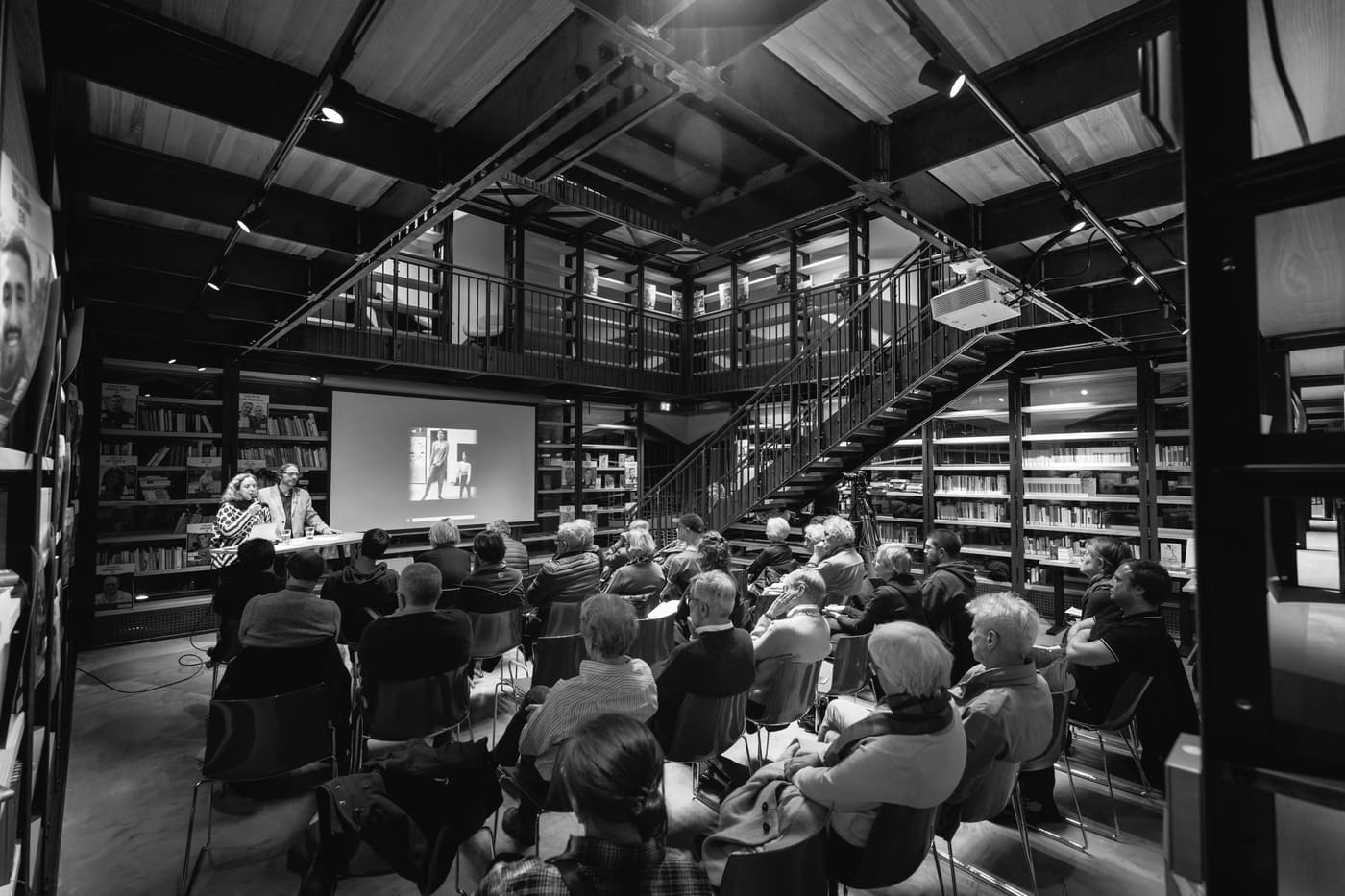
Njinga, Sediqeh Dowlatabadi, Irena Sendler – Jasmin Lörchner read the stories of these three women from her book „Nicht nur Heldinnen“ at the Fritz Bauer Library on 1 March. In an exciting exchange between the readings, the role of historiography and the invisibility of individual stories were discussed.
The term „heroine“ was also discussed in many cases. The title „Not just heroines“ indicates the diversity that Lörchner wants to cover in her book. She doesn’t just want to tell the „perfect“, one-sidedly positive stories of women and queer people, but to depict reality. The term heroine or role model, Lörchner explains her approach, places high demands on the person portrayed; they must not be guilty of anything. Heroisation leaves no room for missteps and we should „get away from that“. The history of these strong personalities is a process, missteps are part of it and are human, they have to be depicted, otherwise we would no longer do justice to the historical figures and their actions.
What can we do to make current problems and the actions of women and marginalised groups or individuals visible? Lörchner answered this question by saying that we need to give these people a forum and a voice, listen to them and talk to each other in order to give them more recognition.
The week from 4 to 8 March was very special for us because we had guests from Israel for talks at the Fritz Bauer Forum. Ayelet Bargur, an Israeli author and filmmaker whose films have received international acclaim and take a critical look at everyday life in Israel, and Dani Engel from Tel Aviv visited us. Dani Engel’s brother Ronen was murdered by Hamas on 7 October 2023, his family was kidnapped from Kibbutz Nir Oz and only released after 52 days.
The shock among the Israeli population runs deep. How could it have come to this, to be defencelessly at the mercy of this attack? But just as pressing is the question of when and how the more than 100 hostages will be released, under what conditions a ceasefire is possible and how things can actually continue after this experience and after the war.
We have been dealing with these questions for several months and took the opportunity to discuss them with politicians at a meeting in the Düsseldorf state parliament on 5 March. Ayelet Bargur and Dani Engel first spoke to SPD MP Serdar Yüksel (MdL) and told him how they experienced 7 October and how Engel found out about his brother’s death via Facebook.
This was followed by a meeting with the President of the State Parliament André Kuper (MdL, CDU) and the NRW-Israel Parliamentary Group, during which Bargur and Engel signed the Golden Book of the NRW State Parliament. In her conversation with the MPs, Ayelet Bargur emphasised that she would like to see far-reaching global support for Israel in the future, especially in the coming reappraisal of the conflict and the question of how things can continue after the war has ended. She referred to the Marshall Plan of 1948, which, in addition to an economic reconstruction programme for Europe after the Second World War, also led to a change in German society, which had been discredited by National Socialism. Bargur called for nothing less than international intervention, which, in addition to economic and security policy aspects, must also have societal and social consequences. In her opinion, this was the only way to ensure a long-term solution to the conflict.
„We need to talk, talk, talk“ was the motto with which we planned the series of events („We need need to talk“) after it quickly became clear to us how much more difficult the conversation about the Middle East conflict became day by day after 7 October. It was important to us that Ayelet Bargur and Dani Engel came to the Fritz Bauer Library. They reported on what they experienced on 7 October 2023 in a lecture followed by a discussion. Both emphasised how much the Hamas attack has changed life in Israel. They emphasised that the top priority was the release of the hostages.
Ayelet Bargur also visited the Hildegardis School in Bochum and the Louis Baare Vocational College in Wattenscheid. The teachers there watched Bargur’s film „Das Haus in der Auguststraße“ with the pupils, which tells the story of the Jewish children’s home Beit Ahawah in Berlin in the 1930s. After the transfer of power to the National Socialists, the director of the children’s home, Beate Berger, whose great-grandniece Bargur is, quickly realised that there was no future for her charges in Germany. She made the timely decision to move the children’s home to Palestine. In doing so, she saved the lives of more than a hundred children. In addition to a discussion about the film, both schools also talked intensively about 7 October, the hostage-takings and the war in the Gaza Strip.
The film „Das Haus in der Auguststraße“ was also the subject of the „Wednesday Talk“ in the Fritz Bauer Library on 6 March. The film captures the voices of people who travelled to Palestine as children and escaped the murderous Nazi regime. Ayelet Bargur found the survivors by placing an advert in a German-language newspaper in Israel. She talked about the five-year research process for the film and the importance of coming to terms with her own family history.
The events with Ayelet Bargur and Dani Engel were part of the „We need need need to talk“ series of events. This is funded by the Federal Ministry for Family Affairs, Senior Citizens, Women and Youth, the City of Bochum, the Bochum Municipal Integration Centre and the Kinder- und Jugendring Bochum e.V. as part of the federal „Live Democracy!“ programme.
On 12 March, Julia Machtenberg, PhD student at the Institute of American Studies at RUB, presented the poetry and history of the poet and activist Audre Lorde. In her texts, Lorde develops new perspectives on her socio-cultural environment, criticising the oppression of black women in particular. At the same time, she develops visions of a trans-regional social coexistence with regard to marginalised people and deals with the concept of intersectionality before this term was even coined. Based on a number of selected poems, an interesting discussion developed about the importance of poetry for Lorde, who saw it not as a luxury but as a necessity for expressing her own personality. Audre Lorde once said that it is not the differences that paralyse us, but the silence about them. This describes a basic understanding of the work of the Fritz Bauer Forum and we are delighted that we were able to gain a deeper insight into Audre Lorde’s work on this evening.
In mid-March, this year’s „AG Menschenrechte“ (human rights working group) from Herne-Eickel grammar school visited the Fritz Bauer Library in Bochum together with their teacher Tristan Abrolat. In the working group, which was created in cooperation with the school, the pupils deal with human rights and develop a story for the interactive Fritz Bauer Library , choosing the protagonist themselves. This year, too, they have researched five exciting personalities and we are looking forward to finding out more about their stories. In a small workshop, Magdalena Köhler gave the pupils an insight into the basics of academic work and research.
If you are interested in setting up a human rights working group at your school, please contact Magdalena Köhler at magdalena.koehler@fritz-bauer-forum.de.
Political scientist Dr Carmen Wunderlich and Dr Ingrid Farzin addressed this question in a lecture followed by a discussion at the Fritz Bauer Library on 14 March. Both the lecture and the discussion emphasised the central role that women have played and continue to play in the global anti-nuclear movement. It was emphasised how great the transformative potential inherent in the Treaty on the Prohibition of Nuclear Weapons, which entered into force in 2021, is. It breaks with the status quo by turning the prevailing ’nuclear patriarchy‘ on its head, thinking about marginalised groups and the impact of nuclear weapons on them. This is clearly a step forward, but there is still a lack of approaches that aim to change the underlying structures, as became clear in the subsequent discussion on the proclaimed „feminist foreign policy“.
Discussions about the situation in Israel and the Gaza Strip are currently more urgent than ever, but what, or rather who, are we actually talking about when we talk about Israel? Does Israel mean the state itself or its government? Are we talking about Israel as a Jewish state or are we talking about a pluralistic society and a democracy under dangerous pressure? In a lecture on 15 March, the author and journalist Dr Ofer Waldman succeeded in shedding light on these questions and made one thing clear above all: when we talk about Israel in Germany, we are primarily talking about ourselves.
„Morality becomes a hobby in a world in which people are dispensable“. Waldman introduced his lecture with these words, expressing the most pressing problem in the discussion about the current situation: We want to be on the „right“ side of history rather than endeavouring to find a real solution to the conflict with all its facets. According to Waldman, the German debate repeatedly reveals old patterns and attitudes which, in their extreme forms, brand any criticism of the government in Israel as anti-Semitic or, conversely, falsely declare Israel solely responsible for the situation in the Middle East. The public debate should be more about the efforts of the civilian population on both sides, their suffering and their prospects, and less about blind support for the far-right government in Israel on the one hand and the radical Islamic Hamas on the other.
Ofer Waldman pleads for a rethink in the culture of debate and for a greater awareness of the fact that we in Germany always look in the mirror of our own history when we look at Israel. We have published Ofer Waldman’s lecture here on our YouTube channel.
The event was part of the event series „We need need need to talk“. This is funded by the Federal Ministry for Family Affairs, Senior Citizens, Women and Youth, the City of Bochum, the Bochum Municipal Integration Centre and the Bochum Children’s and Youth Association as part of the federal programme „Live Democracy!“
With the protagonists Noem and Myop, author Günter Pohl has created two cheerful gentlemen who fast-forward through the history of philosophy from Ancient Greece to the present day, leaving plenty of room for discussion and self-reflection.
On 19 March, Pohl read from the first two parts of his book series „Von der Ordnung der Welt. A philosophical dialogue in three volumes“.
The author explained the meaning of the two names, Noem (in linguistics the smallest unit of meaning, literally „thought“), who always knows everything exactly, and Myop (derived from the term myopia, short-sightedness), who acts somewhat more emotionally and quickly, which complement each other in the Platonic dialogues and work well together. From this, Pohl develops his two characters and how they see and deal with their different themes in the history of philosophy.
We are already looking forward to welcoming Günter Pohl to another reading after the publication of the third volume of his trilogy in the autumn.
11 April, 18.00 – 19.30: Dr Gerd Hankel: The 1994 genocide in Rwanda – history, course and consequences. Further information here .
17 April, 17.00 – 18.30: Guided tour of the building site. Further information here .
18 April, 18.00 – 19.30: Dr Esther Mujawayo-Keiner: „…because I did not believe that there could be justice.“ Further information here .
25 April, 18.00 – 19.30: Gudrun Honke and Otto Honke: Rwanda as a German colony – photo exhibition. Further information here .