

Autor/Autorin

April was an exciting month for us: the panelling that was installed to protect the glass windows in the former mourning hall was removed and the glass windows are now shining in all their glory again! There was another insightful event in our „Lawyers for Democracy and Human Rights“ series – lawyer Gabriele Heinecke spoke about the history of the Oury Jalloh case. In addition, the legacy of the lawyer Dr Helmut Kramer is coming to the archive of the Fritz Bauer Forum. And the biggest surprise: we have been nominated for the GRIMME ONLINE AWARD 2023 with our digital exhibition on Fritz Bauer!
Although we have known since the beginning of April that we were nominated, we had to keep it a secret until the official announcement of the nominations on 28 April. So here is the official news: our digital exhibition „Fritz Bauer. In the fight for human rights“ has been nominated for the Grimme Online Award 2023 in the „Knowledge and Education“ category! We are very happy about this great honour and could not be prouder! We would also like to take this opportunity to thank the Grimme Institute once again, which selected 28 entries from over 800 proposals. Jennifer Haas and Magdalena Köhler were in Cologne for the announcement and were able to get to know the many great programmes a little better, you can find the complete list of all nominations here . The award ceremony will take place on 15 June in Cologne, with 8 prizes awarded by a jury and an audience award – so keep your fingers crossed and vote for us, there is also something to win: VOTE NOW .
At the end of April, the time had finally come: the panelling that had been fitted in front of the glass windows of the future Fritz Bauer Library since 2022 to prevent them from being damaged during the renovation work could finally be removed!
Now the beautiful windows can finally be seen to their best advantage again, both from the inside and the outside. When the sun shines on the library windows, the rays cast bright colours into the interior and the building looks even more beautiful from the outside. The windows were designed by architect and glass artist Egon Becker (1910-1989). This marks a major step in the transformation of the former mourning hall into the future Fritz Bauer Library!
On 17 April, a group of lawyers, international law experts and historians met in Bochum as part of our emerging Fritz Bauer Forum to discuss the preservation and evaluation of the extensive legacy of the lawyer Dr Helmut Kramer (born 30 March 1930). Helmut Kramer, a former judge at the Higher Regional Court of Braunschweig and at the Lower Saxony Ministry of Justice, founding member of the Forum Justizgeschichte e. V., of which he was chairman until 2006, has entrusted his son Christian Kramer with securing his estate. It is to be analysed, i.e. given a finding aid, digitised, indexed and securely stored, and later made available for research in the digital reading room of the Fritz Bauer Forum in Bochum.
The former judge Helmut Kramer clarified the events that led to the investigations against the heads of the Nazi judiciary involved in the Nazi „euthanasia“ murders being closed immediately after Fritz Bauer’s death. In the 1980s, Kramer experienced similar hostility to Fritz Bauer when he initiated investigations against a whole series of members of his own guild. There is therefore a direct link to the extensive collection on Bauer, which the forum named after him keeps and will also make accessible in future. The group will meet again on 15 May at the archive of the lawyer Helmut Kramer in Wolfenbüttel.
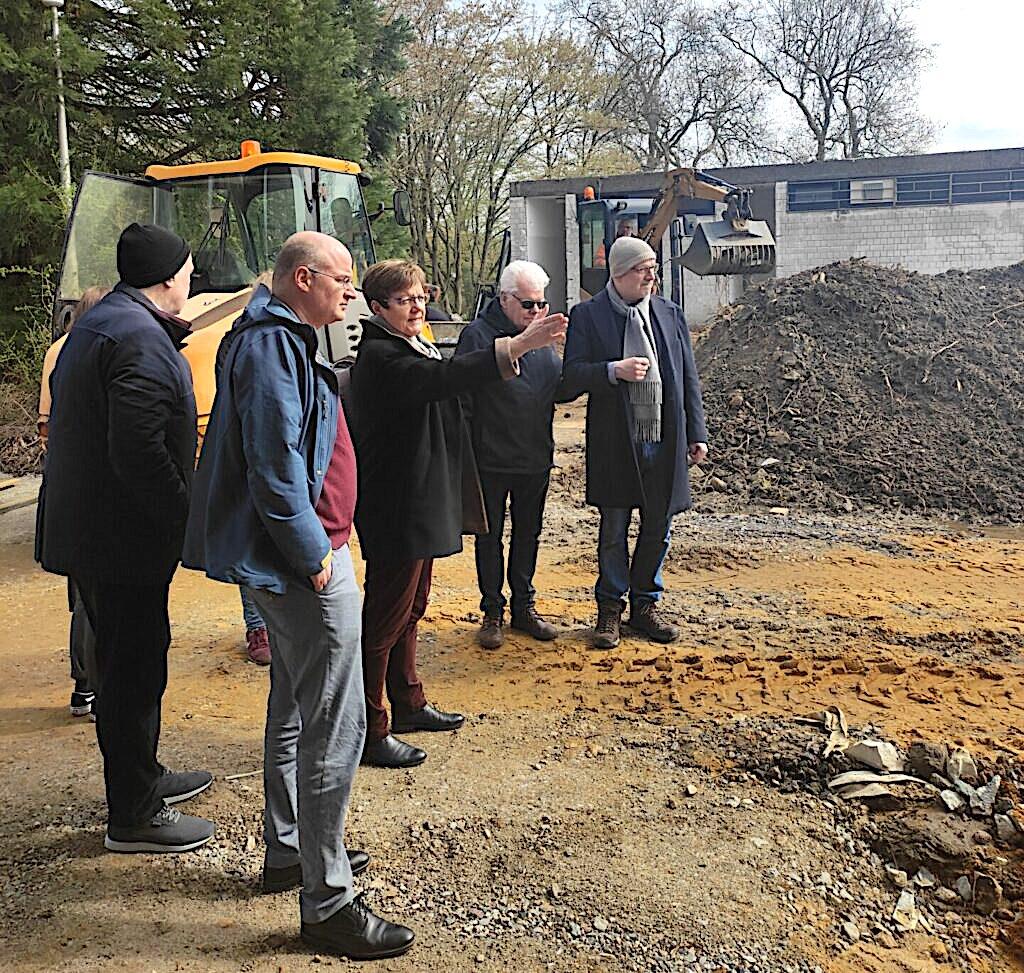
Christian Kramer, Hans-Ernst Böttcher, Irmtrud Wojak, Uwe Boysen and Gerd Hankel visit the „FRITZ BAUER FORUM construction site“ © FRITZ BAUER FORUM | BUXUS STIFTUNG
We were able to hold further exciting discussions in April, with Magdalena Köhler and Tobias Fetzer visiting the Hillerheide youth centre in Recklinghausen to talk about possible cooperation. We will continue our search for cooperation partners in May, for example we are planning a meeting with Steele bleibt bunt e.V. . We also took part in the Bochum Initiatives Flea Market at the Kofabrik on 29 April with a book stall and were able to talk to many interested people.
On 20 April, Gabriele Heinecke spoke about the Oury Jalloh case in Bochum’s Q1. As a lawyer, she represents his family and relatives in court and knows all the gruesome details of the case, which has since become synonymous with police violence. She talked about the evening that would ultimately lead to Oury Jalloh’s death. It was 2005, Oury Jalloh, a refugee from Sierra Leone who had been living in Dessau for several years, drunkenly accosted two €1 jobbers at night. What follows is an incomprehensible sequence of events at the Dessau police station that has not been fully explained to this day, which ultimately leads to Oury Jalloh being found dead in his cell, number five – his body is burnt and charred.
Gabriele Heinecke gave an impressive and factual account of the attempt to clarify the events in court. It was shocking to hear how often those responsible not only looked the other way, but actively covered up their misbehaviour. Only recently, a constitutional complaint was rejected by the Constitutional Court and the family is now considering taking the case to the European Court of Human Rights. One quote by Gabriele Heinecke from the event that has particularly stuck in our minds is this one, which describes the core of the problem:
„A judiciary that, despite massive evidence, considers it simply inconceivable that in a German police station in broad daylight officers would lay hands on a refugee and set him on fire may not recognise reality. A justice system that acts and works in this way is part of the problem. Civil society scrutiny is urgently needed.“
For all those who were unable to attend the lecture but would like to find out more: We conducted an interview with Gabriele Heinecke before the lecture, which we will publish together with the lecture in the coming weeks.
Amineh Kakabaveh, Kurdish Peshmerga fighter and until recently a member of the Swedish parliament, was our guest in Bochum for the second time. Together with the „Rojava Solidarity“ group, we invited her to a book presentation followed by a discussion on 29 April in Bochum’s Q1. After an exciting event last June, this time she presented her autobiography Amineh – no bigger than a Kalashnikov , which has been published in German and English translation by our publishing house.
Barbara Dahlhaus and Magdalena Köhler read out some passages from the biography and were thus able to give a good insight into the book. Amineh Kakabaveh commented on what she had read and spoke about what it was like to grow up as a child in Kurdistan in constant fear for her own life and that of her family and friends. Joining the Peshmerga was a way for her to deal with this fear and turn it into courage, because being a Peshmerga means „facing death“. In the subsequent discussion round – thanks to great translation – Agir Mustafa Birhîmeoğlu and Amineh Kakabaveh spoke about the current situation in Iran, the struggles against oppression worldwide and the increasing division of the left.
We are very happy that Amineh could be with us. If you don’t know Amineh’s book yet, you can order it here in our shop. You can also find a little insight into her life and work in our podcast Ten Twelve.
From 8 May, you can buy the German translation of Jamie B. Raskin ’s new book The Unthinkable here with us.
In this book, Democratic US Congressman Jamie Raskin describes two unthinkable traumas: the death of his son on 31 December 2020 and the attempted coup by incited supporters of former President Donald Trump on 6 January 2021. Raskin then led the impeachment proceedings against Trump. You can read in his book how Raskin dealt with the loss of his son and the attack on American democracy and what lessons he learnt from it.
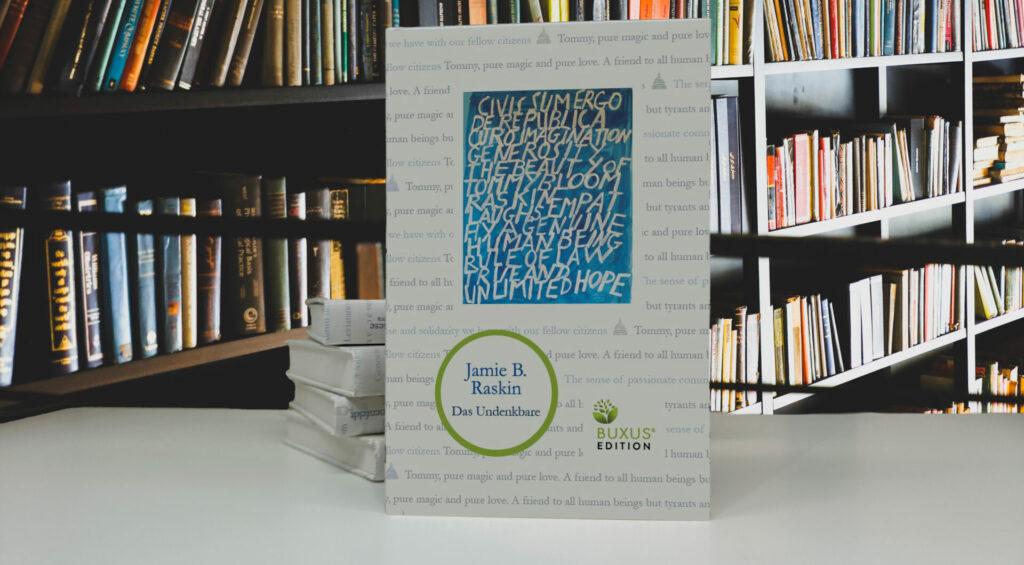
Cover The Unthinkable by Jamie B. Raskin, © Fritz Bauer Forum | BUXUS STIFTUNG
Last week, Repr. Raskin published the news of his recovery from a serious cancer. We hope with him! The extraordinary book that Jamie Raskin has written in just a few months is a humanly and politically moving read. It bears witness to what a person can achieve and not only bear personal suffering, but also move out of love for his family and the democratic tradition of his country – un(un)conceivable.
06.05. Anti-fascist day of struggle on Dr Ruer Platz
11.05. Thomas Galli in Q1, more here
14.05. Bicycle scavenger hunt with bo-initiativ.de