
Autor/Autorin


In April, we dealt with the genocide in Rwanda in 1994 and again with the possibilities of Jewish-Palestinian cooperation after 7 October 2023 and Hamas‘ attack on Israel. We also looked at the privatisation of water in Chile since the military dictatorship and there was also a tour of the construction site – the last one before the topping-out ceremony on 23 May 2024.
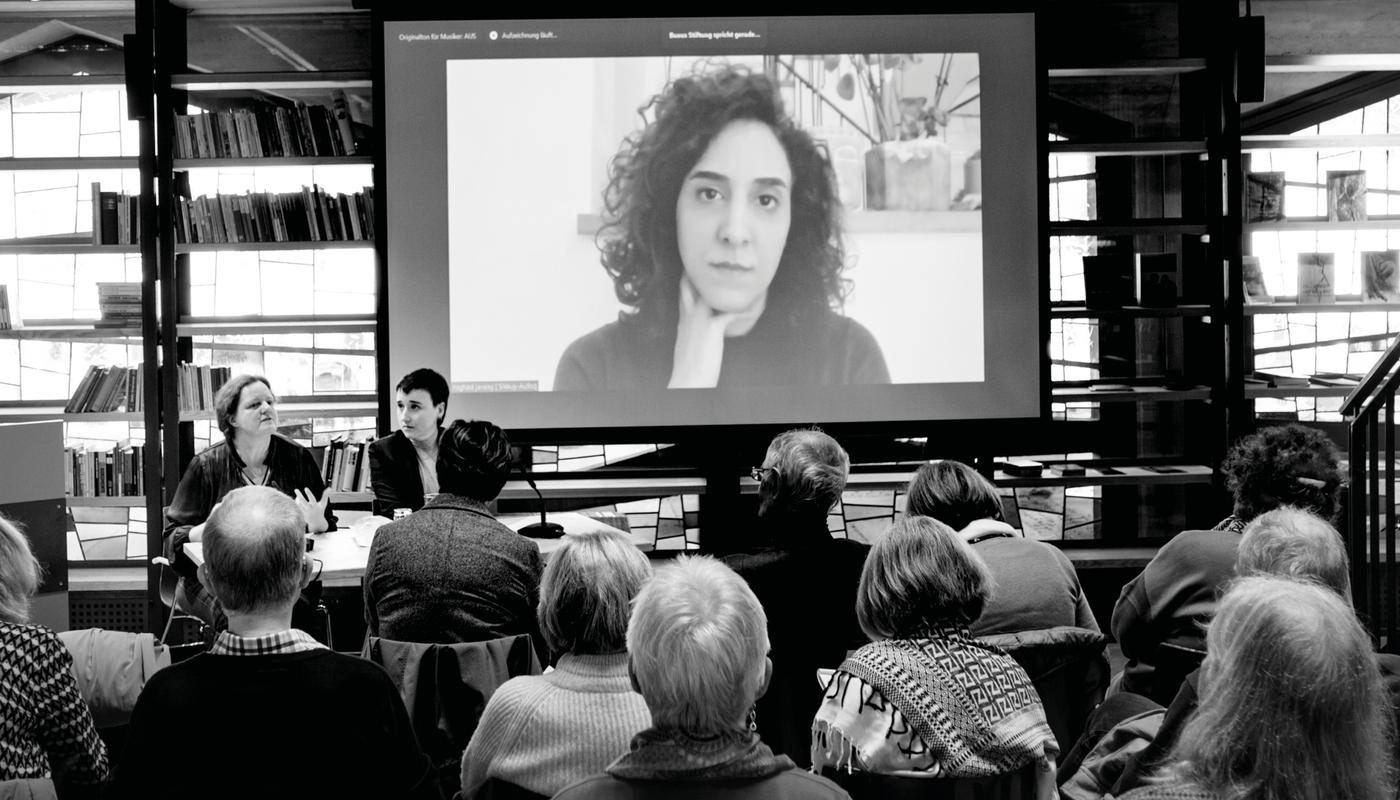
As part of our series „We need, need, need to talk“ and the Wednesday Talks, we welcomed Maja Sojref, Managing Director of the New Israel Fund Deutschland e.V. , to the Fritz Bauer Library on 10 April. She reported on the work of the organisation , which promotes Jewish-Palestinian cooperation. Raghad Jaraisy , co-director of the organisation Sikkuy-Aufoq , was connected live from Israel and spoke about the specific challenges of the work on the ground. In an exciting discussion, it became clear how important it is to talk about such examples of Jewish-Palestinian cooperation here in Germany in order to depolarise debates and to be able to advocate for multi-perspectivity, without which the complexity of the narratives and the historical context would be lost. During the discussions, it became clear how little is known about this civil society engagement here in Germany.
On 17 April, there was another guided tour of the construction site of the future Fritz Bauer Forum. This time there were nine visitors, to whom Jennifer Haas introduced the site, its history and its future use. It is now clear to see what the Fritz Bauer Forum will look like in the future. The majority of the exterior walls are already in place and you can also see where we will be working with you and experiencing new event formats in the future. The last guided tours of the building site before the opening will take place in October this year.
In co-operation with Medizinische Flüchtlingshilfe Bochum e.V. (MFH), we dealt intensively with the genocide in Rwanda in 1994, in the course of which around 1 million people were murdered. Between the beginning of April and mid-July 1994, in just one hundred days, members of the Hutu majority murdered members of the Tutsi minority. But how can society come to terms with such a crime?
On 11 April, the lawyer and international law expert Dr Gerd Hankel spoke about the history, course and consequences of the events between April and July 1994. In his lecture, G. Hankel, who visited Rwanda for the first time in 2002, addressed the question of whether there can be a justice that heals after a genocide and when a society can be considered reconciled. Hankel described the significance of the International Criminal Tribunal for Rwanda (ICTR), which sent an important, albeit symbolic, signal. However, the ICTR was unable to satisfy the needs of the Rwandan population for the prosecution of perpetrators. This also reveals another problem: not only did the genocide reveal the major social and political problems in the country, it also destroyed the institutions that could have dealt with it. Rwanda found a solution in the traditional gacaca courts , which have their origins in the village structures of Rwanda. Over 10,000 such gacaca courts convened and categorised the perpetrators according to the severity of their guilt. The goal: to build a new Rwanda and restore social peace. In his intensive research, Hankel also identified two taboos concerning the genocide and the process of coming to terms with it. On the one hand, the involvement of the Rwandan Patriotic Front (today’s ruling party) in the genocidal atmosphere in Rwanda in 1994 is kept quiet. Secondly, according to Hankel, it is often concealed that there were also Hutu who did not participate in the genocide and were killed for it. With his criticism, Gerd Hankel emphasised how important it is for society to come to terms with such a crime in a ruthless manner.
But what does this reappraisal look like from the perspective of a survivor and what role does the justice system play in this? And how did Rwandan society deal with perpetrators and survivors? Trauma therapist and genocide survivor Dr Esther Mujawayo-Keiner provided answers to these questions in a lecture on 18 April.
She spoke about what it is like to build a new life as a genocide survivor, as she initially felt „condemned to live“. Her work and the community with other survivors helped her to rebuild trust in other people and to remember what she had left. The organisation AVEGA, which she co-founded and which primarily looked after the women who had to completely rebuild their lives after the genocide, also played an important role in this. In the subsequent discussion, Esther Mujawayo-Keiner emphasised that there is always resistance and that the criminal prosecution of the genocide played and still plays an important role, even if there is much important and correct criticism of the criminal prosecution of the perpetrators of the genocide. Esther Mujawayo-Keiner also talks about the importance of resistance in the interview we conducted with her in 2022 , which you can find here . You will soon find Esther Mujwayo-Keiner’s lecture on our YouTube channel.
On 25 April, Gudrun and Otto Honke explained the significance of the colonial past for the genocide and for German-Rwandan relations as part of their project presentation: „Rwanda as a German colony – photo exhibition“. In collaboration with Rwandan historians, they developed a concept for a photo exhibition which, in a modified form, attracts numerous visitors to the Kandt House, the historical museum in the Rwandan capital Kigali. Various photos of people from Rwanda during German colonial rule are shown here, with the big difference that photos were selected that show people in dignity. This contrasts with the photos from this period, which you will certainly recognise and which mostly show racist motifs and constellations. Similar to the written sources, these reveal that they report on non-whites by whites for whites, which is why dignified portraits and texts are very rare. As in other examples from the colonial period, this is based on the racist assumptions of the time, such as the Hamite theory , a pseudo-scientific attempt to hierarchise people on the basis of their assumed biblical descent.
René Vergara from the Chilean organisation MODATIMA, the „Movement for the Defence of Access to Water, Earth and Environmental Protection“, spoke at the Fritz Bauer Library on 29 April about the right to access to water and the current situation in Chile in this regard. Using the example of the monoculture of large-scale avocado cultivation, the already devastating consequences of which are exacerbated by climate change, R. Vergara highlighted the alarming water problems in Chile, which have become even more acute following the failed constitutional process. Access to water and its management are in private hands in Chile and there is an urgent need to raise and consolidate awareness of the ecological problems among the population in rural areas in order to strengthen the protest against the exploitation of the vital resource of water and in favour of the human right to water.
In addition to lots of information and insights into Chilean society, the evening was also accompanied by music, with Rodrigo and Lorenzo Tobar playing wonderful Chilean music.
05 May, 11.00 – 17.00: Bike scavenger hunt, open day of the Bochum initiatives. Further information here .
07 May, 18.00 – 19.30: Nora Hespers: My grandpa, his resistance against the Nazis and me. Further information here .
13 May, 18.00 – 19.30: Dr Dietmar Köster and Uta Zapf: Europa zwischen Atomwaffenverbotsvertrag und atomarer Aufrüstung. Further information here .
23 May, topping-out ceremony in the afternoon and from 19.30 the Bochum Symphony Orchestra will be performing at the Fritz Bauer Library. Further information here .
27 May, 17.00 – 18.30: Book club: Nora Hespers: My grandad, his resistance against the Nazis and me. Further information here .
28 May, 18.00 – 19.30: Roland Vossebrecker: The uprising of the Jewish Sonderkommando of Auschwitz-Birkenau. Further information here .
31 May, 18.00 – 19.30: Jamie Raskin: The unthinkable – the struggle for American democracy. Further information here .