
Autor/Autorin


Before our event break in July/August, we once again dealt with many different topics such as freedom of expression, the fire in the Valparaíso region of Chile, resistance against the Nazi regime in Dortmund and discrimination in football. The next events will take place in late summer and autumn, including „Open Monument Day“, a book publication in our „Fritz Bauer Library“ series on the subject of Colonia Dignidad and further events on the ongoing conflict in Israel and Palestine.
Europe and the European Union remain an important topic for us, especially because of the results of the European elections. But how can we reach people in the long term and get them excited about the European idea? One answer is teachers. We were therefore delighted to be able to offer a training programme for teachers on this topic together with the Ruhr University Bochum, the Professional School of Education and the Ruhr/Westphalia Employers‘ Association.
The Professional School of Education at Ruhr-Universität Bochum has been organising a series of events entitled „Education in Focus“ for some time now. The focus is on issues relating to the transfer between science and practice in the field of education and schools. We are delighted that the 8th edition of the series took place at the Fritz Bauer Forum. The event focussed on the question of how Europe is understood and taught in schools – fittingly, shortly before the European elections. The lecture by historian Prof Dr Markus Koller began by shedding light on the question of what Europe actually is in concrete terms and what different images of history are used in the classroom. The subsequent discussion with experts from academia and practice focussed on the impact of past and current spatial and political borders, the way in which historical education is taught and the challenges that teachers face on a day-to-day basis. It became clear that Europe is strongly characterised by diversity and that this must be seen as a strength, but that schools as places of education should also be open to new teaching and learning concepts.
In cooperation with the Bochum Adult Education Centre and the Bochum City Library, we were able to invite Susann Franke, project manager of the „Hafen der Zuflucht Hessen“ project of the „Gefangenes Wort e.V.“ association in Giessen, and Umar Abdul Nasser, an Iraqi poet, songwriter and performance artist living in Berlin, to the Fritz Bauer Forum at the beginning of June. In her lecture, Susann Franke reported on the importance of freedom of expression worldwide and discussed some specific examples, including the case of the Kurdish journalist Nedim Türfent or that of the Eritrean writer and journalist Yirgalem Fisseha Mebrahtu (whose story you can read here in the interactive Fritz Bauer Library). Afterwards, Umar Abdul Nasser presented an artistic performance that dealt with the topic of freedom of expression and the experience of war, violence and peace on an artistic level. A varied evening that emphasised above all the importance of reliable news sources and that we must listen to those whose voices are suppressed by dictatorial regimes.
Together with the Alliance Solidarity with Chile , we organised a matinee for reconstruction in the Chilean region of Valparaíso at the Fritz Bauer Library on 9 June. At the beginning of the year, Valparaíso experienced what was probably the worst fire in its history, hitting the poorer neighbourhoods of the city particularly hard. This is where the Escuela Popular de Arte (EPA) is located, a school run by an NGO that has made it its mission to teach music and art to the children of the region. Although the school itself was spared by the fire, many of the families affected lost all their possessions, including the children’s musical instruments.
In addition to an auction of a donated painting, there was much to discover on this day. On the first floor of the library, various art objects were on display, which could be purchased through the Alliance Solidarity with Chile , delicious food and music by Grupo Manzanar . The musicians of Grupo Manzanar have a personal relationship with the EPA, about which the artists gave a talk on the current situation on the ground alongside their music.
The entire proceeds of the day, more than €1000, will be donated directly to the EPA.
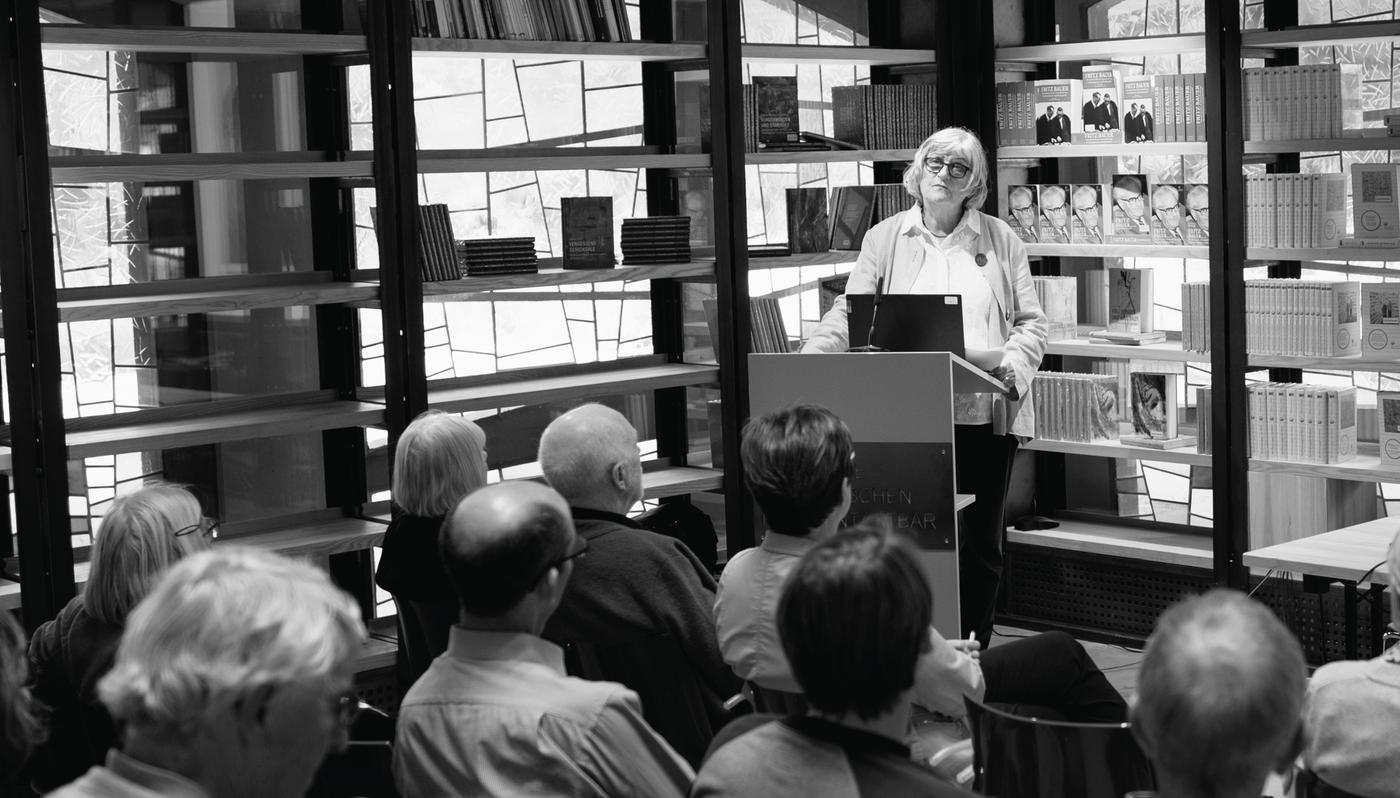
On 11 June, author Dagmar Scholz and Jan Ropeid, director of the Bergen Tor Gestapo Museum Association, presented the book Vergessene Schicksale (Forgotten Fates) , published by BUXUS EDITION . The book deals with the resistance against the Nazi regime in Dortmund by a group of pupils, the so-called Paul Winzen Group .
Author Dagmar Scholz talked about how the book came about and the resistance of the group led by Paul Winzen from Dortmund. According to Dagmar Scholz, the aim of the book was to allow those who could no longer speak for themselves to have their say. The aspect of the perpetrators also plays a role, and Tor Jan Ropeid, author of the foreword to the book and director of the memorial on the history of the Gestapo and German occupation in Bergen, Norway, who had travelled from Norway, spoke about this at the book launch. One of the Dortmund perpetrators had been transferred there in 1941 and was known there for his cruel interrogation methods.
The book tells us more about how the resistance group around Paul Winzen was organised, what their resistance actually looked like and about their persecution. It also includes research into the perpetrators and their activities in Dortmund and Norway. Overall, the book Forgotten Fates paints an impressive picture of the courageous and self-sacrificing resistance against the Nazi regime.
The book can be purchased here in our online shop.
The lecture by Dagmar Scholz and Tor Jan Ropeid will be published on our YouTube channel shortly.
On 20 June, Anuscheh Amir-Khalili (Anstiftung, Munich) told us about the establishment of the HEVRîN XELEF garden project in Berlin-Neukölln. The garden, named after the politician Hevrîn Xelef, offers refugee women* the opportunity for self-empowerment, self-organisation and self-sufficiency. In addition to a deep connection to Rojava and the rojava healthcare project as well as to the mother of Hevrîn Xelef, who was murdered in 2019, the garden is characterised by the medicinal and useful plants planted there. For example, a black mulberry was planted in 2022 in memory of Jina Mahsa Amini, who died in police custody. In Iran, the wood of the black mulberry is traditionally used to make flutes that are played at funerals. Another component of the garden is the cultivation of knowledge about medicinal plants and remedies from all over the world, which is collected, shared and passed on by the refugee women*. The „HEVRîN XELEF“ garden is an impressive example of what solidarity and a transcultural approach can look like in practice.
Just in time for the 2024 European Men’s Football Championship, images and impressions showing the idealised world of football are once again dominating the news in Germany. The often-cited integrative power of football and the work of the clubs are at the centre of this report. On the other hand, we are seeing an increase in anti-Semitic incidents and far-right parties and groups gaining political space. What challenges arise for political education in a post-national socialist society, what anti-democratic and misanthropic tendencies are reflected in football? Because it is clear that social developments are also reflected in football.
Together with the Reporting Centre for Discrimination in Football NRW (MeDiF-NRW) , we explored these and other questions during the group phase. In this context, Dr David Berchem spoke about anti-Semitism in football at the Fritz Bauer Library on 21 June. Berchem’s initial question was: „How does anti-Semitism materialise in football?“. Starting with a few introductory words and a working definition of anti-Semitism, Berchem prepared the audience for case studies that showed how present this specific form of discrimination is in football. Hidden or open, in the form of images or metaphors, anti-Semitism is changeable and adapts to its social context. According to Berchem, football is political in both its integrating and marginalising forms. Discriminatory statements and attitudes are widespread in football and manifest themselves in very different ways. Be it numerical codes on jerseys, hidden codes on banners and posters or quite openly in the form of the „underground song“. The word „Jew“ is considered by many to be a maximum insult, even beyond ultra groups and right-wing extremist football fans. MeDiF-NRW has also observed an increase in Israel-related antisemitism since 7 October 2023, especially towards Maccabi clubs. Berchem’s presentation not only highlighted the abysses of the football fan community, but also outlined what individuals, fan initiatives and large clubs are doing to counteract these developments.
David Berchem’s presentation will be published on our YouTube channel shortly.
The workshop „ What do Fritz Bauer, the Auschwitz trial and discrimination in football have in common? “ has been postponed to 8 November 2024.
We wish you a relaxing summer and look forward to welcoming you again to events at the Fritz Bauer Forum in late summer!