
Autor/Autorin

In July, we were able to talk to Rolf Gössner about human rights and German history, planned our summer party on 11 August and the „Memoria Viva – Latin America on the move“ series of events. In addition, our seminar at the University of Witten ended, which brought exciting stories to light that we want to present to you in the coming weeks.
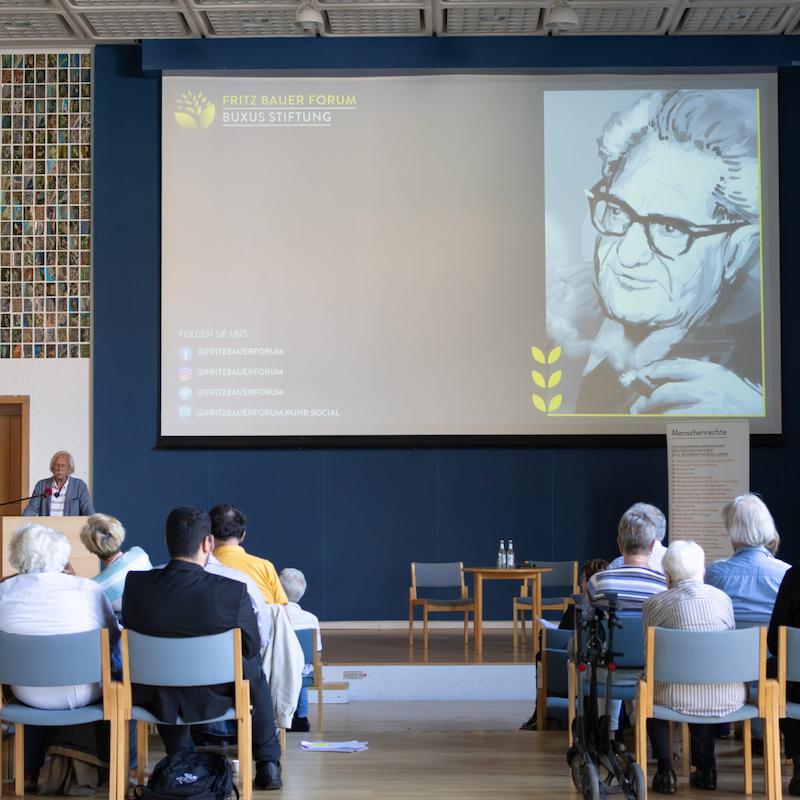
Rolf Gössner was observed by the Office for the Protection of the Constitution for a total of 38 years (from 1970 to 2008). On 6 July, he spoke at an event in the Bochum Art Museum about human rights and the importance of the Basic Law. As an „epochal work“ and a „lesson learnt from the horrors of fascism“, the Basic Law expresses the tension between civil liberties and internal security like no other German legal text. In a historical outline, Gössner took the audience from the ban on the KPD and the criminalisation of political action to former Nazi functionaries in leading positions in the young FRG, unlawful occupational bans and the German Autumn to the 1983 census and the Last Generation. He showed in an impressive way that the history of political activism in Germany was also a history of violations of fundamental rights by the federal government and that the criminalisation of social protest is by no means a novelty.
However, it is not only the restriction of political action that concerns Gössner, but also the informational self-determination of citizens, which has continued to decline in the wake of new technology. „In principle, everyone is allowed to make their own decisions about their own data,“ says Gössner, adding that everything else requires a legal basis. State surveillance and „[…] the excessive prevention“ of so-called anti-terror laws after 11 September 2001 also undermine the presumption of innocence and thus one of the cornerstones of our legal system. According to Gössner, people mutate into a source of danger in this system and must first prove that they are harmless.
In front of almost 50 people, Gössner spoke for about an hour about historical events and categorised the events in legal terms without getting lost in legal jargon. Gössner also showed in his lecture that the fight against these legal offences can be worthwhile and that the illegality of the state’s actions can still be established years later. In the Rolf Gössner case, a court ruled in 2018 that the 38 years of surveillance were unlawful.
In mid-July, the last date of the seminar „Resistance for Human Rights – The Interactive Fritz Bauer Library“ took place at Witten/Herdecke University, which was offered as part of the Studium fundamentale programme. Over the summer semester, students worked on the question under the guidance of Magdalena Köhler: What does it actually mean to resist human rights violations – what forms of resistance are there and what are human rights anyway? And what role did Fritz Bauer play? Selected examples were used to shed light on resistance under the Nazi regime, but current cases of human rights fighters were also discussed. Irmtrud Wojak was a guest on one of the dates and gave the students fascinating insights into Fritz Bauer’s life and his commitment to human rights. The seminar resulted in some great contributions for the interactive Fritz Bauer Library, which will be published in the near future.
This month, we were able to finalise the programme for our major autumn event series „Memoria Viva – Latin America on the move“ and are already looking forward to welcoming many interesting guests! In co-operation with Amnesty International Bochum, we have created an exciting series dedicated to the topic of memory and resistance in Latin America. In workshops, book presentations, lectures and films, the forms of protest and lively resistance against social inequality, against the impunity of crimes committed by civil and military dictatorships and the struggle for human rights in Latin America will be examined and discussed in more detail. Some of the events are part of the series „Chile – 50 Years of Putsch, Resistance and Solidarity“, organised by the Bochum-based alliance „Solidarity and Remembrance“, which will take place from August to mid-December 2023. An overview of the events in the series „Memoria Viva – Latin America on the move“ can be found here.
11 August 2023, 15:00 – 21:00: Half-time – completion of the Fritz Bauer Library and summer party of the Fritz Bauer Forum. There’s lots to see, art, talks and live music with Grupo Manzanar from 6.00 pm!
29 August, 18:30: Moshe Zimmermann „Solidarity does not mean silence“
31 August, 19:00: „Start Wearing Purple“ film evening in collaboration with BO-Initiativ.de
Start of the series „Latin America on the move“ in cooperation with Amnesty International Bochum
13 September, 5.30 – 9.30 pm: Chile: book presentation, discussion and film
21 September, 18.30 – 20.30: Argentina: Book presentation and discussion
24 September, 18.30 – 20.30: Chile: Lecture and discussion
26 September, 19.00 – 21.00: Argentina: Film and discussion
All dates of the series here .