
Autor/Autorin


In October, we continued seamlessly with our event series „Memoria Viva. Latin America on the move“. Jennifer Haas, Magdalena Köhler and Tobias Fetzer were also in the „Heart of Europe“ and we were at the Frankfurt Book Fair with the publisher BUXUS EDITION.
Max Lucks (Bochum Member of Parliament, The Greens) had already invited us to Strasbourg this summer. An extensive programme awaited us from 9 October, starting with the European Court of Human Rights (ECtHR). After a short guided tour and a film describing the work of the ECHR, we were able to ask questions to a member of staff. We found the individual proceedings, their procedures and the consequences that such proceedings can have for a state particularly interesting. The special and unique nature of this legal body, which stands for human rights and their observance like no other, became clear to us.
After a short break, we continued on to the Council of Europe. Here we had the opportunity to spend an hour asking Max Lucks questions about developments in Europe, human rights and how the Council of Europe works. Following this discussion, we had the opportunity to watch a debate organised by the Council of Europe entitled „The challenge of right-wing extremist ideologies for democracy and human rights in Europe“. As the Council of Europe is currently meeting on the premises of the European Parliament, we were not far from our last major item on the programme, a guided tour of the European Parliament.
Even though our trip ended after a day and a half, we took a lot away with us from Strasbourg. In addition to a deeper understanding of how the various institutions work and function, it was above all the space that Strasbourg gives to Europe and human rights and the large number of people who are fighting to ensure that human rights remain more than just a promise. We can only recommend such an information trip.
On 17 October, the Chilean writer and journalist Jorge Montelaegre presented his recently published work Edition National Stadium 1973: Autobiographical Essay in the BUXUS EDITION. Montelaegre, who holds a doctorate in American Studies, began writing poetry at the age of 19 as a political prisoner.
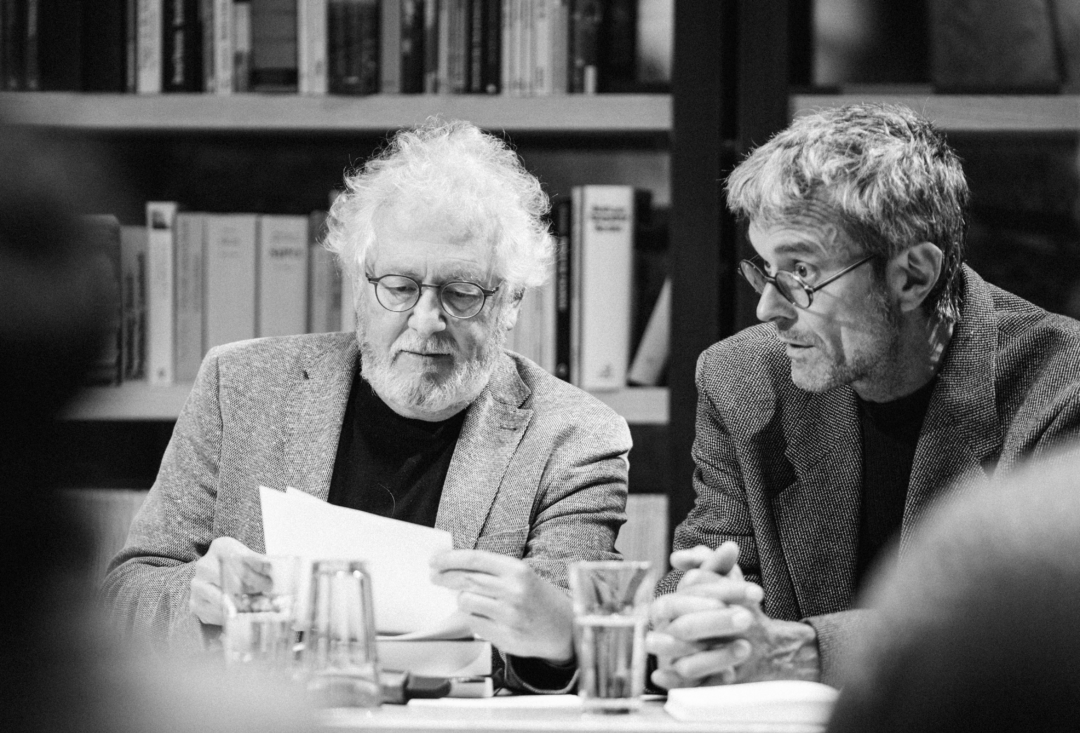
Together with Dr Irmtrud Wojak (editor and director of the Fritz Bauer Forum) and Mathias Sasse (literary scholar, translator of the book for BUXUS EDITION), he spoke about his memories of the military coup in Chile. Günter Pohl (an expert on numerous Latin American countries, who himself lived in Ecuador for some time ) translated for Jorge Montealegre.
Reinhold Spratte, an artist and educationalist from Witten who designs the covers of the „Fritz Bauer Library“ book series, read from the book.
Jorge Montealegre’s narrative focuses on survival rather than the horror and violence that were omnipresent during his time in captivity. He emphasises the importance of humour, which runs through his experiences in 1973, but also through his book. Because humour, he emphasises, preserves one’s own humanity. In conversation with the audience, it became clear that it is precisely this approach that encourages people to read the book and that the author’s humour also encourages his readers in a certain way.
Jorge Montealegre talked about the various forms of resistance, be it through singing, drawing or the small gestures of sharing among the prisoners, which he emphasises again and again. The word „blanket“ is a key word here, which is reflected in the Spanish title of the autobiography: „The Blankets of the National Stadium“ (Las Frazadas del Estadio Nacional ). The great importance of these blankets for the resistance plays a special role in the autobiographical essay, as they allowed people to protect themselves, sleep on them, keep themselves and others warm… and also hide violence behind them.
Mathias Sasse, translator of the book into German, also took part in the discussion. He spoke of the valuable personal encounter with Jorge Montealegre before he began his translation work, and he accompanied the author throughout the reading tour. Thanks to the personal contact, he was sometimes able to ask difficult personal questions and learn how he feels about his experiences today and how the way he deals with them has changed, that there is a personal and a scientific perspective.
For us, the book and Jorge Montealegre’s story are an important contribution to the question of what characterises and defines stories of survival, not least an answer to the question of what can enable people to act humanely under extreme conditions.
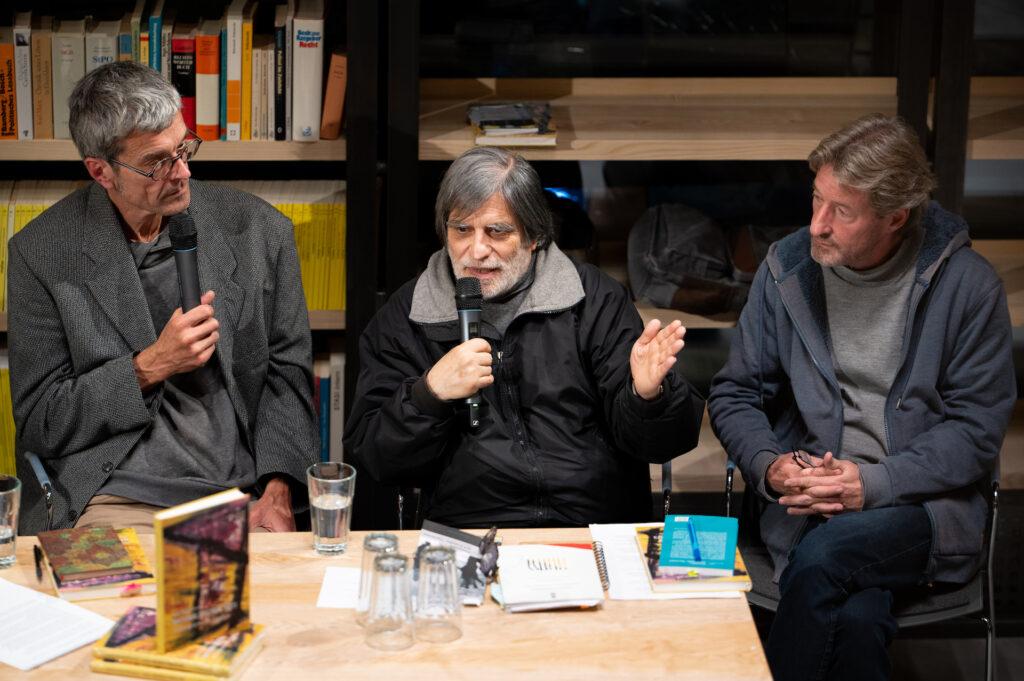
G. Pohl, J. Montealegre, M. Sasse (from left to right) © FRITZ BAUER FORUM | BUXUS STIFTUNG, Photographer: Richard Lensit
Hall 3.1. Stand H61, behind this inconspicuous name, we were represented for the first time this year at the Frankfurt Book Fair with our in-house publishing house BUXUS EDITION with a small stand. On display were the books from the „Literature and Human Rights“ series, which is being produced jointly with the BERG INSTITUTE (Madrid), as well as the biographies from the „Fritz Bauer Library“ series with cover illustrations by Witten painter Reinhold Spratte. We were particularly pleased that our author Jorge Montealegre was invited to an event in Frankfurt.
We exhibited our series on a joint stand and were only there in person on Saturday. However, it was a successful day for us, as we got to talk to a number of visitors and had an exciting exchange about current topics and especially about the relevance of the topics of our namesake Fritz Bauer. Here again is the link to our books in our webshop, where you can also find our events.
Although the autobiographical work Am Ende wartet das Vergessen was published in April 2022, our event series „Memoria Viva. Latin America on the move“, this impressive homage to one of Latin America’s most important doctors and human rights fighters was not to be missed. On 24 October 2023, the award-winning Colombian author Héctor Abad Faciolince came to the Fritz Bauer Library to present the German edition of his book El Olvido Que Seremos . As at the previous event, Irmtrud Wojak, Reinhold Spratte and Günter Pohl accompanied the author through the evening.

R. Spratte, I. Wojak, H. Abad, G. Pohl (from left to right) © FRITZ BAUER FORUM | BUXUS STIFTUNG, Photographer: Richard Lensit
Above all, the author’s deep love for his father, Héctor Abad Gomez, became clear that evening when the author recalled his childhood in the city of Medellín. The book is written from Héctor Abad’s perspective as a child and in the subsequent discussion, the author reported that it took him a long time to find a voice to be able to write this book at all. He was 27 years old when his father was murdered in 1987, and it was only 18 years later that he wrote his book, which reads like a coming-of-age novel. In the interview, Abad described how the first-person narrator unites the polyphony of the family’s memories. It’s something we’re all familiar with: to a large extent, we only remember our own childhood from stories, we ourselves have forgotten many things that are kept alive by our shared memories. Another major theme of the evening was his father’s commitment to human rights – as a doctor, but also as someone who was not afraid to say what he thought and who stood up for the weaker members of society. Although Héctor Abad Gomez knew that it was not only dangerous for him, but also for his family, he named the crimes of the Colombian paramilitaries in radio programmes and newspapers. You could clearly feel the admiration that Héctor Abad has for his father. He only really realised the acute danger to his father and the family later, as a young man.
Based on a passage in the book that dealt with the treatment of Jewish neighbours, an interesting discussion about the current war in the Middle East ensued. Héctor Abad criticised the Hamas attack on Israel as a terrible pogrom, but this realisation and its significance was quickly covered up by Israel’s harsh reaction to the attack. He criticised the fact that there was no condemnation of the anti-Semitic pogrom from a Colombian perspective and that the Colombian president refused to condemn it. The attack on a kibbutz and a festival of young people was an act of terrorism. At the same time, however, Israel’s harsh reaction and the bombing of civilian neighbourhoods should also be condemned under international law.
Finally, there were a few questions from the audience, which led to an interesting discussion about father-son relationships and the development of one’s own personality. Irmtrud Wojak summarised the evening: The title of the book is „In the end, oblivion awaits“ – but thanks to this book, Héctor Abad Gomez has not been forgotten and his impressive and encouraging story in the fight for human rights will receive further attention with the German-language edition of the book.
We would like to thank Héctor Abad Faciolince for travelling to Bochum and for the fascinating insights that painted a very personal picture not only of his father, but also of himself. It was an impressive evening that none of those present will forget in a hurry. We would also like to thank Günter Pohl for his excellent translation of the evening into German and Reinhold Spratte for bringing the narrator’s voice in the book to life during his reading.
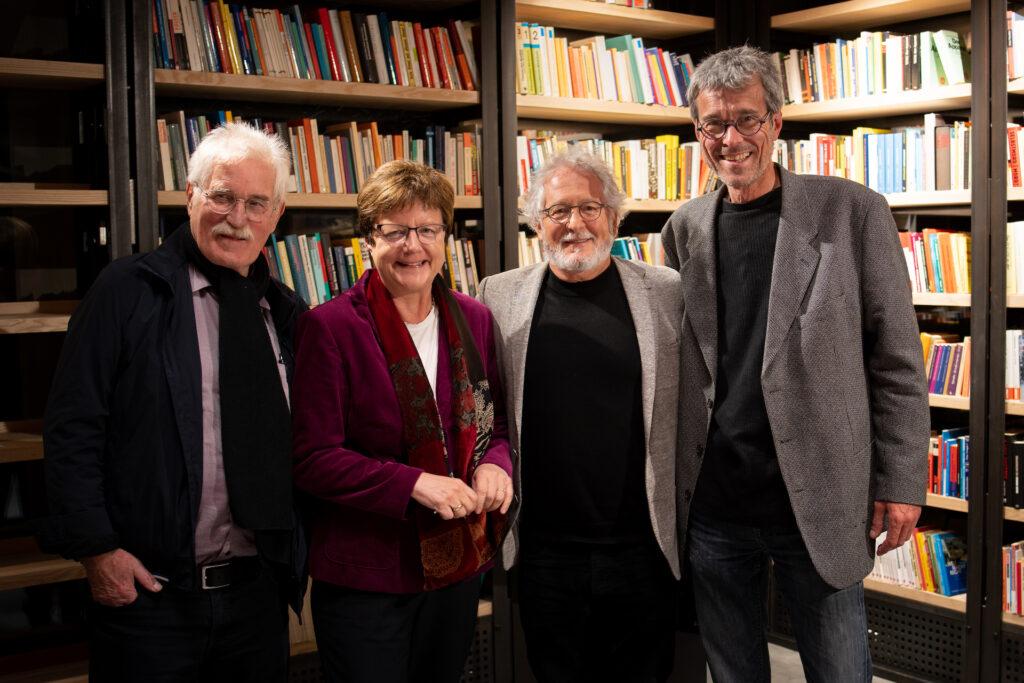
R. Spratte, I. Wojak, H. Abad, G. Pohl (from left to right) © FRITZ BAUER FORUM | BUXUS STIFTUNG, Photographer: Richard Lensit
Looking back, human and civil rights in Colombia have a tradition dating back to the 19th century. Nevertheless, the gap between these rights guaranteed in the constitution and social reality remains huge. The historian and journalist Joachim Jachnow addressed the topic of „Human rights in Colombia: between ideal and reality“ at a workshop on 26 October.
The workshop shed light on the background to the story of Héctor Abad’s book and the murder of his father by paramilitary death squads. A history of violence since colonial times that has always been about land, in other words about land theft, flight and expropriation, which have affected society and in particular the indigenous population for centuries and against which they have tried to defend themselves with ever new means. This historical background does not appear in the world of Héctor Abad’s development novel; it was not part of the young Abad’s sheltered childhood, but it still characterises the history of his homeland to the present day.
In the evening, the film El Olvido que Seremos / Memories of My Father was shown. The award-winning film is based on the novel by Héctor Abad Faciolince and tells the story of his father. It is a moving film, although the political background to the murder of Hector Abad Gomez by right-wing paramilitaries is neglected. In this respect, however, it is a faithful reproduction of the book from the perspective of a very sheltered childhood and youth in Medellín.
Series of events „Memoria Viva. Latin America on the move“ in cooperation with Amnesty International Bochum
02 November, 17.30 – 21.30: Peru: Workshop and film
07 November, 17.30 – 21.30: Uruguay: Workshop and film
10 November, 19:00 – 21:00: Peru: Panel discussion
16 November, 17:30 – 21:30: Mexico: Workshop and film
30 November, 18:30 – 20:30: Chile: Lecture and discussion