
Autor/Autorin


These were the words used by State Secretary Dr Daniela Brückner yesterday in her press release on the occasion of an event with the Spanish lawyer and prosecutor of ex-Junta General Pinochet, Dr Juan Garcés, at the invitation of the Fritz Bauer Forum, which took place in the Bochum Justice Centre and to which the Bochum Alliance „Solidarity and Remembrance“ also invited (see below).
This can also be taken as the motto for the entire series of Latin American events organised by the Fritz Bauer Forum together with the Amnesty International Co-Group Bochum and the „Remembrance and Solidarity“ alliance. The series of events was continued in November.
Corruption, the military and the ultra-right have been undermining democratic development and coexistence in Peru for years. On 2 November, Peruvian documentary filmmaker, ethnologist and human rights activist Heeder Soto and Saywafilms manager Kerstin Kastenholz showed us what the fight for human rights and the organisation of social protest can look like in such an environment.
We started the workshop with the help of photos from around Peru. The participants each chose two of the pictures and exchanged their knowledge and experiences and entered into dialogue. They were also used to transition to the actual topic of the event by showing the beautiful touristic aspects of Peru, its culture and landscape. Together with short film clips from his latest film (Vientos y Memorias ), Heeder Soto talked about his experiences during the civil war in Peru, which claimed the lives of around 70,000 people between 1980 and 2000. Around 75% of these were part of Peru’s marginalised indigenous population. The conflict was based on a racist motive, which particularly affected and still affects the indigenous population. Another topic was the attempt to come to terms with the past, which has been underway since the 2000s. On the one hand, a „truth commission“ was formed, which published a report in 2003, but which does not address many of the problems of the conflict – sexual assaults, for example, barely feature in the report. Another point of criticism is the lack of documentary evidence, which leads to perpetrators not being charged. In 2015, a „Place of Remembrance“ (Lugar de la Memoria ) was opened in Lima, and smaller memorials were also created in the Peruvian Andes. This is a good start in dealing with history and violence, but education in schools and poorer sections of the population must be further promoted.
In the evening, we showed Heeder Soto’s film „ Titicaca entre oro y mercurio / Titicaca zwischen Gold und Quecksilber“.
Yannik Holsten, who is currently studying law in Hamburg, came to Bochum on 7 November 2023 to talk about the culture of remembrance in Uruguay, where he completed a six-month internship at the Bertolt Brecht House (Casa Bertolt Brecht ) this year, co-financed by the BUXUS STIFTUNG.
During his stay in Uruguay, Yannik Holsten was able to interview several contemporary witnesses of the civil-military dictatorship. This was established after the coup d’état in 1973 and lasted until 1985. The workshop began with a discussion about the term ‚culture of remembrance‘ and a dialogue ensued about what the participants understood this to mean. A significant difference between the German culture of remembrance and that in Uruguay soon became clear: in Uruguay, the fixed term „ Memoria, Justicia y Verdad “ is often used as a demand to state authorities. The culture of remembrance is essentially linked to the actively understood struggle for truth and justice and is more political in the sense of being more relevant to the present than is the case in Germany.
The participants then read an excerpt from an interview by Y. Holsten with the artist and activist Elbio F., who had joined the guerrilla group „MLN-Tupamaros“ in 1970. As a result, he was arrested in 1972 and imprisoned for twelve years until he was released in 1985 due to the increasing democratisation of the country and an amnesty law. Yannik Holsten provided helpful context for the interview, for example on the various phases of the dictatorship in Uruguay and more recent political developments. It became clear from the interview that Elbio F.’s personal commitment to remembrance was always embedded in political activism. For example, he became the director of a project aimed at establishing a „ Museo de la Memoria “ („Museum of Memory“) in Montevideo. This museum pursues an exciting concept of combining musealisation and activism, as it is civil society that decides on the exhibits. A quote from Elbio F. about the culture of remembrance („ memoria „) in Uruguay was particularly impressive: “ Memoria is not something that lies in the past, but in the present, and we are in the process of giving it a form. […] memoria illuminates the dangers of the present.“ At the same time, however, it is always a new struggle.
Another interview with contemporary witness Lilian T. was used to discuss the shame often felt by survivors of having survived while relatives or friends were murdered, which reinforces the awareness of responsibility for telling one’s own story. The two interviews made it clear that the remembrance of the military dictatorship in Uruguay emanates to a large extent from civil society actors and the important role they play in this.
The stories of Elbio F. and Lilian T. as well as a transcription of the interviews will soon be available on the Survivors‘ Stories website. The interactive Fritz Bauer Library .
Overall, the workshop provided an exciting insight into the emergence of the culture of remembrance in Uruguay and its special features. Thanks to the extracts from the two interviews, it was possible to discuss their development in concrete terms. The film shown afterwards, „ Compañeros – La Noche de 12 Años / The Twelve Year Night“ , was about the twelve-year imprisonment of the writer Mauricio Rosencof , the later Minister of Defence Eleuterio Fernández Huidobro and the later President José Pepe Mujica. The film provided a powerful visual supplement to what had previously been learnt and discussed in the workshop. The resistance and solidarity of the prisoners despite brutal torture and solitary confinement remained in the minds of the participants. For example, they used knocking signals to communicate with each other, playing chess or exchanging valuable information.
One week after the Peru workshop with Kerstin Kastenholz and Heeder Soto, a panel discussion on the situation of human rights activists and current developments in Peru took place on 10 November. The discussion was attended by Bochum MP Max Lucks (B90, the Greens), who spoke as a representative on the German Bundestag’s Committee on Human Rights and an expert on the transnational right-wing movement and the threat to the rights of queer people and women in Peru, Sara Leman, who reported on the work of Amnesty International Bochum and, as a member of the Chile/Venezuela Co-Group of Amnesty International/Germany , in particular on racist violence by security forces and discrimination against refugees, and Vanessa Schaeffer Manrique , lawyer, mining and human rights officer in the diocese of Freiburg and representative of Red Muqui (Peru) in Germany. The discussion was moderated by Martin von Berswordt-Wallrabe .
The discussion primarily centred on the events surrounding the impeachment of left-wing President Pedro Castillo in December 2022 and the resulting protests and demonstrations, which resulted in numerous injuries and deaths. Above all, Amnesty International observed that a large proportion of those injured and killed were minorities and underpinned its observations of racially motivated violence by police security forces.
However, it can also be observed that in large cities such as Lima, activists and NGOs can still operate relatively freely. A shift can also be observed in Peru, the social movement is strong and this gives rise to hope.
All three panellists agreed that the violent development was already foreseeable, there were some harbingers, both in politics and in society, but they were not taken seriously as such. However, there are differences in the situation in rural and urban regions, and the economic development brought about by the conservative parliament is an advantage for some, which is why fewer voices of protest were raised.
There was also much discussion about the question: What can we do in Germany, or rather in Bochum? Politicians must no longer „roll out the red carpet“ for right-wing, nationalist political leaders, emphasised Max Lucks, they must be openly criticised for their misconduct.
Above all, civil society can support organisations in Peru itself that campaign for human rights on the ground, such as NGOs or other groups, and it can also support educational work on human rights in Peru here in Germany.
„The fact that Fritz Bauer was able to do what he did despite all the adversity seems incredible to us.“ This is how the most famous Spanish writer Antonio Muñoz Molina describes the life and work of our namesake Fritz Bauer.
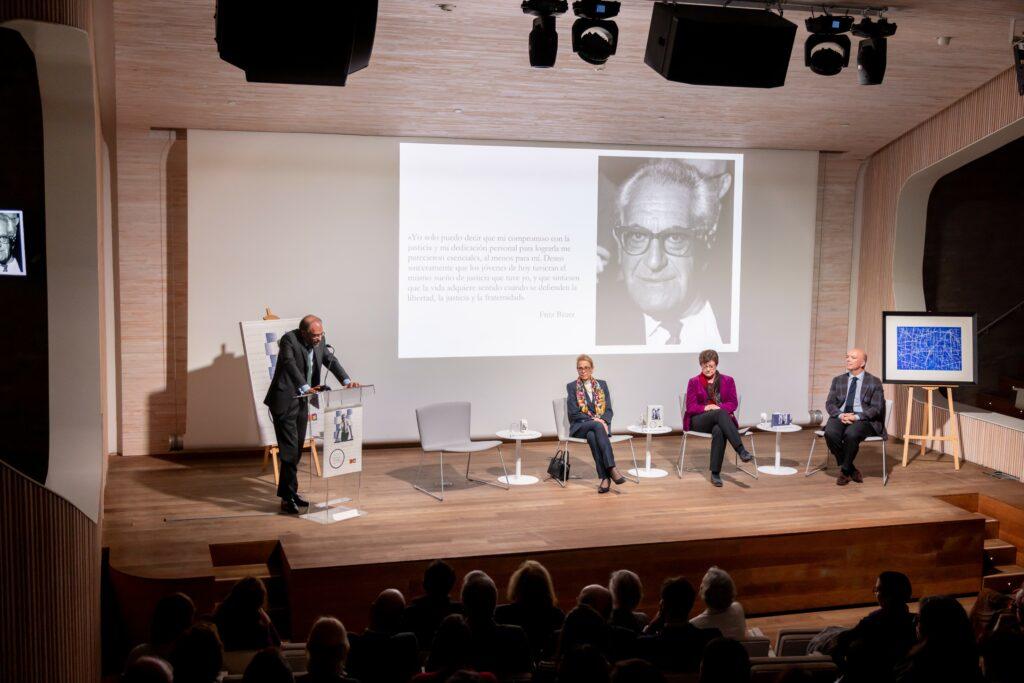
His biography, written by Forum founder Irmtrud Wojak, has now been published in Spanish translation by the BERG INSTITUTE (Madrid) in its renowned Literatura y Derechos Humanos series. Together with the German Ambassador Maria Margarete Gosse and the Vice-President of the Universidad Complutense de Madrid , the institute, with which the BUXUS FOUNDATION has been cooperating for several years, presented the book on 15 November in the packed hall of the Fundación Giner de los Ríos .
In her speech, Fritz Bauer’s biographer alluded to the words Fritz Bauer spoke at the beginning of the Auschwitz trial in 1963. In his very personal speech, the lawyer recalled Anne Frank as a representative symbol for all those who were oppressed and murdered by the Nazi regime in the concentration camps. Fritz Bauer reflected on the loneliness of the individual as a survivor of the Holocaust, he emphasised the task of remembering those who helped the persecuted and posed the question of the possibilities of resisting oppression. As the historian emphasised, Bauer saw Anne Frank as representative of all the persecuted, the unfortunate and all those who died and continue to die as victims of unjust state violence.
The speech can be read here in German and Spanish and is documented on You Tube by the Berg Institute and the Universidad Complutense de Madrid.
(c) Jorge Rosenvinge
8 December, 18:00 – 21:00: Human Rights Day „Opinion. Freedom. Freedom of expression?“, Anneliese Brost Music Forum. Further information here.
12 December, from 18:00: Lecture and discussion with Hajo Funke „Solidarity on the edge of the abyss“, Fritz Bauer Library. Further information here .
18 January, from 17:30: Lecture and discussion with Moshe Zimmermann „Solidarity and reason of state“, Bochum Justice Centre. Further information here .
1 February, 18:00 – 19:30: Workshop on Martin Luther King Jr. with Julia Machtenberg, Fritz Bauer Library. Further information here .
7 February, 16:00 – 17:30: Wednesday talks with Anja Stuckenberger and Irmtrud Wojak on the situation in Israel and Palestine, Fritz Bauer Library. Further information here .
16 February, 18:00 – 19:30: The invisibility of black women in activism with Rahab Njeri, Fritz Bauer Library. Further information here .
29 February, 18:00 – 19:30: Workshop on Audre Lorde with Julia Machtenberg, Fritz Bauer Library. Further information here .