
Autor/Autorin
„If I were Pope, I would beatify Oscar Romero tomorrow. But I will never be pope,“ said Cardinal Jorge Mario Bergoglio in 2007. He was wrong about the second statement. Elected Pope in 2013, Francis kept the first promise: On 3 February 2015, he declared the Archbishop of El Salvador, who was murdered by death squads on behalf of the military regime on 24 March 1980, a martyr, thus paving the way for his beatification. In the course of his increasingly prominent devotion to the oppressed of his country, Oscar Romero advocated an understanding of the church and a basic position of liberation theology that met with vehement resistance within the church in the 1970s and 80s and was constantly accused of abandoning church teachings to secular left-wing ideologies. Liberation theological approaches also characterise Pope Francis, who already aligned his pontificate with the programme of a church of the poor when he gave it his name.
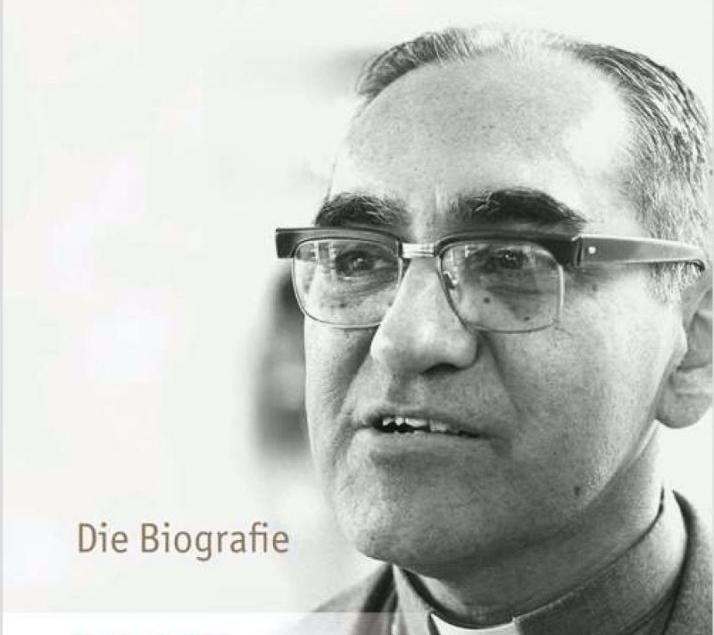
Martin Maier SJ was at the beginning of his Jesuit career when he learnt of the assassination of Oscar Romero. He confesses that the life of the Salvadoran archbishop has stayed with him ever since. Years later, he himself worked as a priest in El Salvador and got to know the two liberation theologians Jon Sobrino SJ and Ignacio Ellacuría SJ, who had once been Romero’s companions and close advisors. (S. 11).
With this book, published in 2015, Maier, a profound expert on Romero’s life and thought, has not added to the series of existing biographies (1 ). Although he reconstructs the stages of the archbishop’s life in an initial chronological chapter (pp. 15-88), the focus here remains consistently on Romero’s inner struggles. At the centre of the account is rather an inner process of change, Romero’s „conversion“; the work accompanies in a very sensitive way the recognition and admission of „errors“ on the bishop’s path from a rather conservatively oriented churchman on the side of the ruling upper class, who was clearly opposed to liberation theological approaches, to an advocate of a church of the poor who followed his conscience to the last consequence.
Romero’s parents were both mestizos, descended from indigenous people and European settlers. As the second of eight children, he grew up in poor conditions in a provincial town in the north of El Salvador and initially completed an apprenticeship as a carpenter (p.16). The political and social conditions – a ruling upper class that owned almost all the fertile land, social inequality, the repression of those in power, the massacre of 30,000 people within a few days in 1932, when social protests by impoverished farm labourers were brutally crushed, the military dictatorships that prevailed until the 1970s and one of the cruellest civil wars in Latin America – formed a formative background to Romero’s development. His years of study in Rome were, of course, formative for his spiritual development. He did not support the liberation theological approaches that crystallised as the Latin American response to the Second Vatican Council at the General Conference of Medellín (1968), which was supported by the Latin American Bishops‘ Council. Romero’s attitude at this time was characterised by a decisive rejection of a feared politicisation of the Church in the social areas of tension in Latin America. The more clearly the split between liberation theology and conservative internal church positions within the Salvadoran church emerged, the more clearly he retreated to traditional positions (p. 29). As late as 1975, in a memorandum to Rome, he described the „Justita et Pax“ commission as too critical of the government, saying that it had „distanced itself from the actual task of the church“ and was moving „dangerously close to revolutionary ideas.“ (S.31)
During his time as a pastor in the town of San Miguel in eastern El Salvador, he conveyed the image of a „traditional priest“ (Jesus Delgado, see note 1), a „friend of the poor and the rich“ (p. 23 f.), who was on good terms with the coffee barons, reminding them to give alms to the poor, while promising the latter the front row in the kingdom of heaven. He later distanced himself from this attitude and confessed that with this consolation for the hereafter, the church (not only) in El Salvador had contributed „to the justification and consolidation of existing injustices“.
The impetus for a critical reflection on his ecclesiology was the increasing number of murders of priests orientated towards liberation theology during El Salvador’s escalating civil war. The decisive event, however, was the assassination of Rutilio Grande, who from 1972 onwards pursued a pastoral approach that involved the laity and, orientated on the decisions of Medellin, put into practice the change of position of the church to the side of the poor. Grande encouraged the campesinos to demand their right to a dignified life and quickly came into conflict with the interests of the landowners. The first tortures of priests began in 1977 (p.40). One of his sermons culminated in the words that the Bible and the Gospel would soon have to stop at the borders of El Salvador, as each of their sides were subversive. If Jesus came to El Salvador today, he would be tried as a revolutionary and subversive. He would be accused of anti-God ideas and crucified again (p.41). This sermon was probably his death sentence – and thus confirmation of the content of his sermon. On 12 March, Grandes was murdered on behalf of large landowners (p.41). According to Jon Sobrino, this was a turning point, a „conversion“ in Romero’s life. Now an archbishop, Romero had only one mass said for Rutilio Grandes in San Salvador, a plan that the regime, fearing a mass rally, had tried to prevent. In his sermon, a sign of change, Romero proclaimed that anyone who touched one of his priests would touch him himself. (S. 43).
As a result, he was offered a car and the construction of a bishop’s palace if he would only stop preaching about social justice and the rights of the poor. Romero refused. He subsequently lived in a simple room in a hospital for cancer patients. (p.45) The regime and landowners turned their backs on him, death squads advised him to leave the country, threatening that Jesuits would become military targets. He was ordered by postcard with a swastika to publicly condemn communism and praise the dead of the security forces (p. 47).
Romero had taken the step from a charitable to a structural approach to combating poverty. Anyone who questioned the causes of injustice was questioning the system and affecting the interests of those who benefited from this system. Romero rejected violence, both acts of violence committed by death squads and by the government, but also „terrorist violence“ by left-wing guerrillas. However, he saw the root of all violence, in reference to the Medellin Conference, in a state-sponsored „institutionalised violence“ of injustice. (S. 53). „Those who disturb are killed“ he once remarked succinctly (p. 52). Romero began to cause massive disruption. Not least with the statements in a pastoral letter:
„The Church is persecuted because in truth it wants to be the Church of Jesus Christ. As long as the Church proclaims otherworldly salvation without immersing itself in the real problems of this world, it is respected and praised […]. But when she is faithful to her mission and points out the sin that plunges so many into misery, when she proclaims the hope of a more just and humane world, then she is persecuted and slandered, called subversive and communist.“ (p. 52). (S. 52).
He prophetically denounced modern idolatry that demands human sacrifice. He named the idol of wealth, the idol of power and the idol of the ideology of national security. The church had the right, even the duty, to knock these idols off their pedestals. Such positions inevitably led to conflicts with the Vatican and Washington. Romero saw an interaction between socio-political reality and the Gospel, a deepening of faith conviction through this interaction. According to Romero, the gospel is radical. No compromises can be made in the radical nature of the gospel if one has decided to follow it. He had decided to follow Christ. This meant that he had to do this alongside the poor and oppressed with all radicalism, with the ultimate consequence. The assassination attempt to which he fell victim on 24 March 1980 was announced for this week. Nevertheless, he did not leave his place at the side of the poor this week.
Martin Maier traces Romero’s inner process of transformation with stupendous sensitivity, placing much between the lines and incorporating the external, political, social and inner-church influencing factors without losing sight of the central mental and personal process of confrontation.
Maier dedicates the following chapter (Oscar Romero – a saint for the 21st century) to the formative forces in the life of the Jesuit Romero and naturally dwells on the spirituality of Ignatius of Loyola, the co-founder of the Jesuit order. Parallels in Romero’s and Pope Francis‘ understanding of the Church are clearly identified. The consequence: „Honouring Romero means following his path: Calling injustice by its name and demanding justice. Raising Romero to the „honour of the altars“ must go hand in hand with raising the poor and marginalised in this world to the „honour of a dignified life.“ (S.171)
A final chapter deals with Romero’s legacy; however, it remains to be seen and hoped to what extent Pope Francis, whom Maier sees in the tradition of Romero and other liberation theologians, will be able to substantially assert a church of the poor against resistance within the church.