
Autor/Autorin

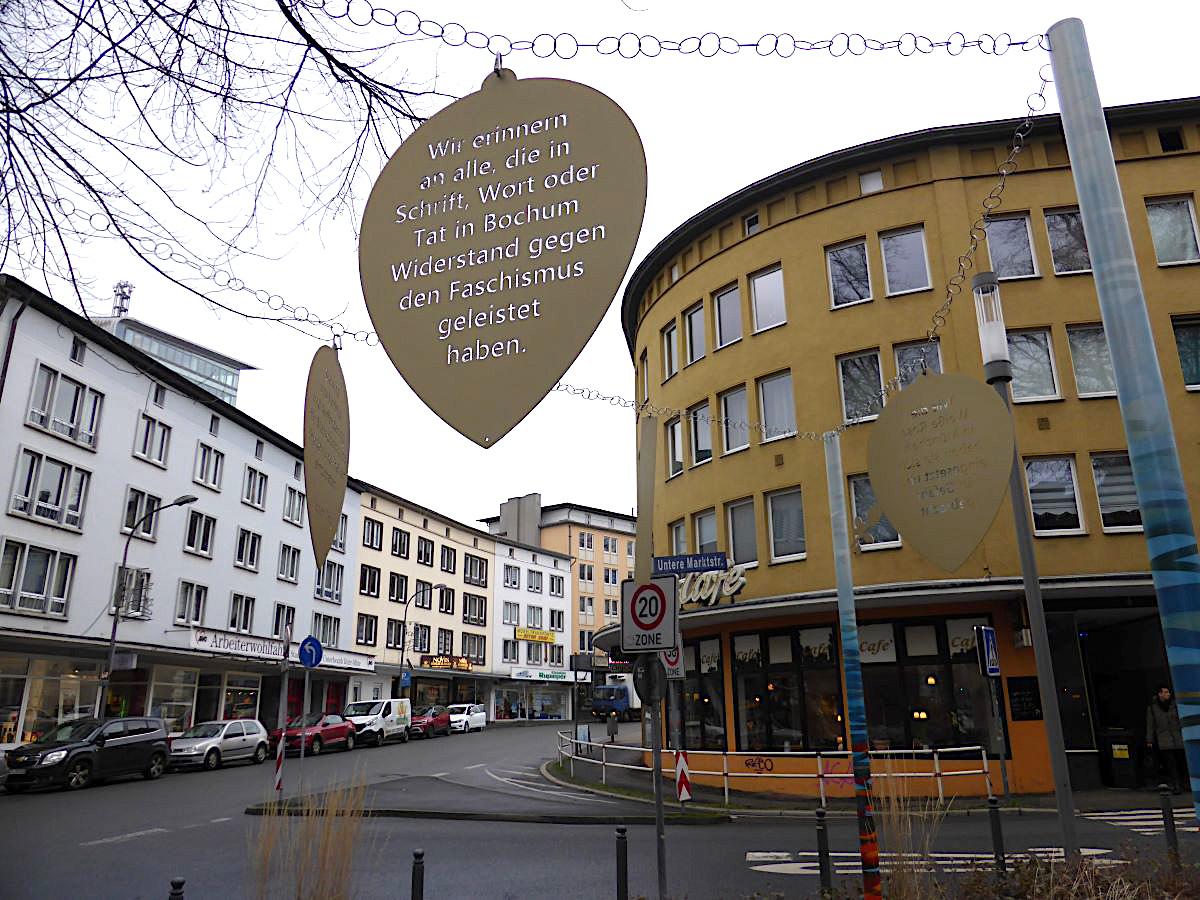
On 27 January 2027, the day of remembrance of the victims of National Socialism, Bochum artist Dorothee Schäfer presented her sculpture on the subject of resistance, which was commissioned by the Bochum-Mitte district council. It is one of the few monuments to anti-fascist resistance in Germany. It is located in front of the church on Bleichstraße. The artist invited the public to continue designing the artwork with their own contributions.
Irmtrud Wojak, the founder and director of the Fritz Bauer Forum in Bochum, stated in her appreciation of the new memorial site that „there are only a few and even fewer known memorials to the diverse anti-fascist resistance in our country“. She urges people to take up the idea of the sculpture and actively participate in its development – especially in this day and age.
Ladies and gentlemen, dear Dorothee Schäfer,
Welcome and, above all, thank you for allowing the Fritz Bauer Forum, on whose behalf I am speaking today, to be part of the first presentation of the Bochum Monument to the Resistance.
I am delighted about this for many reasons. I would like to mention three of them.
Firstly, I am delighted about the memorial itself. Because let me say this in advance: apart from the Museum of German Resistance in Berlin’s Bendlerblock, where the resistance fighters of the assassination attempt of 20 July 1944 were executed, and perhaps the „Silent Heroes“ museum, also in Berlin, there are only a few and even fewer well-known memorials to the diverse anti-fascist resistance in our country. Even fewer memorials have been erected to civil disobedience. However, this was carried out by very different groups and above all by individuals to an extent that should not be underestimated.
Apart from the resistance struggle of the martyrs, such as the Scholl siblings, Claus Schenk Graf von Stauffenberg or Georg Elser, and perhaps even Dietrich Bonhoeffer, who became famous through numerous books and films, this resistance struggle has faded into the background. Or has it even been completely forgotten in many places? In any case, apart from a few exceptions, resistance is hardly mentioned in schools and universities and the memorials to the victims of National Socialism rarely deal with this topic. Fritz Bauer, for example, is not mentioned in school textbooks.
What makes people strong and empowers them to speak out against injustice and the violation of human rights – their own and those of others? And this even when it involves risks and possibly jeopardises their own existence.
This brings me to the second reason why the memorial designed by Dorothee Schäfer is important to me.
I am concerned with the question – which also came up during the preparations for today’s event – of whether 27 January, the official day of remembrance for the victims of National Socialism, on which the Auschwitz concentration camp was liberated by the Red Army in 1945, can be an occasion to remember resistance to fascism. In other words, can the memory of the victims of National Socialism be linked to that of the resistance fighters against the Nazis, mixed up, so to speak? Because that is surely what lies behind this question.
This made me wonder. Once again, I realised that victims and resistance seem to exist in two separate worlds within the culture of remembrance. This is strange, because most resistance fighters, regardless of party or organisation, were also victims of the Nazi regime. When the National Socialists tracked them down and arrested them, they made short work of them and the prisoners were deported and murdered. They fared no differently than the persecuted Jews, Sinti*zze and Roma*ja, homosexuals, so-called asocials, the disabled and all others persecuted by the Nazis.
And had those who were victims of the Nazis‘ racist policy of extermination not defended themselves and offered resistance? Both before and after the transfer of power to the National Socialists in 1933 and after 1945 in the fight against impunity for Nazi crimes and for reparation (insofar as this was even possible given the extent of the crimes).
We made this the subject of yesterday’s event with Achim Doerfer. The lawyer has researched Jewish resistance and the revenge actions of Jews who returned after 1945 to liquidate Nazi perpetrators (he estimates there were around 600 of them). Their history is virtually unknown in Germany, as is the history of Jewish resistance in general, which was an act of self-assertion during the Nazi regime and especially in the ghettos, camps and prisons. With regard to the often claimed successful German-Jewish history of reconciliation, this means that Achim Doerfer exposes it as a fairy tale. Due to the failure of German politics and justice after 1945, reconciliation in this generalised form was not possible. Denazification, which failed for many reasons, made it impossible from the outset.
But why and with what interest is this fairy tale still being told? After all, it is also reminiscent of the fairy tale of German-Jewish symbiosis as a result of the history of Jewish emancipation in Germany, which undoubtedly existed, although the symbiosis was only one-sided and was not shared by the majority society.
I think this is how victims are turned into perpetrators: by creating a story that distracts from one’s own responsibility, which is often perceived as too painful. This suppresses what really needs to be done and – precisely because of the experience during the National Socialist regime and as a lesson from the Nazi trials – is our constant and permanent task: to say no loudly and audibly when injustice occurs and human dignity is violated.
This brings me to my third and final point as to why this „Resistance in Bochum“ memorial is currently so important. And why I am particularly pleased about it from the perspective of the Fritz Bauer Forum that is being created in Bochum and why the design that Dorothee Schäfer has found for this memorial corresponds with our concerns.
Fritz Bauer once said:
„ The great resistance on the evil days of barbaric injustice presupposes struggle against the small injustices of everyday life.“
Dorothee Schäfer’s memorial takes up this idea. It is not complete, not a finished monument and nothing is hastily raised onto a pedestal. Once in place, it is not just a reminder of a criminal past that is perhaps in danger of being forgotten. It is not just a warning.
Rather, this memorial is conceived as a living work whose effectiveness, addition and resonance we can contribute to from now on. And I think we should do so – and not just once a year on a specially designated memorial day.
The idea of this monument to resistance is that it can continue to grow, just like the effort of our compassion that is required when human rights are violated.
On behalf of the Fritz Bauer Forum, I can say that we are happy to be involved. We are happy to contribute to making this rare monument to resistance the starting point for questions about our history and ourselves. I can imagine many possibilities for this.
It can be the starting point for city tours on the subject of resistance, I have already spoken about this with members of the VVN Bochum.
It can also be the starting point for workshops and seminars that deal with current questions about our culture of remembrance. For example, what civil resistance actually is and means. Have we really researched and publicised the resistance of the victims and survivors, which did not just begin in the year of the handover of power to the Nazis in 1933, but long before that? What conclusions do we draw from this for civil disobedience in today’s world when it is criminalised? Truly a topical issue.
A „disobedience workshop“ could also be created, where people from very different backgrounds, religions and abilities can get to know their diverse and often courageous stories and in this way practise dialogue at eye level. The Fritz Bauer Forum has already been inspired by these courageous stories from all over the world with its Interactive Fritz Bauer Library. It is an active contribution to strengthening the resistance of victims and survivors through their own voices.
To put it in one sentence: I can imagine and we will gladly contribute to ensuring that the Bochum Resistance Memorial is as alive as it needs to be for opposition and resistance „In the struggle for human rights“ – and I quote Fritz Bauer – in a democracy.
27 January 2023