
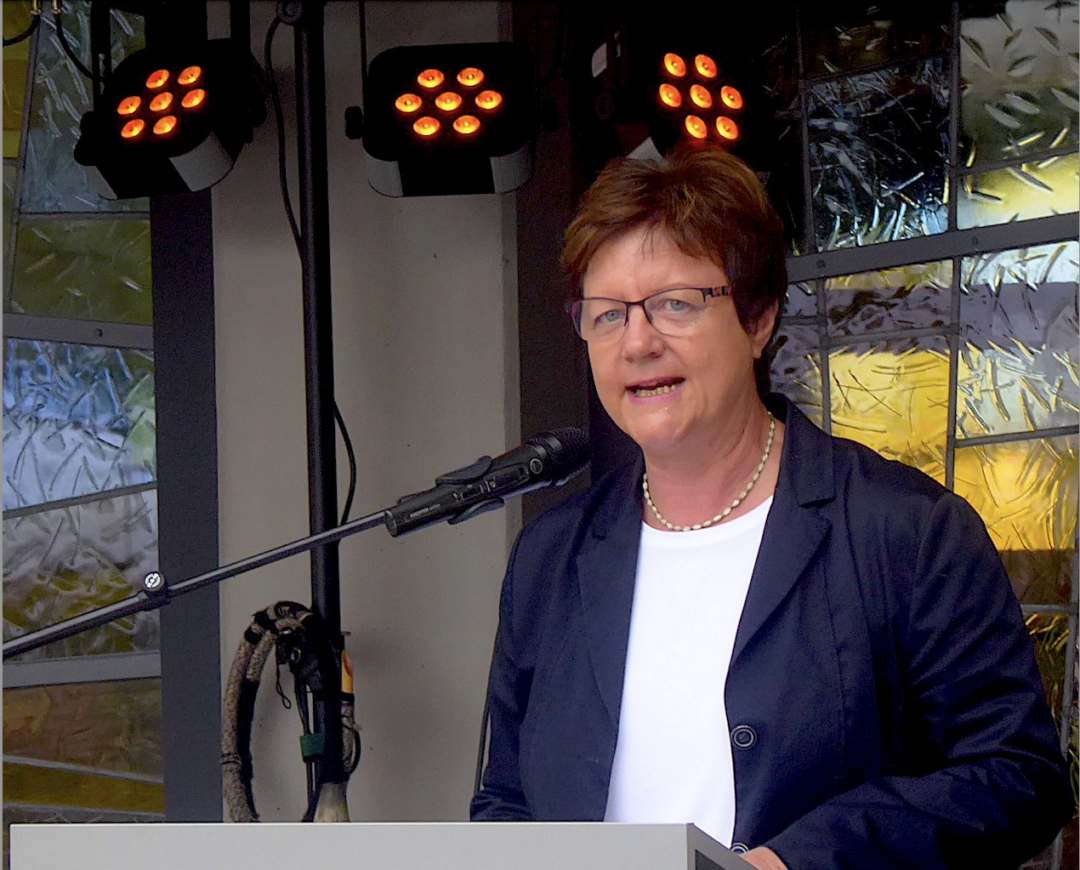
We are delighted to announce the completion of our Fritz Bauer Library today and I would like to welcome you all to our building site. I am very pleased about this big step on the way to the Fritz Bauer Forum in Bochum.
This is certainly a moment to pause and say thank you. Thanks to all those involved who have helped me and us since the foundation stone was laid two years ago and who have encouraged us to move forward in these times, to think about the organisation of the Forum and its tasks. Especially under the external pressure that can sometimes make you feel tired. Tired because you get the feeling that this Fritz Bauer Forum will be needed more than ever in the long term in the face of growing misanthropy in day-to-day politics as well as in everyday life. It makes you wonder how we actually manage this.
Fortunately, in these situations I usually think of Fritz Bauer, the man who gave the forum its name, who once said: There is German poetry and there is the German forest and the German Alps, but we can only be proud of something that we have created ourselves.
Fritz Bauer said this while fighting for denazification and the restoration of a humane legal order in Germany, even under the most difficult socio-political conditions. He was the lawyer, the Holocaust survivor and the political remigrant who brought Auschwitz, Nazi justice and the crimes of Nazi medicine to justice. He held up a mirror to German society that the vast majority did not want to look into. That is why he was accompanied by hostility and death threats until his death.
Let me summarise it in one word: Fritz Bauer was a resistance fighter. He was not discouraged, even if he was sometimes tired and thought about returning to his country of exile because he did not receive enough support. It was no coincidence that the chief prosecutor in Nuremberg, Robert M. W. Kempner, who was also a refugee from the Nazi regime, used drastic words at Bauer’s death and asked the assembled mourners: „What have we actually done for Fritz Bauer?
They had left him alone, the greatest ambassador, according to Kempner, that the Federal Republic of Germany had after the death of Konrad Adenauer.
Today we can say that through a joint effort we have created this wonderful Fritz Bauer Library for the forum named after him in Bochum, which is now increasingly taking shape.
This was made possible by Jens Mittelsten Scheid, who has constantly encouraged me on my way to not only give Fritz Bauer’s concerns a place in our memory, but also to draw conclusions for my own actions from his life’s work: through his friendship, energy and extraordinary financial support. I say this explicitly in this order, because without this marvellous trust this would not have been possible. Dear Jens, thank you very much!
Irmgard Schmidt, who never allowed herself to be put off and helped move mountains, has helped shape and travelled this path for several years. And old and new friends have joined us, to whom I would like to express my heartfelt thanks without being able to mention them all by name.
I would also like to thank the team of architects at planplus GmbH, led by Mr Tönnes, who worked with us to complete this project in difficult times, the site manager Mr Kanke, and the tradesmen and women who actively tackled the major challenges of this construction project with us.
Finally, and I cannot emphasise this enough, I would like to thank the Fritz Bauer Forum team, which has grown together over the past few years and which has helped to drive our Forum forward and shape the way forward – sometimes with voluntary support and often beyond the usual workload. Many thanks, dear Magdalena Köhler, Jennifer Haas and Tobias Fetzer, for your great, extraordinary commitment. For your willingness to help build and create a place where we can contribute with others to finding ways out of the „collective negative memory“. To complement it with the disobedience and resistance that Fritz Bauer and other survivors of the Nazi regime returned to Germany to encourage.
Because let me remind you once again: Fritz Bauer returned to reassert the right and duty to resist. That sounds as improbable as it was daring. Even after 1945, resistance was considered treason in Germany. Returnees who, like Bauer, had fought against the National Socialist evil from the very beginning were vilified as traitors.
And what about the reputation of resistance or disobedience today?
Mind you, I am not referring to the resistance in the days of great injustice, the siblings Hans and Sophie Scholl or the resistance of 20 July 1944, to whose rehabilitation Bauer made a decisive contribution. It is about the small resistance against injustice in everyday life, which must be tested and practised every day in a democracy. Fritz Bauer also emphasised this time and again: resistance in the days of great injustice presupposes small-scale resistance to injustice in everyday life.
In the library of the Fritz Bauer Forum, we will continue to pursue this point of view on a site predestined for this. The listed former „Havkenscheid Mourning Hall“ by the Bochum city architect Ferdinand Keilmann (1907-1979), an impressive building in the architectural style of Brutalism, has been converted into the Fritz Bauer Library. From a purely structural point of view, it is a counter-model to the Nazi architecture at the main entrance to Bochum’s main cemetery. A centre for human rights is now being built here on 5,000 square metres around our library, in the immediate vicinity of the graves of over 2,000 forced labourers and the memorial to the Bochum resistance fighters against National Socialism. In future, research seminars and workshops as well as exhibitions will be held here, and the universality of human rights will be expressed through art and culture.
And that brings me back to the beginning and my heartfelt thanks, which today go in particular to Dorothee Schäfer and the artists who, through their expressive works, are reinforcing the spirit of our project. What could be more beautiful and groundbreaking! Let us be inspired and encouraged by their works, so that from now on this Fritz Bauer Library will send out the signal:
Anyone and everyone can do something to oppose racism, anti-Semitism and, as its flipside, nationalism with a clear NO. Everyone can raise their voice against all kinds of injustice in their own personal space, whether at home or at work, at school, in training or in everyday life, on the street, in conversation with acquaintances or strangers.
To be more specific:
Let us affirm human dignity and condemn every violation of the
human rights, the declaration of which was born out of the experience of National Socialism. Let us not leave it to others who want to abuse democracy for a promise of law and order and security, which in reality benefits no one and only serves to maintain their own power.
The lesson from the Nazi trials, said Fritz Bauer, is: You should have said NO. So let us say NO more often to any kind of distortion of history and also to the criminalisation of civil disobedience, as we are currently experiencing with the „last generation before the tipping points“.
Remembering is resistance, this signal is now being sent out from the Fritz Bauer Library, from this place. For and by all those who not only want to remember for reasons of state, but who are committed to and fight for a fairer and better world at personal risk, no matter where on our threatened and wonderful planet.
I would like to thank you once again and now, dear Dorothee Schäfer, I would like to invite you as curator to speak to us. Afterwards, Grupo Manzanar will play Latin American music for us and we will also learn more about the singer Víctor Jara and the sculpture that stands here in his honour.
11 August 2023
