
Autor/Autorin

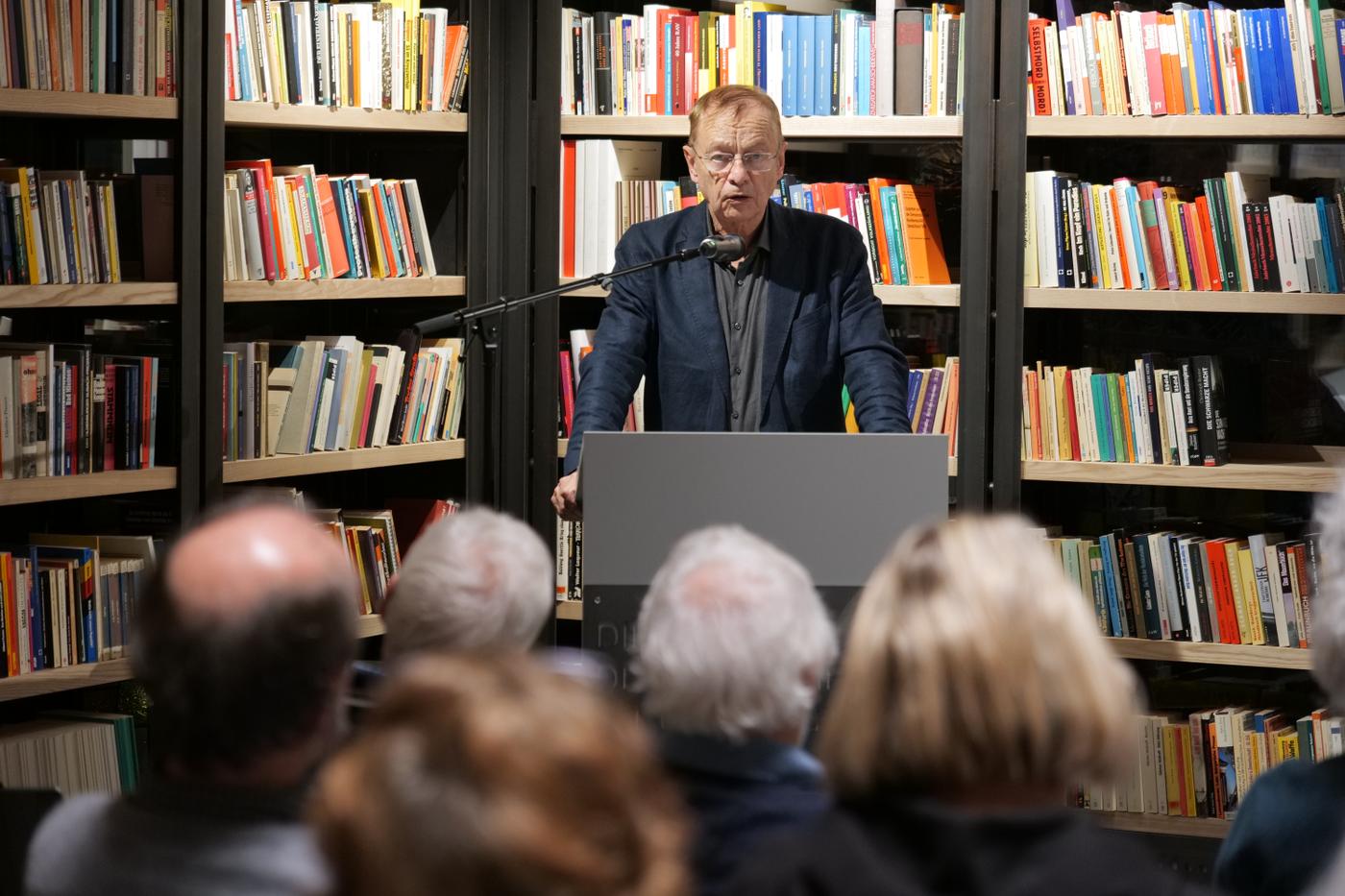
Lecture and discussion at the Fritz Bauer Library in Bochum on 12 December 2023 [1]
In my lecture „Solidarity at the Abyss“ I will refer 1. to solidarity with Israel and Israelis, 2. but also to the importance of solidarity with the Palestinian civilian population, i.e. solidarity with Israelis and Palestinians alike. [2] In my understanding of solidarity, this is a principle of humanity that is voluntarily constituted and also refers to those who are disadvantaged or endangered, and by no means only to those who are next door; solidarity follows the universalist principle of the right to have rights (Hannah Arendt) and human dignity. It is about recognising others and ensuring that everyone can live differently without fear. (Adorno)
I consider this dual perspective of solidarity to be particularly urgent in the third month of an extraordinarily brutal war over Gaza and an unprecedentedly high number of civilian deaths. Because without such a perspective, it is even less realistic than before to sound out the topic I have been given, „Opportunities for a two-state settlement“.
In order to provide these opportunities with a realistic perspective, especially in view of the crisis and the war, (2) a fundamental change is needed from the previous policy of the Netanyahu government, as it clearly has no interest in a two-state settlement. I have therefore outlined in detail the anti-Palestinian orientation of Netanyahu’s policy to date and now even more so in the current war
Even if the conditions for reopening a two-state perspective after the terrible attack by the terrorist group Hamas and the now brutal war over Gaza seem to be moving further and further away, there is no real alternative to a dialogue on how this conflict, which has been smouldering for many years and regularly explodes into wars, can possibly still be addressed and contained by a two-state settlement under conditions that are now enormously more difficult.
In their invitation, they rightly write: „Israel is deeply shaken after the Hamas pogrom of over 1,200 innocent people of all ages on 7 October 2023 and the deadly endangerment of the more than 240 hostages who were abducted.“ (Irmtrud Wojak) It goes without saying that Israel has every right to adequate self-defence after the barbaric massacres of 7 October. The barbarity of Hamas‘ actions becomes even more disturbing with every new hostage released. Murder in front of family members. Young hostages released like shadows of children. Doctors report mistreatment by the hostage-takers; many children and young people were severely malnourished. Some of them were drugged. „What these children have been through is unimaginable“ (dpa/tas). NYT : „President Biden condemned the ‚unimaginable cruelty‘ of Hamas attackers who raped and mutilated women in Israel on Oct. 7.“ (I also addressed this publicly many times after 7 October, incidentally also in my blog hajofunke.wordpress.com or „Hajo Funke/Politik und Zeitgeschehen“)
Solidarity with Palestinians
However, against the backdrop of the deaths of more than 10,000 civilians in Gaza after 66 days of war, we need our solidarity with the Palestinians as rarely before, for a free, self-governing Palestine without the discriminatory occupation that is contrary to international law.
Omri Böhm is right to criticise the Declaration of Principles of Solidarity by Jürgen Habermas, Rainer Forst and others in his interview in Der Spiegel on 2 December. It is not helpful, as much as he respects the two thinkers. „They failed to declare their solidarity with the Palestinian civilian population and to mention the authority of international law.“ He also criticised a section of the left in Israel, which also lacked a sentence stating that civilian lives in Gaza must be protected and that the Israeli army must respect international law.
When it comes to solidarity, we must include the victims of this warlike escalation on both sides in our solidarity. All the more so as solidarity is directed in different ways against the further endangerment of the safety of Israelis, as in the case of the hostages, but also against the attacks on Israel and also against the endangerment of the lives of tens of thousands of Palestinians, mostly in Gaza, but also increasingly in the West Bank. It is about solidarity with Palestinians and Israelis in the face of the abyss of this war, the end of which has not yet been achieved, not even by the United States. It is a solidarity on the edge of the abyss of both peoples.
Rather one-sided solidarity with one side or the other, on the other hand, exacerbates divisions and polarisation worldwide and at home, as could be seen in Berlin two days ago, when only a few thousand people came to show solidarity with Israel and just as few separately stood up for the rights of the Palestinians. (For Böhm, Germany’s responsibility for Israel means that this attitude should not be instrumentalised to play one side off against the other, as that would be a betrayal of responsibility. We should not use it to construct an „us“ that stands against another part of the population). Incidentally, it would be the opposite of solidarity, especially in times of war, on the brink of the abyss.
However, it would be anti-Semitic to equate the terror of Hamas with Israel’s war in Gaza, to question Israel’s right to exist, indeed the existence of Israelis and Jews worldwide, on the basis of the egregious misguided developments in Israeli domestic and foreign policy, or even to take violent action against them. This should be particularly clear in the German debate 79 years after the end of Germany’s murderous anti-Semitism.
Following Netanyahu’s declaration on 10 December 2023 that there would be no ceasefire until the military objective of destroying Hamas had been achieved, it must be feared that this is a war of indefinite duration. Emmanuel Macron even speaks of ten years in this context. Above all, it must be feared that this is aimed at one of Netanyahu’s presumed goals: the destruction of Palestinian existence in Gaza – in addition to the increasing attacks by settler militias and parts of the Israeli army on the livelihoods of Palestinians in the West Bank. That would be the destruction of any possibility of Palestinian survival after this war.
The increasingly urgent calls by the strongest allies, such as the United States, for a ceasefire appropriate for humanitarian supplies are clearly being ignored by the Netanyahu government more and more resolutely. At the same time, pressure and threats are growing in the region, from Turkey to Iran; the Turkish president is now threatening to intervene militarily. There is a growing danger that the situation will escalate into a three-front war, which is dangerous for Israeli security: in Gaza itself, on the West Bank, through increased activity in Lebanon and in Syria and Iran.
Looking into the abyss
In Blick in den Abgrund (C.H. Beck, 2023), Saul Friedländer rightly referred to the danger of the Netanyahu government as one of doom and disaster and to Nero’s policy of destroying Rome in the run-up to this war. (Compare my blog entries in hajo.funke.wordpress.com since the beginning of October 2023 on Saul Friedländer’s view into the abyss ). His dark prophecy is also an expression of his deep despair about his country, in which he had placed his hopes at the age of fifteen after hiding in a Catholic boarding school in France and the murder of his parents in Auschwitz, had helped to build it up and was secretary of the influential World Jewish Congress under Nachum Goldmann. A diary written with a deep connection to Israel, with empathy and solidarity with the people of Israel and characterised by absolute concern about the state of his country.
It took me a few days, writes Friedländer, now 91 years old, on the first page of his diary, to realise that the political coalition that Benjamin Netanyahu had formed was a monster with teeth and threatened to devour the liberal and democratic country as we knew it (an association with one of the most important books characterising National Socialism by one of the forefathers of German political science, Franz Neumann: It bears the name Behemoth – Ungeheuer ). „It took me a few more days to realise that every Israeli, first and foremost those who lived in the country, but also those who lived elsewhere and were connected to the country, like me, had to do their utmost to tame the monster. He writes about the Netanyahu government’s plans to overthrow democracy and hopes for the victory of democracy and fears that the vibrant country in which I lived and worked for decades is dead, that something else, something unacceptable has taken its place.“
The fire of fanaticism and the vicious circle of violence
For him, the regime established by Netanyahu and his allies in Israel is „a typical messianic regime, a mixture of extreme nationalism and extreme religiosity, to which cliquish and personal interests are added“. (p. 68) There have always been such fanatics, but now the „fire of fanaticism is being fuelled by politicians“ like Netanyahu for his own personal political survival. Friedländer, however, sees no one who can make them give in and poses the desperate question of which external actor can stop them (ibid.).
In the hands of extremists – and promoters of the American coup attempt of 6 January 2021
In addition, the extremist Smotrich, appointed by Netanyahu, is not only finance minister, but also responsible for the occupied territories; he openly calls for the resettlement of Palestinians to neighbouring Arab countries, while his partner Ben Gvir, police minister of all things, is driving the settlers to more and more violence.[3] The increasingly radical attitude of the fanatics in Israel, however, „ seems to follow Kohelet, an ultra-right libertarian organisation that acts in the spirit of extreme religious nationalism. Kohelet is apparently financed by two American-Jewish billionaires, Geoffrey Jass and Arthur Dantchik, who, among other things, financially supported the rioters of the storming of the Capitol on 6 January 2021. Nice people .“ (55) Selffulfilling prophecy of the great war: „The country may be heading for a major war“.
What makes this diary really depressing, however, is how much Friedländer sees the Netanyahu government endeavouring to escalate into a possible war as a salvation for the Netanyahu government in these seven months of the diary: The only thing that could explain Netanyahu’s strange behaviour, after all, is that he is planning an attack on Iran in the near future. That would put an end to the protests, restore national unity and save his skin (p. 118). Two days later, on 26 March 2023, Friedländer notes: „ The Chief of the General Staff, the head of the Mossad and the head of the Shin Bet issue a joint warning: The continuation of the legislative campaign (towards an authoritarian reorganisation of democracy in Israel) poses a concrete danger to the country’s security. Israel’s enemies are aware of the internal division and are ready to exploit it. You can’t say it any clearer than that .“ (S. 121/22)
The armed violence against the military opponent and the civilian population is a blatant violation of international humanitarian law. The extent of the humanitarian catastrophe caused by the interruption of water, food and medical supplies is equally so. According to the New York Times of 7 December 2023, the behaviour of the Israeli army has been compared to the destruction of the Second World War and the Vietnam War, also in view of the number of civilians killed. Around 10,000 civilians have been killed (another 6,000 are expected to be missing); at most 1/3 are Hamas activists who have been killed. [5]
According to the Israeli army’s so-called „The Gospel “ AI system, tens of thousands of targets are proposed for bombing in the Gaza Strip. After the first 35 days of the war, 15,000 targets have already been attacked, three times as many as in the last Gaza war in 2014, which lasted 51 days. What’s more, in the current war, known as Operation Iron Swords, the expanded targets are by no means just military, but include private homes, public buildings, infrastructure and, above all, high-rise blocks as “ power targets“ (matarot otzem) as defined by the army. [6] The bombing of these buildings is also aimed at shaking and destroying Palestinian civil society – in the words of one intelligence officer, to create a shock that will lead civilians to increase pressure on Hamas.
Yuval Abraham’s report shows that the Israeli army’s new tactics are indeed – as he writes – „mass killings“, which clearly target civilians to a large extent. These are war crimes allegedly produced by the decisions of the Israeli army in this war. They have nothing to do with respect for international humanitarian law. These mass killings continued at the beginning of December after an interruption of a few days. The scale of the killings of civilians is reminiscent of the Second World War and Vietnam and does not fulfil the objective set by Netanyahu. At the beginning of December, US President Joe Biden spoke publicly for the first time about indiscriminate bombing.
Genocide?
„There will be no electricity, no food, no fuel, everything is closed. We are fighting animal people and acting accordingly“ (Defence Minister Gallant) Whether this war, now in its third month, constitutes genocide is controversial, but should also be seriously discussed here. The renowned international law expert Norman Paech takes a closer look in „Schwerter aus Eisen“ – Ein Völkermord in Gaza. (3 November 2023 in Nachdenkseiten ). International law has its criteria for genocide in Art. II of the Genocide Convention of 1948, Art. 6 of the Rome Statute of the International Criminal Court of 1998 and § 6 of the German International Criminal Code of 2002. According to this, „genocide is any of the following acts committed with intent to destroy, in whole or in part, a national, ethnical, racial or religious group as such“.
These acts include the „killing of members of that group“, whereby the number is irrelevant . It also includes „causing serious bodily or mental harm to members of the group“ and „intentionally imposing on the group conditions of life likely to bring about its physical destruction in whole or in part“.
Unfortunately, according to Paech, there can be no doubt about this, as there are too many clear and radical statements from politicians, the army and the press. Whether President Yitzchak Herzog at a press conference on 14 October: „It is a whole nation that is responsible. This rhetoric about civilians supposedly not being involved is absolutely untrue […] and we will fight until we break their backs“, or Prime Minister Netanyahu on 8 October: „We will turn Gaza into an island of ruins“, or Israeli army spokesman Daniel Hagari on 10 October in Haaretz: „We are dropping hundreds of tonnes of bombs on Gaza. The focus is on destruction, not accuracy“ and Defence Minister Yoav Gallant on television on 9 October: „There will be no electricity, no food, no fuel, everything is closed. We are fighting animal people and acting accordingly.“ Or the Major General of the Israeli army, Ghassan Allan, in a speech on 9 October: „Animal people will be treated accordingly, you wanted hell and you will get hell“ and a veteran of the Israeli army, Ezra Yachin, in a speech to reservists on 13 October: „Wipe out their families, their mothers and children. These animals must no longer be allowed to live“, and finally the ruling party MP Tally Gotliv on 9 October in the Knesset: „Jericho rocket! Doomsday weapon. That is my opinion. Powerful rockets should be fired without borders, Gaza should be smashed and levelled to the ground. Without mercy.“
According to Paech, who could doubt the subjective offence of „destroying the group in whole or in part“ – almost winged words of genocide. „Raz Segal, an Israeli Holocaust and genocide researcher at Stockton University in New Jersey, USA, calls this war – and I quote Paech further – „a textbook case of genocide“.
The components of this war are indeed special, even in comparison to the chain of Gaza wars: 1. its ideological orientation, as expressed in the quotes of those responsible; 2. the radicalised tactics of the Israeli army, deliberately bombing large buildings in particular, in which no Hamas perpetrators are suspected, and thus killing hundreds of civilians. Added to this is 3. the sheer fact of the associated killings totalling well over 17,000 and 4. the attitude of Netanyahu, who continues to be the head of government, to prevent or even deny the Palestinians‘ right to their own existence. It is still necessary to examine empirically whether the world is confronted with genocide in Gaza.
Just how concerned the United States is is also shown by the repeated call on 14 December for the Israeli war effort to contain the ground war in Gaza and enforce ceasefires.
Saul Friedländer had already asked desperately in the spring of this year who could be an external player in Netanyahu’s arm. This is even more true today. This requires a different attitude from the most important allies, the United States, the Western European states and not least the German government, which speaks of the reason of state to be on Israel’s side, while Israel itself violated its reason of state to protect its citizens safely when it failed in its defence against Hamas on 7 October. The radicalised war, if it continues and there is no end in sight, is itself a further threat to Israel’s security. This means that it is high time for the German government to exert political and financial pressure to bring the fighting to an immediate end through a ceasefire. [6]
„If we continue to ignore the Palestinians – according to the Israeli-German philosopher and publicist Omri Böhm – it will end in disaster.“ It is a catastrophe for the Palestinians and Israel. And even Böhm, who had vehemently opposed a two-state settlement, now finds it important to keep the two-state settlement alive with public pressure from the United States on Israel and thus recognise Palestinians as legal subjects in the debate and bring about a political solution rather than a military one. He is once again irritated by the fact that, from a German perspective, only lip service is paid to a two-state solution and hardly anything else. At the moment, however, anyone calling for a two-state solution is preventing the Palestinians from continuing to be ignored (see Böhm in: Spiegel , 2.12.23).
In order to contain this war and, even more so, to develop a perspective for the Palestinians‘ own lives, there are also very pragmatic first steps that are recommended for Gaza and the West Bank. The highly informed Middle East expert Daniel Gerlach now describes a scenario for the current conflict mitigation in Gaza without the presence of the Israeli military. Instead, a temporary Arab responsibility in Gaza. This presupposes that Israel first agrees to a ceasefire lasting several weeks and stops the widespread destruction so that any power could declare itself willing to take responsibility. As a next step, Gerlach proposes a Gaza conference (consisting of Israel, the USA, the European Union and the United Nations and the powers of the Security Council as well as the Palestinian Authority and Egypt, Jordan, Qatar, Morocco and Saudi Arabia), which would put together a police and military force under an Arab personality of integrity. In parallel, an assembly of experts, notables and respected families from the Gaza Strip should be convened to appoint the head of a provisional civil administration – while Israel implements an immediate moratorium on the construction and expansion of settlements in the West Bank, on any expropriation of Palestinian property whether in Jerusalem or on the West Bank, and on the disarmament of settler militias by the Israeli Defence Forces.
Peaceful coexistence may still not be out of the question on the Palestinian side, especially among those who are working with Israeli Jews to defend Palestinian lives in Gaza – a bridge that could soon collapse, Böhm firmly believes, if a military solution continues to be pursued as it is at present.
I conclude with a report from the Wochen-taz from 9 to 15 December, according to which Jews and Palestinians such as Alon Lee Greene and Rula Daood from the standing together movement (the dictation says: to Gaza – I am impressed by the Freudian slip of my computer) are standing together for peaceful coexistence and are facing the task of their lives: we must show that peace is possible and necessary.
[1] Lecture slightly revised on 14/12/2023. I am impressed by the more than 2-hour event under the direction of Dr Irmtrud Wojak and an extraordinarily constructive discussion atmosphere in the Fritz Bauer Library in Bochum that respected the opinions of others.
[2] Cf. on solidarity, among others: „Only a world based on solidarity can be a just and peaceful world.“ (Richard von Weizsäcker, Responsibility for Social Progress and Human Rights. 1986)
[3] Haaretz , 14.12.23: „Ben-Gvir’s Ministry Runs ‚Like a Crime Organization Has Taken Over‘, The security minister casts fear over his employees and interferes incessantly with their work to promote his political interests, sources say. He surrounds himself with senior police officers to bolster his public image and is ‚obsessed with the media‘, another source describes. At the end of the month, Itamar Ben-Gvir will conclude a year in the National Security Ministry – with the entire brass of the ministry gone. The esteemed director-general he brought in as a professional left after incessant intervention by the minister. A replacement Ben-Gvir dropped in, contrary to the position of the Civil Service Commission, was made to leave, having been found to fall short of the most basic criteria for the position.“
[4] Yuval Abraham in „+972“
[5] Haaretz , 9.12.23: „The Israeli Army Has Dropped the Restraint in Gaza, and the Data Shows Unprecedented Killing
The IDF chief of staff recently boasted of the army’s precise munitions and its ability to reduce harm to noncombatants. But the data shows that in the war on Hamas that principle has been abandoned.“
[6 ] Out of a mixture of desperation and powerlessness, I recently wrote a letter to the German Chancellor asking him to join forces with French President Emmanuel Macron and President Biden in favour of an immediate ceasefire. In my opinion, it is no longer just about the right to self-defence, but about limiting the conflict for all sides and preventing it from spreading to the entire region with unforeseeable consequences for Israel as well. In other words, it is a failure of the Federal Government and the Federal President, and indeed of the German reason of state, if they do not now do everything in their power to bring about a ceasefire.