
Autor/Autorin

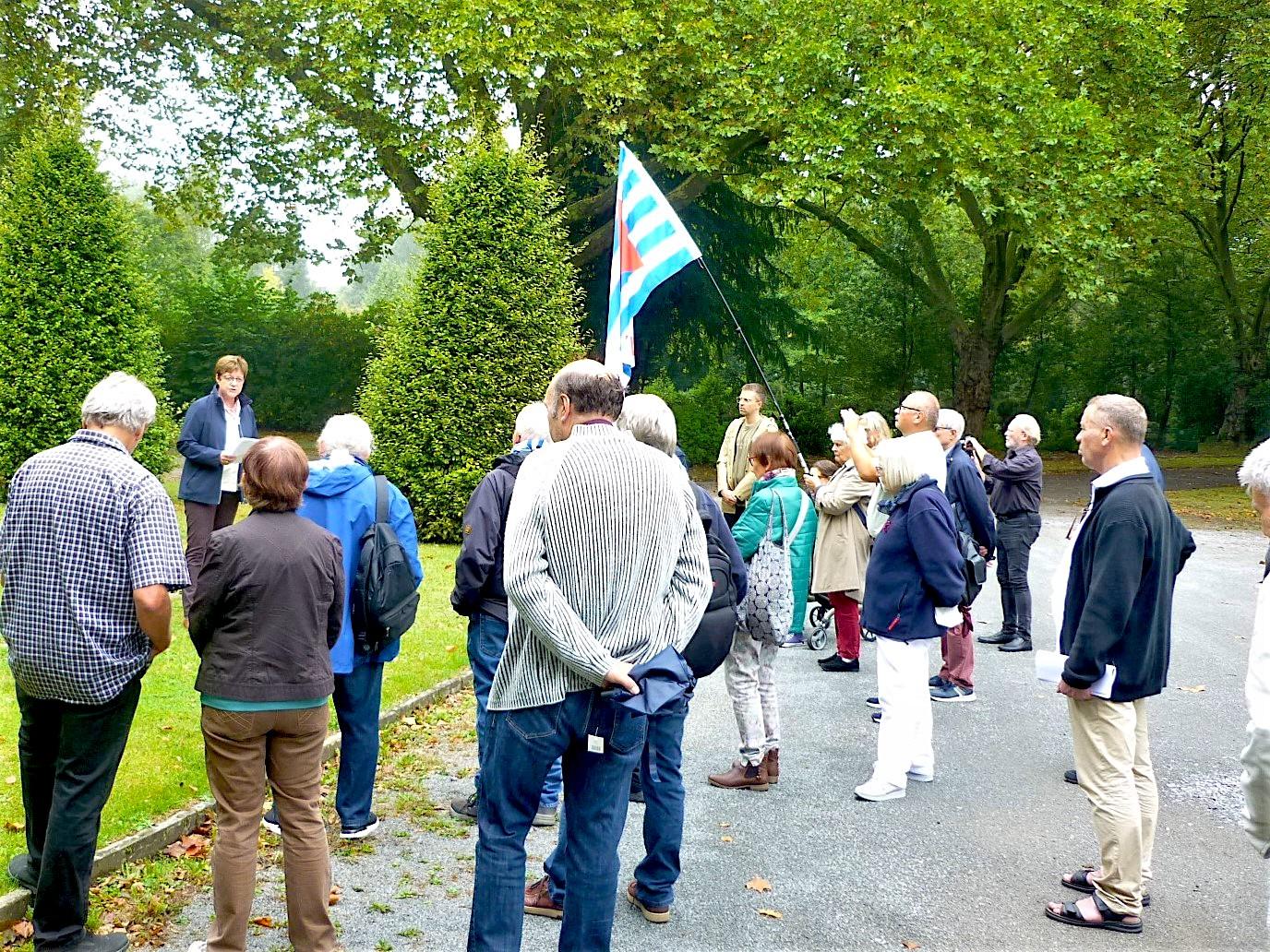
The Association of Persecutees of the Nazi Regime – League of Anti-Fascists calls on people to commemorate the murdered resistance fighters against fascism and war on the occasion of the Day of Remembrance of the Victims of Fascism. The day of remembrance was proclaimed by survivors in 1946. The commemoration ceremony took place on 11 September 2022 in front of the memorial to the murdered resistance fighters on the Ehrenrundplatz at Freigrafendamm cemetery. The urns of 8 fighters against fascism who were executed or died in concentration camps were buried here in 1947. Among them were Moritz Pöppe and Johann Schmidtfranz, who had led a large resistance group against war and fascism in Bochum in 1943/44 and were executed in Brandenburg-Görden prison in November 1944. This year, Dr Irmtrud Wojak, founder of the Fritz Bauer Forum in Bochum and managing director of the non-profit BUXUS STIFTUNG, spoke. – The editors.
Dear friends,
Many thanks to the Association of Persecutees of the Nazi Regime – League of Anti-Fascists for honouring the resistance fighters against National Socialism here today. I consider this an honour and also an increasingly urgent necessity to keep this memory alive together.
It is a particular pleasure for me to do so this year in view of the Fritz Bauer Forum, which is being built in the immediate vicinity of this memorial site. A centre for human rights, which is now being built in Bochum and for which we laid the foundation stone a year ago. The Fritz Bauer Forum will be a place of research and encounters, of art and exchange, of learning and yes, I would like to emphasise this at this place in memory of the resistance fighters against National Socialism, also of joy. Let me or let me take a brief look back.
Perhaps it is symptomatic that I do not know the personal history of the courageous people who are buried here and whom we are remembering today. Frankly, I have not yet had the opportunity to familiarise myself more closely with this history, which is one of the important topics of the VVN League of Anti-Fascists and which should be much better known.
But when Wolfgang Dominik invited me to speak here today, these questions came to my mind, as they have often done in recent years:
Why do fewer and fewer people actually know and talk about the stories of resistance against National Socialism? With the possible exception of the stories of the Scholl siblings and Colonel Claus Schenk Graf von Stauffenberg, made famous in major cinema films, and more recently Georg Elser.
What has happened that the history of the resistance has been pushed further and further into oblivion in our culture of remembrance, or perhaps pushed into oblivion? After all, the fact that there were too few of them cannot be a reason to forget them – on the contrary. I am thinking of the resistance and self-assertion of the persecuted Jews, the communist and social democratic resistance, the Christian-motivated resistance and, in general, that of rescuers and helpers.
Should we perhaps start thinking anew about the topic of resistance? About what resistance actually is and means, what it has to do with ourselves?
I also immediately thought of what Fritz Bauer said about why he had returned to the Federal Republic of Germany after thirteen years of exile, almost exactly when our Basic Law was passed. „I returned,“ he explained, „because I believed I could bring something of the optimism and faith of the young democrats in the Weimar Republic, something of the spirit of resistance and will to resist of the emigration in the fight against state injustice. (…) I wanted to be a lawyer who did more than just lip service to the law and justice, humanity and peace.“
It was with this unbroken, militant spirit that the Social Democrat, who had fought against the Nazis from the very beginning and was chairman of the non-partisan Republic Protection Organisation Reichsbanner Schwarz Rot Gold in Stuttgart, who had been imprisoned in a concentration camp and suffered years of persecution in Denmark under National Socialist administration, returned to Germany.
Nobody called him back; emigrants or returnees were vilified as traitors to the fatherland at the time. Bauer nevertheless wanted to return in the hope of being able to help bring about a fundamental new beginning and contribute to the urgently needed „intellectual revolution of the Germans“. The lawyer considered it essential to confront the roots of National Socialism. The Germans should „hold a day of judgement“ on themselves, he said, on the dangerous factors in their history, on everything that was inhumane here.
Have we understood or interpreted Fritz Bauer’s concerns correctly?
The fact that the majority of Germans did not want to be reminded of the resistance after 1945/49 sounds almost like a truism today. Similarly, the smooth integration of the Nazis is generally regarded as the greatest success of Konrad Adenauer’s government, as the foundation of our „successful democracy“ and the „success story of the Federal Republic of Germany“.
After all, who wanted or wants to seriously confront their own guilty conscience? The vast majority preferred to see themselves – and probably still do today – as victims. As victims of war, of bombing terror, of the expulsion of millions. In our case, ultimately as victims of a National Socialist leadership that they had run along with and followed, in whose name they had expelled people, robbed them and – orders are orders and the law is the law, was one of the favourite excuses of the Nazi perpetrators in the trials – killed millions of people.
From the point of view of the social democratic resistance fighter and human rights advocate Fritz Bauer, this was and is our heaviest burden. As if there had not been millions of convinced National Socialists who wanted to help their convictions and beliefs to victory, as he criticised the well-known attitude of subservience in the majority of post-war society.
Bauer held up a mirror to the Germans who wanted to duck behind their own history, a mirror they did not want to look into. Perhaps out of fear or apprehension of the personal consequences this could have had. The lawyer admitted this without hesitation in conversation with students when asked what we could be proud of. He then immediately added that we can only be proud of something that we have done and created ourselves.
Let me conclude with this. Fritz Bauer’s life and work have been with me for several years now. However, I have only gradually realised what the sentence that he returned because he wanted to do more than just lip service to justice, humanity and peace has to do with us and with me. Doing things himself and making his own decisions were the centrepieces of Fritz Bauer’s life. The lawyer did not allow himself to be stopped and provoked a guilty conscience by confronting society with all the details of the crime of the so-called „Final Solution to the Jewish Question“ through the Nazi trials. Above all, however, he made it clear that there are always alternatives to blind obedience and conformity. He saw the roots of National Socialist behaviour in authoritarian faith in the state and a lack of civil courage. He did everything in his power to ensure that the resistance was recognised under constitutional and political law.
For Fritz Bauer, whose aim was to teach young people to live confidently and freely, and who did not spare himself in the process, the lesson of the Nazi trials was „that there is a limit to our lives where we can no longer participate“. For him, the decisive lesson of all trials against Nazi perpetrators was:
„You should have said ‚No!“
Today we know that part of obedience and conformity is that the associated self-sacrifice can be directed not only against oneself, but also against others. Our own weaknesses and mistakes are repressed as pain and turned against other people in the form of pent-up anger. It is the fear of this pain that repeatedly becomes a betrayal of mankind. It leads to a willingness to make false compromises and to ally oneself with the seemingly stronger and more powerful, instead of resisting and rejecting conformity and followership.
The few who have the courage to stand up against war, fascism and human rights violations are therefore our role models and our motivation. Through people who live empathy and who share the suffering of others through their actions – like Fritz Bauer and the resistance fighters we commemorate here today – peace and social justice remain alive, no matter where in the world. We owe the resistance fighters our thanks and recognition, but above all this is and remains our own task.