
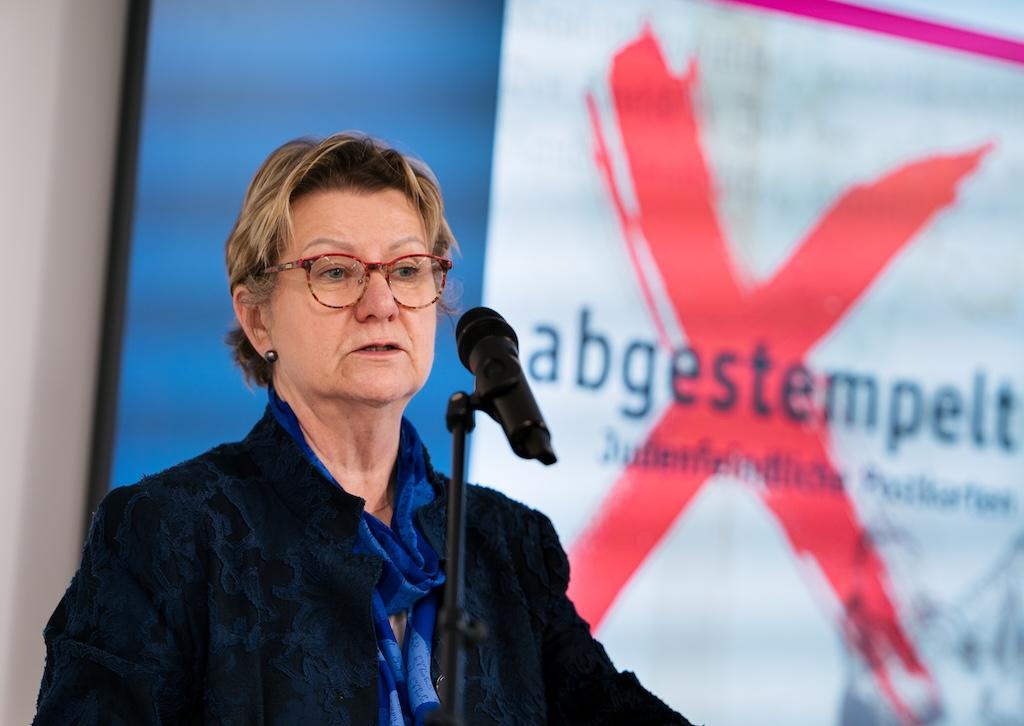
Autor/Autorin
Dear Dr Wojak, Ladies and Gentlemen,
Thank you very much for the warm welcome here in Bochum today. I am very pleased to be with you today and especially pleased, dear Dr Wojak, dear team of the Fritz Bauer Forum, that this exhibition opening finally gives me the opportunity to experience the Fritz Bauer Forum and get to know it better.
After all, it is remarkable what you are all organising here after the renovation and even during the renovation in terms of events, workshops and exhibitions with a great deal of commitment, passion and heart and soul, in line with the guiding principles of the BUXUS FOUNDATION, which is so closely associated with the Fritz Bauer Forum, and I quote: „We celebrate diversity. We fight nationalism and anti-Semitism. We strengthen human rights and democracy.“
I would like to thank you sincerely for this and wish you and us that you will continue to be so energetic and bring powerful exhibitions like the one we are opening together today to Bochum. It is not a „simple“ exhibition, not a simple subject, as we have just heard in Dr Wojak’s introduction.
Nevertheless, it is important, because we must, in the spirit of Fritz Bauer, „Ask for the roots of evil“, as he titled a lecture at the University of Frankfurt. This exhibition shows us with frightening clarity how deeply anchored anti-Semitic images and ideas were in everyday life.
The postcards from the Haney Collection shown here are not harmless curiosities from a bygone era such as the Wilhelmine Empire. No, they are mirrors of a society that often communicated and passed on its hatred between the lines or quite blatantly in illustrations, in so-called „Jewish mockery postcards“, as the collector Wolfgang Haney himself once categorised them in an interview with the Federal Agency for Civic Education.
In the digital age, we can hardly imagine how powerful such hate speech was using the now almost ridiculed medium of the postcard.
But in an era without the internet, radio, television or smartphones, the postcard was a popular, far-reaching means of communication. It conveyed news, moods, humour – and, as we can see here, also prejudices. They created a mood and spread hatred and anti-Jewish agitation. Sent out millions of times, these cards show how anti-Semitic stereotypes subtly and „playfully“ crept into everyday life. Intended to creep in. What is outrageous today was accepted in many places back then. Considered harmless fun. As a joke. Today, it is unimaginable that anyone would send such postcards.
It is precisely this supposed normality of the time that makes the cards so dangerous – and historically so valuable as a source, as Wolfgang Haney recognised. With their images and texts, these postcards helped to reinforce centuries-old anti-Semitic stereotypes and prejudices and spread them to the centre of society. They thus prepared the ground for the Nazi ideology and the crimes against humanity of the Holocaust and the crimes of the Nazi terror regime with millions of murders, torture and disenfranchisement.
Last year, I had the honour of accompanying André Kupfer, President of the State Parliament of North Rhine-Westphalia, on his trip to Israel and the Palestinian territories at the end of October. During a guided tour of the Yad Vashem memorial site, the Aachen-based academic and historian Dr Marc Neugröschel gave us a very vivid description of the so-called „vicious circle“: centuries-old anti-Semitic stereotypes and prejudices that continue to have an effect today and generate hatred of Jews, which manifests itself in anti-Semitic incidents and criminal offences. Also here in North Rhine-Westphalia.
Fritz Bauer, who gave his name to this forum, once said, and I quote: „Nothing belongs to the past; everything is still present and can become the future again.“ Unfortunately, as the state’s commissioner for combating anti-Semitism, for Jewish life and the culture of remembrance, I have to tell you that anti-Semitism is becoming increasingly open and unrestrained.
Publicly – be it in everyday situations, at demonstrations, in sport or online and in social media.
We are witnessing a rise and a level of anti-Semitism that I could not have imagined: Hatred of Jews in all its facets. Houses are being marked, people threatened, insulted, covered in hatred and agitation, and even verbal and physical violence. There are calls for boycotts. People are intimidated. Israel’s right to exist is denied. The result: Jews deny their identity, feel not only unwelcome at school, at universities and in cultural institutions, at sporting events and at work, but often also threatened.
And to make it clear to you how dramatic the situation still is, I would like to give you some figures on the situation in North Rhine-Westphalia. Please note that these are figures from 2024, as the current figures have not yet been published. I know from conversations that the situation has not eased since then, quite the opposite. And the development in 2024 is already alarming enough: according to police statistics, there were 695 antisemitic offences in North Rhine-Westphalia in 2024. An increase of 27 per cent compared to 2023.
In addition, there were anti-Semitic incidents below the threshold for criminal offences. Furthermore, not every incident, not every criminal offence, is reported. For a wide variety of motives. In order to combat antisemitism effectively, we need a comprehensive picture of the situation that not only records antisemitic offences, but also incidents below the threshold of criminal liability. This is why the Anti-Semitism Reporting Centre, or RIAS for short (Research and Information Centre for Anti-Semitism), was established, which also has a reporting office set up at the University of Münster specifically for incidents in the university sector.
RIAS NRW documented 940 antisemitic incidents in North Rhine-Westphalia in 2024. An increase of 42 per cent compared to 2023.
2024 also saw a significant increase in anti-Semitic incidents at colleges and universities in Germany.
We should always be aware of this: Behind each of these sober statistics is a person who has been denigrated or mentally and sometimes even physically injured by word or deed! The extent to which anti-Semitic stereotypes and prejudices are widespread in North Rhine-Westphalia society as a whole was also clearly demonstrated in 2024 by the „dark field study“ initiated by my predecessor in this honorary post together with Interior Minister Reul:
It must alarm us that every second person surveyed wants to „draw a line under“ the greatest crime against humanity, the murder of 6 million Jews! Anti-Semitism today has many manifestations and is anchored in many inhuman ideologies. It can be no coincidence that many of these ideologies also reject the German state, our democracy and our values. Occasionally, one variant of anti-Semitism is labelled as particularly bad, particularly aggressive in the press and on the radio.
Let me be clear about this: There is no anti-Semitism „competition“ – every form of Jew-hatred – regardless of its colour, regardless of its origin – is equally bad!
This makes it all the more necessary to oppose all anti-Semitic ideology and to work every day to ensure that Jews can live freely and safely in Germany. For our democracy, for our values and for our social cohesion. Germany – the country that must never forget the crime against humanity of the Holocaust – has a responsibility to combat anti-Semitic incitement, hate speech and the trivialisation of historical guilt with the utmost determination.
An article about Wolfgang Haney states that he considers his collection to be his duty to the victims, but also to the survivors of the Holocaust, a tribute to all those who were persecuted, disenfranchised, degraded and murdered. He commented on this in the same article in an interview with the Austrian Standard:
„My family was despised, persecuted and annihilated for twelve years, I felt it was my duty as a survivor to inform the new generations.“
Like Fritz Bauer, he had recognised this early on: Knowledge and the adequate naming of the causes of anti-Semitism are essential elements in the fight against hatred of Jews. This is why exhibitions such as „Stamped“ are so important: in order to effectively combat anti-Semitism, we need to know about its roots and historical background.
This knowledge helps us. So that together we can consistently oppose every manifestation and every anti-Semitic ideology: In word and deed. For our society, our values and our democracy. At school, in the neighbourhood, at work, in the club, in public. Even if it is uncomfortable.
Let’s take a stand: for history not to repeat itself and for Jews to be able to live freely, safely and without fear in Germany again. Let me conclude with another quote from Fritz Bauer: „We cannot make heaven out of earth, but each of us can do something to ensure that it does not become hell“.
Thank you for your attention and I wish the exhibition many visitors!
The exhibition will be on display at the Fritz Bauer Forum until 28 April 2026.
Opening hours
Monday to Wednesday and Friday 10.00-16.00
Thursday 10.00-19.00
On weekends by appointment