
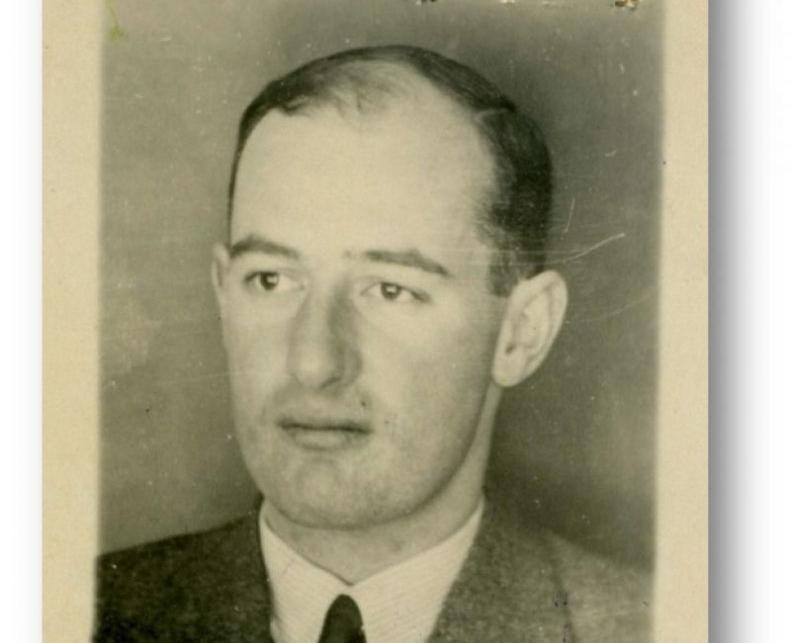
Despite clear evidence that Russian officials continue to withhold vital information about the fate of Raoul Wallenberg, Swedish officials are not demanding answers from the Russian authorities. I want to know why.
Last 27 August, on the occasion of Raoul Wallenberg Day, the Swedish government announced the release of 40,000 new documents contained in its official Raoul Wallenberg case file. The announcement did not mention that the release was not on the government’s own initiative. Instead, the declassification of a shelf metre of documents came in response to a formal research request I submitted with two experts back in March 2018. The request is part of a new research project that aims to obtain more comprehensive background knowledge about the Raoul Wallenberg case in Sweden and also in Russia. This will allow the research to ask more precise and targeted questions that the authorities in both countries will need to answer before they finalise the Wallenberg investigation.
The release of the additional documents is undoubtedly very welcome and will hopefully provide important new insights into the official handling of my uncle’s disappearance in the Soviet Union in 1945.
In a public statement on the release, Swedish Foreign Minister Margot Wallström emphasised that „it is important that the memory of Raoul Wallenberg remains alive“. (Det är vikitgt att hålla i liv Raoul Wallenbergs minne.) However, she shied away from saying that the Swedish government would continue to actively try to solve Wallenberg’s disappearance. Instead, Mrs Wallström merely stated that the Swedish government „will continue to support efforts to clarify the fate of Raoul Wallenberg“. (Regeringen commercial att fortsätta att stödja arbetet me att försöka få klarhet I Raoul Wallenbergs öde).
The Foreign Minister makes an important distinction, and in this careful choice of words lies the problem: the fact is that for twenty years the Swedish authorities have, with few exceptions, done very little to advance the efforts of those who really want to clarify what exactly happened to my uncle after the spring of 1947, when his trail in the Lubyanka prison in Moscow was broken off in the spring of 1947.
Since the conclusion of the official investigation by the bilateral Swedish-Russian working group in 2000, the Swedish government has tacitly transferred the burden of clarifying the case to private individuals – Raoul Wallenberg’s immediate family and researchers. Swedish officials have insisted on this approach, even though it is very obvious that it is an almost impossible task without determined official support.
For me and my family it is a sacred duty to find out the full truth about Raoul Wallenberg’s fate – for more than twenty years we have once again been forced to carry this more or less on our own shoulders. As a result, we find ourselves at a serious impasse. The current situation seems all the more frustrating because it could easily have been avoided: it is clear that Russia has highly relevant information in the Wallenberg case, but the Swedish government will not press the Russian authorities to provide the access needed for an independent review of the documents. We have provided Swedish officials with a growing list of key materials. If access to these papers were granted, the question of Raoul’s fate could almost certainly be resolved, or at least decisive progress could be made. In many cases, we can name the exact archive collection or even the exact file and document to be investigated. However, the Swedish authorities are still unwilling to pressurise the Russian government to release the material. So we have to try to get the access we need in other ways. Meanwhile, the Swedish government publicly states that it supports our current efforts in Russia. In reality, it does not.
When information emerged from the Russian State Security Service (FSB) archives in November 2009 that an unidentified prisoner No. 7 was held in Lubyanka prison in July 1947, there was real hope that this could be the first step towards a full resolution of the case. Based on strong circumstantial evidence, FSB archivists concluded at the time that the prisoner was most likely the Swedish diplomat Raoul Wallenberg. If so, this means that Raoul was alive six days after his official date of death on 17 July 1947. Prisoner No. 7 was interrogated on 22 July 1947 together with Raoul’s long-time fellow prisoner, the German diplomat Willy Rödel. The next day, prisoner no. 7 was interrogated for more than 16 hours together with the Hungarian citizen Vilmos Langfelder, Raoul’s driver and assistant in Budapest.
With the exception of Tomas Bertelman, the Swedish ambassador in Moscow in 2009 – who described the new information as „almost sensational“ and wrote two letters to the Russian authorities asking for clarification and additional details – Swedish officials did little to follow up on the new leads. In November 2009 and again in early 2010 – just weeks after the Swedish authorities officially learnt about Detainee No. 7 – Sweden’s Prime Minister Fredrik Reinfeldt and Foreign Minister Carl Bildt met the then Russian President Medvedev and then Prime Minister Vladimir Putin – but they failed to take up the new findings in their formal discussions. They merely chose to remind their Russian counterparts to ensure that experts were given appropriate access to key archival holdings. When this access was not granted, Swedish officials shrugged their shoulders and said there was nothing they could do.
The 100th anniversary of Raoul Wallenberg’s birth in 2012 provided another unique opportunity to draw international attention to the urgent need to press the Russian authorities to provide clarity about Prisoner No. 7. . In January 2018, in response to repeated appeals from researchers and our family, the Swedish Foreign Minister Mr Bildt appointed the former Chair of the Swedish Working Group, Ambassador Hans Magnusson, to conduct a new formal review of the Raoul Wallenberg case. Although Mr Magnusson was officially acting as an agent of the Swedish government, the FSB archivists refused to allow him to inspect the documentation on Prisoner No. 7 and related issues. Again, the Swedish government did nothing to protest this serious snub by Russian officials.
The failure of Swedish diplomats to help us pursue one of the most important leads in the Wallenberg case since 1957 is truly disappointing. There is a broad consensus among researchers and other experts that even if Prisoner No. 7 was not Raoul Wallenberg, it would be crucial for the Wallenberg investigation to obtain all available information about this person.
Ten years after the information first surfaced, the question of Prisoner No. 7 remains unresolved. The lack of official Swedish support to break through the Russian walls led to my reluctant decision to sue the FSB in 2017. The lawsuit is currently pending.
There is now growing evidence of a disturbing pattern of deliberate obstruction, including strong indications that Russian officials conducted a deliberate disinformation campaign in the 1990s and 2000s to influence the Wallenberg investigation. I have come back to Stockholm this week to present the Swedish Foreign Ministry with a list of concrete questions and research requests on specific documents we are seeking in Russian archives. I also intend to discuss a number of carefully selected questions about the background to the Wallenberg case in Sweden. We, Raoul’s family, will not rest until we know what happened to him. The Swedish authorities, who regularly invoke his name, praise his courage and hold up his selfless actions in support of his fellow human beings 75 years ago as an example for the next generation to emulate, owe Raoul Wallenberg more than words. They have an obligation to stand up and do what is necessary to end the nightmare that has plagued him and his entire family for far too long.
Marie von Dardel-Dupuy is the daughter of Professor Guy von Dardel, Raoul Wallenberg’s brother.