
Autor/Autorin

Psychiatric and violent experiences of children and adolescents at St. Johannes-Stift in Marsberg (1945-1980), by Franz-Werner Kersting and Hans-Walter Schmuhl. Münster: Ardey-Verlag, 2018, 384 pages, € 24.90.
St. Johannes-Stift in Marsberg, which was founded in 1881 as an „institution for idiots“ for children who were „born stupid“ and „mentally ill“, has increasingly become the focus of public attention in recent years. (1 ) This is particularly thanks to the victims who have publicised the injustice committed against them. (2 ) As early as 1987, Paul Brune (1935-2015), who was brought to Marsberg in 1943, reported on his outrageous experiences in the television programme „Wednesdays in Marsberg“ and described St. Johannes-Stift as a „little Auschwitz“. (3 )
The book Psychiatry and Experiences of Violence by Children and Adolescents at St. Johannes-Stift in Marsberg (1945-1980) records the results of a research project conducted by the Landschaftsverband Westfalen-Lippe (LWL), the institution’s former and current sponsor. (4 ) The research project was carried out against the backdrop of new revelations and the associated public pressure. As part of the project, numerous contemporary witnesses were interviewed, providing readers with an authentic insight into the microcosm of this total institution.
Prof Dr Franz-Werner Kersting is an academic consultant and has worked at the LWL Institute for Westphalian Regional History in Münster since 1986. He is an adjunct professor at the University of Münster and a member of the working group for research into National Socialist „euthanasia“ and forced sterilisation. He is also a member of the historical commission of the German Society for Psychiatry and Psychotherapy, Psychosomatics and Neurology (DGPPN) on the project: Psychiatry in Germany after 1945. (5 )
Prof Dr Hans-Walter Schmuhl is an independent historian and adjunct professor at the University of Bielefeld. He is deputy director of the Institute for Diaconal and Social History in Wuppertal-Bethel and a member of the Commission for Contemporary Church History. He also sits on the theological committee of the Protestant Church of Westphalia and is an honorary member of the DGPPN. (6 )
Both authors have already published numerous works on the history of psychiatry.
This book is divided into three parts:
1. psychiatric and violent experiences of children and adolescents at St Johannes-Stift in Marsberg (1945-1980). Everyday institutional life, individual memory, biographical processing
2. documents
3. interviews
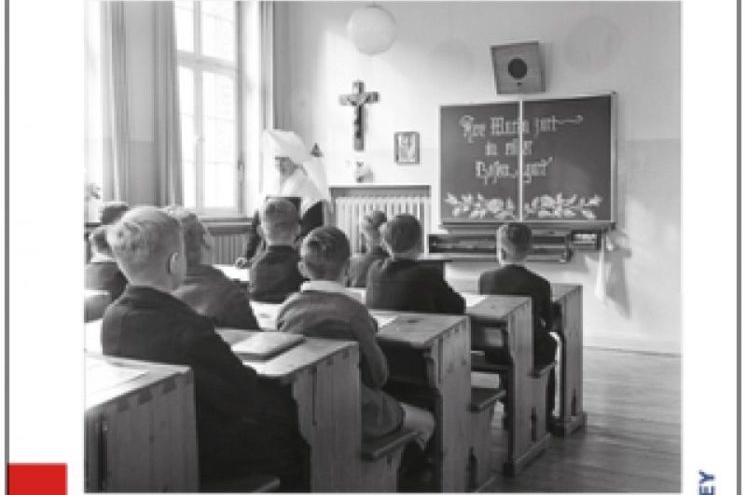
In the first part of the book, the authors go into the background of the research project, the (historical) framework conditions of St John’s Abbey and their theoretical foundations. This part also contains the empirical analysis followed by a summary and evaluation of the research results. An illustrated section with numerous – mostly posed – photos of everyday life at the institution concludes the first part, which runs to around 110 pages. The second part extends over almost 150 pages and contains historical documents that serve to supplement and deepen the study. The last part comprises the interviews conducted on just 100 pages.
At the beginning of the book, the current LWL director Matthias Löb writes these remarkable lines in his foreword:
„Physical violence, sexual abuse, immobilisation with straitjackets and medication, confinement in closed rooms, humiliating punishment rituals, unloving treatment – the residents of St. Johannes-Stifts in Marsberg in the Sauerland region experienced the ’specialist hospital for adolescent psychiatry‘ under the auspices of the Landschaftsverband Westfalen-Lippe (LWL) as a place of the greatest suffering and injustice in the years from 1945 to 1980.“ (S. 7)
In the 1990s, such words were not to be heard from the lips of an LWL director, as for years efforts were made to forget what had happened. Nevertheless, on further reading, it is difficult to avoid the feeling that the self-critical lines are primarily intended to emphasise the special merits of the LWL in „coming to terms“ with its own history. A kind of change in remembrance policy strategy in the form of a flight forward is emerging: away from decades of denial and suppression towards the postulate of a successful „coming to terms“ with history in the interests of the organisation. The 2014 chronicle on the 200th anniversary of Marsberg’s psychiatry states that Marsberg „as a whole“ has developed a „(…) special empathy, appreciation and tolerance for mentally ill people“, before concluding with the pathetic and euphemistic words: „Seen in this light, the entire town of Marsberg has been ‚living inclusion‘ for 200 years.“ (7 )
Doubts already arise when reading the introduction, as the very first page provides grounds for criticism, as the two authors cite the „Paul Brune case“ without remotely addressing the inglorious role that the LWL played in his fight for recognition. Instead, they refer to a documentary film by the LWL Media Centre and emphasise that the then director of the LWL apologised to Paul Brune „as early as“ 2003 for the injustice he had suffered. For an apology that was not made of his own free will and came far too late, this is an unacceptable way of presenting things, which unfortunately should read that the director was only prepared to apologise 50 years after the events.
It goes on to say that 19 former „residents“, who are now between 48 and 75 years old, were recruited for the interviews. „The research project focused on the experiences and consequences of violence and traumatisation as well as the question of how these are remembered today by those affected and how they are located in their biographies.“ (p. 16) The unimaginable conditions at St Johannes-Stift between 1945-1980 are then described. The Catholic nuns from the Congregation of the Sisters of Mercy of St Vincent de Paul in Paderborn, who did not shy away from even the most brutal methods of punishment, were particularly responsible for the smooth running of the huge institution, in which over 1100 children, adolescents and adults lived at times. (8 ) In general, a climate of violence prevailed at St. Johannes-Stift and the situation was characterised by massive overcrowding, a shortage of supplies and catastrophic hygienic conditions.
In the theoretical preliminary considerations, Erving Goffman’s concept of the „total institution“ (9 ) is discussed and a concept of violence is defined that forms the basis of the research work. However, the communication with the object of research is only half-hearted, which is sometimes evident in the fact that immediately after the remarks on Goffman, who explicitly speaks of „inmates“, there is again – euphemistically – talk of „residents“ of St Johannes-Stifts. To speak of „residents“ does not do justice to the role of the people in this total institution and leads to a conceptual obfuscation and trivialisation of the actual conditions of violence.
The findings of the research project are then presented, which cannot be reproduced in detail here. The five levels of escalation identified by the authors and the punishments applied by the supervisory staff are particularly shocking. These ranged from being sent to bed hungry, standing or kneeling as punishment, being beaten with the flat of the hand, with a fist or with a tool, permanent baths in cold water, fixation in blood-encrusted straitjackets, injections and electric shocks. It is also pointed out that children were forced to eat their own vomit at the table.
The second part of the book consists of a collection of documents containing a total of forty historical documents, almost all of which come from the archives of the Landschaftsverband Westfalen-Lippe. Numerous exchanges of letters, memos, entries, minutes and reports invite in-depth examination and facilitate research work. The focus is on documents that explicitly address the violence at St. Johannes-Stift.
The concluding third section contains forty extracts from 18 interviews conducted with former inmates who were housed at St. Johannes-Stift between 1945 and 1980. The extracts are roughly organised thematically and provide an authentic insight into everyday life in the institution at the time. The former inmates report on how they were admitted to St. Johannes-Stift, what forced labour they had to perform, how they resisted, what the hygienic conditions were like, how they were punished and what consequences their accommodation in St. Johannes-Stift had on their future lives. The interviews bear impressive witness to life in this total institution. They shock, enlighten, touch, provoke outrage and leave the reader with the urgent question: How could all this happen?
Despite the atrocities described in the third part and the documents in the second part, the two authors come to an astonishing conclusion in the first part in their summary and assessment of the research project:
„There is no evidence of a systematic use of violence at St Johannes-Stift, but the analysis reveals systemic conditions of violence on various wards. As far as can be ascertained, violence was not omnipresent at St Johannes-Stift, but it was not a (rare) exception“ (p. 103).
How the two authors arrive at this – linguistically acrobatic – conclusion remains a mystery, even against the background of the abbreviated concept of violence on which the authors are based, and they should have come to a completely different conclusion. If their concept of violence is supplemented by those of Galtung or Basaglia, the facts become clearer: St. Johannes-Stift was an institution of violence and this was omnipresent in its various forms. (10 ) The authors‘ reference to the „development of a subculture of violence“ therefore not only obscures the prevailing, i.e. actual, structural conditions of violence, but the suffering of the victims and survivors is also subsequently trivialised with linguistic acrobatics.
The motives are open to debate, but ultimately the question arises once again as to why the song of praise is being sung about a supposedly successful „coming to terms“ with the history of crimes and their denial, which we know did not take place. In whose interest should this actually be?