
Autor/Autorin

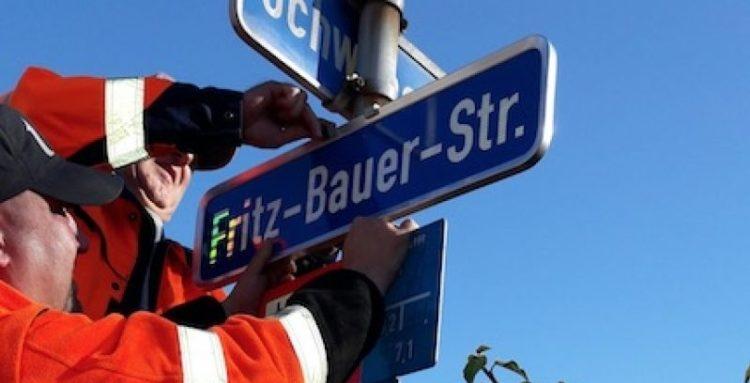
On 25 February 2017, the Schwäbisches Tagblatt reported that nothing stood in the way of renaming the street in honour of the initiator of the Auschwitz trial. According to the local council, the street, which was named after the mayor of Tübingen until 1939, Adolf Scheef, who was made an honorary citizen by the Nazis, should have changed its name three years ago. In a survey, however, a majority of local residents had spoken out against it. They took the matter to the Sigmaringen Administrative Court, which dismissed the complaint on 4 July 2016. This has now been followed by the final judgement of the Mannheim Administrative Court.
The old signs will be removed on 27 March, according to the Schwäbisches Tagblatt (9 March 2017). The city council will inform all residents, property owners, companies, banks and other institutions. This puts an end to years of dispute, even if some residents who have to change their sender may still not like it.
The venerable old university town of Tübingen, where Fritz Bauer studied Protestant theology among other things, is honouring a lawyer whose life and memories are closely linked to the hometown of his mother Ella Gudele Bauer (née Hirsch) with this renaming. Fritz Bauer’s maternal grandparents, Gustav and Emma Hirsch, lived here, the family ran a textile wholesale business in Tübingen’s Kronenstraße and happy childhood memories of Bauer are associated with this place. Here in Tübingen, his ancestors fought for the legal equality of Jews, and throughout his life, the lawyer, who himself did not belong to any religious community but always described himself as „non-believing“ in official documents, was aware of this history. The struggle for legal equality shaped his legal thinking and historical awareness, as did the anti-Semitic hostility he experienced as a child. The clothing shop in Kronenstraße (see illustration, © privately owned), which was run by Fritz Bauer’s uncle Leopold Hirsch, was „aryanised“ during the Nazi regime – hence the name Tressel (from Josef Tressel) on the photo. The Hirschs had to sell their house and business for far less than they were worth.
„Tübingen, the old Kronenstraße, the silence of the avenues“
In Tübingen, Fritz Bauer, who was born in Stuttgart in 1903, learnt of the birth of his sister Margot (1906). It was the earliest event that he „remembered“ in later years. Here is an extract and a photograph of the Bauer family from his biography, which bears witness to his love for his mother and her home [1 ]:
„The memories of Tübingen, recalled again and again, are the earliest testimonies of Fritz Bauer’s life. He recorded them in a moving letter to his mother: „‚Today, you write, dear mother, I travelled to Tübingen to wind up grandfather’s business…'“ [2 ] Shaken, her son Fritz Bauer – by this time already a refugee in Copenhagen – replied in an almost solemn tone: „Memories are awakened, I write them down, for your love, mother. When I listened to myself, as I always did in quiet hours, looking backwards, Tübingen, the old Kronenstraße and its people, the bustling market with its scent and noise, the idyllic silence of the avenues, the humanism of the assembly hall were always before me. My earliest childhood memories centre around Tübingen; I often wondered how this was possible. We lived in Stuttgart for years and years, grew up here, and our horizons widened, but Tübingen is more vivid and colourful in my memory than playing in my home town and its streets, eating and sleeping in my parents‘ house.“
Filled with a deep affection for his mother, Fritz Bauer’s thoughts wandered back to Tübingen, because there, he wrote to his mother Ella, „in its atmosphere, its sound, its day and its night“, he had felt and grasped the colouring of his mother’s world, her roots and education there, and had even experienced it in the fast pace of his earliest youthful years. „Science also believes,“ he continued, „that the grandfather is reflected in the grandson. I am not able to decide all this. The days of my youth in Tübingen stand out like hills and mountains in the landscape of my early years, while the everyday hustle and bustle of Stuttgart has faded into oblivion.“
Fritz Bauer’s Tübingen was the place of his childhood experiences, also in the stories and marvellous tales of his mother, which he imagined as a child and growing boy to be even more romantic, adventurous and fairytale-like than his own childhood and his school years in Stuttgart, which fell in the middle of the First World War. Neither the famous Uhland monument nor the efforts of the city authorities to achieve metropolitan splendour could distract him, Bauer wrote; his love belonged solely to the small town of Tübingen. It reminded him of the world of the painter Spitzweg, especially the view from the Neckar bridge on Sunday family walks, „the abundance of small and tiny houses on the left bank of the Neckar […], closely packed together, roofs nested inside each other, windows with flowers and washing, and all dominated by the proud and defiant Swabian collegiate church. The colourfulness of the picture is perhaps only surpassed by the panorama offered to the astonished traveller from the Ponte Vecchio in Florence. How happy I felt […].“
The holidays he spent with his sister Margot at his grandparents‘ in Tübingen remained in Fritz Bauer’s memory for the rest of his life as wonderful journeys into the past. He was therefore deeply shocked by the sad news in his mother’s letter in 1938, which immediately brought the atmosphere in his grandparents‘ house back to life – the „experience of Kronengasse. It is difficult to convey all the emotions that the steep little street harboured for me and that I still can’t forget today. Everything, even everything, had its charms. Kronenstraße was a shop for boys, not dead, full of activity. […] Next to my grandparents‘ house was the butcher, next to it the baker, and opposite was the flour shop. The pub was to the left of our house. And the grandparents‘ shop had clothes. A few houses away, you could see and even taste the café, the patisserie. Everything your heart desired was there; nothing was closed; it was the whole economic world of the young boy.“
„How many secrets were there in Kronenstraße 6. Everything was shrouded in a strange twilight. And yet it was the simplest things in the world, often only things from one or two generations back.“ For example, there was the „guest room“ on the second floor, a holiday home she shared with her sister for many years: „[I] still remember with the sharpest clarity all the things I felt there in my youth.“ With its strange furniture, it looked like a room from a museum: the colourful peculiarity of the wallpaper with huge, now faded chrysanthemums, the obligatory red plush armchair and the old table, both of which „limped“, the sofa „whose entrails were covered all my life by a heavy fabric with colourful flowers“. As a young boy, Fritz Bauer recalled, he had fainted here for the first time when he fell off the sofa in his sleep. A scene that he could not tell his sister Margot about often enough.
In general, storytelling in Tübingen was a chapter in itself. In the semi-darkness of the gas lamp, which they kept burning all night with a low flame for fear of the mice, Fritz Bauer wrote to his mother in 1938, he invented „tapeworms of stories“ for his sister Margot before going to sleep. The heroes of the story had one adventure after another, and he had made every effort at the time to continue the story, to extend it, to find no conclusion for as long as possible and only then, when one of the heroes found himself in a hopeless situation, to put his listener off until the next evening. „Only in Tübingen was such a thing possible.“
It is not known whether Fritz Bauer’s letter reached his mother Ella, who managed to escape to Copenhagen with her husband at the last minute after the so-called „Reichskristallnacht“ with the help of her son. As mentioned, the business in Kronenstraße was „aryanised“, the whole family was torn apart and Bauer’s relatives lived in the USA, South Africa, Denmark and Sweden after the end of Nazi rule. Bauer himself returned to Germany in 1949, but was unable to find a new job in his beloved Swabia.