
Autor/Autorin

Accompanied by a greeting from the German Ambassador Steffen Seibert
The Fritz Bauer & Raphael Lemkin Human Rights Film Prize , named after two lawyers and Holocaust survivors, is endowed with 10,000 euros in the feature film category. It was donated by the BUXUS STIFTUNG, sponsor of the Fritz Bauer Forum in Bochum. The foundation is committed to strengthening democracy and human rights. The film prize jury includes: Prof Sung Hyung Cho (filmmaker and professor of artistic film), Tomas Bastian (sound designer and sound mixer), Maria Wolf (actress), Franz Birkner (filmmaker, photographer and artist).
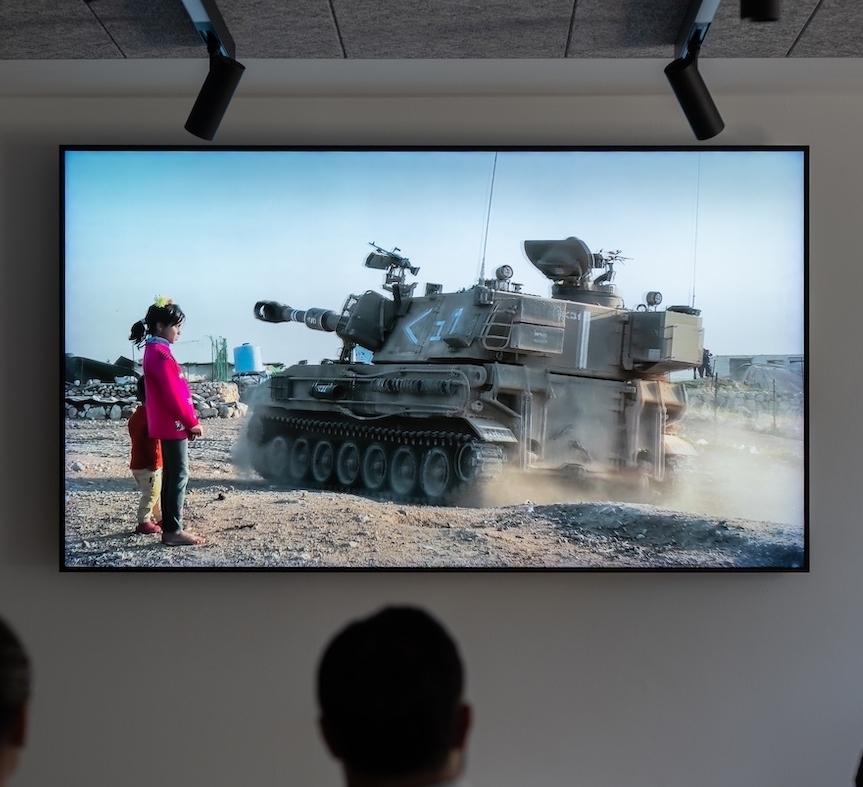
In the feature film category, the jury of the UNLIMITED HOPE festival, headed by Jakob Gatzka, awarded the prize today to the film NO OTHER LAND. The certificate was read out by filmmaker Sung Hyung Cho. Dr Henry Wahlig, programme director of the Dortmund Football Museum, was unfortunately only able to present the award symbolically today. The directors from Israel and Palestine were unable to accept the award in person due to the tense situation in their home countries, which the film confirms in a harrowing way.
At the centre of NO OTHER LAND is the young Palestinian activist Basel Adra from Masafer Yatta, a collection of small villages south of Hebron in the West Bank. The houses there are to make way for an Israeli military training area. The army is using bulldozers to demolish the buildings. Together with Israeli journalist Yuval Abraham and his colleague Rachel Szor, as well as Palestinian photographer Hamdan Ballal, Basel films the destruction and the villagers‘ protests against it. NO OTHER LAND was honoured with the Oscar for Best Documentary 2025.
The award ceremony was accompanied by a greeting from the German Ambassador to Israel, Steffen Seibert, and a greeting from the director Yuval Abraham. His Palestinian friend Basel Adra was unable to record a video.
Quote from the jury:
„As the jury of the Fritz Bauer & Raphael Lemkin Human Rights Film Award, we are deeply convinced: Cinema must not only entertain. It has a social task. It must look where others look away. It must tell stories that are true – and for this very reason are kept in the dark. It must seek out truths – and preserve hope. This is exactly what the film that the jury is honouring today is about.
This film is a stirring moral appeal, especially to the German conscience, which stubbornly hides behind the concept of reasons of state in order to overlook injustice and violence and thus betray the true lesson of the Holocaust: Human rights for all!
Beyond all political and moral urgency, NO OTHER LAND is also a cinematic masterpiece. The precise editing, the alternation of tension and moments of silence in which we can process what we have seen, the emotional depth and the complexity of the narrative from the present and the past – all this is an extraordinary artistic achievement.“
The Fritz Bauer & Rapahel Lemkin Human Rights Film Prize in the short film category was awarded to the documentary WALUD.
The film WALUD is set in 2014: Amuna and her husband Aziz, an IS fighter, live as shepherds in the rural Syrian desert. When he takes an IS convert as his second wife, all their lives are thrown into turmoil. In the end, Amuna helps the young European woman to flee to the West.
The Human Rights Film Festival’s short film prize is endowed with 3,000 euros. The laudatory speech for the film WALUD was read out by Bochum actress Maria Wolf and presented by Tomas Bastian as a member of the jury.
„The directing team succeeds in visualising the gravity of the situation with a light hand, without explaining, without judging, without using too many words.
WALUD thus achieves a form of timelessness that lifts the film above the ever-present current events and makes it valid for all times.“
The Fritz Bauer & Rapahel Lemkin Human Rights Film Prize in the Special Prize category was awarded to the documentary film WALUD and is also endowed with 3,000 euros.
The highly topical content: Can we manage? Or do we finally have to deport people on a grand scale? While Germany is grappling with these questions, which were posed by two different chancellors at completely different times, Fortress Europe is raising its walls.
„Is the German public aware of this?“ KEIN LAND FÜR NIEMAND takes us on a journey through politically turbulent times, from the Mediterranean to the European Parliament to German cities and communities. Activists, politicians and academics guide us through the political, media and social labyrinth of a much-vaunted crisis. But what exactly is this crisis about? While the fight against unwanted migration continues, refugees are arriving every day, carried by something that seems to be fading for many in the country: hope for a better future.
Germany is at a historic turning point: for the first time since 1945, a migration policy resolution will be adopted in the Bundestag in 2025 – with the support of the AfD, which is being monitored by the Office for the Protection of the Constitution due to its far-right endeavours. KEIN LAND FÜR NIEMAND – ABSCHOTTUNG EINES EINWANDERUNGSLANDES sets out in search of the causes of this political turning point and takes the audience on a stirring journey.
Quote from the jury:
But this film does not dwell on suffering. It also shows that behind the major political turning point lies a decision. A decision that is not inevitable, but is made by politicians, by the media, by us as a society.
“No Country for Nobody” is therefore more than a document about flight.
It is a mirror for our democracy.
It shows how easily we reinterpret “never again” as “not here.” And how dangerous it is when we make the weakest members of society scapegoats.
But the film does something else: it exposes the contradiction.
We talk about “burden” and “problem.”
Yet we have known for a long time that Germany is aging.
We need people to come.
We need new stories.