
Autor/Autorin
„The history of the endeavours and events that came together and unravelled in the most unfortunate way on 20 July 1944 is a widely ramified one . . .“
This sentence by the Catholic writer Reinhold Schneider from his „Commemoration of 20 July“, published in 1947, shows that it is not easy to research and assess all the causes and connections of the events surrounding 20 July. It is impossible to make a sweeping judgement. Reinhold Schneider says of those involved in the conspiracy: „As different as the men were, so different were their hopes, their goals . . . Many of them had helped to strengthen the powerful, to adorn him with the dubious gloriole of his victories.“
The question of what the external picture of the situation was in the summer of 1944 should be the starting point for these observations. About five years after the start of the war, most German cities lay in ruins. Thousands died every day in the hail of bombs, suffocated in air raid shelters or burned to death in the rain of phosphorus. Thousands succumbed to the appalling living conditions in the concentration camps and penitentiaries or suffered an agonising death in the gas chambers or torture caves of the SS and Gestapo. Germany seemed to become a single cemetery. The situation on the fronts signalled the imminent end of the National Socialist regiment of terror. In the east, Army Group Centre had collapsed under the blows of the advancing Soviet units; in the west, the Allies had – late but nevertheless – opened the second front and begun their land operations.
The end long predicted by the resistance fighters was looming. Only those who had been struck blind could still hope that Hitler’s Germany would succeed. In this situation, some generals also felt it was appropriate to express their reservations about Hitler’s „art of war“, which had existed since Stalingrad, more openly than they would have dared before. However, the differences between them and the „supreme commander“ were less about drawing the only possible conclusion from the situation that had arisen, namely to end the war, and more about improving the management of military operations in order to either achieve the war aims or at least stabilise the situation.
In his „History of the Second World War“, General Tippelskirch writes at the beginning of the chapter on 20 July:
„Since the catastrophe of Stalingrad, the inner rebellion against the principles according to which Hitler conducted the operations has not subsided in those circles of the army officer corps who had a deeper insight into the context.“ Bundestag President Eugen Gerstenmaier, who was in contact with resistance groups at the time, wrote in the Hamburg newspaper „Die Welt“ on 20 July 1954 about the timing of the assassination attempt of 20 July: „In view of the immense blood sacrifices on the fronts and in the cities at home, in the concentration camps and their gas ovens, the deed, the deed at any price, was long overdue.“
Gerstenmaier was expressing what many resistance fighters felt at the time in view of the late action.
To understand the difficulties faced by those directly involved in the assassination attempt, as well as the entire resistance movement with its many small groups, it must be pointed out that the terror of the Nazi regime against dissidents had assumed almost unimaginable proportions at the time. According to the then Reich Minister of Justice Thierack, which can hardly be regarded as complete, no fewer than 176,670 people were arrested for political reasons within three months in 1944. This terror naturally made all acts of resistance more difficult.
However, the existence of countless resistance groups, primarily in working-class circles but also in middle-class, intellectual and church circles, as well as the unbroken acts of resistance by these groups since the beginning of the reign of terror, make it clear that the determined will of unbroken anti-fascists was able to withstand even the greatest pressure from the misanthropic regime. In this respect, the objective difficulties faced by the conspirators of 20 July should really only be seen as relative.
Moreover, these difficulties could have been reduced if the opposing officers and generals had realised that a successful strike against the tyrant regime was only possible in close connection with the resistance groups outside the country and thus with important layers of the people. Unfortunately, there were forces among the men of 20 July who rejected such a connection. They did not do so for reasons of security, but because they feared that involving the resistance groups from the labour movement could give the action a direction that ran counter to their political, military and economic ideas. On the other hand, many resistance groups in factories and apartment blocks were – one might say naturally – resentful of the generals, who had been loyal supporters of Hitler in their ranks for many years and had made the dictator’s military adventures possible in the first place.
Despite these reservations, there were even isolated links between members of the 20th July Circle and communist resistance groups. In his book „German Resistance“ (1947), Rudolf Pechel reported on the determination of communist resistance fighters to take action against Hitler with the generals due to the situation at the time. On 29 June 1944, Pechel’s wife had a conversation with the communist Franz Jacob, who commented as follows: „Now the time has come for us to make a pact with the devil himself, i.e. the generals, and stage a coup d’état together.“ However, this pact did not materialise because there was a lack of willingness on the other side.
However, it was not only the lack of connection to wider popular circles that made a plan to turn the tide seem unpromising from the outset. The officers and generals involved in preparing the assassination attempt, who had shown no small degree of skill in military offensive operations in Hitler’s service, displayed a marked dilettantism in planning the attack on Hitler and the subsequent actions. They focussed everything on one man, Colonel Claus Schenk Graf von Stauffenberg. He was the man who pulled all the strings in Berlin. He should have been available in Berlin during the assassination attempt on Hitler. Instead, he was sent by plane to Rastenburg to carry out the assassination himself in the „Wolf’s Lair“, Hitler’s headquarters. Stauffenberg, who had lost an arm and three fingers on his right hand and was also blind in one eye, would not even have been able to defend himself with a pistol in an emergency.
It has been said on several occasions that no one other than Stauffenberg would have been able to gain access to Hitler’s meeting room, where the bomb with the time fuse was to be placed. In view of the crucial importance of the attack on Hitler, this argument is not convincing. It is shameful for the co-conspirators that they burdened Stauffenberg, who had been severely tested and robbed of his fighting ability, with the dual role of carrying out the assassination attempt and immediately returning to Berlin to take command of the conspiracy.
The fact that the personally brave and determined Stauffenberg had the willingness and courage to take on this dual role is a great honour for him. In his book „Der 20. Juli“ (Wedding-Verlag. Berlin 1946), Dr Franz Reuter, who was involved in the plans to eliminate Hitler and was at the headquarters on the day of the assassination attempt, also questions whether Stauffenberg’s mission was appropriate. He writes: „If no better-placed assassin could be found, couldn’t and didn’t the external circumstances have to be organised in such a way that there was no chance of success? To ask the question is to answer it in the affirmative.“
Stauffenberg returned to Berlin in the belief that the assassination attempt had succeeded. In the meantime, the news of the failure had increased the uncertainty within the conspirators‘ inner circle. General Fromm, who belonged to their circle, confessed in his diary on 20 February 1943 about the mood that had long prevailed among them: „One wants to act when he receives orders, the other wants to give orders when action has been taken . . .“ As the chief of intelligence, General Fellgiebel, who was privy to the assassination plans, was unable to cut off the „Wolf’s Lair“ from the outside world as planned, the camarilla around Hitler was able to initiate countermeasures immediately.
Dr Franz Reuter is also critical in his book about the behaviour of the conspirators: „Even after the failure of the assassination attempt, all need not have been lost if the further execution had been better prepared, or more correctly – the military preparations were in any case very extensive – had not been too one-sidedly focused on Hitler’s death and another high-ranking officer had jumped to the front after the failure. That the latter did not happen will always remain incomprehensible.“ Reuter writes about the decisive point of the „failure“: „In the deepest sense, the 20th of July failed because the generals decided far too late and too little and backed the civilians extensively. Time and again they made excuses based on the situation.“
In fact, the conspirators had confidants and supporters in many key command centres of the Wehrmacht, in espionage and defence, and even in SS and Gestapo offices. They therefore had a large number of weapons at their disposal, but they shied away from open combat, whereby – as already mentioned – the decisive deficiency was the lack of a close relationship with the resistance groups rooted in the people and with the people in general.
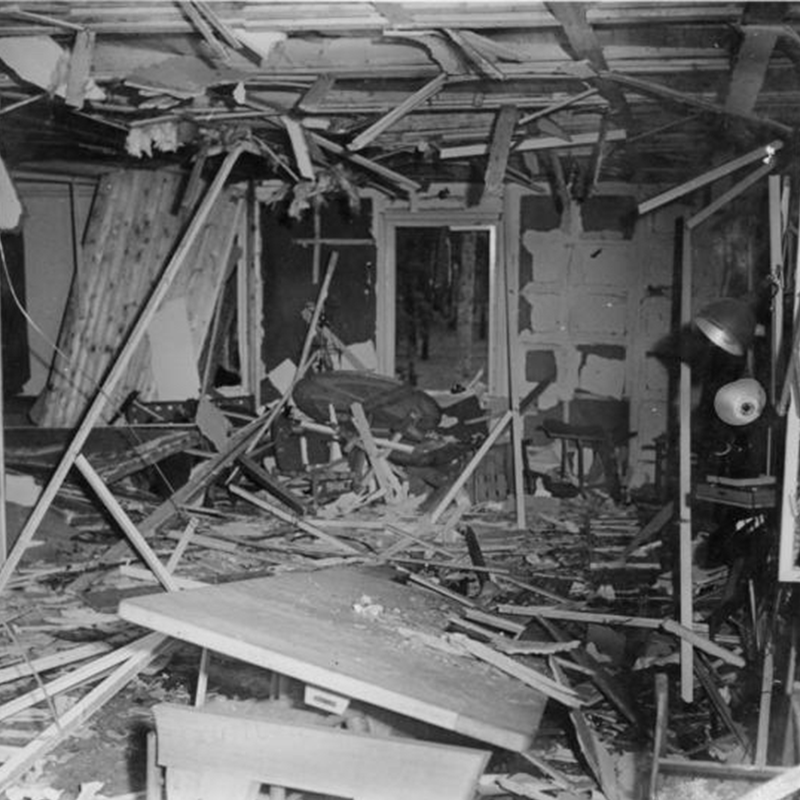
Interior of the destroyed briefing barracks after the assassination attempt of 20 July 1944
The question remains as to what goals the conspirators were striving for. Günther Weisenborn writes in the book „Der lautlose Aufstand“ (The Silent Uprising) that there was much discussion in resistance circles about the justification of the path taken by the conspirators of attempting a coup d’état from above instead of activating the opposition of the masses from below. There are a number of statements according to which various participants in the conspiracy were not interested in putting an end to the madness of war, but in seeking an arrangement with the Western Allies in order to mobilise forces there for the defeat of the Soviet Union. „The main motive for their actions,“ writes Allen W. Dulles in his book „Conspiracy in Germany“ on page 170, „is the ardent desire to prevent Central Europe from coming under Russian domination, ideologically and de facto.“ It continues: „In early May 1944, Gisevius received a plan from Berlin (…) The main content of the plan was that the anti-Nazi generals would clear the way for the American and British troops to occupy Germany and at the same time keep the Russians on the eastern front.“ Allen W. Dulles was director of the American secret service CIA; Hans Bernd Gisevius was the liaison officer of the resistance group around Colonel General Beck to the US secret service.
From the „Appeal to the German People“ intended for the press by Carl Friedrich Goerdeler, who was to take over the office of Reich Chancellor after Hitler’s removal, in the event that the assassination attempt was successful, it is clear that there was possibly not even any thought of an immediate withdrawal of German troops from the countries that had been unjustly invaded and occupied. The question of whether a general cessation of the war was planned also remains open in the appeal. It states: „Our first task will be to cleanse the war of its degenerations.“ It should be ensured „that, insofar as foreign territories still have to be occupied at present, full self-government is restored to those affected and the presence of German troops is made as little of a burden as possible.“
The aforementioned Franz Reuter writes on the foreign policy intentions of the conspirators of 20 July: „As far as the eminently important question of foreign policy was concerned, it was hoped for the most part to come to terms with the Anglo-Saxon powers first. At the same time, however, they also wanted to end the war in the East, except that they had more, albeit by no means exclusive, sympathy and opportunities for contact with the West… The former Roman ambassador von Hassel, son-in-law of Grand Admiral Tirpitz, who was considered for the post of foreign minister, was close to the West in his sentiments.“ The following sentence by Reuter suggests that various co-conspirators were thinking of a concept that differed only gradually from that of the Nazi government in terms of foreign policy. He writes: „I myself took the view early on that the impetus for a bold or unusual foreign policy should have come from someone other than von Hassel.“
Confirmation of the conspirators‘ intention to make a pact with the West and fight against the East can be found in the following statement by Reuter: „I myself took the view early on that a split between the Anglo-Saxon powers and Russia was never to be expected before the victorious conclusion of the war…“ Such speculation undoubtedly played a role among various members of the 20th July circle and encouraged them to think that they could turn the tide of the war with the help of Western tanks and cannons in a way that might have suited the ambitions of the generals, but not the interests of the people, who had been hard hit by the consequences of the past years of war.
That there were intentions of this kind does not, however, speak against those conspirators who honestly and with the utmost personal courage stood up for the interests of the people and showed bravery to the death. Among them were men who did not want to eliminate the forces of the people in the elimination of the Nazi regime and who – like Count Stauffenberg and Adam Trott – had connections to active resistance groups and were in favour of an alliance with them
After all that has become known about 20 July, it must be said that – based on the interests of the people and the ideals of the resistance movement – the forces that were effective or ineffective on that day united positive and negative elements. The events surrounding 20 July have gone down in history as an act of resistance against a barbaric regime and deserve to be honoured accordingly.
However, it would be wrong to regard this act as the only act of resistance worth mentioning. Long before the circle surrounding the 20th July recognised the need for defensive measures, resistance fighters had already stood up for the elimination of the Nazi regime. For the sake of historical truth, it must be said that these were primarily Communists and Social Democrats. Countless of them were barbarically murdered because of their fearless struggle. The tragedy of their sacrifice lies in the fact that they did not come together in time to act together.
Despite all reservations with regard to the 20th July, the surviving resistance fighters are resolutely opposed to belittling the merits of the positive forces of the 20th July and the resistance movement in general. Their reputation and honour must be defended against all those who are encouraged by political developments in the Federal Republic of Germany and the resurgence of militaristic forces to suspect them of being „traitors to the country“ and to question their noble motives. As for the attempts by the Inspector General of the Bundeswehr, Heusinger, to place himself in front of the men of 20 July, he would have done better to stand by them in 1944!
Author: Kurt Nelhiebel (www.kurt-nelhiebel.de) wrote this article in 1959 under the pseudonym Peter Nau.
Text source: Taken from the anti-fascist weekly newspaper DIE TAT from 18 July 1959.
Image source: Federal Archives, Image 146-1972-025-12 / CC-BY-SA 3.0, CC BY-SA 3.0 de