
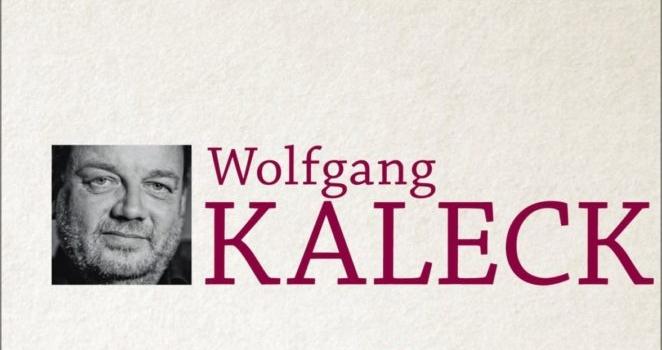
Autor/Autorin

Time and again, it is the insinuation of a „rather political-tactical relationship to the law“ (Christian Hillgruber, FAZ, 22 December 2015) that is used against those who are committed to human rights, regardless of their profession. The lawyer Wolfgang Kaleck is in excellent company in this respect. The lawyer and human rights campaigner Dr Fritz M. Bauer (1903-1968) has also been the target of such criticism to this day. However, he was no more „socialised to the left from the outset“ than Kaleck, of whom Hillgruber claims this. Bauer came from a middle-class family in Stuttgart and had to flee from the Nazis after being imprisoned in a concentration camp, while Kaleck’s family worked their way up in Munich in lower middle-class circumstances, his mother came from Transylvania, his father had to flee from the Red Army as a child with his mother and two siblings from what was then Königsberg and „was always caught between the changing front lines“ (26 f.).
It is therefore not „biographical irony“, as Hillgruber writes, when Kaleck, who was characterised by silence about the past in his childhood, becomes an advocate for human rights, making the punishment of right-wing extremist violence and the fight against state-sanctioned injustice his mission. It is also not a position on the left that does not exist in this form, unless you share the friend-foe thinking that Hillgruber – citing Carl Schmitt of all people – accuses Wolfgang Kaleck of, who studied Schmitt’s concepts of authoritarian statehood during his studies in Bonn.
In fact, Kaleck does not belong to any political party and writes that he has taken a position „between all stools“ as his own. This was already the case when he refused to do military service after a short time in the German army and then worked for the Malteser Hilfsdienst as a civilian service volunteer.
The budding lawyer was swept up in the political upheaval of the 1980s, in which the anti-nuclear and anti-war movements, the census boycott (1983) and the now long outdated vision of the Orwellian surveillance state politicised young people and triggered civil disobedience. During this time, Kaleck studied law and political science, demonstrated against the Nato Double-Track Decision in 1983 and against the 1985 World Economic Summit in Bonn, as well as against the US interventions in Central America. He saw himself as an internationalist, which is not unusual for human rights activists.
It was the human rights-orientated young people and students of the 1980s who developed an eye for global events and networks that were urgently needed worldwide in order to not only document the consequences of environmental destruction, wars and genocide, but to take effective action against them. To put it in the words of Wolfgang Kaleck, who moved to Berlin after completing his studies: the solidary observer who did his traineeship in Mexico City with a Guatemalan human rights organisation working in exile (p. 37) and met people there who, despite the high risks, stood up for a fairer society, became an active „participant in their struggle“ (p. 51).
After his second state examination, Kaleck founded a law firm in Berlin’s „House of Democracy“ together with Dieter Hummel and Volker Ratzmann. Their cases: Victims of racist and right-wing extremist violence; Kaleck travelled to Magdeburg alone over a hundred times for this purpose. He works as a defence lawyer in Warsaw, Athens and Barcelona, defending demonstrators from the anti-globalisation movements.
The decisive turning point came at the end of 1996 when Kaleck travelled to Uruguay, Chile, Brazil and Argentina on a private trip – Bruce Chatwin’s Patagonia stories had made an impression on him. He immersed himself in the South American landscape until he arrived in Buenos Aires a few weeks later. He would return here again and again. It was here that he received his first transnational mandate as a lawyer for Ellen Marx, whose daughter Nora was kidnapped by the Argentine military on 21 August 1976 and has since disappeared.
In Argentina, 20 years after the end of the military dictatorship, the lawyer campaigned for the repeal of the amnesty laws and filed a complaint against a German-Argentine representative of the Daimler-Benz group regarding the disappeared trade unionists – a story that was uncovered by the German-Argentine journalist Gaby Weber and publicised in a radio report.
Such cases, but also Baltasar Garzón’s investigations into the Chilean dictator Pinochet, against whom an international arrest warrant was issued in 1998 and who was then actually arrested in London, are what encourage Kaleck – although they do not always lead to success. He meets like-minded people, and the „nomad“ becomes a politically active lawyer and human rights advocate who examines the social causes of violence and terror.
In 2004, Kaleck met Michael Ratner and Peter Weiss from the Centre for Constitutional Rights (founded in 1966) in New York. Again, it was an encounter with consequences. Weiss – who, like Ellen Marx, had to flee from the Nazis – has written a piece of legal history: „He embodies a historical line that stretches from the destruction of the trusts that supported the Nazis in Germany, through the trials in Nuremberg, to the current practice of human rights organisations.“ (p. 101) Michael Ratner’s professional career is closely linked to the Vietnam War and the defence of victims of state violence. After the 9/11 attacks, the Centre, which Ratner and Weiss co-directed at the time, took on the task of defending those suspected of terrorism who were detained and mistreated in Guantánamo without charge or a court order.
In 2004, it was the torture methods used by the American armed forces in Abu Ghraib that led to the first personal meeting between the three lawyers. Ratner and Weiss read in an article about the International Criminal Code that came into force in Germany in 2002: „It sounds promising to them. It offers German prosecutors a wide range of options for taking action in war crimes cases.“ (p. 99) Kaleck is recommended to the two as a lawyer; they want to initiate investigations into the Abu Ghraib case, in Germany, in Europe. „I feel,“ writes Kaleck, „like an activist against torture who, together with American colleagues, is trying to bring those responsible to justice.“ (p. 105) Together they drafted the complaint against US Secretary of Defence D. Rumsfeld, which was published in Berlin on 30 November 2004.
Afterwards – Kaleck, Ratner and Weiss will file a second complaint against Rumsfeld, again without a positive result – Wolfgang Kaleck begins a new stage in his professional career.
The lawyer is now certain that he wants to set up his own organisation in Germany, „which can initiate and carry out legal initiatives to defend human rights worldwide, free from financial interests – just as the New York Center for Constitutional Rights has been doing for decades.“ (p. 171) In March 2007, Kaleck and his colleagues founded the European Centre for Constitutional and Human Rights (ECCHR) in Berlin – a work in progress.
The experience of failure helped, because for Kaleck it is linked to the certainty that there is no failure in the fight for human rights, because setbacks can also bring truths to light.
Fritz Bauer, the aforementioned Attorney General and advocate for victims and survivors in the Federal Republic of Germany, felt much the same way after the Holocaust and the Second World War. The Auschwitz trial initiated by him ended in 1965 with the deputy commandant of Auschwitz being convicted merely as an „accomplice“ and with him, with three acquittals, more than half of the 20 defendants. However, the trial brought the truth about Auschwitz to light.
This hope also plays an important role in Kaleck’s book, which repeatedly comes up against his own history: that the ECCHR will help many more victims and survivors find justice – or at least the truth.