
Autor/Autorin

Irmtrud Wojak
9 October 2021
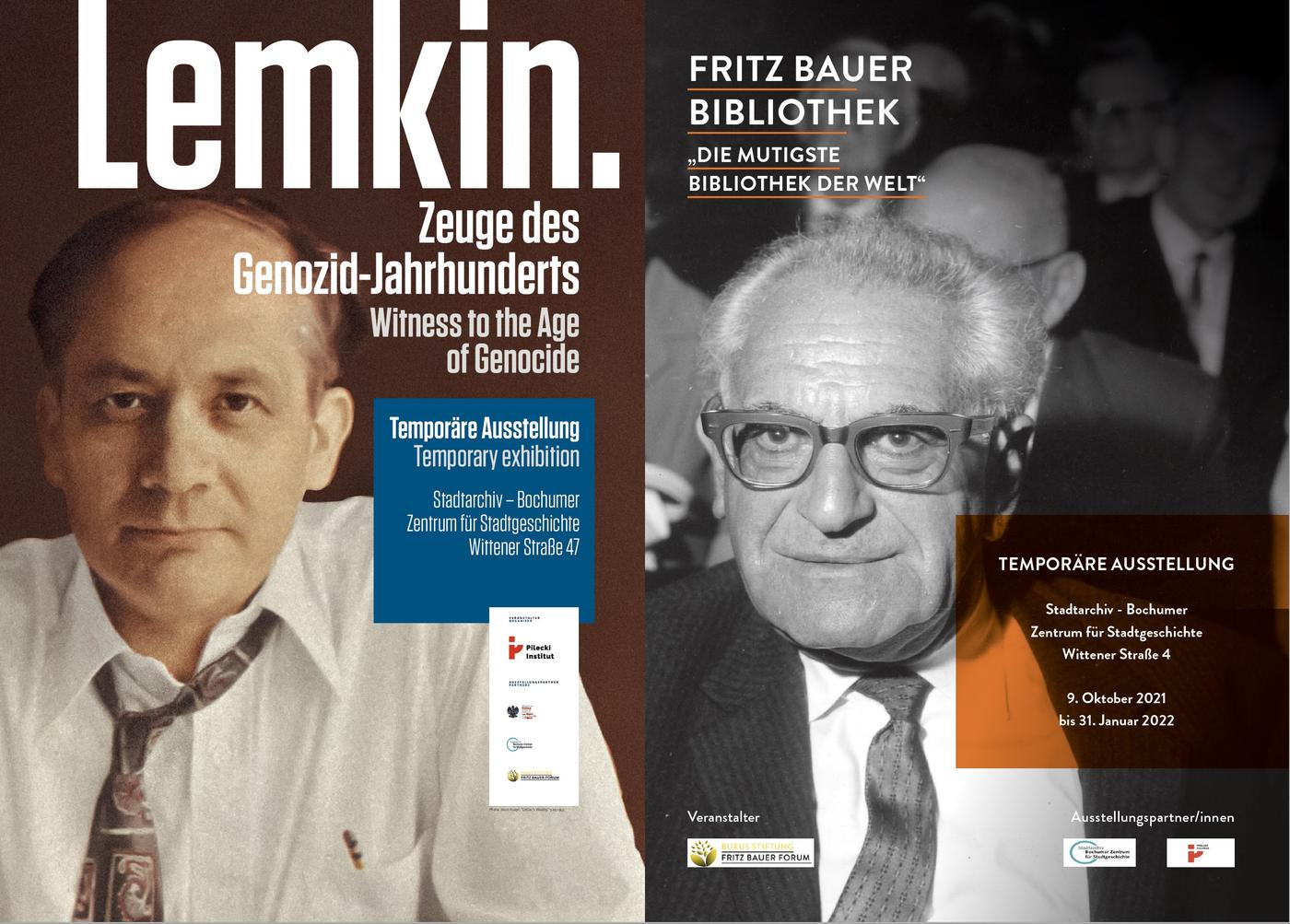
The exhibition can be seen until 31 January 2022 at the Stadtarchiv – Bochumer Zentrum für Stadtgeschichte, Wittener Straße 47.
When the Pilecki Institute invited the emerging Fritz Bauer Forum to collaborate last year, I already suspected that a joint project could emerge. Our conversation quickly turned to Raphael Lemkin and Fritz Bauer. We talked about the resistance of two lawyers against National Socialism. It was about their lives and the hopes of two courageous people who, in the face of an unprecedented crime, were committed to the further development of the law.
Fritz Bauer and Raphael Lemkin – both sought ways in which genocide could be prevented in the future.
There was and is a unifying idea here. The stories and the work of two extraordinary people, their commitment to international law and human rights, which form the starting point of our research work, have brought us together. And what could be more inspiring than the lives and hopes of two people like Lemkin and Bauer, who refused to be deterred and risked their lives for the cause of human rights. Both were Holocaust survivors and political exiles. The Polish citizen Raphael Lemkin (1900-1959) coined the term genocide based on his experiences and became the originator of the UN Genocide Convention. The German citizen Fritz Bauer (1903-1968) coined the term „unjust state“ for the Nazi regime. And he brought the Nazi judiciary and the crime of Auschwitz to justice in the Germany of failed denazification. In 1966, Bauer’s comprehensive article „Genocidium (Genocide)“ on the convention brought about by Raphael Lemkin, to which the Federal Republic of Germany acceded by law on 9 August 1954, appeared in the Handbuch der Kriminologie.
The special thing about Lemkin and Bauer, I think, is that they both acted „without a mandate“. „Ohne Auftrag“ is the title of Lemkin’s autobiography in German, which we published last year. „In the fight for human rights“, as Fritz Bauer in turn described his work in retrospect, the two extraordinary lawyers are united by their perpetual search for justice in the face of a crime that was still nameless at the time. Both contributed to changing and expanding our view of our own history.
This brings me to our exhibition here at the City Archive, one of which is the presentation of our planned Fritz Bauer Library, which in turn was the beginning of our Fritz Bauer Forum, which is currently being built in Bochum (we will also be hearing more about the Lemkin exhibition).
The Fritz Bauer Forum, with its Fritz Bauer Library, is intended to provide insights into how the lives of people who seek justice and consequently resist or have to resist differ from the lives of people who watch or observe but do not actively participate themselves.
The Fritz Bauer Library has a radically new approach. Its starting point is that it is one thing to remember and commemorate the victims and another to honour the resistance. With this approach, the Fritz Bauer Library is not just a data repository, but actively reaches out to people. It has something to do with their lives by addressing current issues that are directed at each and every individual:
What encourages people to stand up and raise their voices against injustice and violence, especially when most or even almost everyone remains silent and merely looks on?
What conditions do we need to create so that young people in particular do not conform and merely learn to obey, but rather develop the courage to put their humanity on the line? Especially when it comes to defending human rights, their own and those of other people.
The German culture of remembrance, with its collective negative memory developed over decades, is regarded as particularly exemplary. With regard to the hitherto unique crime of the Holocaust, it is internationally praised as a success story that serves as a role model for states in the transition phase after a dictatorship.
 Those who risked their lives „in the struggle for human rights“ are remembered as victims in this culture of remembrance. Their courageous resistance, on the other hand, is virtually absent from this historical image of the land of perpetrators and victims. Unconventional life paths such as that of Fritz Bauer are thus relativised. Unlike Raphael Lemkin in the film Watchers of the Sky or Martin Luther King Jr. in the film Selma , Fritz Bauer is accordingly portrayed in German books and films merely as a Nazi-hunting anti-hero, whereas in reality it should be about his extraordinary courage and fight for human rights.
In fact, it has become customary in the culture of remembrance to barely remember the resistance – with the exceptions of Claus Schenk Graf von Staufenberg, Hans and Sophie Scholl and perhaps Georg Elser on the anniversaries of their deaths. Accordingly, political resistance and the fight for human rights are even more rarely spoken about in public. Describing Fritz Bauer’s life as a courageous story of resistance and his actions as advocacy for human rights, on the other hand, is rejected as heroic and saintly historiography, as a „monumentalist“ view. (2)
According to a recent survey (2019), only 5.3% of respondents actually want resistance fighters from the National Socialist era to be commemorated, while 49.4% believe that „all victims“ or „victim groups“ should be commemorated. This deconcretisation of the groups of victims who were persecuted and resisted during National Socialism is also criticised in some cases. After German-German reunification in 1990, however, the historical image of perpetrators here and victims there became a much-praised success story in the Federal Republic. (3)
Only recently have more and more people in positions of responsibility realised that this „crime of remembering“ alone, which revives violence and thus also feelings of powerlessness and anger, can neither prevent the growth of racism and nationalism nor, as its flip side, anti-Semitism.
Nor can mere appeals to empathy and compassion for the victims and survivors of terror and violence protect our liberal values and democratic structures from erosion in the long term and secure them for the future. Young people who have grown up with the prevailing view of history since the 1990s – perpetrators and bystanders here, victims and survivors there – have lost touch with history to no small extent. How could it be otherwise when they are predominantly given the impression that no one could do anything about the injustice and the violation of human dignity and if someone did, then it was in vain. Or, to put it the other way round, anyone who did something against tyranny ultimately became a victim, either as a lonely and abandoned anti-hero – like Fritz Bauer, who is allegedly portrayed as a suicide right at the beginning of the film „The State against Fritz Bauer“ – or as a martyr, like Claus Schenk Graf von Stauffenberg, the siblings Hans and Sophie Scholl and Georg Elser, who paid for their resistance with their lives, which ultimately no one can be obliged to do.
Against this backdrop, the American psychologist Eva Fogelman quotes Rabbi Harold Schulweis with the incendiary question and answer: „What moral code says that evil can obscure good? What twisted logic leads us to erase the memory of what is noble in man in order to preserve the memory of his degeneracy? If we unearth the criminal outrages, we must by no means bury the virtues of humanity.“(4)
It can also be put this way: the history of crimes against humanity and genocide must not be forgotten, especially not that of their victims. But neither should the history of their struggle and resistance against human rights violations. The survivors‘ „Never again!“ is linked to the call to remember and also to the obligation to always fight against nationalism and, as its flipside, racism and anti-Semitism with all the means available in a democracy.
I am therefore pleased about the co-operation with the Pilecki Institute in the spirit of two pioneering jurists. The memory of their actions in favour of human rights creates a new capacity for action. Mutual recognition can lead to action, joint action based on human rights.
(1) Fritz Bauer, „Genocidium (Völkermord) (1952)“, in: The Humanity of the Legal Order. Selected Writings. Frankfurt am Main, New York: Campus, 1998, pp. 61-75.
(2) The historian Professor Norbert Frei, for example, criticised Ilona Ziok’s film „Fritz Bauer – Death in Instalments“, saying that it caused a furore because it insinuated that Bauer had „possibly died an unnatural death“. According to Frei, „activists of the much-vaunted civil society“ stylised a courageous public prosecutor as a „lonely hero (…) with whose fight for the prosecution of Nazi crimes one can identify.“ See N. Frei, „Fritz Bauer or: When does a hero become a hero?“, in: Gerber, Stefan et al. (eds.), Zwischen Stadt, Staat und Nation. Citizenship in Germany. Göttingen: Vandenhoeck & Ruprecht, 273-279, here p. 275. Bauer „hagiography“ outraged above all the former archivist of the Fritz Bauer Institute Werner Renz; cf. the review of publications by Renz‘, who, due to a lack of historical source criticism, has already put numerous misinterpretations of Bauer into the world, by Irmtrud Wojak, „Fritz Bauer als Antiheld“, in: Forschungsjournal Soziale Bewegungen 28. Jg. (2015) H. 4, p. 377 f.
(3) Rees, J., Zick, A., Papendick, M., Wäschle, F., Multidimensional Memory Monitor (MEMO) II/2019 . Bielefeld: Institute for Interdisciplinary Research on Conflict and Violence (IKG), Bielefeld University, 2019, p. 12.
(4) Eva Fogelman, Conscience and Courage: Rescuers of Jews During the Holocaust. New York: Random House, 1995, p. 12.