
Autor/Autorin
YIRGALEM FISSEHA, SAMSON SOLOMON, BETHLEHEM ISAAK and MERON ESTEFANOS are continuing their parents‘ and grandparents‘ decades-long fight for freedom and democracy in Eritrea. They are consciously using peaceful means to do so. We spoke to them for the Fritz Bauer Blog and begin the series with the
Isaias Afwerki has ruled Eritrea since the country was founded in 1993. Afwerki is a former military commander and political commissar of the Eritrean Liberation Front (ELF, later Eritrean Peoples‘ Liberation Front, EPLF), which led the struggle for Eritrea’s independence from Ethiopia. At that time, there was great hope that Eritrea would introduce a democratic system of government. In 1996, the Eritrean government passed a so-called Press Proclamation Law, which allowed the private ownership of print media?
In the 1990s, however, Afwerki’s rule became increasingly autocratic. In 1997, the Eritrean National Assembly ratified Eritrea’s constitution, but it was never officially implemented. In early 2001, a group of prominent Eritrean politicians and government ministers publicly criticised and expressed concern about the way President Afwerki was ruling the country. This group later becomes known as the „G-15 „. In a series of open letters, they call for elections to be held as promised and for the constitution to come into force. They also express their great concern about the ongoing border war with Ethiopia. Despite threats and growing risks to their own security, journalists regularly report on these demands in the Eritrean media.
On 18 September 2001, the Eritrean authorities order the closure of eight private newspapers. These include the weekly newspapers Meqaleh, Setit, Tsigenay, Zemen, Wintana and Admas. This was followed by mass arrests of journalists and members of the government, which lasted for years.
For almost twenty years now, Eritrea has been one of the most repressive regimes in the world. An entire generation of Eritrea’s intellectual elite has been brutally and systematically wiped out – lawyers, journalists, politicians, engineers, IT specialists, doctors and artists. The world has paid little attention to these serious crimes.

Thousands of Eritreans have fled their homeland. Those who remain are obliged to perform indefinite, compulsory national service, which is poorly paid and offers virtually no opportunities for advancement. Freedom of expression and assembly, the right to vote and other civil rights have been completely abolished. Although an electoral law was passed in 2002, official elections are never held. Eritreans are subject to arbitrary arrest and long periods of detention without charge, trial or access to effective legal representation to challenge these violations of their fundamental rights.
Contribution and interviews: Susanne Berger (Washington D.C., USA)
Film: Jakob Gatzka (Vierkirchen, Germany)
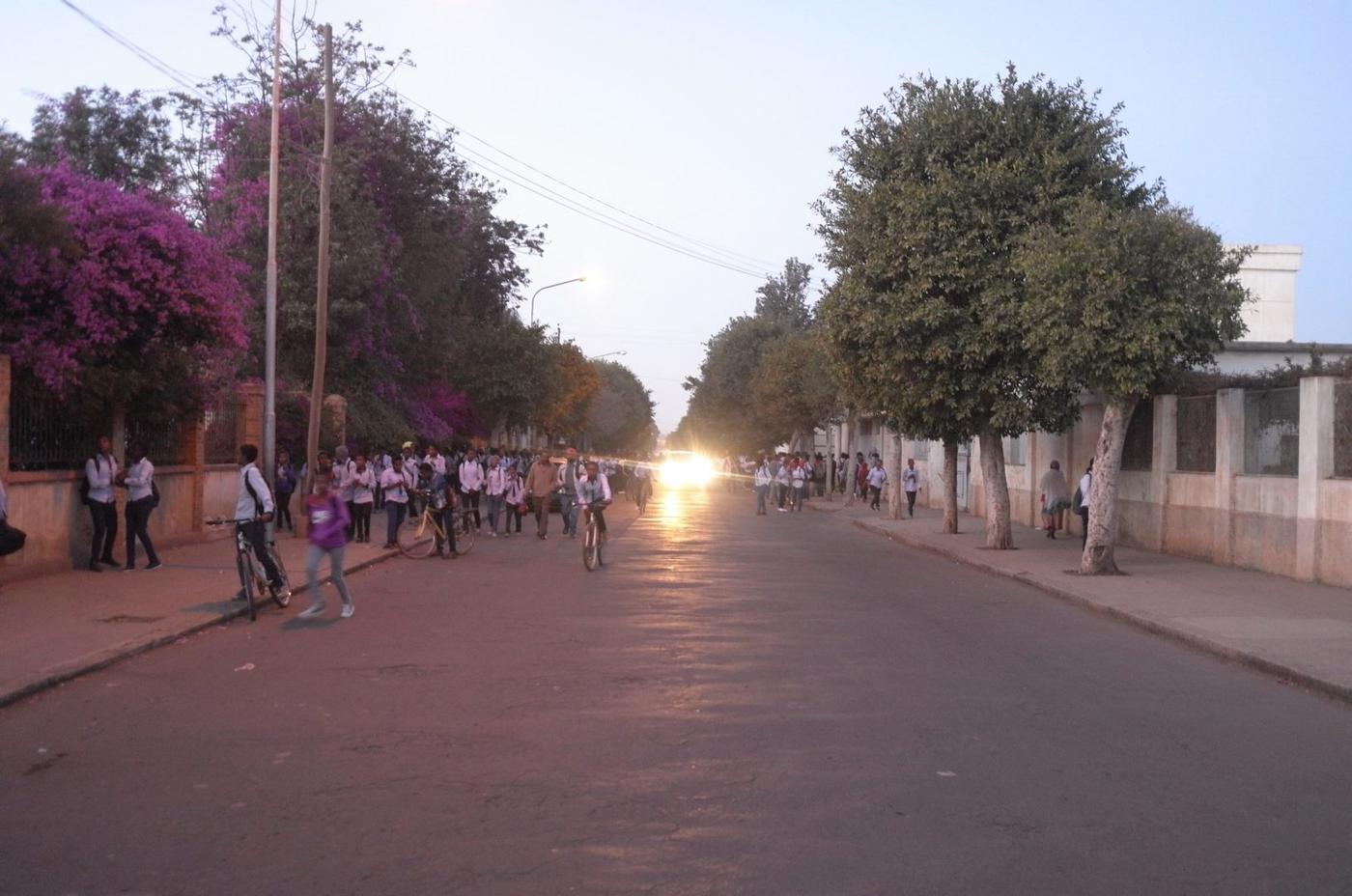
Photo: Header image Martin Schibbye , Future of Eritrea, Students going home from school in Asmara, Eritrea
Ogbe Abraha – General, former Commander-in-Chief of the Eritrean Defence Forces, then Minister of Foreign Trade and Security. He later served as Minister of Social Affairs.
Dawit Isaak – Swedish-Eritrean journalist and author. Co-founder of the newspaper Setit , which published the open letter of the „G-15“ in 2001. Isaak has been in prison for 18 years without charge or trial. He has been denied any legal assistance or medical care. He has no contact with the outside world, neither with his family nor with representatives of the Swedish embassy. Dawit Isaak, a citizen of the EU, is now one of the longest imprisoned journalists in the world.
Seyoum Tsehaye – journalist and co-founder of Eritrea’s first state television and radio station. He has been imprisoned for 18 years without charge or trial and without contact with the outside world.
Petros Solomon – Eritrea’s former Minister of Defence and later Minister of Foreign Affairs (1994-1997) was arrested in 2001.
Aster Yohannes – Petros Solomon’s wife was arrested at Asmara airport on her return to Eritrea in December 2003. She had previously been assured by officials that she was in no danger. Aster and Petros Solomon’s four children have been living in exile ever since.
Haile Woldensae – Petros Solomon’s successor as Foreign Minister. He allegedly died in prison.
Solomon Habtom – Director of Telecommunications. He died in 2017 in Carcheli prison in Asmara, after 14 years in prison. He had had no contact with his family since 2003.
Ciham Ali Ahmed – the then fifteen-year-old was arrested in December 2012. There has been no trace of her since then. Chiam Ali has both Eritrean and American citizenship.
In November 2003, the African Commission on Human Rights ruled that the members of the G-15 were being held in arbitrary and unlawful detention. The Commission called on the Eritrean government to release and compensate all those arrested. The Eritrean government ignored the judgement.
Report by Daniela Kravetz, UN Special Rapporteur for Eritrea, March 2020
Response from Tesfamicael Gerfahtu, Eritrea’s Ambassador to the UN, March 2020
Quote: „YAKIL! – Enough is enough! – The call of a new generation of young Eritreans. Interviews with Yirgalem Fisseha, Samson Salomon and Bethlehem Isaak by Susanne Berger (Washington D.C.)“, in: Fritz Bauer Blog, 11 March 2020, URL: https://www.fritz-bauer-blog.de/de/startseite/aktuell/yakil-es-reicht-uns-der-ruf-einer-neuen-generation-junger-eritreer