
Autor/Autorin

 The dossier is published to coincide with the publication of the book by Emma Sepúlveda Pulvirenti, Erinnerungen von Ilse an Colonia Dignidad . Bochum: BUXUS EDITION , 2024, 230 pages, ISBN 978-3-949379-17-8 (19.00 euros).
BUXUS EDITION is publishing Emma Sepúlveda Pulvirenti’s book and the Fritz Bauer Forum is publishing the accompanying dossier in order to strengthen a culture of remembrance that sees survivors as more than just passive objects of history. The human rights organisation Asociación por la Memoria y Derechos Humanos Colonia Dignidad is also calling for this. (1) The president of the Asociación told the Frankfurter Rundschau newspaper in August 2024 that in „Germany, victims are usually assigned a passive role“, while organisations like hers insist „that the victims of human rights violations actively fought against the situation“. Karen Cea emphasises: „Our culture of remembrance also includes an appreciation of resistance to human rights violations.“ (2)
Emma Sepúlveda Pulvirenti’s novel is such an appreciation of the resistance struggle of a victim or survivor of Colonia Dignidad, without romanticising this resistance struggle. The fact that the victims also became perpetrators in a „closed totalitarian group“ (Jan Stehle) with a religious organisation is part of the infamy of history. The National Socialist policy of extermination and the Holocaust in particular are the most terrible examples of such a crime. Emma Sepúlveda Pulvirenti does not ignore this infamy but, on the contrary, makes it painfully comprehensible in all its ambivalence in her narrative.
Emma Sepúlveda Pulvirenti is a historian who studied history at the University of Chile and graduated in the United States, where she has spent most of her professional career. Among other things, she worked in the Nevada print media for seventeen years and was the first Latina to run for the Nevada Senate in 1994. The author of more than thirty books, including the award-winning Setenta días de noche , she has been honoured with several awards for her literary work and her advocacy for Latino rights in the United States, including the Latino Book Award , the Thorton Peace Prize and the GEMS Woman of the Year in Literature . She is Professor Emeritus at the University of Nevada, Reno, where she founded the Centre for Latino Studies .
Writer, politician and journalist Emma Sepúlveda Pulvirenti spent many years researching for her novel Ilse’s Memories of Colonia Dignidad , transforming reality into a fictionalised reality that captivates her readers. The memories of a young woman (Ilse), who has to spend part of her youth in Colonia Dignidad and witnesses, but above all experiences first-hand, how the victims can be turned into perpetrators, are hard to bear.
How can a young person free themselves from addiction, what forces help Ilse not to surrender to the terror, does she get help? The book tells the open and unsparing story of a young woman who experiences one of the most sinister periods of Chilean and German history and who learns to free herself. The story complements the previously published survival stories of refugees from Colonia Dignidad.
We have created a glossary for the book (PDF) to help readers who have not yet familiarised themselves with the history of Colonia Dignidad or only know it from hearsay as a „religious sect“ or „Nazi settlement“ – neither of which is true. In it you will find brief explanations of people, terms and places that the author Emma Sepúlveda Pulvirenti discusses in her book.
Click here for the glossary of the book by Emma Sepúlveda Pulvirenti (PDF) . It was compiled by Dr Mathias Sasse, who translated the novel by Emma Sepúlveda Pulvirenti.
Colonia Dignidad in Chile was founded in 1961 around 350 kilometres south of the capital Santiago – in an idyllic location at the foot of the Andes – by the evangelical pastor Paul Schäfer and was inhabited and run by around 300 German „settlers“. Schäfer (*1921 – †2010), a sadist, rapist and criminal wanted by the judiciary for child abuse, had fled to Chile. He created and shaped the self-contained hierarchical terror system of Colonia Dignidad until his escape to Argentina in 1996 and his arrest in 2005. His reign of violence still determines life in the colony to this day, as there are still „colonos“ (as the residents call themselves) living here who have not renounced the system and are severely traumatised.
Under the Chilean military dictatorship led by General Augusto Pinochet, who seized power in 1973 by betraying the government of President Dr Salvador Allende, Paul Schäfer, together with his leadership clique and followers as well as the guards in Colonia Dignidad, served as a central torture centre. The Chilean secret service (DINA) had been in and out of Colonia Dignidad since 1973 and it served as one of the most important torture and killing camps of the violent regime.
Politically persecuted people „disappeared“ here forever, their mass graves have still not been found, let alone the identity of all those murdered in the colony. Not even after Colonia Dignidad was officially dissolved in 1994 and Schäfer was convicted several times in Chile for violent crimes. The number of people murdered in the colony is estimated at over a hundred, and the number of those tortured at several hundred. Relatives of the „arrested and disappeared“ continue to demonstrate regularly in front of the Colonia Dignidad site and today’s Villa Baviera.
Meanwhile, the hotel built on the site and the stylishly furnished Bavarian restaurant attract numerous tourists, even after the entire residential area was placed under a preservation order by the state. The future of the site is uncertain, whether it will ever become a memorial site is highly questionable, and the ownership situation is still unclear, which means additional uncertainty for the current residents. Some apparently remain there because they do not want to give up their property and expect compensation from the colony’s management group.
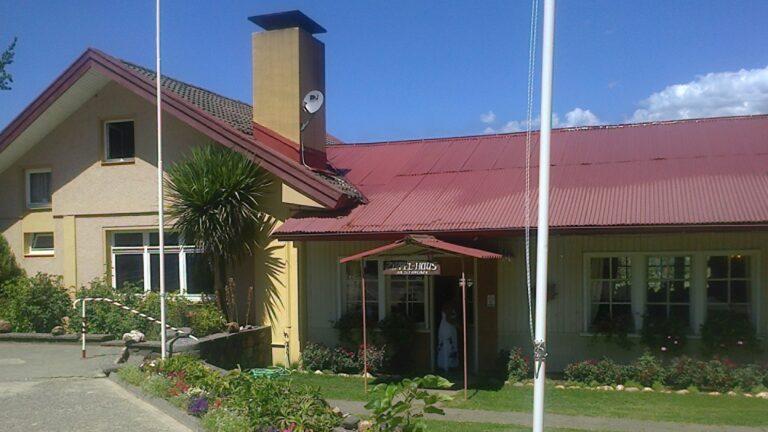
From Xarucoponce, Restorán anexo al Hotel de Villa Baviera
Over the last twenty years, extensive academic research from various disciplines has been published on the history of Colonia Dignidad, especially in recent times. In the meantime, around 25 books have been published about the crime scene and the functioning of the terror system that prevailed there. For decades, human rights activists and journalists had been drawing attention to the many crimes committed in the colony since the early 1960s, especially against women and children (boys and girls). These crimes included paedocriminal acts, rape, abductions, forced labour, beatings and sexualised violence on a daily basis, both gender-specific and cross-gender.
In addition to the civil society engagement and associated publications that were crucial for clarifying the history and dealing with it, reports and testimonies from group members who had fled also appeared. For years, however, they were just as unable to break the silence that was practised by the authorities, particularly in Germany, towards the group that had emigrated to Chile, where sexualised violence, torture and indoctrination were the order of the day. The Chilean victims who were tortured and murdered in Colonia Dignidad during the military dictatorship were almost completely ignored by the German authorities.
The more recent and most recent publications in particular provide important new impetus for further in-depth research. The oral history archives that now exist with interviews with victims and survivors (and more rarely with perpetrators) have not yet been exhaustively analysed. Many archive sources, which are widely scattered and can be found in private archives in particular, will probably also become accessible. The files in the Federal Foreign Office have also not yet been fully analysed and released.
Anyone wishing to find out more about the history of the Colonia can do so in detail using the latest publications. Here are a few pointers:
– The most recent publication is the anthology edited by Stefan Rinke, Philipp Kandler and Dorothee Wein, Colonia Dignidad. New Debates and Interdisciplinary Perspectives . Frankfurt am Main: Campus-Verlag 2023.
The volume contains starting points from a psychological perspective as well as classifications in sect research and in the study of resistance. It summarises the state of recent research, especially as the main participants in the uncovering of the crimes in Colonia Dignidad are brought together in this volume.
The editors (Prof Rinke) and research assistants have set up an oral history archive at the FU Berlin entitled: „Colonia Dignidad. A Chilean-German Oral History Project“. The archive is open to the public and is partially analysed in the current anthology. See the website of the project with further text contributions: https://www.cdoh.net/
The website states the following about the project: „As part of the project, 64 life history interviews were conducted with residents, political prisoners, relatives, Chilean boys against whom Paul Schäfer committed sexual violence and other contemporary witnesses. The German and Spanish-language video interviews were transcribed, translated and scientifically edited. The interviews are available in an online archive in a protected environment.“
Issue 04/2024 of the journal for biographical research, oral history and life course analyses BIOS contains an article by project team member Dorothee Wein (FU Berlin) on the interview archive and the context in which it was created, specifically examining the question of how the archive and its interviews themselves became an actor in the examination of history.
– Dorothee Wein, „Colonia Dignidad told from today. A Chilean-German oral history archive as a polyphonic resonance chamber“, in: BIOS Journal for Biographical Research, Oral History and Life Course Analyses , 2/2022 (published 04/2024), pp.138-163. DOI: https://doi.org/10.3224/bios.v35i2.02
In September 2021, a study of women’s protocols from Colonia Dignidad was completed; it has since been published in a second edition in 2022 under the title Lasst uns reden (Let’s talk) and provides detailed information about the lives of women in Colonia Dignidad for the first time. This is of particular interest because the colony continues to be associated primarily with the sexual abuse of boys, while the experiences of girls and women have long been ignored.
The author Heike Rittel, a teacher by profession, visited Colonia Dignidad for the first time in 2012 and then returned again and again to live and speak with the female victims. Co-author is Jürgen Karwelat, who had already worked on the Amnesty International brochure published in 1977, which for the first time informed a wider public about the events at the site and did not omit the collaboration with the secret service.
– Amnesty International (ed.), Colonia Dignidad: German model estate in Chile – a DINA torture camp. Frankfurt am Main 1977.
– Heike Ritter and Jürgen Karwelat, Let’s talk. Women’s protocols from Colonia Dignidad. With photographs by Andreas Höfer. 2nd ed., Stuttgart (Schmetterling Verlag) 2022, ISBN 3-89657-034-x.
The volume also contains a very readable introduction and a „timeline of history“, explanations of terms and an index of people, which are helpful additions to accompany the individual stories, which were not recorded in interview form but as narratives.
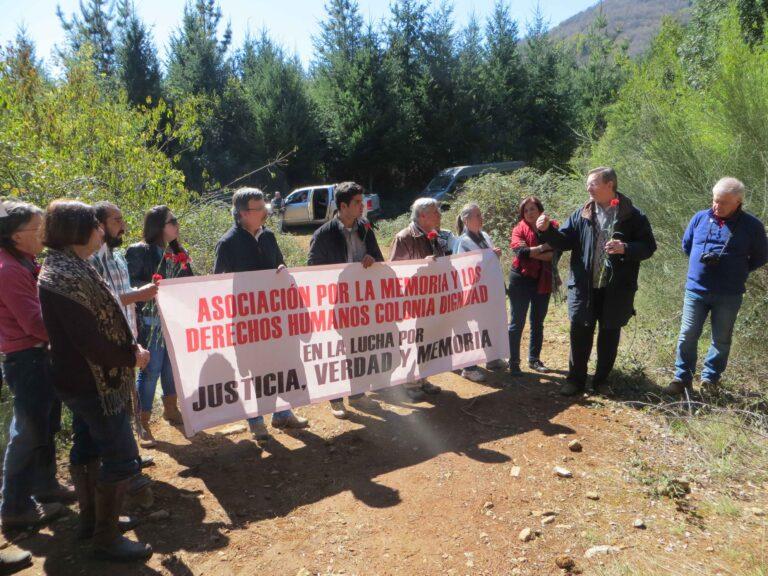
By Zazil-Ha Troncoso 2: Integrantes de la Asociación por la Memoria y los Derechos Humanos Colonia Dignidad hicieron un homenaje en las fosas donde fueron inhumados y exhumados ilegalmente los cuerpos de los detenidos desaparecidos en Colonia Dignidad durante la dictadura de Augusto Pinochet en Chile.
Unlike in Chile, the legal debate about the crimes committed in Colonia Dignidad is a blank space in Germany. It is a story of failure and looking the other way that has dragged on for decades. Although the journalist Dieter Maier, Amnesty International and other human rights activists and publicists repeatedly drew attention to the case and human rights lawyers repeatedly filed complaints, no convictions were ever handed down. In fact, Paul Schäfer and his team managed to turn the tables from the very beginning and turn the accusers into defendants, as in the case of the Amnesty International brochure. Colonia Dignidad employed entire teams of lawyers to prevent the investigation.
Jan Stehle, a political scientist at the Research and Documentation Centre Chile-Latin America (FDCL) in Berlin, who has been researching and publishing on the Colonia Dignidad case for years, investigated in particular the question of the German authorities‘ shared responsibility for the human rights violations in his dissertation and comprehensively analysed primary sources for his book. He comes to the conclusion that the authorities covered up the crimes and thus supported the criminal behaviour, so that in the end not hundreds but thousands of people were harmed. Above all, Jan Stehle criticises the judiciary in North Rhine-Westphalia for never having conducted an adequate investigation:
„Even at the end of the 1980s, when more critical tones and demands for clarification of the crimes were heard even from the AA (=Foreign Office, ed.), and even in the 2010s, when extensive investigations and judgements by the Chilean judiciary were available, decisive actors in the NRW judiciary remained largely inactive or supported existing patterns of argumentation. In any case, at no time did the judiciary in North Rhine-Westphalia research and investigate actively enough to even begin to scrutinise the connections and background of the CD system. It closed all investigations without bringing charges. From a legal point of view, the CD crimes still do not exist in Germany today, at least officially there are no perpetrators. Without the judgements of the Chilean judiciary, there would still be no official recognition of the CD crimes as confirmed facts.“
Jan Stehle, The Case of Colonia Dignidad. Zum Umgang bundesdeutscher Außenpolitik und Justiz mit Menschenrechtsverletzungen 1961-2020 . Bielefeld (transcript) 2021. The book is thankfully available as an e-book edition (open access): https://www.transcript-verlag.de/author/stehle-jan-320027450/)
The study concludes with five points, all of which call for a fundamental reappraisal of the Colonia Dignidad case from the perspective of the victims and survivors. Jan Stehle proposes a truth commission, calls for the disclosure of all sources regardless of state interests, adequate compensation for the victims, a legal approach to Colonia Dignidad as a criminal organisation and the establishment of a memorial and documentation centre when the remaining power structures from the Colonia Dignidad era are dissolved, i.e. also the clarification of the financial circumstances (p. 612f.).
A particularly revealing testimony to the systematic repression during the Pinochet dictatorship fell into the hands of the Chilean police in 2000 when they were searching for weapons: the Colonia Dignidad index card archive . It consists of 45,000 index cards and other documents, which the German scholar and Protestant theologian Dieter Maier analysed together with the Chilean journalist Luis Narváez with the help of a database. The index cards, which were initially kept under lock and key and became known in 2014 through Narváez’s television film Las fichas del Horror , are now accessible in the National Archives in Santiago de Chile on the initiative of the Asociación por la Memoria y Derechos Humanes Colonia Dignidad ; the database can be accessed online at: www.fichas-chile.com.
Dieter Maier (who also wrote about Colonia Dignidad under the pseudonym Paul Heller and published a biography of Pinochet) describes the purpose of the archive, which Dr Gerd Seewald created for Paul Schäfer and which was kept in Spanish, as a „ service“ of Colonia Dignidad, which was of central importance to the dictatorship and the secret service DINA. The index card archive covers the years 1973-1990 and primarily concerns the Chileans who were forcibly „ disappeared“. However, it also provides information about the terror system within Colonia Dignidad, the people involved and how it functioned.
Dieter Maier and Luis Narvaéz, Kartei des Terrors. Notes on the inner workings of the Chilean military dictatorship (1973-1990) from Colonia Dignidad. Stuttgart: Schmetterling Verlag, 2022.
In her dissertation, Meike Dreckmann-Nielen (cultural scientist and historian) deals with the topic of „ remembering and forgetting „ the crimes committed in Colonia Dignidad and the view of the traumatised survivors on this topic and has worked out the dynamics of memory culture in detail and after extensive research at the site itself. Above all, the Schäfer system’s maxim of forgiveness for sins, which she uncovers, explains the conflicts that still exist today regarding an open confrontation with the violent crimes committed in the colony. Virtually everyone has become a perpetrator in the system, but due to the prevailing religious promise of redemption and salvation, people are constantly „forgiving and forgetting“ each other in order to escape hell. This maxim of forgiveness, practised over many years, has led to a spiral of silence within the colony, which includes the forced disappearances during the military dictatorship in Chile. Silence means that there are no witnesses to speak and reveal the truth.
The system of a self-contained criminal organisation, whose numerous crimes would have to be legally clarified, is reflected in the debates on the culture of memory and continues to this day in a struggle for interpretative sovereignty and victim identities that is very difficult to break through. M. Dreckmann-Nielen emphasises that even if a legal ruling were to be made, this would not mean that it would be recognised by the residents, who continue to move in the spiral of silence of the maxim of forgiveness.
To encourage open dialogue, Meike Dreckmann-Nielen has launched a blog on the Internet:
Colonia Dignidad Public History Blog (CDPHB) : The blog sees itself as a platform for information, networking and discussion on the history of Colonia Dignidad and aims to bring research and the interested public closer together. It was created to accompany Meike Dreckmann-Nielen’s dissertation, as part of which she investigated the culture of remembrance/historical culture of Colonia Dignidad (although the blog hardly seems to be updated any more).
(1) See about the human rights organisation: https://www.coloniadignidad.cl/quienes-somos/
(2) Quote from the Frankfurter Rundschau , 11 August 2024: https://www.fr.de/politik/colonia-dignidad-die-zukunft-der-foltersekte-93232568.html
Britta Buchholz: It stays in the family. In: Die Zeit , 28 April 2005 (with paywall).
Meike Dreckmann-Nielen, The Colonia Dignidad between remembering and forgetting. On the culture of remembrance in the former settlement community . Bielefeld: Transcript Verlag, 2022, ISBN 978-3-8376-6213-9 (transcript-verlag.de – Open Access as PDF).
Annette Ende, Enslaved in the name of God. Children in the hell of Colonia Dignidad. Abused, tortured, murdered, buried. Radeberg: DeBehr, 2023, ISBN 978-3-987-27110-6.
Ulla Fröhling, Our stolen life. The true story of love and hope in a cruel sect. Cologne: Bastei Lübbe, 2012, ISBN 978-3-404-61660-2.
Gero Gemballa, Colonia Dignidad. A German camp in Chile . Reinbek near Hamburg: Rowohlt, 1988, ISBN 3-499-12415-7.
Gero Gemballa, Colonia Dignidad. A reporter on the trail of a German scandal . Frankfurt am Main / New York: Campus, 1998, ISBN 3-593-35922-7.
Christoph Gunkel, Victims of Colonia Dignidad, „Das waren wahnsinnige Schreie“, annotated photo series, Der Spiegel , 15 February 2016.
Friedrich Paul Heller (Dieter Maier), Colonia Dignidad. From psycho-sect to torture camp . Stuttgart: Schmetterling, 1993, ISBN 3-926369-99-X.
Friedrich Paul Heller (Dieter Maier), Lederhosen, Dutt und Giftgas. The background to Colonia Dignidad . Stuttgart: Schmetterling, 2006 (4th, expanded and updated edition 2011), ISBN 978-3-89657-096-3.
Ute Löhning, Victims of Colonia Dignidad – Versklavt, verarmt, vergessen? , Deutschlandfunk – Hintergrund from 12 April 2017.
Ute Löhning, Bundesregierung muss Konzept vorlegen – Schwierige Aufarbeitung der Colonia Dignidad-Verbrechen , Deutschlandfunk – Hintergrund from 28 June 2018.
Dieter Maier, Colonia Dignidad. On the trail of a German crime in Chile. Stuttgart, Schmetterling, 2016, ISBN 3-89657-098-6.
Dieter Maier / Luis Narváez, Kartei des Terrors: Notizen zum Innenleben der chilenischen Militärdiktatur (1973-1990) aus der Colonia Dignidad . Stuttgart: Schmetterling, 2022, ISBN 3-89657-045-5.
Dietmar Pieper and Helene Zuber: The pistol was always at hand. In: Der Spiegel 3, 10 August 1997.
Stefan Rinke, Philipp Kandler, Dorothee Wein (eds.), Colonia Dignidad. New Debates and Interdisciplinary Perspectives. Frankfurt am Main: Campus, 2023, ISBN 978-3-593-51583-0.
Horst Rückert, The Blendwerk. From Colonia Dignidad to Villa Baviera. Munich: A1 Verlag, 2014, ISBN 978-3-940666-56-7.
Klaus Schnellenkamp, Born in the Shadow of Fear. I survived the Colonia Dignidad . Munich: Herbig, 2007, ISBN 978-3-7766-2505-9.
Julio Segador, The former Colonia Dignidad in Chile – From torture centre to holiday paradise , Deutschlandfunk – Background from 19 January 2016.
Jan Stehle, Colonia Dignidad. Zum Umgang bundesdeutscher Außenpolitik und Justiz mit Menschenrechtsverletzungen 1961-2020. Bielefeld: Transcript Verlag, 2021, ISBN 978-3-8376-5871-2 (transcript-verlag.de – Open Access as PDF or EPUB).
Efrain Vedder/ Ingo Lenz, Away from Life. 36 Years of Imprisonment in the German Sect Colonia Dignidad . Berlin: Ullstein, 2005, ISBN 3-550-07613-4.
Klaus H. Walter, Colonia Dignidad – die unendliche Geschichte, in: Jahrbuch Menschenrechte 2007 . Frankfurt am Main: Suhrkamp, 2006, ISBN 978-3-518-45817-4, pp. 183-188.
Final Report of the Valech Commission on Torture in Chile (Spanish), especially p. 351 of 24 August 2009 in the Internet Archive.
Minutes of a 1988 Bundestag hearing on human rights violations and deprivation of liberty: Colonia Dignidad – Villa Baviera, Bundestag Minutes No. 10, 22 February 1988, Subcommittee on Human Rights.
2009: German Souls – Life after Colonia Dignidad , by Martin Farkas and Matthias Zuber
2020: Colonia Dignidad – From the inside of a German sect , miniseries by Annette Baumeister and Wilfried Huismann, 2×89 min, Arte-Mediathek
2016: Colonia Dignidad – Es gibt kein Zurück (Official website of the film), feature film by Florian Gallenberger with Emma Watson and Daniel Brühl
2018: La Casa Lobo , feature film by Cristóbal León and Joaquín Cociña
2019: Dignity , TV series by the German streaming platform Joyn and the Chilean TV channel Mega
2021: Un lugar llamado Dignidad , feature film by Matías Rojas Valencia with Hanns Zischler