
Autor/Autorin
The war in Darfur, a region in western Sudan consisting of three federal states, has now been going on for fifteen years. In the conflict between the Sudanese central government in Khartoum and various ethnic groups in the Darfur region, which has been ongoing since 2003, Sudanese government troops, supported by local Arab militias, killed around 400,000 people by 2016. Thousands of women and girls were raped.
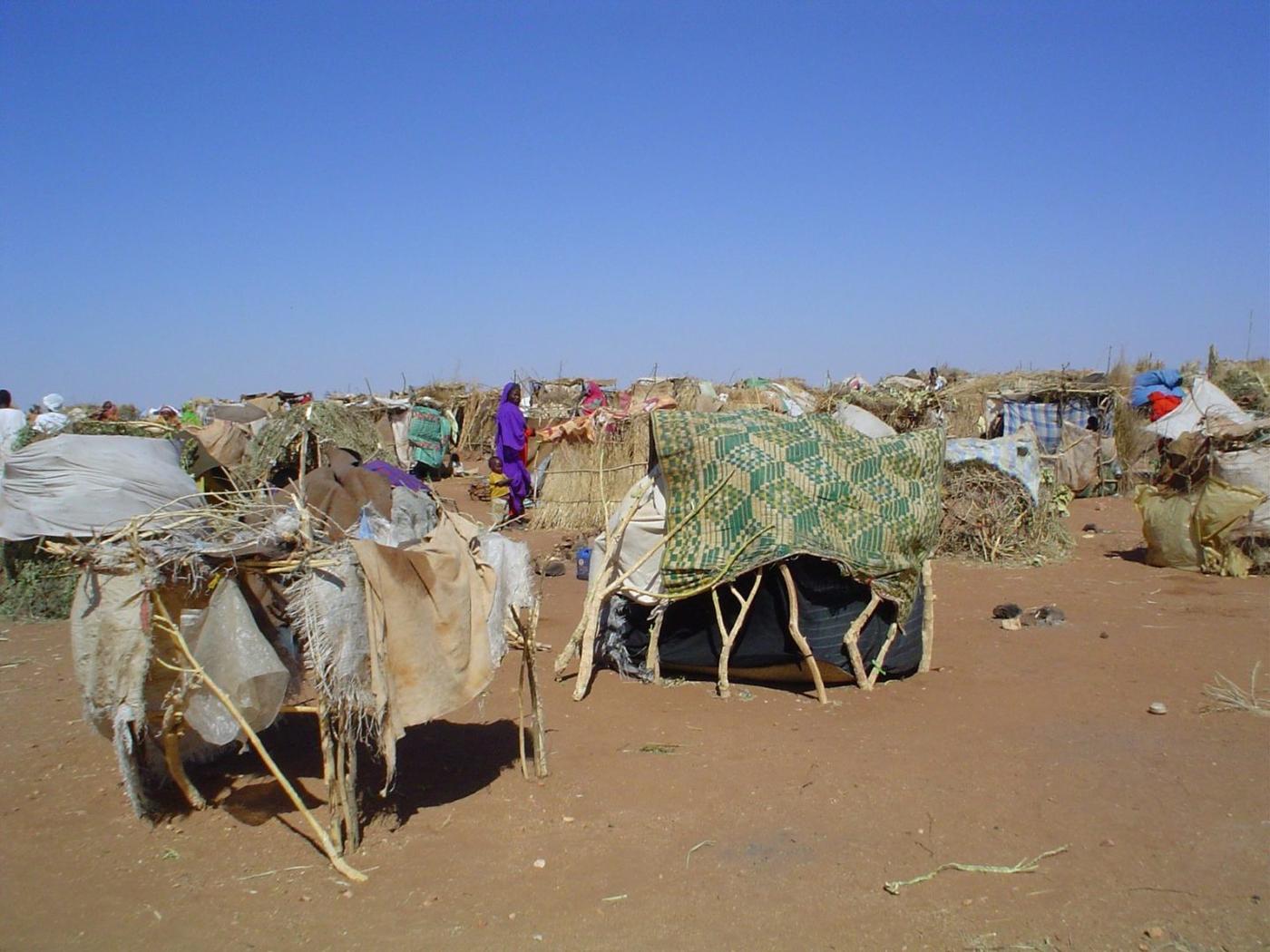
In January 2007, around two million internally displaced people were living in camps in Darfur, and at least 230,000 people had fled to neighbouring Chad. According to the United Nations, a further two million people are directly affected by the conflict, as the regional infrastructure has been destroyed and agriculture, trade and markets have been severely affected.
Although the civil war has been waged with less intensity for several years, a peace solution is not in sight. The international community is increasingly withdrawing from the conflict. For some years now, the United Nations, the European Union and the Federal Republic of Germany have been increasingly focussing on limiting the movement of refugees towards Europe as a result of the civil war and reducing their commitment to a negotiated solution.
Darfur (Dar Fur = land of the Fur), consisting of the three Sudanese states of Shamal Darfur (North Darfur), Gharb-Darfur (West Darfur) and Janub-Darfur (South Darfur), has always been a disadvantaged region. These three states border Libya to the north, Chad and the Central African Republic to the west and the Republic of South Sudan, which has been independent since 2011, to the south.
Access to water and fertile land is limited. North Darfur is located in the Sahel region and periods of drought are not uncommon. Population growth has also led to overgrazing, overcultivation of the barren soils and uncontrolled deforestation, resulting in further expansion of the deserts and semi-deserts. West and South Darfur are essentially characterised by savannah landscapes, which are also only partially suitable for agriculture. The conflict, which has been ongoing since 2003, was initially primarily a conflict over resources, but soon became racially charged as an Arab-Black African conflict.
Several Christian kingdoms, whose origins date back to the 10th century, were conquered and Islamised by Arab tribes from the 13th century onwards. An independent sultanate until 1640, Darfur subsequently became dependent on Egypt and in 1898 became a semi-autonomous British colony along with the other areas of modern-day Sudan. Sudan gained its independence in 1956 and the Darfur region was divided into three federal states in 1994, in which around seven million people lived at the start of the war in 2003.
Traditionally, conflicts over scarce resources were usually resolved by mediators (ajawid), usually the head of an uninvolved tribe. The colonial administration and the governments in Khartoum supported this system, in which local government institutions monitored and guaranteed compliance with the compromises reached. This was also the case in a conflict between the Fur and Arab tribes over territories and livestock in 1989, which centred on the accusation of discrimination and exclusion from political and economic participation levelled by the Fur against the Arab ethnic groups[1].
After the military coup in June 1989 under the leadership of General Umar Hasan Ahmad al-Bashir (born 1944), who still rules the country today according to an Iranian-style Islamic fundamentalist orientation, Arab militias, supported by the new government, intensified their attacks on the black African population in Darfur, who, under the influence of the conflict in South Sudan, were increasingly striving for independence, or at least for greater political participation in Karthum. They also demanded a share in the oil reserves in South Darfur and investment in the chronically underdeveloped infrastructure of the neglected region. These demands became louder as a political solution to the conflict in the south of the country emerged without the involvement of the Darfurian states.
The military conflict between the Muslim-Arab-dominated north of Sudan with the capital Karthum and the predominantly Christian, black African ethnic groups based on regional tribal structures ended with a peace agreement in 2005 and led to the founding of the Republic of South Sudan in 2011. The war of secession in the south of the country for self-determination and independence from Karthum, but also for control over the oil reserves and the wealth of raw materials in the south, had claimed around two million lives since the 1950s.
Since 2003, rebel movements that emerged from local tribal communities in the Darfur regions have attempted to violently assert their demands for economic development and greater political representation at a central level. The Justice and Equality Movement (JEM) and the Sudan Liberation Movement/Army (SLM/A) emerged as the most important rebel groups. The latter published a declaration of principles at the end of 2003 in which key objectives were formulated:
„The objective of the SLA is to create a united democratic Sudan. Sudan’s unity must therefore ultimately be based on the right to self-determination and the free will of the various peoples of Sudan […] on an economy and a political system that address the uneven development and marginalisation that have plagued the country since independence.“
The traditional form of conflict resolution through mediation and the state guaranteeing a compromise no longer worked, as the state itself was now a party to the dispute.
The military conflict began on 18 April 2003 with a guerrilla attack by the SLA on a military airport in which 75 soldiers were killed. The rebels justified this attack with the neglect of the Darfur region by the government in Khartoum and also described the attack as a reaction to increased Arab militancy. The government in Khartoum responded with a massive military operation, bombing villages from whose tribal communities rebels had emerged, making no distinction between rebels and the civilian population and further arming the Arab militias (Janjaweed).
With Resolution 1564, the UN Security Council decided in September 2004 to send a commission of enquiry to the region. The commission, consisting of five people, reported on ethnic cleansing, mass executions, mass rape, expulsions and the prevention of the return of refugees by burning villages and destroying wells. The Janjaweed are accused of committing the most serious human rights violations against the black African civilian population with impunity under the responsibility of the Sudanese government. The commission was unable to find any evidence of systematic genocide as defined by the UN Genocide Convention of 1948, while the US administration spoke of genocidal acts in the Darfur region from 2004 onwards.[2] The systematic killing of the civilian population does indeed amount to the murder of entire ethnic groups.
As early as the end of 2004, it became clear that none of the parties to the conflict would be able to win the conflict militarily. Neither side was seriously interested in a negotiated solution. Instead, the Sudanese army and the Janjaweed intensified their attacks, while the two rebel groups SLA and JEM also contributed to the radicalisation of the conflict. The attacks on the civilian population intensified further. Most of the victims were killed in the first five years of the civil war until 2008. The United Nations estimates that up to 300,000 people died and around 2.7 million fled during this period[3].
A 45-day ceasefire negotiated in April 2004 in N’Djamena, the capital of neighbouring Chad, was not observed by the Arab militias and was declared a failure by the two rebel groups SLA and JEM. In November of the same year, the parties to the conflict signed an agreement on humanitarian issues and the containment of violence. In the agreement, which was reached after lengthy negotiations in Abuja, the capital of Nigeria, under the mediation of the African Union (AU)[4], the Sudanese government committed itself to demobilising the Janjaweed militias and to ceasing airstrikes on the civilian population in Darfur.
This agreement was not implemented either. In September 2005, the humanitarian situation deteriorated as a result of intensified fighting between government troops and rebels, increased attacks on the civilian population and increasingly also on aid organisations. Due to the destruction of villages, fields and wells, the population is still urgently dependent on aid from international organisations.
At the end of November 2005, negotiations were resumed at the urging of the AU. On 5 May 2006, the Sudanese government and a sub-group of the SLA signed the Darfur Peace Agreement (DPA ) in Abuja.[5] The agreement regulated issues of Darfur’s political representation at national and regional level, an immediate ceasefire, the disarmament of the Janjaweed militias and the integration of rebels into the Sudanese army. However, the SLA is divided and parts of the rebel group rejected the agreement, as did the JEM. The groups that rejected the agreement announced the founding of the National Redemption Front in June 2006 and continued the fight. The name of the new rebel group already makes it clear that it would no longer be satisfied with a solution to Darfur’s political and economic problems. In May 2006, UN Secretary-General Kofi Annan (1938-2018, UN Secretary-General 1997-2006) urged these rebel groups to sign the treaty after all[6].
As early as May 2004, the AU agreed with the parties to the conflict to launch an African peacekeeping mission to ensure the protection of the civilian population and a safe return route for refugees. The African Union Mission in Sudan (AMIS), in which the AU states of Gambia, Kenya, Nigeria, Rwanda, Senegal and South Africa participated and which was supported by the provision of transport capacities from Germany, the UK, the Netherlands and the USA, was unable to achieve any of the stated objectives. In October, the strength of the multinational African peacekeeping force was 6,300 men, the equipment was inadequate and the financial resources too limited. The Sudanese government proved uncooperative, not least by refusing to grant travel permits. Furthermore, the government in Khartoum only allowed a mission with observer status, which meant that effective protection for the population could not be realised.
Against the backdrop of the catastrophic humanitarian situation, a joint AU/UN mission was deployed on 31 December 2007 (African Union/United Nations Hybrid Operation in Darfur, UNAMID, based on UN Resolution 1769 of 31 July 2007).[7] This mission, which at times comprised 21,000 soldiers and 4,500 civilians and cost around 1.6 billion dollars a year until 2014, was also unsuccessful. As early as 2008, a consortium of several human rights organisations concluded that the Sudanese government was obstructing the mission to the best of its ability and that the hybrid mission was not succeeding in effectively protecting the population either.[8] In 2014, the UN stated that UNAMID had not achieved its main objectives. This statement is still valid today.
In January 2016, the government launched a large-scale offensive in which chemical warfare agents were also allegedly used.[9] Despite the presence of UNAMID forces, the Sudanese army succeeded in preventing access to the combat zones. Independent journalists and human rights organisations have no way of gaining insight. It can be assumed that there is ample evidence of extensive human rights violations and genocide.
Thirteen aid organisations, which up to that point had supplied the majority of the two million people in need of food aid, were expelled in March 2009. This was President Al Bashir’s reaction to the indictment against him by the International Criminal Court (ICC).[10] While the AMIS observers were unable to find any evidence of genocide in 2004, the ICC took a different view and brought charges against Al Bashir and others in the same year.
The ICC, founded at an international conference in Rome in 1998, is an independent organisation based in The Hague and is outside the framework of the United Nations. The court intervenes in cases of genocide, crimes against humanity and serious war crimes. In 2018, its jurisdiction was extended to the offence of war of aggression. States are free to accede to its jurisdiction. In 2002, the ICC began its work after 60 states ratified the Rome Statute, which defines, among other things, the legal status and powers of the Court.[11] By 2018, the number of signatory states had grown to 120, although Sudan is not one of them. However, the United Nations Security Council has the power to authorise the Court by resolution to initiate investigations in states that have not acceded to the jurisdiction of the ICC and thus override the sovereignty of a state. This is what happened in the case of Sudan.
The ICC investigation was opened in June 2005. The indictment against Bashir, other members of the Sudanese regime, the military, the Janjaweed, but also the rebel groups, was filed for genocide, which was not only perpetrated through targeted mass murder, but also through the deliberate creation of living conditions that led to the physical destruction of entire ethnic groups. The indictment also included war crimes, including attacks on civilians, robbery, sexualised violence, abductions, forced relocation and torture.[12]
The war in Darfur was the first to be referred to the International Criminal Court by the United Nations Security Council,[13] and was the Court’s first investigation into genocide crimes. Omar al Bahir is also the first sitting president to be indicted for genocide by the ICC and wanted on international arrest warrants (dated 4 March 2009 and 12 July 2012). The arrest warrants, including those against other defendants, were never executed and the defendants are free while the victims await justice. Trials in absentia do not take place. Impunity persists while crimes of humanity continue to be committed, the regime in Karthoum continues its policy of non-cooperation with the United Nations in violation of Resolution 1593 and obstructs investigations by the international community.
The fact that the arrest warrant against Bashir has not yet been executed despite numerous trips abroad weakens the position of the International Court of Justice in the long term.
At the beginning of 2018, fighting between the Sudanese army and the main rebel groups was rare. The government controls large areas, and the security situation has improved slightly thanks to a disarmament campaign by the United Nations. However, armed attacks by Arab nomads on the civilian population are the order of the day and there is currently no dialogue involving all parties to the conflict. A negotiated solution is not in sight, while the rebel movements have splintered into a large number of armed groups led by local warlords in recent years. Apart from the fact that the fulfilment of the rebels‘ original demands is a long way off, the confusion caused by the fragmentation of the insurgents makes a negotiated solution even more difficult. For these groups, the continuation of the armed conflict is a source of income.
The current relative ceasefire is all the more deceptive as the original centre-periphery conflict over economic support for the disadvantaged Darfur region and political representation has expanded and the rebels‘ list of demands now includes supra-regional claims.
By June 2018, the UNAMID mission had been further reduced in terms of personnel by UN Resolution 2363[15]. The reduction to 8735 soldiers and 2500 police officers appears to be the start of the exit from an urgently needed mission of the international community.
[1] In detail: International Crisis Group, „Darfur Rising. Sudan’s new crisis, “ in: Africa Report , No. 76: https://www.crisisgroup.org/africa/horn-africa/sudan/darfur-rising-sudans-new-crisis.
[2] Text of the resolution: http://unscr.com/en/resolutions/1564. Text of the Commission Report http://www.un.org/news/dh/sudan/com_inq_darfur.pdf and text of the UN Genocide Convention: https://www.uni-marburg.de/icwc/dateien/voelkermordkonvention.pdf. Testimony of then US Secretary of State Colin L Powell before the US Senate Foreign Relations Committee, Washington, 9 September 2004: https://2001-2009.state.gov/secretary/former/powell/remarks/36042.html.
[3] Cf. The Guardia, 23 April 2008: https://www.theguardian.com/world/2008/apr/23/sudan.unitednations.
[4] First basic information on the AU: https://www.auswaertiges-amt.de/de/aussenpolitik/regionaleschwerpunkte/afrika/uebersicht-regionalorganisationen-node/afrikanische-union-node.
[5] Text of the agreement: http://www.un.org/zh/focus/southernsudan/pdf/dpa.pdf
[6] Cf. the BBC report: http://news.bbc.co.uk/2/hi/africa/5037452.stm.
[7] UN press release and text of the resolution: https://www.un.org/press/en/2007/sc9089.doc.htm.
[8] The Darfur Consortium. An African and International Civil Society Action for Darfur : Putting People First: The Protection Challenge Facing UNAMID in Darfur : Kampala 2008: http://www.sudanconsortium.org/darfur_consortium_actions/reports/2008/Putting_People_First_UNAMID_report.pdf; cf. also the press release from Amnesty International (AI), 19 December 2007: https: //www.amnesty.org.uk/press-releases/sudan-obstructions-and-delays-endanger-un-deployment-and-civilian-lives-darfur.
[9] Jonathan Loeb, „Did Sudan use chemical weapons in Darfur last year?“, in: Bulletin of the Atomic Scientists , 17 January 2017: https://thebulletin.org/2017/01/did-sudan-use-chemical-weapons-in-darfur-last-year/
[10] Text of the indictment: https://www.icc-cpi.int/CourtRecords/CR2010_05477.PDF.
[11] Text of the Rome Statute of 17 July 1998: http://www.un.org/depts/german/internatrecht/roemstat1.html.
[12] Cf. the information provided by the ICC-02/2005: https://www.icc-cpi.int/darfur
[13] With Resolution 1593 of 31 March 2005. text: https://www.icc-cpi.int/nr/rdonlyres/85febd1a-29f8-4ec4-9566-48edf55cc587/283244/n0529273.pdf.
[14] ICC prosecution statement to the United Nations Security Council of 14 December 2018: https://www.icc-cpi.int/Pages/item.aspx?name=181214-stat-otp-UNSC-1593.
[15] Text of the resolution of 29 June 2017: http://www.un.org/en/ga/search/view_doc.asp?symbol=S/RES/2363(2017) .
Noah R. Bassil, The post-colonial state and civil war in Sudan: The origins of conflict in Darfur . London 2012.
Allard Duursmam, „Counting Deaths While Keeping Peace: An Assessment of the JMAC’s Field Information and Analysis Capacity in Darfur“, in: International Peacekeeping, Vol. 24 (2017), No. 5, pp. 823-847.
Ali Hamid Eltigani, Darfur’s political economy . London 2015.
Julie Flint, Alex de Waal, Darfur. A New History of a Long War . London, New York 2008.
Elke Grawert (ed.), After the Comprehensive Peace Agreement in Sudan . Suffolk, 2010.
Fred Grünfeld, Wessel N. Vermeulen, Jasper Krommendijk, Failure to prevent gross human rights violations in Darfur: warnings to and responses by international decision makers (2003-2005) . Leiden et al. 2014.
Douglas H. Johnson, The Root Causes of Sudan’s Civil Wars . Oxford 2011.
Khalid Y. Khalafalla, „Der Konflikt in Darfur“, in: Aus Politik und Zeitgeschichte (APuZ 4/2005) , digitally available at: http://www.bpb.de/apuz/29275/der-konflikt-in-darfur?p=0.
Mahmood Mamdani, Saviors and Survivors. Darfur, Politics and the War on Terror . New York 2009.
Tanja R. Müller, Zuhair Bashar, „‚ UNAMID Is Just Like Clouds in Summer, They Never Rain‘: Local Perceptions of Conflict and the Effectiveness of UN Peacekeeping Missions‘, in: International Peacekeeping , Vol. 24 (2017), No. 5, pp. 756-779.
Paul L. Moorcraft, Omar al-Bashir and Africa’s longest war . Barnsley 2015.
Friederike Maria Posor, Der Darfur-Konflikt und seine Auswirkungen auf die internationale Staatengemeinschaft vor dem Hintergrund neuer völkerrechtlicher Rechtsfortbildung. Frankfurt am Main 2013.
Gérard Prunier, Darfur. A 21st Century Genocide. Ithaca, New York 2008
https://www.crisisgroup.org/africa/horn-africa/sudan/darfur-rising-sudans-new-crisis
International Crisis Group
https://www.hrw.org/de/africa/sudan
Human Rights Watch, with further links
http://amnesty-sudan.de/amnesty-wordpress/2016/09/01/darfur-ursachen-hintergruende-und-entwicklung-des-konflikts-eine-dokumentation-der-sudan-koordinationsgruppe/
Amnesty International, Sudan
http://www.bpb.de/internationales/weltweit/innerstaatliche-konflikte/54699/sudan-darfur
Federal Agency for Civic Education (bpb) on Darfur with further links
http://www.fao.org/emergencies/countries/detail/en/c/148725
Food and Agriculture Organisation (FAO) of the United Nations on Darfur