
Autor/Autorin
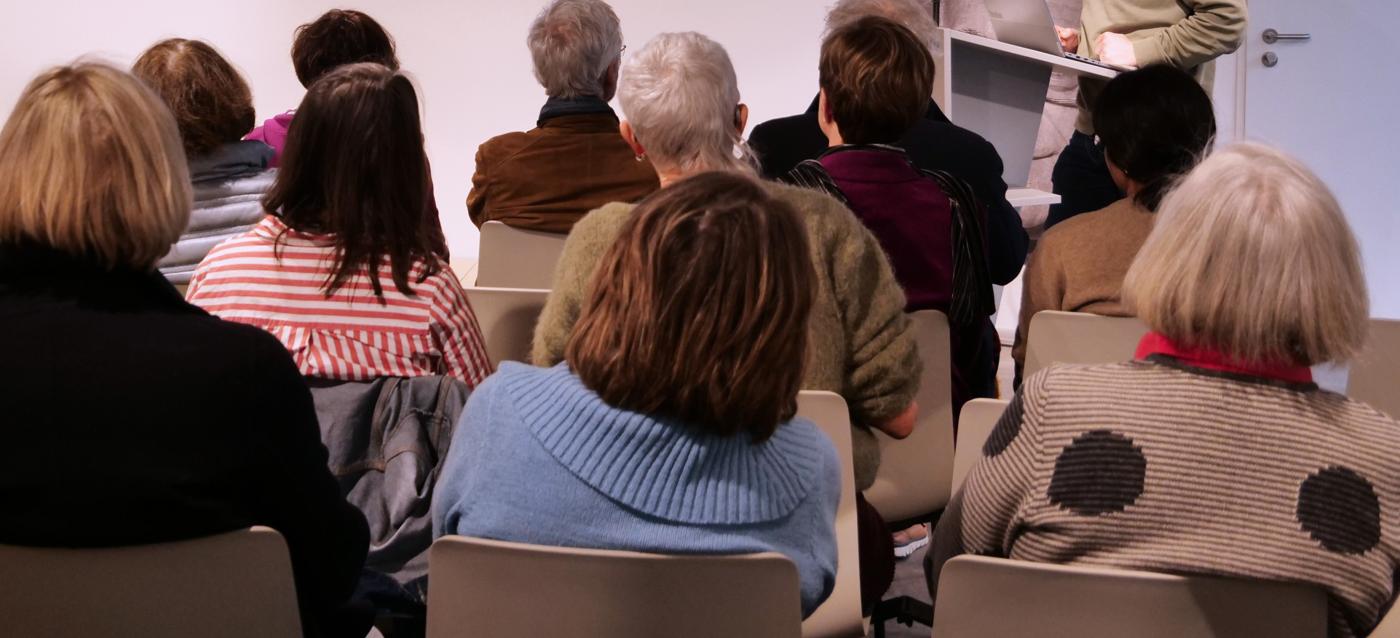
Over the past two years, the Fritz Bauer Forum has organised a series of events to open up different perspectives on Israeli civil society and focus on the situation of Israeli democracy and prospects for peaceful coexistence between Israel and Palestine. Sybille Heilbrunn kicked off 2026 with a lecture on the heterogeneity of civil society initiatives from Israel and their changing role following the terrorist attacks by Hamas on 7 October 2023. This was followed by another discussion event with her, the Standing Together initiative presented itself and its work, and finally Ami Dror spoke about the protest movement in Israel and possible scenarios after the upcoming Knesset elections.
On our Fritz Bauer Blog, we would like to offer space to expand our own perspectives, initiate and accompany discussions about human rights. In this context, it is important to us to also give space to reactions to our formats. The following blog post by Harald Bolle-Behler is one of these reactions and we would like to thank him for submitting it.
Feel free to contribute to the discussion with a text (by e-mail to info@fritz-bauer-forum.de) or by participating in other events on the topic. As the Fritz Bauer Forum, we stand for plurality of opinion within the boundaries of a respectful, human rights-orientated discourse and publish contributions without adopting the positions of the respective guest contributors as our own.
The 2023 protests by Israeli civil society against the Netanyahu/Ben Gvir/Smotrich government’s announced authoritarian reorganisation of the state (judicial reform) were overwhelming – an unforeseen surprise even for Israeli experts. However, they had one serious shortcoming: no mention of the occupation and vehement defence against futile attempts by a small group to change things. This group includes Standing Together, Breaking the Silence, Combatants for Peace and Peace Now.
Sally Abed, a Palestinian Israeli and Standing Together activist, reported:
„When I came off the stage, many women came up to me and said, ‚Why are you ruining this?‘ I asked, ‚What do you mean?‘ They said, ‚Nobody wants to hear about Palestine and the occupation right now.‘ […] I thought to myself: my fight is not only against the fascist government and the radicals who openly want to expel me from here. I also have to fight against the other half, which still only wants to grant me a conditional partnership.“ (translated from English)
One of the groups that vehemently opposed any discussion of the occupation issue was Brothers and Sisters in Arms.
In his recently published book „Besatzung von innen“ (Occupation from within), Israeli human rights lawyer Michael Sfard describes the connection between the occupation and authoritarian state restructuring:
„While all the attention is on the legal overthrow, it is by no means an only child: parallel to it, the Israeli government has set in motion a second overthrow, no less radical and far-reaching: a fundamental change in the structure of rule and administration in the West Bank, which on a legal level means a full-scale annexation of the territory. […] The details of the second coup are explicitly set out in the coalition agreements. […] The aim is to complete a process that has been progressing consistently for over five and a half decades: the implantation of the West Bank into the Israeli body politic, while at the same time consolidating Jewish supremacy. And when that happens […] you can forget about Israeli democracy.“
Prominent Israeli voices were quick to point out the corrosive internal effects of the occupation policy. These included the philosopher Yeshayahu Leibowitz (1903-1994), a harsh critic of the occupation policy from the outset. Ron Pundak (1955-2014), one of the Israeli initiators of the secret negotiations with the PLO in the early 1990s and long-time director of the Peres Centre for Peace, quotes none other than former Shin Bet chief Yuval Diskin (Israeli domestic intelligence service) in his study for the Konrad Adenauer Foundation Israel (2014, „Twenty years after Oslo“):
„He ‚agreed with every word‘ of Prof Yeshayahu Leibowitz, who had said a year after the Six-Day War that ‚a state that rules over a hostile population of a million foreign people will inevitably be a state of security services – with everything that entails, such as the nature of its educational system, the impact on freedom of speech and thought, and the form of democratic rule. The arbitrariness that characterises every colonial regime will have an effect on the state of Israel itself.“
This coincides with your statement that democracies do not die overnight, but in the mode of „normalising the unbearable“. In Israel, this mode has long been called „conflict management“ instead of conflict resolution.
After 7 October, the hostage crisis, the war in Gaza, the worsening situation in the West Bank and in southern Lebanon up to Beirut and the renewed war with Iran – to stick with this nameless list of the incomprehensible: What is the current state of the civil society protest movement in Israel?
According to an article in the Times of Israel (01.04.2026, „Government opponents step up anti-war rallies as support for hostilities wanes“), Jewish Israelis‘ support for the war against Iran fell from 93% to 78% according to polls by the Israel Democracy Institute (IDI); among Arab Israelis from 26% to 19%.
With constant rocket alerts and current bans on large public gatherings, it is very difficult to mobilise for protest rallies. Alon Lee Green (Standing Together) sees his movement as a link between left-wing opponents of the war and anti-government moderates: he endeavours to find common ground with anti-government groups „by largely avoiding sensitive national security issues such as Israel’s control over the West Bank.“ The article continues:
„ The two groups still holding back are the high-tech sector protest movement and the reservist-led ‚Brothers in Arms‘ group, reflecting the still high level of support for the war among most Israeli Jews. Both have considerable influence in the Israeli protest scene.“
Gil Shohat, head of the Rosa-Luxemburg-Stiftung’s Israel office, in an interview with the weekly newspaper „der Freitag“ (31 March 2026) on perceptions in Israel:
„Gaza has completely disappeared from the public debate. What is now more of an issue is the West Bank. The settler violence is reaching a level that we would not have thought possible. This is also being strongly criticised in circles that see themselves as Zionist-liberal […]. There are members of parliament who also address this in the Knesset and describe it as a ‚moral stain on the country‘.“
When asked why criticising the settlement policy in the West Bank seems more acceptable than criticising Gaza, Shohat answers:
„Because ‚Gaza‘ is equated with ‚Hamas‘. That’s an exaggerated way of putting it. But the idea that there are no innocents in Gaza is even held by people who see themselves as liberal […] (and) basically peace orientated. For them, what Hamas has done is inexcusable. That […] doesn’t mean that all people in Israel defend what was done there – but it does mean that in the minds of these people Gaza and the West Bank are completely different realities.“
And more fundamentally:
„For the Israeli population, a peaceful solution beyond small political circles is currently not an imaginable constellation at all. […] In a way, Netanyahu has succeeded: he has completely banished the idea of a peace-oriented political solution in Israel and Palestine to the realm of political utopia.“
The complexity and contradictory nature of the civil society protest movement in Israel can be seen in the example of the „Brothers and Sisters in Arms“ mentioned above. As you explain in detail in your article, this grouping transformed itself ad hoc from a protest organisation to a rescue organisation after 7 October and, with its commitment and organisational strength, developed into a kind of parallel structure to the state between 2024 and 2025. This was also emphasised by Moshe Zimmermann in the Fritz Bauer Forum podcast „Zehn Zwölf“ on 11 December 2023:
„ This civil society is saving the country of Israel at the moment. The state has failed. The government has failed. Not only on 7 October. You could also see it afterwards. Now people are not protesting on the streets, now they are trying to organise.“
With this achievement, Israeli civil society had filled a vacuum left behind by the failure of the state. But has civil society also overtaken the state? You have actually already answered the question by formulating it in question form in your concluding paragraph: „Can civil society permanently stop the democratic erosion in Israel“ – I would add: and the occupation – „or is it only temporarily compensating for a structural regime problem?“ Obviously – as far as can be seen so far – the latter is the case.
In the book „Denk ich an Deutschland … Ein Dialog in Israel“ (2023), published jointly with Moshe Zuckermann, Moshe Zimmermann formulates:
„Ever since the Jewish nation and its right to national self-determination were invented and Palestine was chosen as a territory for the purpose of realising the desire for national self-determination, we have been under an obligation to recognise the right to national self-determination also to the non-Jewish population, which in turn lays claim to national identity in the same land, Palestine. Then only the practical question of realisation remains: How can this be achieved with minimal damage on both sides?“
For us, it is important to take note of current solutions, to disseminate them in public discourse and to support them. I would like to point out three approaches that I know of: one Israeli, one Palestinian and one German. In the Israeli public and democracy movement, these contributions are obviously hardly recognised and certainly not appreciated.
In January 2025, the Forum for Regional Thinking , in cooperation with the Van Leer Jerusalem Institute, published its recommendations for a way out of the war towards a historic reconciliation between Israelis and Palestinians based on a comprehensive analysis. This policy paper was signed by more than 130 Jewish-Israeli and Palestinian-Israeli scholars and intellectuals and is explicitly aimed at a Jewish-Israeli audience .
The short version linked on the website of the Rosa Luxemburg Foundation Israel states:
„We reject the widespread view in Israel that enmity between Jews and Arabs is a natural or inevitable state of affairs. We are of the opinion that the policy of „conflict management“ has failed. […] The fiasco of 7 October was not just the result of a tactical or military failure to provide intelligence information in time, to alert political decision-makers or to mobilise sufficient troops. Rather, the main reason for this failure was Israel’s long-term policy of conflict management: the intensification of the occupation in the West Bank while simultaneously heading towards a comprehensive regional conflict with Iran and its allies and proxies.“
This plan was published in June 2025 by a group of leading Palestinian academics, experts and professionals from across the Occupied Palestinian Territories and the Palestinian diaspora under the auspices of the Cambridge Initiative on Peace Settlements. This document is also referred to in the following „expert paper“. The introduction states:
„This working paper presents a pragmatic, rights-based plan for advancing Palestinian self-determination, starting from a permanent ceasefire arising from a so-called ceasefire agreement, and a subsequent, time-limited transitional phase […] until a just, lasting and comprehensive peace agreement is reached in accordance with international law. The paper includes proposals for national reconciliation, institutional renewal and governance in Palestine during the transition period. It also includes recommendations on how best to promote humanitarian assistance, early reconstruction and rebuilding efforts in the destroyed parts of the Occupied Palestinian Territories […]. […] The paper (also) proposes immediate mechanisms to activate civic engagement.“
At the Federal Press Conference on 2 October 2025, the expert paper for a turnaround in Middle East policy „Beyond raison d’état: How historical responsibility, strategic interests and international law can be reconciled“ was presented. It was initiated, written and coordinated by a core team led by diplomat Philip Holzapfel, political scientist Dr Muriel Asseburg (who has also been a guest at the Fritz Bauer Forum) and Middle East expert Daniel Gerlach. It presents a broad, non-partisan consensus among Middle East experts and experts in other relevant fields regarding the urgent need for a new policy approach for Germany, including within the European Union.
„The paper is guided by a firm commitment to international law and the Basic Law, an awareness of historical responsibility and deeply felt empathy for the countless innocent victims of the humanitarian catastrophe in the Middle East. These include Israelis who were killed, abused and abducted by Hamas and other militant groups on 7 October 2023, as well as the large and growing number of Palestinians who have since been killed, abused and detained without due process by Israel.“
I agree with you: „In the long term, democracy needs both functioning institutions and an alert, resistant public.“ In Germany, this currently also means resistance to attempts to repressively restrict civil society’s scope for discourse and action and the growing pressure from conservative forces on progressive projects.
The arc spans from the controversially discussed Bundestag resolution of 7 November 2024 („Never again is now: Protecting, preserving and strengthening Jewish life in Germany“) to the currently controversial reform of the „Live Democracy“ funding programme. Meron Mendel, Anne Frank Educational Centre in Frankfurt, warned in the ARD culture magazine „ttt“ (12.04.2026):
„We are currently seeing a culture of mistrust being fuelled. Checks are being carried out, written authorisations are being withdrawn. I wonder what’s behind this. Is civil society the enemy of the government?“.
The expert paper „Beyond the raison d’état“ recommends the federal government, among other things:
„ Ensure that in the fight against anti-Semitism a clear distinction is made between constitutionally protected expression of opinion […] and banned racist hate speech. Several examples of the IHRA definition of antisemitism contain a problematic mixture. […] Alternative frames of reference such as the Jerusalem Declaration on Antisemitism should therefore be considered.“ And: „ The fight against anti-Semitism , which is not related to the Middle East conflict and continues to top the crime statistics in Germany, must be consistently intensified.“
And also:
„ Promote human encounters between Jewish, Arab, Muslim and majority societies in Germany and Europe in a targeted manner in order to create the urgently needed space for exchange and debate instead of deepening existing rifts. Direct human encounters remain the most effective means of breaking down prejudices and counteracting dehumanisation.“
What can we do as civil society? For the authors of the expert paper, civil society engagement is crucial:
„The basics of effective peace policy (include) identifying voices of reason and reconciliation in both camps – political and civil society – strengthening them and empowering them as favoured points of contact. It is particularly important to make the voices of those working for peace and reconciliation on the basis of equal rights heard. Civil society plays a crucial role in promoting peace narratives and shaping public discourse and thus influencing government policy. “
Nohma El-Hajj, a doctor and freelance author with Palestinian-Lebanese roots, emphasised in an interview with „der Freitag“ (14/08/2025):
„Germany is home to the largest Palestinian diaspora in Europe, around 200,000 people, who would certainly have a lot to tell. […] Where there are no narratives of their own, an invisibility arises in which the marginalised group is not considered and certainly not empathised with.“
I advocate a dialogue based on empathy and compassion for the suffering on both sides. The Israeli psychologist Dan Bar-On, who died in 2008, spoke of a „triangle of tension“ between Israelis, Germans and Palestinians in his dialogue approach „Storytelling“. Moshe Zimmermann and Moshe Zuckermann also emphasise the historical dimension of this „Germany-Israel-Palestine triad“ in their book „Denk ich an Deutschland …“. Zimmermann:
„From the very beginning, the dialogue between Jews and Germans, or rather: between Zionists and Germans, could not simply exclude the Arab population in the so-called Middle East.“
Such a dialogue could be titled “ Talking about Israel and Palestine and thinking ahead together in dialogue“. In my opinion , the Fritz Bauer Forum is a predestined place for such a dialogue – in the spirit of the event series „We need need need to talk“.
Autor
[1]
Sally Abed (Standing Together), 24.03.2023: https://www.emergingvoices.co.uk/post/palestinian-voices-sally-abed
[2]
Michael Sfard: Auszug aus seinem neuen Buch „Besatzung von Innen“, 21.07.2025: https://www.rosalux.org.il/artikel/dann-koennt-ihr-die-israelische-demokratie-vergessen-auszug-aus-dem-neuen-buch-besatzung-von-innen/
[3]
Ron Pundak: Zwanzig Jahre nach Oslo. Taktik und Strategie in Richtung Neu-Zionismus, Konrad-Adenauer-Stiftung Israel, 2014: https://www.kas.de/documents/252038/253252/7_dokument_dok_pdf_38150_1.pdf/3ecf7df4-0c54-350d-ac40-d19ec425f6e7?version=1.0
[4]
The Times of Israel: Anti-government protesters boost rallies against war as support for fighting slips, 01.04.2026: https://www.timesofisrael.com/anti-government-protesters-boost-rallies-against-war-as-support-for-fighting-slips/
[5]
Gil Shohat: „Israel hat sich verändert. Die Linke muss ihre Position in Nahost überdenken“, der Freitag, 31.03.2026: https://www.freitag.de/autoren/konstantin-nowotny/gil-shohat-israel-hat-sich-veraendert-die-linke-muss-ihre-position-ueberdenken
[6]
Moshe Zimmermann, Moshe Zuckermann: Denk ich an Deutschland … Ein Dialog in Israel, 2023.
[7]
Der Tag danach ist heute. Friedensschaffende Alternativen für die israelische Politik, Januar 2025: https://www.rosalux.org.il/artikel/der-tag-danach-ist-heute/
https://www.regthink.org/wp-content/uploads/2025/02/The-Present-Day-2025.pdf
[8]
Ein Palästinensischer Waffenstillstands-Plan: Juni 2025:
https://cambridgepeace.org/wp-content/uploads/2025/06/Palestinian-Armistice-Plan.pdf
[9]
Expertenpapier für eine nahostpolitische Wende „Jenseits der Staatsraison“, 2. Oktober 2025:
https://staatsraison.net/wp-content/uploads/2025/10/Expertenpapier-fuer-eine-nahostpolitische-Wende_24.10.pdf
[10]
IHRA-Arbeitsdefinition von Antisemitismus: https://holocaustremembrance.com/resources/arbeitsdefinition-antisemitismus
[11]
Antisemitismusbeauftragter der Bundesregierung: IHRA-Definition: https://www.antisemitismusbeauftragter.de/Webs/BAS/DE/bekaempfung-antisemitismus/ihra-definition/ihra-definition-node.html
[12]
Jerusalemer Erklärung zum Antisemitismus (JDA): https://jerusalemdeclaration.org/
[13]
Podcast Shai Hoffman: „Über Israel und Palästina sprechen“ mit Prof. Dr. Stefanie Schüler-Springorum über Erinnerungskultur, Förderlandschaft und die Funktion von Antisemitismus, 14.03.2025
[14]
„Zeit zu reden“, 28.11.2024, über: Antisemitismus – Definitionen, Interpretationen und Verwendung: https://zeitzureden.org/pastevent/zeit-zu-reden-antisemitismus-definitionen-interpretationen-und-verwendung/
[15]
Bundestagsresolution vom 7. November 2024 „Nie wieder ist jetzt: Jüdisches Leben in Deutschland schützen, bewahren und stärken: https://dserver.bundestag.de/btd/20/136/2013627.pdf
[16]
„ttt“ 12.04.2026: Kritik an der Reform des Förderprogramms „Demokratie leben“: https://www.ardmediathek.de/video/ttt-titel-thesen-temperamente/kritik-an-der-reform-des-foerderprogramms-demokratie-leben/ndr/Y3JpZDovL25kci5kZS8xY2M5YjJmOS1jODljLTQwZTAtODJiZS1iYWViNzkxOWEwNzY
[17]
Nohma El-Hajj: Palästinenser in Deutschland: Warum wir so lange unsichtbar im Diskurs waren, 14.08.2025, der Freitag: https://www.freitag.de/autoren/der-freitag/palaestinenser-in-deutschland-warum-wir-so-lange-unsichtbar-im-diskurs-waren
[18]
Dan Bar-On: DIE »ANDEREN« IN UNS. Dialog als Modell der interkulturellen Konfliktbewältigung, 2003
[19]
Sami Adwan, Dan Bar-On, Eyal Naveh (Hg.), Peace Research Institute in the Middle East: Die Geschichte des Anderen kennen lernen, 2015 (hebräische und arabische Originalausgabe 2009)