
A review by Irmtrud Wojak
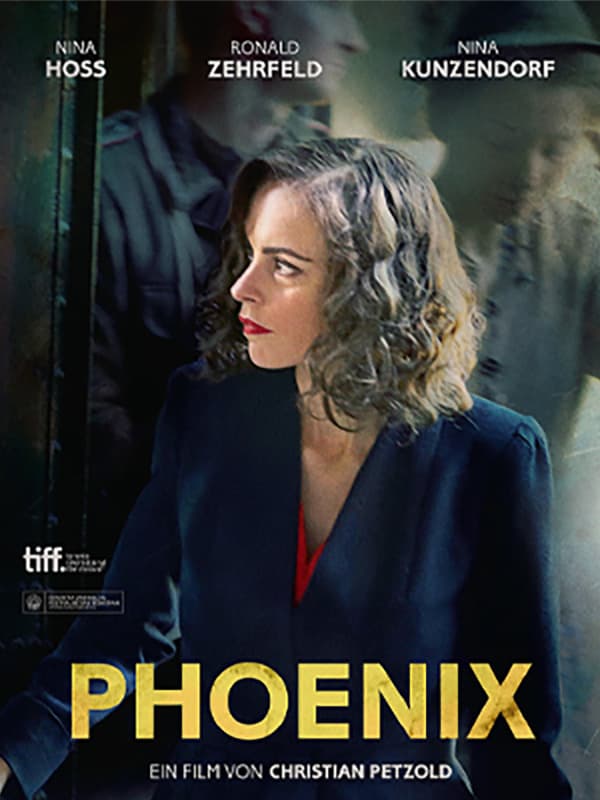
PHOENIX is a cinema film that reflects the atmosphere of the post-war years in Germany, one could also say the „aftermath of mass murder“, without any false embellishments or false morals. It is about lost and betrayed love and about what survival actually is and means. PHOENIX is a courageous film about a woman who survived the Auschwitz concentration camp and who, in the autumn of 1945, begins the search for her own history without any self-sparing.
The story is basically not complicated and has happened many times, in one way or another, even if we have rarely or reluctantly thought about it. A young woman, her name is Nelly, returns to her former home town of Berlin. She has survived the Nazi extermination camp, where the betrayal of her husband Jonny has taken her, who now has to fight for survival himself in the destroyed post-war Berlin. The woman’s face was destroyed by shots fired by the Nazis and she had to continue to fight for survival even after her liberation. Now, however, she wants to regain her own identity and find out what happened before she was deported to Auschwitz. Meanwhile, her husband, who doesn’t seem to recognise his own wife, can think of nothing better than to give her back her former face and appearance – if possible one-to-one. In this way, he hopes to obtain his wife’s inheritance from her relatives in order to get out of his own post-war misery and earn money again.
The film does not reveal whether the man succeeds in the coup with which he wants to free himself, but this is unimportant. What is more important is that existential questions are raised and – which is unusual for a German film about Auschwitz and how we deal with our history afterwards – the answers are not already provided.
The story, this one in particular, is one of the film’s statements, is not over. The strange thing about PHOENIX is that although the film repeatedly hints at the guilty conscience, the feelings of guilt of those who betrayed themselves and our humanity, it is precisely by only hinting at them that it makes clear the mechanisms of repression that continued to be practised after 1945 in order to shift responsibility onto the others, the victims. Just to be able to continue exactly where most Germans had already been before or after 1933, when the Nazis came to power, surrendering their own conscience to a supposedly „higher being“, be it their „leader“ or the state authority.
Unlike films such as THE STATE AGAINST FRITZ BAUER, which unilaterally assigns victims and survivors – in this case Attorney General Dr Bauer – the role of the state. Bauer – one-sidedly ascribes the role of avengers and fanatical „Nazi hunters“ to victims and survivors, or like IM LABYRINTH DES SCHWEIGENS, which turns the suffering of the victims into a touching piece of the Restoration years, against which individual rebels in the judiciary heroically fought, PHOENIX confronts viewers with a reality in which victims and survivors are also subsequently instrumentalised for their own purposes.
What is perhaps most disturbing and is indicated by the title PHOENIX is a decisive statement of the film: it is the victims and survivors, those from whom the Nazis wanted to take their lives, who have preserved their own history and identity, perhaps even as the only ones looking back on the Nazi regime. They saved themselves and us, because no one could survive Auschwitz without their own, without the human story, without the help of someone who was there at the decisive moment.
Christian Pätzold’s film is about the resistance of the victims and survivors. A story that is often suppressed. Fritz Bauer presented it to us in the Nazi trials as a possibility and an alternative. This special film is dedicated to him.
Discover your next favorite book
Discover and support - browse the store now
Our store with the topics literature and human rights, survival stories as well as art and history.


The Fritz Bauer Forum organises events about Fritz Bauer. We present the life, work and legacy of the lawyer and Holocaust survivor in schools. Please contact us a few weeks before the desired date.

Magdalena Köhler (M.A.)
Events and interactive Fritz Bauer Library
Phone
+49 (0) 1573 2562392email address
magdalena.koehler@fritz-bauer-forum.deOpening hours:
Monday to Wednesday 10.00 - 16.00 | Thursday 14.00 - 17.00 | Fridays by appointment