
Autor/Autorin

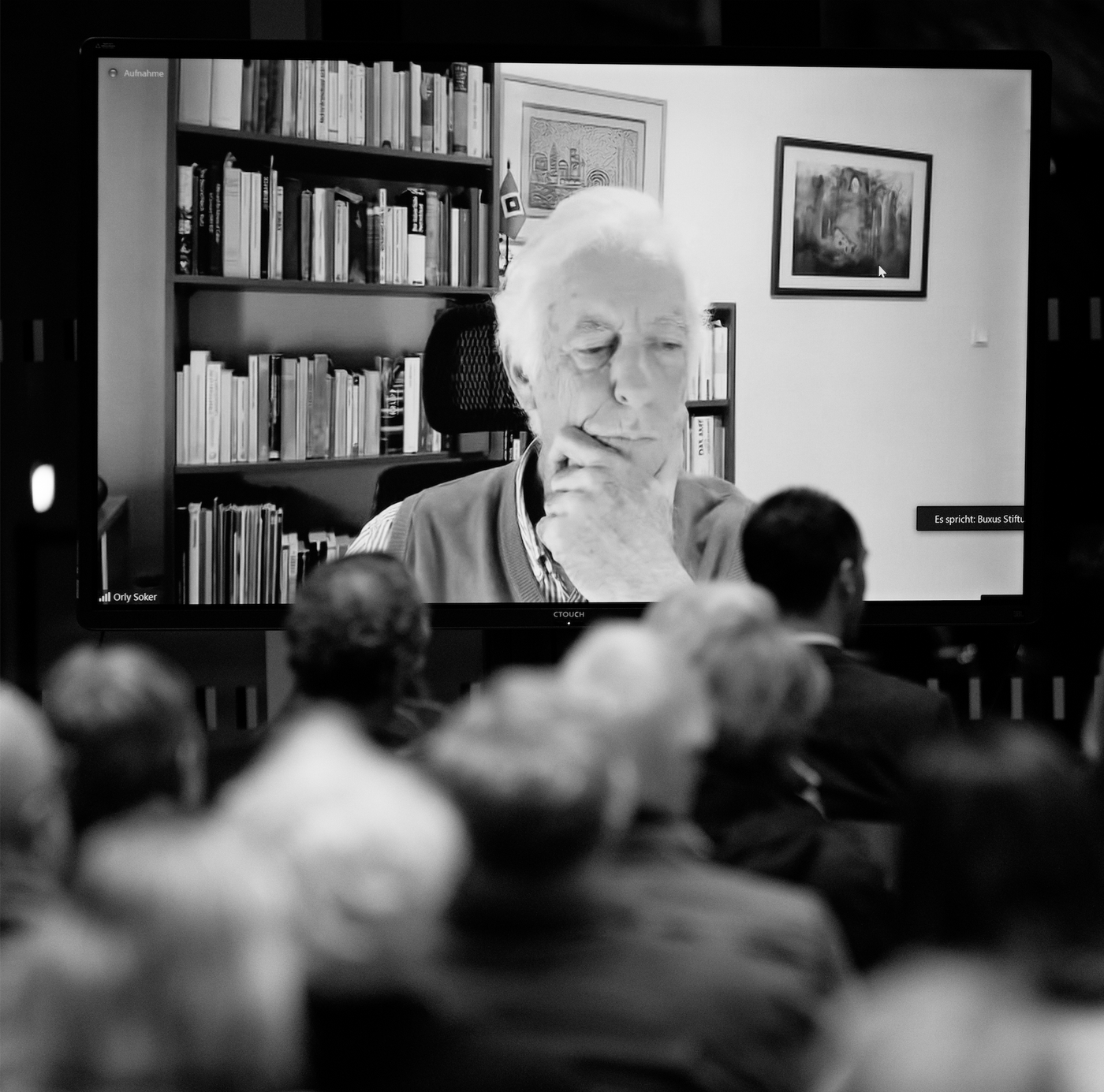
On 16 July, Prof. Dr Moshe Zimmermann was a guest at the Fritz Bauer Forum. A year ago, on Constitution Day, he joined us via video link from Israel for the opening of the Fritz Bauer Forum in Bochum. The discussion centred on the topic of ‘Law and Morality’ and the legacy of Fritz Bauer. 16 July is Fritz Bauer’s birthday. On this occasion, the Israeli historian presented his new book to us, *People Gone Mad*.
Moshe Zimmermann, whose parents fled to Palestine in 1937–38 to escape the Nazis, was born in Jerusalem. He is Professor Emeritus of Modern History at the Hebrew University of Jerusalem; his main areas of research include, amongst others, anti-Semitism and nationalism, and German history following the French Revolution. Until 2012, he headed the Koebner Centre for German History at the Hebrew University and has held visiting professorships at several universities in Germany. He is the author of numerous books; in 2024, Propyläen published *Never Peace? Israel at a Crossroads was published by Propyläen, and most recently: *People Gone Mad – How Democracy is Destroying Itself*.
One protagonist plays a special role in this destruction. One who is, in reality, an antagonist and represents the masses (‘the people’), who, led astray, become the adversary of democracy and its greatest enemy: the rhinoceros.
Fritz Bauer also referred to this ‘rhinoceros’ in his 1960 lecture ‘The Roots of National Socialist and Fascist Action’. At a conference organised by the Rhineland-Palatinate State Youth Council, he sought to explore what drives people to marginalise, expel and exterminate others.
According to Bauer, there is a play that ‘can provide an answer to the question of what happened in Germany in 1933 and later (…) the drama *The Rhinoceros* by Ionesco. In *The Rhinoceros*, we see a small town – which, coincidentally, is French – where life has hitherto been as normal as in any other part of the world. However, the town rapidly transforms over the course of the play, as if a virus had suddenly taken hold. At the beginning, a rhinoceros appears. At first, the people find this very strange. From scene to scene, the number of rhinoceroses increases until, by the end (…) the inhabitants of the entire town – with a single, and not entirely unproblematic, exception – have turned into rhinoceroses, screaming and bellowing just as rhinoceroses do. On stage, we witness the emergence of a mass psychosis, a mass illness.
Both at home and abroad, the impression has been gained that Ionesco was also thinking of the Nazi movement in Germany, and some wits in this country have declared that the play has the wrong title in German. They claim the ‘a’ in the word ‘Nashorn’ is superfluous. The play should actually be called ‘Die NS-Hörner’, because it is about how law-abiding citizens became Nazis.”
This phenomenon – how law-abiding citizens, how ‘the people’, were turned into rhinos – was the focus of Fritz Bauer’s work in the Nazi trials, and it is the focus of Moshe Zimmermann’s work today. And, of course, this also raises the question of ‘personal responsibility under a dictatorship’, as posed by the philosopher Hannah Arendt after the Holocaust.
In the final chapter of his new book, entitled ‘post mortem’, Moshe Zimmermann writes that this question has lost none of its urgency.
For the historian, the destruction of democracy in Israel serves as a blueprint for almost everything that lies ahead for us in Germany and in some other European countries in the near future. He describes the authoritarian shift that Israel has undergone since the Six-Day War of 1967 as exemplary of the anti-democratic and anti-liberal movement within Western democracies. Fuelled by growing nationalism (in Israel, by the dream of a ‘Greater Israel’), the turning point of 1989–90 – when liberal democracy prevailed – became the completely underestimated starting point for the formation of its opponents and enemies.
The much-vaunted ‘end of history’ (Francis Fukuyama) was an illusion, according to Zimmermann. From that point onwards, if one follows his chronology of destruction, it became apparent just how ill-equipped Western democracies were to face an organised enemy.
What is at least as astonishing as the fact that, apparently, very few people imagined that these opponents of liberty, equality and fraternity still exist. Against the backdrop of Germany’s Nazi past and the hostility towards democracy in our present day, this discernible lack of historical awareness carries particular weight. The AfD party is exploiting this, referring to the crimes of the Nazi dictatorship merely as a “bird’s droppings” (A. Gauland) in Germany’s long history of success. At the same time , the far-right party aims to undermine democratic institutions in Germany, curtail the rights of minorities and permanently destroy trust in democratic processes. “People gone mad”…